Politics
Granderson: Praising the Jim Crow era? That's a red flag

Jim Crow was not the problem.
Jim Crow was meant to be the solution.
The problem was Rutherford B. Hayes winning the electoral college but losing the popular vote in 1876. To get over the hump — there was a filibuster contesting the results — Hayes agreed to remove federal troops from former Confederate states.
Opinion Columnist
LZ Granderson
LZ Granderson writes about culture, politics, sports and navigating life in America.
In short: The Reconstruction era wasn’t ended because Black Americans had achieved equality. It was ended because Hayes wanted to be president.
Despite being a former Union soldier, he withdrew protection and offered up Black people to the whims of the South’s white supremacists who were still angry about losing the Civil War.
They weren’t going to be allowed to reinstate slavery. So that’s where the “solution” came in. A set of segregationist laws, known as Jim Crow after a minstrel show character, were white Southerners’ best attempt to restore their former way of life. Back when “everyone knew their place.”
This arrangement worked out for Rutherford B. Hayes. Not for Black Southerners or for the country as a whole.
Fast-forward a century and a half. The laws are long dead, and their harms still haunt us. If we can agree on anything as a nation, surely it would be that we’re better off without slavery or slavery lite.
So anyone who feels the need to downplay Jim Crow to gain acceptance from a crowd should probably reevaluate who they are trying to win over.
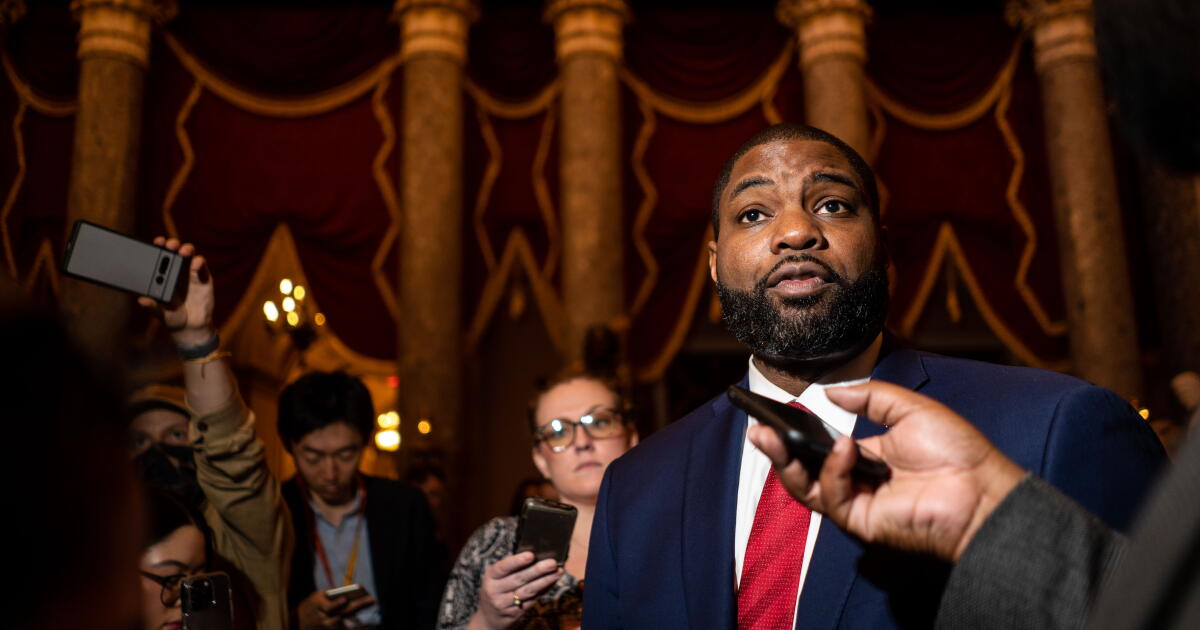
Last week, Rep. Byron Donalds (R-Fla.), a Black Republican who wants to be Donald Trump’s vice president, told voters: “You see, during Jim Crow, the Black family was together.” Referring to the agency that evolved into the Department of Health and Human Services, he continued: “It was the Democrat policies under H.E.W., under the welfare state, that then helped to destroy the Black family.”
He is trying to sell Trumpists on the idea that Black people were better off when more than half of us lived under the thumb of the KKK and in poverty.
It’s bad enough that Donalds wants power so bad that he’s willing to romanticize legislated Black oppression. But what are his chances of actually clawing his way upward? His run for House speaker was so short that Rep. Marjorie Taylor Greene didn’t have enough time to complain about him.
Apparently undeterred, Donalds is now trying to become Trump’s pick for vice president by looking for Jim Crow’s silver lining. Those racist laws had no silver lining. Black families were suffering because of them. Whenever Black communities started to thrive too much, white supremacists were able to murder residents and burn down businesses without being held accountable — as happened in Tulsa, Wilmington, Atlanta…
In 1919 a union made up of Black sharecroppers had formed to negotiate for better working conditions and pay. Their community in Arkansas was greeted by a racist mob hundreds strong, which left more than 200 Black people dead, including children. The mob abducted and tortured 12 men, forcing them into a false confession of insurrection when in fact they were just pursuing the American dream.
A case representing six of them (Moore vs. Dempsey) eventually reached the Supreme Court, which found in 1923 that they had been denied due process because a mob dominated their trial. The Arkansas governor commuted their death sentences to prison terms, and they were allowed parole in 1925.
They had committed no crime but spent six years incarcerated. More than 200 other members of their community committed no crime but were executed by a mob.
When current-day Black conservatives talk about the “Democrat plantation,” I wonder whether they have a name for the one they live on. Because I do.
To suggest the Black community was better off after federal troops left the South, you have to ignore lynchings. To make the argument that Black people had it better during Jim Crow would require someone to overlook the fact that the authors of the laws had fought a war to keep Black people from being citizens.
In the decades following 1870, when the 15th Amendment gave Black men the right to vote, the Hayes administration did nothing as Southern states passed laws aimed at suppressing their voices. There were literacy tests that white southerners were exempt from. Poll taxes white people did not have to pay. Laws restricting where Black people could stand in public.
Even after the 19th Amendment finally gave women the right to vote in 1920, Jim Crow laws prevented many Black women from doing so.
So if someone like Donalds tries to tell you that Black people had it better during the Jim Crow days, remember this: Those laws were written to keep us in our place.





new video loaded: Federal Agent Fatally Shoots Woman in Minneapolis
transcript
transcript
Federal Agent Fatally Shoots Woman in Minneapolis
Federal officials claimed that the 37-year-old woman was trying to kill agents with a car in Minneapolis, while city and state officials disputed their account.
-
“No! No! Shame — shame! What did you do?” “It was an act of domestic terrorism, what happened. It was — our ICE officers were out in an enforcement action. They got stuck in the snow because of the adverse weather that is in Minneapolis. They were attempting to push out their vehicle, and a woman attacked them and those surrounding them, and attempted to run them over and ram them with her vehicle. An officer of ours acted quickly and defensively shot to protect himself and the people around him.” “We’ve been warning for weeks that the Trump administration’s dangerous, sensationalized operations are a threat to our public safety.” “They are already trying to spin this as an action of self-defense. Having seen the video of myself, I want to tell everybody directly: That is bullshit. This was an agent recklessly using power that resulted in somebody dying — getting killed.” “Get out of the fucking car.” “No! No! Shame! [gunshots] Shame! Oh, my fucking God. What the fuck? What the fuck? You just fucking — what the fuck did you do?” “There is nothing to indicate that this woman was the target of any law enforcement investigation or activity. This woman was in her car, and it appears, then blocking the street because of the presence of federal law enforcement, which is obviously something that has been happening not just in Minneapolis, but around the country.”

By Jamie Leventhal and Devon Lum
January 7, 2026
Politics
Trump greenlights Russian sanctions bill, paving way for 500% tariff on countries supporting Moscow: Graham

NEWYou can now listen to Fox News articles!
Sen. Lindsey Graham announced Wednesday that President Donald Trump has approved a Russian sanctions bill designed to pressure Moscow to end its war with Ukraine.
Graham revealed the development in a post on X, describing it as a pivotal shift in the U.S. approach to the Russia-Ukraine conflict.
“After a very productive meeting today with President Trump on a variety of issues, he greenlit the bipartisan Russia sanctions bill that I have been working on for months with Senator Blumenthal and many others,” Graham said.
“This will be well-timed, as Ukraine is making concessions for peace and Putin is all talk, continuing to kill the innocent.”
TRUMP TOUTS ‘TREMENDOUS PROGRESS’ BUT SAYS HE’LL MEET PUTIN AND ZELENSKYY ‘ONLY WHEN’ PEACE DEAL IS FINAL
Sen. Lindsey Graham, R-S.C., speaks during a news conference at the U.S. Capitol July 31, 2024, in Washington, D.C. (Kent Nishimura/Getty Images)
According to the Sanctioning Russia Act of 2025, the bipartisan legislation is designed to grant Trump sweeping, almost unprecedented, authority to economically isolate Russia and penalize major global economies that continue to trade with Moscow and finance its war against Ukraine.
Most notably, the bill would require the United States to impose a 500% tariff on all goods imported from any country that continues to purchase Russian oil, petroleum products or uranium. The measure would effectively squeeze Russia financially while deterring foreign governments from undermining U.S. sanctions.
TRUMP CASTS MADURO’S OUSTER AS ‘SMART’ MOVE AS RUSSIA, CHINA ENTER THE FRAY
President Donald Trump speaks during a meeting at the White House Oct. 14, 2025, in Washington, D.C. (Kevin Dietsch/Getty Images)
“This bill will allow President Trump to punish those countries who buy cheap Russian oil fueling Putin’s war machine,” Graham said.
“This bill would give President Trump tremendous leverage against countries like China, India and Brazil to incentivize them to stop buying the cheap Russian oil that provides the financing for Putin’s bloodbath against Ukraine.”
Graham said voting could take place as early as next week and that he is looking forward to a strong bipartisan vote.
US MILITARY SEIZES TWO SANCTIONED TANKERS IN ATLANTIC OCEAN
The vessel tanker Bella 1 was spotted in Singapore Strait after U.S. officials say the U.S. Coast Guard pursued an oil tanker in international waters near Venezuela. (Hakon Rimmereid/via Reuters)
The move on the Russian sanctions bill follows another sharp escalation in America’s clampdown on Moscow. Earlier Wednesday, U.S. forces reportedly seized an oil tanker attempting to transport sanctioned Venezuelan oil to Russia.
CLICK HERE TO DOWNLOAD THE FOX NEWS APP
Graham publicly celebrated the seizure in another post on X, describing it as part of a broader winning streak of U.S. intervention aimed at Venezuela and Cuba.
In the post, he also took aim at critics such as Sen. Rand Paul, who has opposed the bill, arguing that it would damage America’s trade relations with much of the world.
Fox News Digital reached out to the White House for comment.
Politics
ICE officer kills a Minneapolis driver in a deadly start to Trump’s latest immigration operation

An Immigration and Customs Enforcement officer shot and killed a Minneapolis driver on Wednesday during the Trump administration’s latest crackdown on a major American city — a shooting that federal officials said was an act of self-defense but that the mayor described as reckless and unnecessary.
The 37-year-old woman was shot in front of a family member during a traffic stop in a snowy residential neighborhood south of downtown Minneapolis, just a few blocks from some of the oldest immigrant markets and about a mile from where George Floyd was killed by police in 2020. Her killing quickly drew a crowd of hundreds of angry protesters.
Homeland Security Secretary Kristi Noem, while visiting Texas, described the incident as an “act of domestic terrorism” carried out against ICE officers by a woman who “attempted to run them over and rammed them with her vehicle. An officer of ours acted quickly and defensively, shot, to protect himself and the people around him.”
Emergency medical technicians carry a person on a stretcher at the scene of a shooting in Minneapolis on Wednesday.
(Ellen Schmidt / Associated Press)
But Minneapolis Mayor Jacob Frey blasted that characterization as “garbage” and criticized the federal deployment of more than 2,000 officers to the Twin Cities of Minneapolis and St. Paul as part of the immigration crackdown.
“What they are doing is not to provide safety in America. What they are doing is causing chaos and distrust,” Frey said, calling on the immigration agents to leave. “They’re ripping families apart. They’re sowing chaos on our streets, and in this case, quite literally killing people.
“They are already trying to spin this as an action of self-defense. Having seen the video myself, I wanna tell everybody directly, that is bullshit,” the mayor said.
Frey said he had a message for ICE: “Get the f— out of Minneapolis.”

Police tape surrounds a vehicle believed to be involved in a shooting by an ICE agent on Wednesday.
(Stephen Maturen / Getty Images)
A shooting caught on video
Videos taken by bystanders with different vantage points and posted to social media show an officer approaching an SUV stopped across the middle of the road, demanding the driver open the door and grabbing the handle. The Honda Pilot begins to pull forward, and a different ICE officer standing in front of the vehicle pulls his weapon and immediately fires at least two shots into the vehicle at close range, jumping back as the vehicle moves toward him.
It was not clear from the videos whether the vehicle made contact with the officer. The SUV then sped into two cars parked on a curb nearby before crashing to a stop. Witnesses screamed obscenities, expressing shock at what they’d seen.
After the shooting, emergency medical technicians tried to administer aid to the woman.

-
Share via
“She was driving away and they killed her,” said resident Lynette Reini-Grandell, who was outdoors recording video on her phone.
The shooting marked a dramatic escalation of the latest in a series of immigration enforcement operations in major cities under the Trump administration. The death of the Minneapolis driver, whose name wasn’t immediately released, was at least the fifth linked to immigration crackdowns.
The Twin Cities have been on edge since DHS announced Tuesday that it had launched the operation, which is at least partly tied to allegations of fraud involving Somali residents. Noem confirmed Wednesday that DHS had deployed more than 2,000 officers to the area and said they had already made “hundreds and hundreds” of arrests.

Protesters react after being hit with chemical spray at the scene of a shooting in Minneapolis.
(Alex Kormann / Minnesota Star Tribune via AP)
A large throng of protesters gathered at the scene after the shooting, where they vented their anger at the local and federal officers who were there, including Gregory Bovino, a senior U.S. Customs and Border Patrol official who has been the face of crackdowns in Los Angeles, Chicago and elsewhere.
In a scene that hearkened back to the Los Angeles and Chicago crackdowns, bystanders heckled the officers, chanting “Shame! Shame! Shame!” and “ICE out of Minnesota,” and blew whistles that have become ubiquitous during the operations.
Shootings involving drivers during immigration actions have been an issue since the raids began in Southern California.
In August, masked U.S. Customs and Border Protection agents in San Bernardino opened fire on a truck they had stopped on a street. A video showed an agent demanding the driver roll down his window. When he refused, an agent shattered the window, the truck drove off and gunfire rang out.
When the driver got home, the family reported the incident to police. Federal authorities alleged an agent had been injured when the driver tried to “run them down.” But witnesses and video disputed some aspects of the official account.
In October, a well-known TikTok figure was shot by an agent during a standoff in Los Angeles. The U.S. attorney said the man rammed his vehicle into the law enforcement vehicles in front of and behind him, “spun the tires, spewing smoke and debris into the air, causing the car to fishtail and causing agents to worry for their safety.” But videos showed a much more complicated view of the situation. A federal judge recently dismissed the case against the driver, finding that he had been denied access to counsel while in immigration detention.
Governor calls for calm
In Minnesota on Wednesday, Gov. Tim Walz said he was prepared to deploy the National Guard if necessary. He said a family member of the driver was there to witness the killing, which he described as “predictable” and “avoidable.” He also said that, like many, he was outraged by the shooting but called on people to keep protests peaceful.
“They want a show. We can’t give it to them. We cannot,” the governor said during a news conference. “If you protest and express your 1st Amendment rights, please do so peacefully, as you always do. We can’t give them what they want.”
Minneapolis Police Chief Brian O’Hara briefly described the shooting to reporters but, unlike federal officials, gave no indication that the driver was trying to harm anyone. He said she had been shot in the head.
“This woman was in her vehicle and was blocking the roadway on Portland Avenue. … At some point a federal law enforcement officer approached her on foot and the vehicle began to drive off,” the chief said. “At least two shots were fired. The vehicle then crashed on the side of the roadway.”
There were calls on social media to prosecute the officer who shot the driver. Commissioner Bob Jacobson of the Minnesota Department of Public Safety said state authorities would investigate the shooting with federal authorities.
“Keep in mind that this is an investigation that is also in its infancy. So any speculation about what has happened would be just that,” Jacobson told reporters.
The shooting happened in the district of Democratic Rep. Ilhan Omar, who called it “state violence,” not law enforcement.
For nearly a year, migrant rights advocates and neighborhood activists across the Twin Cities have been preparing to mobilize in the event of an immigration enforcement surge. From houses of worship to mobile home parks, they have set up active online networks, scanned license plates for possible federal vehicles and bought whistles and other noise-making devices to alert neighborhoods of any enforcement presence.
Sullivan and Dell’Orto write for the Associated Press. Dell’Orto reported from St. Paul, Minn. AP writers Steve Karnowski in Minneapolis, Ed White in Detroit, Valerie Gonzalez in Brownsville, Texas, and Mark Vancleave in Las Vegas and Times staff contributed to this report.

Community reacts to ICE shooting in Minnesota. And, RFK Jr. unveils new food pyramid

Woman suspected to have been killed in Colorado’s first fatal mountain lion attack in over two decades

Noem puts Newsom on notice, vows California probe after Minnesota fraud bust

Body found during search for missing Texas teen Camila Mendoza Olmos as another teen girl disappears

Dem governor-elect taps Crockett’s former ‘chief brand strategist’ for top DEI role

Florida High School Football Rankings: Top 25 teams – Oct. 21

Cleary's 21 help Le Moyne down Central Connecticut State 69-64 in OT

How old is Bo Nix? What to know about Oregon quarterback ahead of 2024 NFL Draft

99th annual Pony Swim held in Virginia

Video: ‘It Didn’t Have to Happen This Way:’ U.Va. Faculty Call for Review of Police Response to Protests
Community reacts to ICE shooting in Minnesota. And, RFK Jr. unveils new food pyramid

Video: Minnesota Governor Condemns ICE Shooting

Trump greenlights Russian sanctions bill, paving way for 500% tariff on countries supporting Moscow: Graham

Saudi-led coalition says STC’s al-Zubaidi fled to UAE via Somaliland
U.S. to exit 66 international organizations in further retreat from global cooperation
-

 Detroit, MI5 days ago
2 hospitalized after shooting on Lodge Freeway in Detroit
-

 Dallas, TX3 days ago
Defensive coordinator candidates who could improve Cowboys’ brutal secondary in 2026
-

 Technology2 days ago
Power bank feature creep is out of control
-

 Health4 days ago
Viral New Year reset routine is helping people adopt healthier habits
-

 Nebraska1 day ago
Oregon State LB transfer Dexter Foster commits to Nebraska
-

 Politics4 days ago
Dan Bongino officially leaves FBI deputy director role after less than a year, returns to ‘civilian life’
-
 Nebraska2 days ago
Nebraska-based pizza chain Godfather’s Pizza is set to open a new location in Queen Creek
-

 Louisiana3 days ago
Internet company started with an antenna in a tree. Now it’s leading Louisiana’s broadband push.