Politics
Contributor: Who can afford Trump’s economy? Americans are feeling Grinchy


The holidays have arrived once again. You know, that annual festival of goodwill, compulsory spending and the dawning realization that Santa and Satan are anagrams.
Even in the best of years, Americans stagger through this season feeling financially woozy. This year, however, the picture is bleaker. And a growing number of Americans are feeling Grinchy.
Unemployment is at a four-year high, with Heather Long, chief economist at Navy Federal Credit Union, declaring, “The U.S. economy is in a hiring recession.” And a new PBS News/NPR/Marist poll finds that 70% of Americans say “the cost of living in the area where they live is not very affordable or not affordable at all.”
Is help on the way? Not likely. Affordable Care Act subsidies are expiring, and — despite efforts to force a vote in the House — it’s highly likely that nothing will be done about this before the end of the year. This translates to ballooning health insurance bills for millions of Americans. I will be among those hit with a higher monthly premium, which gives me standing to complain.
President Trump, meanwhile, remains firmly committed to policies that will exacerbate the rising cost of getting by. Trump’s tariffs — unless blocked by the Supreme Court — will continue to raise prices. And when it comes to his immigration crackdown, Trump is apparently unmoved by the tiresome fact that when you “disappear” workers, prices tend to go up.
Taken together, the Trump agenda amounts to an ambitious effort to raise the cost of living without the benefit of improved living standards. But if your money comes from crypto or Wall Street investments, you’re doing better than ever!
For the rest of us, the only good news is this: Unlike every other Trump scandal, most voters actually seem to care about what’s happening to their pocketbooks.
Politico recently found that erstwhile Trump voters backed Democrats in the 2025 governor’s races in New Jersey and Virginia for the simple reason that things cost too much.
And Axios reports on a North Carolina focus group in which “11 of the 14 participants, all of whom backed Trump last November, said they now disapprove of his job performance. And 12 of the 14 say they’re more worried about the economy now than they were in January.”
Apparently, inflation is the ultimate reality check — which is horrible news for Republicans.
Trump’s great talent has always been the audacity to employ a “fake it ‘till you make it” con act to project just enough certainty to persuade the rest of us.
His latest (attempted) Jedi mind trick involves claiming prices are “coming down tremendously,” which is not supported by data or the lived experience of anyone who shops.
He also says inflation is “essentially gone,” which is true only if you define “gone” as “slowed its increase.”
Trump may dismiss the affordability crisis as a “hoax” and a “con job,” but voters persist in believing the grocery scanner.
In response, Trump has taken to warning us that falling prices could cause “deflation,” which he now says is even worse than inflation. He’s not wrong about the economic theory, but it hardly seems worth worrying about given that prices are not falling.
Apparently, economic subtlety is something you acquire only after winning the White House.
Naturally, Trump wants to blame Joe Biden, the guy who staggered out of office 11 months ago. And yes, pandemic disruptions and massive stimulus spending helped fuel inflation. But voters elected Trump to fix the problem, which he promised to do “on Day One.”
Lacking tangible results, Trump is reverting to what has always worked for him: the assumption that — if he confidently repeats it enough times — his version of reality will triumph over math.
The difficulty now is that positive thinking doesn’t swipe at the register.
You can lie about the size of your inauguration crowd — no normal person can measure it and nobody cares. But you cannot tell people standing in line at the grocery store that prices are falling when they are actively handing over more money.
Pretending everything is fine goes over even worse when a billionaire president throws Gatsby-themed parties, renovates the Lincoln Bedroom and builds a huge new ballroom at the White House. The optics are horrible, and there’s no doubt they are helping fuel the political backlash.
But the main problem is the main problem.
At the end of the day, the one thing voters really care about is their pocketbooks. No amount of spin or “manifesting” an alternate reality will change that.
Matt K. Lewis is the author of “Filthy Rich Politicians” and “Too Dumb to Fail.”





Northern California Rep. Kevin Kiley (R-Rocklin), whose congressional district was carved up in the redistricting ballot measures approved by voters last year, announced Monday that he would not challenge fellow Republican Rep. Tom McClintock of Elk Grove. Instead, he plans to run in the Democratic-leaning district where he resides.
“It’s true that I was fully prepared to run in [McClintock’s district], having tested the waters and with polls showing a favorable outlook in a ‘safe’ district. But doing what’s easy and what’s right are often not the same,” Kiley posted on the social media site X. “And at the end of the day, as much as I love the communities in [that] District that I represent now – and as excited as I was about the new ones – seeking office in a district that doesn’t include my hometown didn’t feel right.”
Kiley, 41, currently represents a congressional district that spans Lake Tahoe to Sacramento. He did not respond to requests for comment.
But after California voters in November passed Proposition 50 — a ballot measure to redraw the state’s congressional districts in an effort to counter Trump’s moves to increase the numbers of Republicans in Congress — Kiley’s district was sliced up into other districts.
As the filing deadline approaches, Kiley pondered his path forward in a decision that was compared by political insiders to the reality television show “The Bachelor.” Who would receive the final rose? McClintock’s new sprawling congressional district includes swaths of gold country, the Central Valley and Death Valley. The district Kiley opted to run in includes the city of Sacramento and the suburbs of Roseville and Rocklin in Placer County.
Kiley was facing headwinds because of the Republican institutional support that lined up behind McClintock, 69, who has been in Congress since 2009 and served in the state Legislature for 26 years previously. President Trump, the California Republican Party and the Club for Growth’s political action committee are among the people and groups who have endorsed McClintock.
Conservative strategist Jon Fleischman, a former executive director of the state GOP, said he was thrilled by Kiley’s decision, which avoids a divisive intraparty battle.
“If you open up the dictionary and look for the word conservative, it’s a photo of Tom McClintock. He is the ideological leader of conservatives, not only in California but in Congress for many, many years,” Fleischman said, adding that the endorsements for McClintock purposefully came because Kiley was considering challenging him.
Kiley, who grew up near Sacramento, attended Harvard University and Yale Law School. A former Teach for America member, he served in the state Assembly for six years before being elected to Congress in 2022 with Trump’s backing. But he has bucked the president, notably on tariffs. He also unsuccessfully ran to replace Gov. Gavin Newsom during the 2021 recall, and has been a constant critic of the governor.
Kiley is now running in a Sacramento-area district represented by Rep. Ami Bera (D-Elk Grove). Democrats in the newly drawn district had a nearly 9-point voter registration edge in 2024. Bera is now running in the new version of Kiley’s district.
In Kiley’s new race, his top rival is Dr. Richard Pan of Sacramento, a former state senator and staunch supporter of vaccinations.
“Kevin Kiley can try to rebrand himself, but voters know his extreme record,” Pan said in a statement. “He has stood with Donald Trump 98% of the time and was named a ‘MAGA Champion.’ The people of this district deserve better than political opportunism disguised as moderation. This race is about who will actually fight for healthcare, public health, and working families. I’ve done that my entire career. Kevin Kiley has not.”

new video loaded: Defense Officials Give No Timeline for War in Iran as U.S. Boosts Forces
transcript
transcript
Defense Officials Give No Timeline for War in Iran as U.S. Boosts Forces
At a Pentagon news conference, top defense officials said that the U.S. military was sending more forces to the Middle East and expects to “take additional losses.” Earlier, President Trump said that the U.S. could continue striking Iran for the next four to five weeks.
-
“We didn’t start this war, but under President Trump, we are finishing it. This operation is a clear, devastating, decisive mission. Destroy the missile threat. Destroy the navy. No nukes. President Trump has all the latitude in the world to talk about how long it may or may not take. Four weeks. Two weeks, six weeks. It could move up. It could move back. We’re going to execute at his command the objectives we’ve set out to achieve.” “We expect to take additional losses. And as always, we will work to minimize U.S. losses. But as the secretary said, this is major combat operations.” Reporter: “Are there currently any American boots on the ground in Iran?” “No, but we’re not going to go into the exercise of what we will or will not do. I think — it’s one of those fallacies for a long time that this department or presidents or others should tell the American people. This — and our enemies by the way — here’s exactly what we’ll do. Why in the world would we tell you, you, the enemy, anybody, what we will or will not do in pursuit of an objective?”
By Christina Kelso
March 2, 2026

NEWYou can now listen to Fox News articles!
Americans could soon see higher gas prices as escalating tensions in the Middle East threaten a critical global oil chokepoint, raising fears of supply disruptions that could quickly reverberate across U.S. energy markets.
After joint U.S.–Israeli strikes, dubbed Operation Epic Fury, targeted Iranian sites over the weekend and killed Iran’s Supreme Leader Ayatollah Ali Khamenei, concerns quickly shifted to how Tehran might respond and whether oil infrastructure or tanker traffic could become collateral damage.
Any disruption to global crude supplies could translate into higher costs for American drivers at the pump.
“Every time we’ve had flare-ups in the Middle East like we’re seeing right now — and we’ve seen this kind of situation periodically over the last 50 years — it has caused significant disruption to energy markets,” economist Stephen Moore told Fox News Digital.
“I would expect we could see anywhere from 25 to 50 cents a gallon increase in gas prices in the short term,” he said.
Experts say Americans will likely pay more for gas due to the ongoing conflict in the Middle East. (Matthew Hatcher/Bloomberg/Getty Images)
Market data already shows prices moving higher.
Patrick De Haan, head of petroleum analysis at GasBuddy, said oil prices were up $5 per barrel, while wholesale gasoline prices had risen 11 cents per gallon.
He expects retail gas prices to begin climbing immediately, especially in areas where stations tend to adjust prices in sharp, periodic jumps.
The national average could hit $3 per gallon as soon as Monday, De Haan said, with some stations increasing prices by 10 to 30 cents this week and potentially more in markets that see larger price swings.
Moore warned that prices could climb further and remain elevated if vital transit routes or oil facilities are disrupted.
TRUMP PLEDGES TO ‘AVENGE’ FALLEN US SERVICE MEMBERS AS TENSIONS WITH IRAN INTENSIFY
The ongoing conflict in Iran is near a major energy corridor. (Contributor/Getty Images)
“Huge amounts of global oil travel through the Strait of Hormuz, so this could be incredibly disruptive, delaying delivery of oil and gas,” he said.
“The Iranians have already knocked out some oil facilities in the Middle East, and who knows what they’re up to next. When you have less supply, prices go up. The big question is whether this will be a temporary bump or something more prolonged.”
The ongoing conflict sits near the Strait of Hormuz, one of the world’s most strategically important energy corridors.
“This shipping route represents around 25% of global oil trade and 23% of liquefied natural gas trade,” explained Jaime Brito, executive director of refining and oil products at OPIS.
The Strait of Hormuz, a narrow shipping lane between Iran and Oman that has long been a flashpoint during regional crises, serves as a vital artery for global energy markets.
Roughly 20 million barrels of crude oil and petroleum products — about one-fifth of global oil supply — transit the strait each day, underscoring how disruption there can quickly send shockwaves through international energy markets.
HORMUZ ERUPTS: ATTACKS, GPS JAMMING, HOUTHI THREATS ROCK STRAIT AMID US-ISRAELI STRIKES
A satellite view of the Strait of Hormuz, a critical chokepoint for global energy supply, connecting the Persian Gulf to the Gulf of Oman. (Gallo Images/Orbital Horizon/Copernicus Sentinel Data 2025/Amanda Macias/Fox News Digital)
Highlighting the growing concern, Maersk, widely regarded as a bellwether for global ocean freight, said it will suspend all vessel crossings through the Strait of Hormuz until further notice and cautioned that services to Arabian Gulf ports may be delayed.
Still, not all price movements are immediate.
“Developments over the weekend in the Middle East should hypothetically take time to ripple into the global supply chain. An initial assessment would suggest no specific price impacts should be seen in the gasoline market across the world, including the U.S.,” Brito told Fox News Digital.
However, Brito said prices could climb quickly if markets expect trouble ahead, even before supplies are actually affected.
As a result, Brito said, developments in Iran may have already translated into higher gasoline, diesel and other fuel prices in parts of the U.S., depending on regional supply dynamics and individual company pricing strategies.
CLICK HERE TO DOWNLOAD THE FOX NEWS APP
Experts say the increase in gas prices will be largely determined by how long the conflict in the Middle East lasts. (John McCall/South Florida Sun Sentinel/Tribune News Service via Getty Images)
From a domestic standpoint, Brito added that gasoline prices follow a seasonal pattern, typically climbing during the summer travel months.
“March prices are not expected to be significantly high,” he said, noting that spring break travel could support demand in certain areas — but not at the level seen during peak summer driving season.
Ultimately, the direction of gasoline prices will depend less on seasonal demand and more on how the geopolitical situation unfolds in the days ahead.
Related Article


Why the Microsoft 365 Copilot bug matters for data security
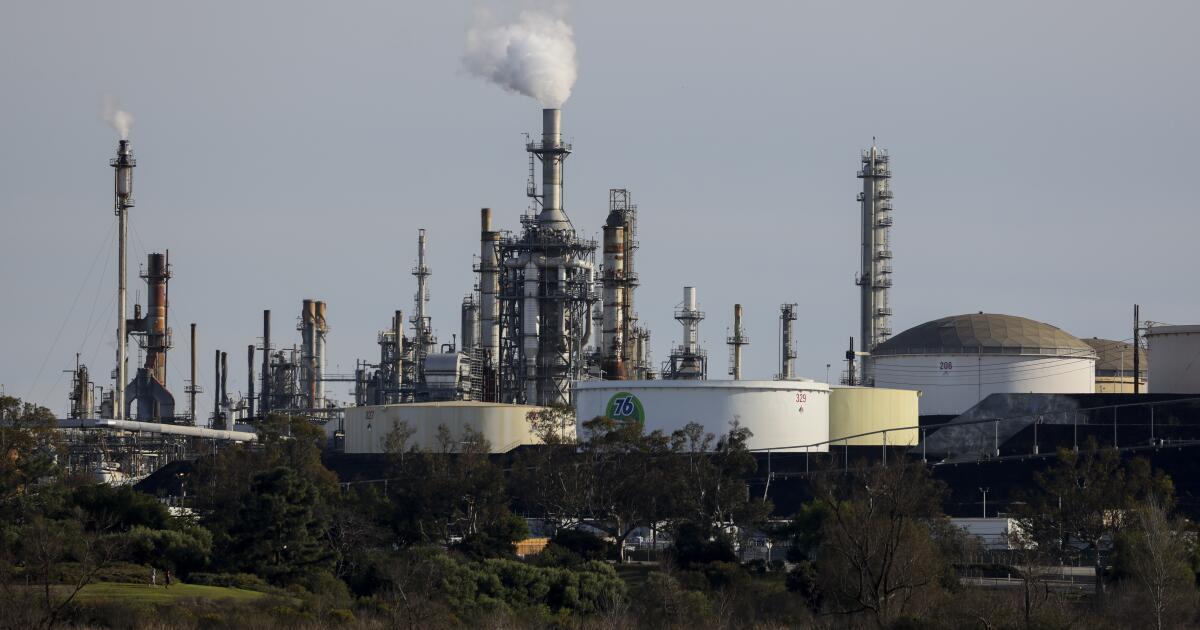
California gas is pricey already. The Iran war could cost you even more

Ulysses Jenkins, Los Angeles artist and pioneer of Black experimental video, dies at 79

‘Evil Dead’ Star Bruce Campbell Reveals He Has Cancer
Rep. Kevin Kiley opts against challenging fellow Republican Tom McClintock

Florida High School Football Rankings: Top 25 teams – Oct. 21

Cleary's 21 help Le Moyne down Central Connecticut State 69-64 in OT

How old is Bo Nix? What to know about Oregon quarterback ahead of 2024 NFL Draft

99th annual Pony Swim held in Virginia

Indiana Members Credit Union announced as new anchor tenant at Bottleworks District

Unexpected birth brings hope to near-extinct Amazon tribe

Supreme Court blocks redrawing of New York congressional map, dealing a win for GOP

Map: Earthquake Shakes Central California

Gas prices could jump as Middle East tensions threaten global oil supply

Pakistan calls troops, orders 3-day curfew as 24 killed in pro-Iran rallies
-

 World5 days ago
Exclusive: DeepSeek withholds latest AI model from US chipmakers including Nvidia, sources say
-

 Massachusetts5 days ago
Mother and daughter injured in Taunton house explosion
-

 Denver, CO5 days ago
10 acres charred, 5 injured in Thornton grass fire, evacuation orders lifted
-

 Louisiana1 week ago
Wildfire near Gum Swamp Road in Livingston Parish now under control; more than 200 acres burned
-

 Technology1 week ago
YouTube TV billing scam emails are hitting inboxes
-

 Politics1 week ago
OpenAI didn’t contact police despite employees flagging mass shooter’s concerning chatbot interactions: REPORT
-

 Technology1 week ago
Stellantis is in a crisis of its own making
-

 News1 week ago
World reacts as US top court limits Trump’s tariff powers