Politics
Commentary: America tried something new in 2025. It’s not going well

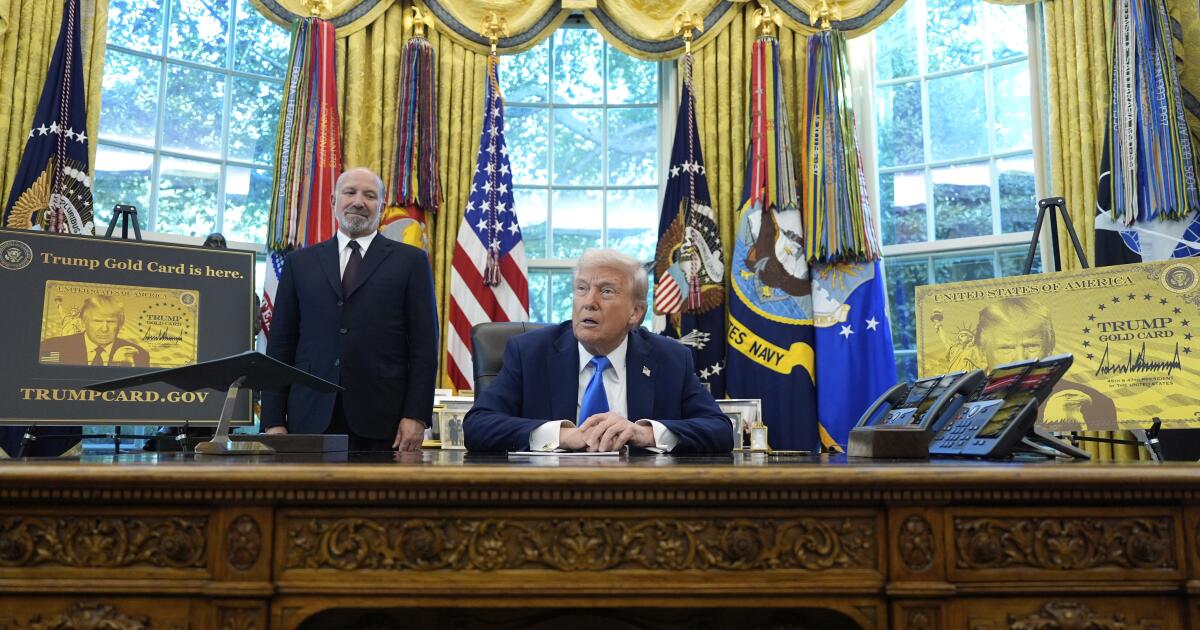
Is there a dumpster somewhere to torch and bury this year of bedlam, 2025?
We near its end with equal amounts relief and trepidation. Surely we can’t be expected to endure another such tumultuous turn around the sun?
It was only January that Donald Trump moved back into the White House, apparently toting trunkloads of gilt for the walls. Within weeks, he’d declared an emergency at the border; set in motion plans to dismantle government agencies; fired masses of federal workers; and tariffs, tariffs, tariffs.
Demonstrators at a No Kings rally in Washington, protesting actions by President Trump and Elon Musk.
(Jose Luis Magana / Associated Press)
By spring, the administration was attacking Harvard as a test case for strong-arming higher education. By June, Trump’s grotesquely misnamed Big Beautiful Bill had become law, giving $1 trillion in tax cuts to billionaires and funding a deportation effort (and armed force) that has fundamentally reshaped American immigration law and ended any pretense about targeting “the worst of the worst.”
Fall and winter have brought questionable bombings of boats in the Caribbean, a further backing away from Ukraine, a crackdown on opposition to Trump by classifying it as leftist terrorism and congressional inaction on healthcare that will leave many struggling to stay insured.
That’s the short list.
It was a year when America tried something new, and while adherents of the MAGA movement may celebrate much of it, our columnists Anita Chabria and Mark Z. Barabak have a different perspective.
Here, they renew their annual tradition of looking at the year past and offering some thoughts on what the new year may bring.
Chabria: Welp, that was something. I can’t say 2025 was a stellar year for the American experiment, but it certainly will make the history books.
Before we dive into pure politics, I’ll start with something positive. I met a married couple at a No Kings rally in Sacramento who were dressed up as dinosaurs, inspired by the Portland Frog, an activist who wears an inflatable amphibian suit.
When I asked why, the husband told me, “If you don’t do something soon, you will have democracy be extinct.”
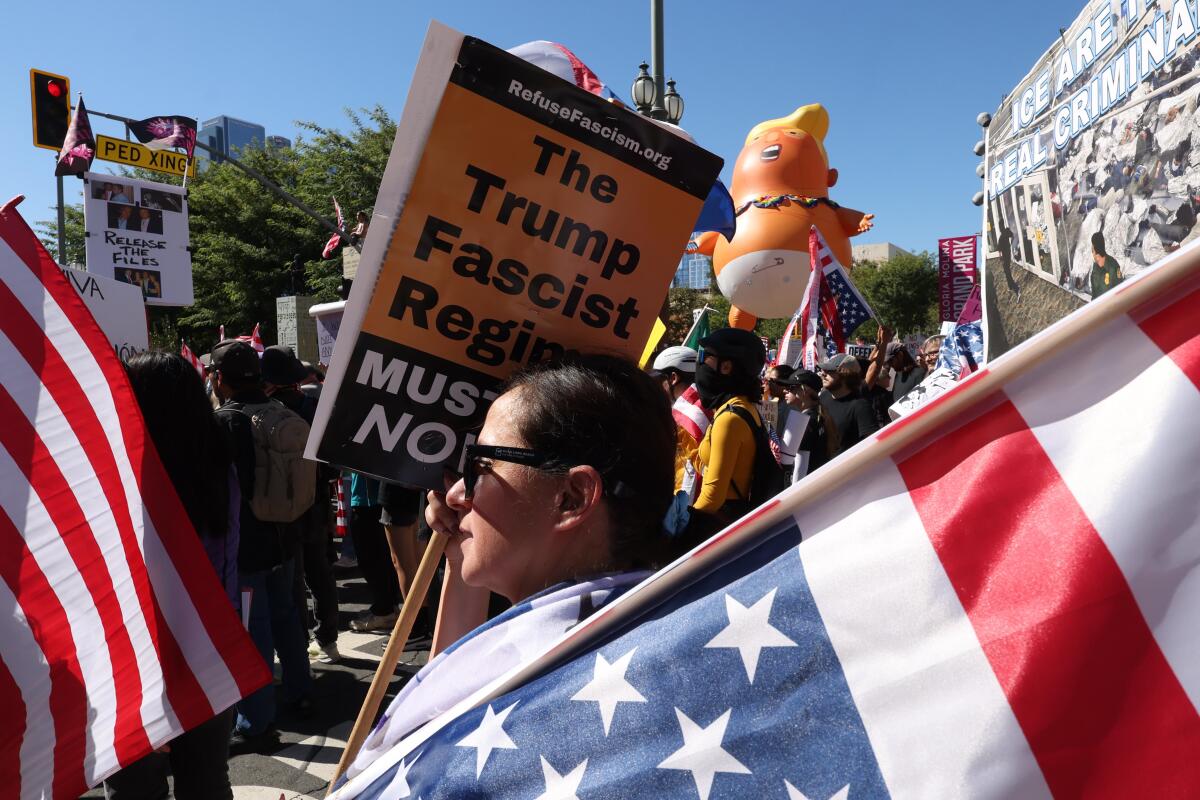
Crowds participate in No Kings Day in downtown Los Angeles in October.
(Genaro Molina / Los Angeles Times)
I loved that so many Americans were doing something by turning out to not just protest policies that hit personally, but to rally in support of democracy writ large. For many, it was their first time taking this kind of action, and they were doing it in a way that expressed optimism and possibility rather than giving in to anger or despair. Where there is humor, there is hope.
Barabak: As in, it only hurts when I laugh?
In 2024, a plurality of Americans voted to reinstall Trump in the White House — warts, felony conviction and all — mainly in the hope he would bring down the cost of living and make eggs and gasoline affordable again.
While eggs and gas are no longer exorbitant, the cost of just about everything else continues to climb. Or, in the case of beef, utility bills and insurance, skyrocket.

The John F. Kennedy Memorial Center for the Performing Arts is another of the long-standing institutions Trump has smeared his name across.
(Jacquelyn Martin / Associated Press)
Meantime, the president seems less concerned with improving voters’ lives than smearing his name on every object he lays his eyes on, one of the latest examples being the John F. Kennedy Center for the Performing Arts.
(The only place Trump doesn’t want to see his name is in those voluminous Epstein files.)
I wonder: Why stop there? Why not brand these the United States of Trump-erica, then boast we live in the “hottest” country on Planet Trump?
Chabria: Stop giving him ideas!
You and I agree that it’s been a difficult year full of absurdity, but we’ve disagreed on how seriously to take Trump as a threat to democracy. As the year closes, I am more concerned than ever.
It’s not the ugly antics of ego that alarm me, but the devastating policies that will be hard to undo — if we get the chance to undo them.
The race-based witch hunt of deportations is obviously at the top of that list, but the demolition of both K-12 and higher education; the dismantling of federal agencies, thereby cutting our scientific power as a nation; the increasing oligarchy of tech industrialists; the quiet placement of election deniers in key election posts — these are all hammers bashing away at our democracy.
Now, we are seeing overt antisemitism and racism on the MAGA right, with alarming acceptance from many. The far right has championed a debate as dumb as it is frightening, about “heritage” Americans being somehow a higher class of citizens than nonwhites.

Vice President JD Vance speaks at the University of Mississippi in Oxford.
(Gerald Herbert / Associated Press)
Recently, Vice President JD Vance gave a speech in which he announced, “In the United States of America, you don’t have to apologize for being white anymore,” and Trump has said he wants to start taking away citizenship from legal immigrants. Both men claim America is a Christian nation, and eschew diversity as a value.
Do you still think American democracy is secure, and this political moment will pass without lasting damage to our democratic norms?
Barabak: I’ll start with some differentiation.
I agree that Trump is sowing seeds or, more specifically, enacting policies and programs, that will germinate and do damage for many years to come.
Alienating our allies, terrorizing communities with his prejudicial anti-immigrant policies — which go far beyond a reasonable tightening of border security — starving science and other research programs. The list is a long and depressing one, as you suggest.
But I do believe — cue the trumpets and cherubs — there is nothing beyond the power of voters to fix.
To quote, well, me, there is no organism on the planet more sensitive to heat and light than a politician. We’ve already seen an anti-Trump backlash in a series of elections held this year, in red and blue state alike. A strong repudiation in the 2026 midterm election will do more than all the editorial tut-tutting and protest marches combined. (Not that either are bad things.)

A stressed-out seeming poll worker in a polling station at Los Angeles’ Union Station.
(Eric Thayer / Los Angeles Times)
The best way to preserve our democracy and uphold America’s values is for unhappy citizens to register their dissent via the ballot box. And to address at least one of your concerns, I’m not too worried about Trump somehow nullifying the results, given legal checks and the decentralization of our election system.
Installing lawmakers in Congress with a mandate to hold Trump to account would be a good start toward repairing at least some of the damage he’s wrought. And if it turns into a Republican rout, it’ll be quite something to watch the president’s onetime allies run for the hills as fast as their weak knees allow.
Chabria: OMG! It’s a holiday miracle. We agree!
I think the midterms will be messy, but I don’t think this will be an election where Trump, or anyone, outright tries to undo overall results.
Although I do think the groundwork will be laid to sow further doubt in our election integrity ahead of 2028, and we will see bogus claims of fraud and lawsuits.
So the midterms very well could be a reset if Democrats take control of something, anything. We would likely not see past damage repaired, but may see enough opposition to slow the pace of whatever is happening now, and offer transparency and oversight.
But the 2026 election only matters if people vote, which historically is not something a great number of people do in midterms. At this point, there are few people out there who haven’t heard about the stakes in November, but that still doesn’t translate to folks — lazy, busy, distracted — weighing in.
If proposed restrictions on mail-in ballots or voter identification take effect, even just in some states, that will also change the outcomes.
But there is hope, always hope.
Barabak: On that note, let’s recognize a few of the many good things that happened in 2025.
MacKenzie Scott donated $700 million to more than a dozen historically Black colleges and universities, showing that not all tech billionaires are selfish and venal.
The Dodgers won their second championship and, while this San Francisco Giants fan was not pleased, their seven-game thriller against the Toronto Blue Jays was a World Series for the ages.
And the strength and resilience shown by survivors of January’s SoCal firestorm has been something to behold.
Any others, beside your demonstrating dinos, who deserve commendation?

Pope Leo XIV waves after delivering the Christmas Day blessing from the main balcony of St. Peter’s Basilica at the Vatican.
(Gregorio Borgia / Associated Press)
Chabria: Though I’m not Catholic, I have been surprisingly inspired by Pope Leo XIV.
So I’ll leave us with a bit of his advice for the future: “Be agents of communion, capable of breaking down the logic of division and polarization, of individualism and egocentrism.”
Many of us are tired, and suffering from Trump fatigue. Regardless, to put it in nonpapal terms, it may be a dumpster — but we’re all in it together.
Barabak: I’d like to end, as we do each year, with a thank you to our readers.
Anita and I wouldn’t be here — which would greatly please some folks — but for you. (And a special nod to the paid subscribers out there. You help keep the lights on.)
Here’s wishing each and all a happy, healthy and prosperous new year.
We’ll see you again in 2026.


By Zolan Kanno-Youngs, Gilad Thaler, Jon Miller, Stephanie Swart, Rafaela Balster, Whitney Shefte and Nikolay Nikolov
May 29, 2026
Politics
Federal judge orders Trump’s name removed from Kennedy Center, says only Congress can rename it

NEWYou can now listen to Fox News articles!
A federal judge on Friday ordered that President Donald Trump’s name be removed from the Kennedy Center for the Performing Arts.
U.S. District Judge Christopher Cooper, an Obama appointee, said the iconic venue cannot be renamed without an act of Congress, ruling that the Kennedy Center Board of Trustees overstepped its “statutory bounds by unilaterally renaming” the building.
As part of his ruling, the Trump administration will be required to take down all physical signage bearing Trump’s name and eliminate any references to a “Trump-Kennedy Center” from official materials.
TRUMP KENNEDY CENTER’S BOARD VOTES UNANIMOUSLY TO APPROVE $257M RENOVATIONS AND TWO-YEAR CLOSURE
A sign is displayed on the John F. Kennedy Center for the Performing Arts building. (Getty Images)
“The Kennedy Center’s organic statute makes crystal clear that the Center is to be named for President Kennedy, and it cannot bear any other formal name or public memorial based on the Board’s unilateral say-so,” Cooper wrote. “Congress gave the Kennedy Center its name, and only Congress can change it.”
Roma Daravi, the Trump Kennedy Center vice president of public relations, said the board plans to appeal the decision.
“We will review the decision carefully though the reality remains — the Center requires an urgent and significant restoration – a truth that even the plaintiff acknowledges,” Daravi said. “With $257 million secured by President Trump and approved by Congress, the resources are in place and we remain committed to pursuing every lawful avenue to ensure the Trump Kennedy Center is restored as a national cultural landmark for all Americans to enjoy.”
The ruling was part of a lawsuit filed by U.S. Rep. Joyce Beatty, D-Ohio. The White House did not immediately respond to a request for comment.
BOARD VOTES KENNEDY CENTER TO BE RENAMED ‘TRUMP-KENNEDY CENTER,’ LEAVITT SAYS
President Donald Trump stands in the presidential box during a tour of the John F. Kennedy Center for the Performing Arts in Washington, D.C., on March 17, 2025. On Friday, a federal judge ruled that Trump’s name must be removed from he iconic venue. (Jim Watson/AFP/Getty Images)
Cooper previously denied a request for a preliminary injunction filed by a preservation group to block the planned two-year closure of the Kennedy Center for a rehabilitation project.
Trump secured $257 million from Congress as part of the One Big Beautiful Bill Act to address disrepair and deferred maintenance of the Kennedy Center, which critics say has been neglected and mismanaged before Trump intervened.
The funds appropriated by Congress are spent on maintenance, repairs, security, and capital projects related to the building and site.
Beatty, who serves as an ex officio member of the board, praised Friday’s ruling.
“Today’s ruling rightly affirms that this administration’s efforts to rename and close the Center have no basis in law,” Beatty said in a statement provided to Fox News Digital. “The Kennedy Center is an institution that belongs to the American people, not to Donald Trump. He has desecrated this sacred memorial for his own vanity. I am proud to have fought for the rule of law and to protect this sacred institution.”
Workers install Donald J. Trump signage above the existing Kennedy Center sign in Washington, D.C., on Dec. 19, 2025. (Jacquelyn Martin/AP)
CLICK HERE TO DOWNLOAD THE FOX NEWS APP
Trump’s name was added to the venue last December following a unanimous decision by the board. In February 2025, Trump was elected chairman of the Kennedy Center board after removing 18 trustees appointed by former President Joe Biden.
WASHINGTON — A framework agreement to end the U.S. war with Iran is all but settled, pending sign-off from the presidents of the two warring sides, President Trump said Friday, projecting optimism that a deal could finally be at hand.
Yet doubt cast a shadow over the diplomatic process entering the weekend as Trump faced a politically fraught decision to enter an agreement that would invariably require significant concessions to Tehran.
The negotiations have faced severe headwinds in recent days, with both sides accusing the other of violating a fragile ceasefire that has largely stopped the fighting since April.
On his Truth Social site, Trump said he had summoned his top aides to the White House Situation Room to decide on the deal.
The agreement would see an end to the U.S. naval blockade on Iranian ports and the removal of Iranian mines from the Strait of Hormuz, an international waterway through which 20% of the world’s energy supply passes each day. The strait, Trump wrote, will reopen with “no tolls” for “unrestricted shipping traffic, in both directions.”
And “Iran must agree that they will never have a Nuclear Weapon or Bomb,” Trump wrote, noting that Iran’s stockpile of highly enriched uranium, the key ingredient for nuclear weapons, “will be unearthed by the United States (which, it is agreed, is the only Country, along with China, with the mechanical capability of doing so!), in close coordination and conjunction with the Islamic Republic of Iran, plus the International Atomic Energy Agency, and DESTROYED.”
“No money will be exchanged, until further notice,” he added.
Treasury Secretary Scott Bessent also said the deal would require Iran to disavow the continuation of its domestic nuclear program — a diplomatic feat never before achieved throughout a quarter-century of international negotiations over Iran’s nuclear work.
It is unclear whether Tehran would go that far. And Iran’s negotiators expressed defiance on Friday, stating that there was “no trust in guarantees or words” from the American side.
“No step will be taken before the other side acts first,” said Mohammad Bagher Ghalibaf, the speaker of Iran’s Parliament. “We do not gain concessions through dialogue, but through missiles.”
It remains unclear when the Trump administration would ease sanctions on Iran, how extensive that relief would be, or what form it would take — questions that fueled Republican criticism of the Obama-era nuclear deal more than a decade ago.
The working diplomatic document would formally extend the existing ceasefire for 60 days, allowing for a more detailed negotiation to take place over Iran’s nuclear program. But the truce as it currently stands is on perilous ground. Iran launched a ballistic missile on Thursday at Kuwait, a close U.S. ally, after American forces took “defensive” actions against Iranian missile launchers and mine-laying boats it had launched in the strait.
The war has proved historically unpopular with the American public, and has seen oil prices soar since the U.S. military, in partnership with Israel, launched its first strikes against Iran in February.
Bessent said he is hopeful that oil prices would drop quickly once an agreement is signed. But industry analysts say the effects of the war on the oil market could last for months, if not years, with the stability of traffic through the Strait of Hormuz now in question for commercial shippers.
While oil has dropped to under $100 a barrel, markets appeared skittish on Friday over the prospects for a deal, with mixed messages appearing to emerge out of the region.
It is also unclear whether a U.S. agreement with Iran would in any way bind Israel’s hands in its military operations, either in Iran or in Lebanon, where an Iranian proxy militia, Hezbollah, has vowed to keep up the fight.
Israel has ramped up strikes against Hezbollah targets in recent days, jeopardizing a delicate ceasefire negotiated with the Lebanese government, a deal encouraged by the Trump administration in order to grease the wheels for its talks with Tehran.
Trump has been uncharacteristically silent on the prospects of an agreement in recent days, expressing cautious optimism in limited exchanges with reporters.
“It’s hard to say exactly when or if the president’s going to sign,” Vice President JD Vance, who has led the U.S. diplomatic team, told reporters, noting that “the nuclear stuff” is still subject to negotiation. “We’re going back and forth on a couple of language points.”
“I do think that we’ve made a lot of progress here,” Vance added. “Hopefully we’ll continue to make progress, and the president will be in a position where he can endorse the agreement. But obviously, that’s still TBD.”
-

 Minneapolis, MN2 minutes ago
United flight from Chicago to Minneapolis diverted to Wisconsin due to unruly passenger: officials
-

 Indianapolis, IN7 minutes ago
Top seeded West Chester cruises to 12-3 win over University of Indianapolis in the Division II championship
-

 Pittsburg, PA14 minutes ago
Pittsburg man accused of hotel kidnapping, assault enters plea deal
-

 Augusta, GA17 minutes ago
Senate candidate Derek Dooley visits Lincolnton, Augusta
-

 Washington, D.C22 minutes ago
Man in critical condition after water rescue in Southwest DC
-

 Cleveland, OH29 minutes ago
Koby Altman Sounds Like Evan Mobley’s Future With Cavaliers Could Be in Question
-

 Austin, TX32 minutes ago
Barton Springs Bridge named one of Preservation Texas’ most endangered places for 2026
-

 Alabama37 minutes ago
A path to employment for Alabama individuals with a criminal background

