Politics
Column: There should be no partisan divide about naming Epstein’s fellow abusers

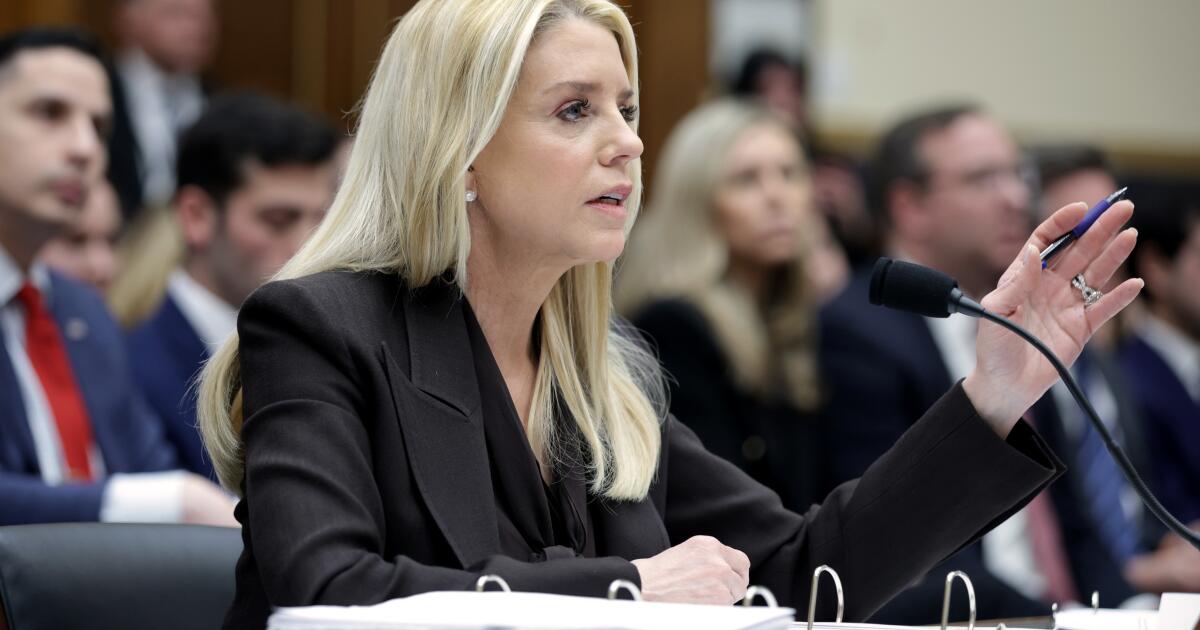
At a House Judiciary hearing on Wednesday, Atty. Gen. Pam Bondi was holding a document labeled “Jayapal Pramila Search History” that included a list of files from the unredacted Epstein archive accessible to lawmakers such as Rep. Pramila Jayapal (D-Wash.).
That means over the course of a year Bondi’s Department of Justice has made time to speak with Ghislaine Maxwell — the New York socialite who helped Jeffrey Epstein run his billion-dollar child-sex-trafficking operation — and it made time to surveil a Democratic lawmaker who conducts oversight as a member of the Judiciary Committee. But it has yet to meet with the victims of Epstein’s crimes who want to talk.
When she took office, Bondi promised us transparency. She didn’t promise we would like what we would see from her.
The general public’s awareness of Epstein’s heinous crimes came with political baggage. However at this point, the question we all should wonder is: How does redacting the names of the men who helped fund Epstein’s operation benefit either political party? It may be good for the rich and powerful men trying to avoid accountability, but it’s not exactly a campaign platform.
Yet here we are as a country, chained to the same vocabulary used during an election, so a conversation that should be about right and wrong is accompanied by poll numbers and analysis about the midterm elections. As if the Justice Department’s refusal to interview rape survivors is an inside-the-Beltway topic and not reflective of a larger moral crisis. We have seen Congress kept out of session to avoid voting on the release of the Epstein files; we have heard equivocation about whether Epstein was a pedophile. We know Epstein’s island was a place where evil resided.
The investigation, or lack of investigation, into Epstein’s fellow abusers should not be seen by anyone as a political quandary in which the object of the game is to keep your party in power. The fact that there is a Republican-vs.-Democrat divide on accountability for sex abuse reveals a national moral crisis. When the abuse of children is viewed through a partisan lens, how else can one describe this period in America?
Fifty years ago, when President Carter was tasked with healing the nation after the Watergate scandal, he told Americans in his inaugural address that he was leaning on his faith, and one prophet in particular.
“He hath shewed thee, O man, what is good; and what doth the Lord require of thee, but to do justly, and to love mercy, and to walk humbly with thy God?,” Carter said, quoting Micah 6:8. “This inauguration ceremony marks a new beginning, a new dedication within our government, and a new spirit among us all. A president may sense and proclaim that new spirit, but only a people can provide it.”
The Hebrew prophet Micah was from a rural area, not born into the wealth of the royal court. He was not being compensated by those who were. Instead, Micah reflected the voice of the people who were forced to live in poor conditions because of corruption. He described the actions of the morally bankrupt judges, political leaders and other elites in graphic, violent terms, condemning those “who hate the good, and love the evil; who pluck off their skin from off them, and their flesh from off their bones.”
This, he said, is what it is like being ruled by those who are not guided by what is good and what is evil, but rather what is most beneficial for themselves in the moment. When Micah spoke, it wasn’t about the latest poll numbers. His warnings about government corruption are not unique to any particular faith, nor are they married to any political party. They embody centuries of human history, a history that tells what happens to a society when power goes unchecked.
And be not mistaken, it was unchecked power — not any party affiliation — that provided Epstein and Maxwell with patronage. It was moral failure, not conservatives or liberals, that provided cover for their child-sex-trafficking ring.
So if for partisan reasons the abusers of children are not held accountable for their crimes, the language of politics fails us. The word for that is simply: evil.
YouTube: @LZGrandersonShow
Insights
L.A. Times Insights delivers AI-generated analysis on Voices content to offer all points of view. Insights does not appear on any news articles.
Viewpoint
Perspectives
The following AI-generated content is powered by Perplexity. The Los Angeles Times editorial staff does not create or edit the content.
Ideas expressed in the piece
-
The Department of Justice under Attorney General Pam Bondi has created a moral crisis by allowing the investigation into Jeffrey Epstein’s fellow abusers to become a partisan political issue rather than a matter of fundamental accountability and justice[3]. The DOJ has monitored a Democratic lawmaker’s access to Epstein files while reportedly meeting with Ghislaine Maxwell but declining to meet with Epstein survivors seeking to discuss their experiences[1][3].
-
Redacting the names of wealthy and powerful men implicated in Epstein’s crimes while exposing victims’ identities serves no legitimate governmental interest and only protects the rich and powerful from accountability regardless of political affiliation[3]. The failure to hold co-conspirators accountable after more than a year in office, combined with refusals to apologize to survivors, demonstrates a troubling prioritization of protecting certain interests over justice[3].
-
When child sexual abuse becomes filtered through partisan politics rather than evaluated on moral grounds, it reflects a fundamental failure of governance and represents a national crisis of conscience[3]. The politicization of this issue obscures what should be a universal principle: that accountability for crimes against children transcends party affiliation and election cycles[3].
Different views on the topic
-
The Department of Justice maintains that it records all searches conducted in its systems specifically to safeguard against the disclosure of victim information, suggesting that monitoring access to sensitive Epstein files serves a protective function rather than partisan surveillance[1]. Attorney General Bondi stated that the department has pending investigations in its office related to potential Epstein conspirators[2], indicating that prosecutorial work continues despite public criticism.
-
The release of Epstein files is an ongoing process requiring careful legal review to protect victims’ privacy and ensure proper handling of sensitive evidence[4]. The DOJ’s approach to redacting certain information may reflect legitimate institutional concerns about victim protection and the complexities of managing millions of declassified documents[1].


America 250” is no “Spirit of ‘76.”
For those of us who remember the bicentennial, the semiquincentennial is a complete and utter dud. Many fine festivities will take place on and around July 4, but compared with the years-long nationwide celebration that marked this country’s 200th anniversary, 250 feels like a nonevent.
Perhaps it was inevitable. Semiquincentennial (meaning half of a 500-year anniversary) certainly doesn’t roll off the tongue as easily as bicentennial and our current president isn’t making it any catchier. Mostly because he seems to think 250 is the new 80 (the birthday President Trump recently marked with his UFC Freedom 250 cage match on the White House lawn).
As many have noted, Trump’s method of honoring this country’s birthday involves making it all about him by demolishing parts of the White House (to install a new bunker-like ballroom), attempting to set up a $1.8-billion slush fund for pardoned Jan. 6 rioters, seeking to build a triumphal arch that a majority of Americans oppose and trying to slap his name and/or image on any surface he can think of (including a proposed $250 bill). No wonder so many artists have dropped out of the concert series planned for the Great American State Fair in Washington, D.C.
To be fair, the federal government’s involvement in bicentennial planning also got bogged down with political and personal hubris. The national commission, originally created by President Lyndon B. Johnson, was reformed under President Richard Nixon. Plagued by criticism and scandal, it was eventually dissolved by Congress and replaced by a new commission that decided to mostly fund community celebrations.
There was much hand-wringing over missed opportunities at the time, but for more than a year, state and local governments staged reenactments, parades and patriotic events all over the country while the commercial sector star-spangled the crap out of everything: T-shirts, bell-bottoms and bathing suits; curtains, bedspreads and throw rugs; dishware, glassware and Tupperware.
The Declaration of Independence appeared on highball glasses, tea towels and collectible plates. Beginning in 1974, CBS ran mini-history lessons called “Bicentennial Minutes,” which were then sent up on shows as diverse as “Hee Haw” and “Maude.” George Washington and other Founding Fathers graced Pez dispensers, coasters and the cover of Mad Magazine. There was a bicentennial Barbie and a colonial Campbell’s Soup doll. McDonald’s sold red, white and blue milkshakes, Burger King offered a flag-bedecked series of glass tumblers, Disney characters wore tricorn hats for a line of park merchandise.
Some called it the “buy-centennial” but for a kid who daily rocked Stars and Stripes sneakers, and, thanks to a year’s worth of American-history-themed “Schoolhouse Rock!,” could, and would, sing the preamble to the Constitution or the anthem “No More Kings” at the drop of a hat, it was great fun.
Now, of course, “No More Kings” is an anti-Trump protest theme, and the right has so co-opted patriotism that wearing a flag-emblazoned T-shirt can feel somehow partisan. American history itself has become a bone of contention, with the left accusing the right of whitewashing this country’s inarguable sins — Native American displacement, slavery, gender inequality and racist policies — while the right insists that the left is obsessed with undermining our nation’s power and legacy by “woke”-shaming it.
The only thing each end of our divided political spectrum can agree on is that democracy is under mortal threat from the other.
That’s one good reason to feel less than festive, and there are plenty of others, including increased political violence, the war in Iran, tariffs, surging gas prices, civil rights rollbacks, Immigration and Customs Enforcement tactics, artificial intelligence’s threat to jobs, the resurgence of measles, the rising cost of just about everything and the fact that some critics are claiming that Steven Spielberg’s “Disclosure Day” is less full of wonder than “Close Encounters of the Third Kind.”

But things weren’t so great heading into the bicentennial either. I was 12 at the time, born nine months after Alabama Gov. George Wallace gave his infamous “segregation now, segregation tomorrow, segregation forever” speech and less than two months before President Kennedy was assassinated. I hadn’t been alive a year when civil rights activists James Chaney, Andrew Goodman and Michael Schwerner were murdered in Mississippi by members of the Ku Klux Klan and hadn’t turned 5 when the Rev. Martin Luther King Jr. and then-Sen. Robert F. Kennedy were also assassinated.
Sure, it was that now-wistfully remembered time when kids went out in the morning and played, mostly unmonitored, until nightfall (with the inevitable trips to the doctor for stitches and tetanus shots for those wounds too obvious to hide from parents). But by the time the bicentennial rolled around, my life had played out against the backdrop of civil unrest and the Vietnam War, both spilling from our black-and-white television almost nightly.
I was 9 when Wallace, then a presidential candidate, was shot and 10 when I learned what OPEC and gas siphoning meant as my family spent hours in an un-air-conditioned car, inching toward the gas pump after the 1973 “Yom Kippur” Arab-Israeli War resulted in oil shortages.
That same year, Vice President Spiro Agnew resigned from office, pleading “no contest” to charges of tax evasion but avoiding prosecution for charges of bribery and criminal conspiracy, and Nixon appointed House Minority Leader Gerald Ford (R-Mich.) to Agnew’s place. In 1974, Nixon, faced with impeachment for his part in the Watergate scandal, became the first president in U.S. history to resign.
The bicentennial’s tall ships festivals, fife and drum parades and Old Glory consumer fest occurred in a country reeling from more than a decade of history-changing assassinations, civil unrest, economic anxiety and high-level political corruption (not to mention a collective fear of the ocean brought on by the 1975 release of Spielberg’s “Jaws”). Democracy was celebrated under Ford, the first, and thus far only, president to come to office through the provisions of the 25th Amendment rather than a national election.
A president who, after being regularly and ruthlessly lampooned by comedian Chevy Chase on the nascent “Saturday Night Live,” reacted by becoming friends with Chase instead of, you know, forcing the network to fire him.
If the bicentennial roiled with some of the same tensions Americans feel today, it did benefit from a cultural cohesion that no longer exists. The year 1976 saw the founding of Apple and the introduction of VHS tapes, but the national audience was still very much a reality. Back then, you couldn’t escape the songs of the summer — “Silly Love Songs” (Wings), “Don’t Go Breaking My Heart” (Elton John and Kiki Dee) and “Afternoon Delight” (Starland Vocal Band) — any more than you could miss those “Bicentennial Minutes.” We all listened to the radio, watched TV, went to the movies and bought books, and our preferences revealed the country’s desire for both comfort and change.
On the bestseller lists, Agatha Christie’s final Hercule Poirot and Miss Marple books marked the end of an era, toggling in the No. 1 spot with the political turbulence of Gore Vidal’s “1876” and Leon Uris’ “Trinity.” “Rocky” beat “All the President’s Men,” “Taxi Driver,” “Network,” “Marathon Man” and “The Omen” at the box office and, later, in the best picture Oscar race.
On television, Americans sought the nostalgic comfort food of “Happy Days,” “The Waltons” and “Little House on the Prairie” amid the more pointed social comedies of “All in the Family,” “The Jeffersons” and “MASH,” all of which had nightly averages of 20 million or more viewers.
In today’s cultural landscape, defined by social media bubbles, streaming services and Spotify libraries, the gap between mass audience and cultural significance is much wider than it was 50 years ago (“The Super Mario Galaxy Movie” may be the highest-grossing movie of the year, but it’s hard to imagine it winning best picture) and mass audience has become a relative term for pretty much everything that is not the Super Bowl.
Even so, we too find ourselves rooting for the little guy (“Project Hail Mary”) and reaching into the past for inspiration (a new “Little House on the Prairie” debuts next week on Netflix) even as we contemplate the future of tech (“The Six Billion Dollar Man” has become every computer genius who can leap a firewall).
I don’t know what it was like to be an adult in 1976, but I remember my parents fretting over the grocery budget, nixing travel plans because of the price of gas and worrying about the future of a country that seemed so irreparably divided. To paraphrase the Diana Ross hit of the time, did we know where we were going to? Not at all. The bicentennial occurred during an election year, with all the partisan denunciations that entails (though when Jimmy Carter narrowly beat Ford, no one thought of contesting the results).
Even so, most Americans were still ready to party, to celebrate the 200th anniversary of a long-shot revolution that resulted in the United States of America.
So does it stink that the semiquincentennial has been such a flop? Yes, it does. But, as is written in its very singable preamble, the Constitution was written “in order to form a more perfect union.” Not “perfect,” but “more perfect.” As in better.
Even in the most troubled times, the cornerstone of our democracy is the understanding that we will always need to do better and there is a living document that allows us to do so.
And 250 years’ worth of that is definitely worth celebrating.

NEWYou can now listen to Fox News articles!
Mallory McMorrow announced Sunday that she is suspending her campaign for the U.S. Senate in battleground Michigan.
The Michigan state senator’s decision leaves her party’s primary as a two-way race between moderate Rep. Haley Stevens, who is backed by longtime Senate Democratic leader Sen. Chuck Schumer and the establishment, and former Wayne County Health Department Director Abdul El-Sayed, a left-wing candidate endorsed by progressive champions Sen. Bernie Sanders of Vermont and Rep. Alexandria Ocasio-Cortez of New York
McMorrow’s name will remain on the ballot for the Aug. 4 primary as ballots have already been printed and distributed to absentee voters, according to Bridge Michigan.
The eventual Democratic nominee will face off in the midterms with former Republican Rep. Mike Rogers, who is on a glide path to the GOP nomination, in a crucial midterm race to succeed retiring Sen. Gary Peters, a Democrat.
MICHIGAN SENATE CANDIDATE ABDUL EL-SAYED TAKES HEAT FOR KHAMENEI COMMENTS, HASAN PIKER EVENT
Michigan state Sen. Mallory McMorrow speaks on the first day of the Democratic National Convention in Chicago on Aug. 19, 2024. (Andrew Caballero-Reynolds/AFP via Getty Images)
The seat is a top Republican target and is a must-hold for the Democrats as they aim to win back the Senate majority from the GOP, which currently controls the chamber 53-47. The leading nonpartisan political handicappers rate the Senate race in Michigan as a toss-up.
In a video posted on X announcing her decision, McMorrow did not provide a specific reason for ending her campaign. She instead thanked her staff and supporters for helping build what she described as a campaign powered by small-dollar donations and no corporate PAC money.
But McMorrow, who has seen her national profile expand in recent years and was running as a progressive in an ideological space between El-Sayed and Stevens, suspended her campaign amid faltering polling numbers and fundraising that weren’t keeping pace with her two main rivals.
McMorrow also pledged to fully support whichever Democrat wins the primary and faces off with Rogers, who is running for the Senate for a second straight cycle and lost in 2024 to now-Sen. Elissa Slotkin by a razor-thin margin.
“So here’s what we do next. Every day through November 3rd. We win this Senate seat and send Mike Rogers back to Florida for good,” she said. “Whoever wins this primary on August 4th will have my full support.”
MICHIGAN DEMOCRATIC SENATE CANDIDATE CLAIMS ISRAEL ‘JUST AS EVIL’ AS HAMAS
Rep. Haley Stevens, D-Mich., speaks during the House Democrats’ news conference in the Capitol on Feb. 6, 2025. (Bill Clark/CQ-Roll Call, Inc via Getty Images)
Following McMorrow’s announcement, Stevens praised her fellow Democrat by calling her an “important voice” for policies that benefit Michigan families.
Stevens then argued that she is the strongest Democratic candidate to win the primary and defeat Rogers in November.
“As we enter the final month of the primary election, I’m excited to continue to make my case to Michiganders why I’m the strongest Democrat to defeat Mike Rogers this November, lower costs, protect manufacturing jobs, and stand up to Trump’s abuses of power.”
MAMDANI-BACKED SOCIALISTS LOOK TO TAKE NEW YORK PLAYBOOK NATIONWIDE AFTER PRIMARY VICTORIES
Abdul El-Sayed, speaks before Sen. Bernie Sanders and takes the stage at Mumford High School on May 3, 2026, in Detroit, Michigan. (Sarah Rice/Getty Images)
In his statement, El-Sayed praised McMorrow for having the “courage” to challenge what he described as a rigged political system, accusing Democratic Party insiders of spending millions to influence the primary. While he did not name specific groups, the remarks appeared to reference corporate PACs and party leaders such as Senate Minority Leader Chuck Schumer, D-N.Y., who has endorsed Stevens.
He then invited McMorrow’s supporters to join his progressive movement to combat big money in politics and defeat the political establishment.
“Throughout this campaign, Senator McMorrow showed what it looks like to fight back against politics that rigs the system against too many of us. While we have policy disagreements, I never questioned whether Senator McMorrow would fight for a better America for my daughters and hers,” he said.
“The same party insiders she had the courage to challenge have been bullying anyone who opposes their chosen candidate. After spending $30 million to drown Senator McMorrow and me out, they’re now spending even more to attack me. It’s everything we are standing up against.”
“I welcome her supporters to our movement to stand up against money in politics, to put money back in pockets, and pass Medicare for All. We cannot allow the establishment to decide our nominee for us.”
U.S. Sen. Bernie Sanders (I-VT) stands with Senate candidate Abdul El-Sayed after speaking at Mumford High School on May 3, 2026 in Detroit, Michigan. (Sarah Rice/Getty Images)
El-Sayed, who, if elected would make history as the nation’s first Muslim senator, is an epidemiologist who unsuccessfully ran for governor as an insurgent candidate in 2018. He has made support for “Medicare-for-all” a major component of his campaign.
El-Sayed also calls for abolishing ICE, and he’s a vocal critic of Israel in its war with Hamas. He has characterized Israel’s actions in Gaza as “genocide” against Palestinians. And El-Sayed, who served as a top surrogate on Sanders’ 2020 presidential campaign, has also vowed not to accept PAC donations.
Schumer and the party establishment view Stevens as more electable than El-Sayed, who has sparked controversy with his past comments. They worry that El-Sayed as the party’s nominee would jeopardize the Democrat-controlled Senate seat by pushing the party too far to the left in a state that President Donald Trump carried two years ago.
Meanwhile, Stevens has been backed by millions in super PAC spending, including big bucks from Israel-aligned groups.
AOC JOINS BERNIE SANDERS IN BACKING SENATE CANDIDATE OPPOSED BY SCHUMER
Former Rep. Mike Rogers, seen speaking with Fox News Digital, is on a glide path for the 2026 Republican Senate nomination in Michigan, as he campaigns for the Senate a second straight time. (Paul Steinhauser – Fox News )
The National Republican Senatorial Committee (NRSC), in a statement reacting to McMorrow’s move, pointed to the burgeoning battle between the far left and the establishment for the future of the Democratic Party.
CLICK HERE TO DOWNLOAD THE FOX NEWS APP
“Bernie Sanders’ radical socialist flank is completely taking over the Democrat Party. It is now up to Chuck Schumer to combat Abdul El-Sayed’s clear momentum and get Haley Stevens over the finish line in their messy primary,” NRSC Regional Press Secretary Samantha Cantrell argued in a statement.
Greg Manz, the Michigan GOP senior communications adviser, said in a statement that “Michigan’s Senate Democrat primary has shifted from a three-car pileup to a head-on collision.”

Immigrants detained at two federal facilities in California have launched a boycott in protest of increasing and, in their view, burdensome prices at the facilities’ commissaries for items including tampons, coffee and soup.
The Times reviewed a grievance letter and spoke with three detainees who are involved in the boycott at the California City Detention Facility, about 80 miles east of Bakersfield, and at the Golden State Annex in McFarland.
More than 300 detainees are estimated to have signed grievance letters sent recently to facility administrators, according to advocates with the California Collaborative for Immigrant Justice.
Both facilities are operated by private prison corporations — the California City facility by Tennessee-based CoreCivic and the Golden State Annex by Florida-based GEO Group.
Ryan Gustin, public affairs director for CoreCivic, said the company cares for people at the facility safely, humanely and with dignity while their cases proceed. He said the facility provides three nutritious meals per day and accommodates religious, therapeutic and cultural diets, and that commissary items are a supplement.
Proceeds from commissary sales, per the facility’s contract, are put into a detainee welfare fund, Gustin added. Those funds are used to buy electronics or recreational or educational items.
“We regularly collaborate with our outside commissary vendor and government partners to review and set commissary item pricing that is reasonable,” he said. “It’s important to note that the commissary program is not a profit mechanism.”
The Times also reached out to the Department of Homeland Security and GEO Group for comment.
Detainees are provided certain essentials, such as food and soap, free of charge, but many also purchase items at commissary stores that are of better quality or otherwise unavailable.
Detainees said shampoo and other hygiene items sometimes run out for days and that meals are small or exacerbate diabetes and other health issues. One detainee said the facility provides a pint of milk twice a week and that he has never received fresh fruit.
“The three daily meals that CoreCivic provides at California City Detention Facility are the bare minimum to keep a person alive,” they wrote. “Because of this, charging inflated prices on necessities is considered price gouging and profiteering against vulnerable incarcerated population who have no ability to refuse or shop elsewhere.”
The detainees said an 8-ounce jar of Folgers instant coffee costs $18 at the California City facility, a single instant ramen soup is 75 cents and a box of 40 tampons costs nearly $21.
At Walmart, the same Folgers coffee costs $8.97, Maruchan chicken ramen soup is 50 cents and 40 Tampax tampons are $12.19.
U.S. Immigration and Customs Enforcement detains immigrants for civil purposes. Detention is meant to facilitate removal proceedings but is not meant to be punitive.
Detainees are paid $1 per day under a voluntary work program for cleaning or cooking. Many detainees rely on money from family and friends.
In their grievance letter, the detainees called the markups an unacceptable business practice with no apparent limit. They said they view the situation as an example of captive market exploitation and economic coercion.
The detainees requested a review of commissary pricing by facility leaders, a comparison of prices with prison industry standards, an immediate reduction in prices of essential items and the implementation of reasonable price caps. They also requested an increase in the portions of daily meals, including meals meeting religious requirements, which they said are particularly small.
In May, the California State Senate passed a bill that would prohibit the excessive markup of products sold at private detention centers, limiting prices to 35% above the vendor cost. Existing California law already limited such markups in state prisons.
“It’s just a cycle of unnecessary exploitation,” said Sen. Steve Padilla (D-Chula Vista), who wrote the bill, which is now in the Assembly. “If someone is under contract, they should engage in ethical business practices.”
Priya Patel, an attorney at the California Collaborative for Immigrant Justice, represents people who have been detained at both facilities. She said that during legal service consultations, the topic of commissary pricing frequently comes up.
“The higher the prices get, the higher of an impact the conditions have on people and the more difficult it becomes to fight their cases,” Patel said.
The collaborative is one of the organizations that brought a lawsuit last year alleging inadequate medical care, as well as insufficient clothing, food, water and outdoor recreation time, at the California City facility, which can hold more than 2,500 people. The lawsuit remains ongoing; in March, a U.S. district judge in San Francisco appointed an external monitor to ensure the facility provides “constitutionally adequate health care.”
The lawsuit describes multiple commissary-related issues. For example, it says the facility doesn’t provide headphones for tablets, making private phone calls — including privileged calls with attorneys — impossible unless the detainee can afford to purchase headphones from the commissary.
“One detained person has difficulty walking and standing for extended periods of time without shoes that provide arch support,” the complaint says. “He arrived at California City with appropriate shoes to accommodate his mobility disability, which were approved as an accommodation at a prior ICE facility. California City staff confiscated those shoes and instead provided him with plastic, orange sandals.”
“Several weeks after staff confiscated his shoes, he had an appointment with a doctor at California City,” it continues. “The doctor told him … to buy different shoes from commissary to accommodate his foot condition.”
Gustin disputed those accounts, saying that detainees are given headphones at intake and that attorney calls typically take place in private booths. He said that the company provides orthopedic footwear for any detainee with a medical provider’s order, and that he couldn’t review the case detailed in the complaint without specifics.
A contract between CoreCivic and ICE for the California City facility, dated April 1, 2025, says that the contractor must provide notice of any price increases and that “any revenues earned in excess of what is required for commissary operations shall be used solely to benefit aliens at the facility.” A 2019 contract between GEO Group and ICE for Golden State Annex and two other facilities in California includes the same language.
Alfredo Parada Calderon, 52, has been detained at the California City facility since September. He said commissary prices were already high before they increased around mid-June.
Parada Calderon said he asked an ICE officer why the prices had increased so much. The officer said he wasn’t aware of the change but that the vendor is Keefe Group, which supplies commissaries at prisons and immigrant detention centers across the country.
Detainees in his dormitory submitted a grievance about commissary prices, Parada Calderon said. The answer was vague.
“They’re blaming it on inflation,” he said.
Parada Calderon said his family sends him about $100 per month for commissary items, which he spends on packets of crackers, coffee, soups, soap, shampoo, deodorant and chips.
“Enough is enough,” he said. “It’s a horrible enough place to be in and you guys are making it even more horrible, not just for me but for my family. The detainees want to be heard and this is the only option we actually have — a peaceful protest.”
Tommaso Bardelli, a researcher at New York University who studies mass incarceration, said the families of most people in prison are working class and may sacrifice their electricity bill or credit card payment to send money to their incarcerated relatives. The money they send no longer pays for small luxuries, he said, because prisons have over the years reduced how much they spend per person on necessities such as food.
Bardelli published a research article in 2022 about inequality within prison commissary stores. Commissaries are often now the difference between starving and having a semi-normal diet, he said.
-

 Lifestyle3 minutes ago
Luxury Clients Want Meaning More Than Status
-
Politics6 minutes ago
Commentary: Even in ugly times, the bicentennial united us. America 250 still can
-
 Sports18 minutes ago
‘I wish she was alive.’ Eliezer Alfonzo has emotional day as Dodgers lose to Padres
-

 World26 minutes ago
Photos: Khamenei funeral procession under way in Tehran
-
 News51 minutes ago
Thunderstorms, heat and wind will hamper efforts to contain Colorado wildfires
-

 New York2 hours ago
10-Minute Challenge: The Ceiling at Grand Central
-

 Los Angeles, Ca2 hours ago
1 killed, multiple people injured in Tarzana 4-car crash
-

 Detroit, MI3 hours ago
Power outage forces flaring at Marathon’s Detroit refinery; portion of Schaefer Road closed

