Politics
Column: Joe Biden's empathy was his superpower in 2020. Can he find it again in 2024?

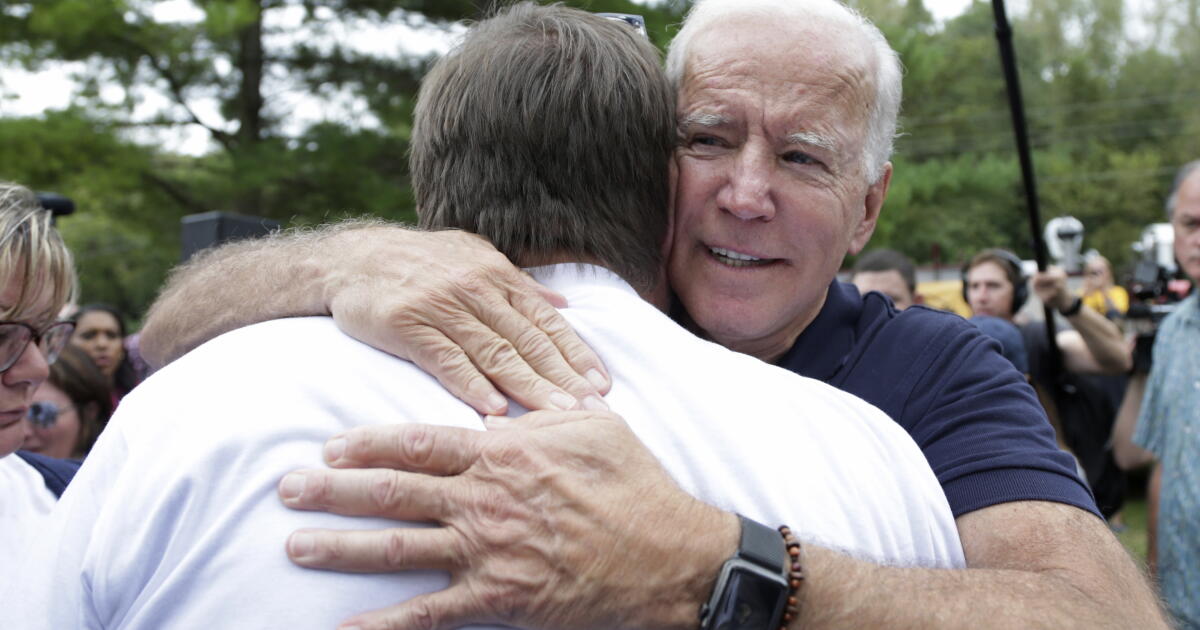
Whatever happened to the empathetic Joe Biden who won the 2020 presidential election?
Some days it feels as if that kindly Uncle Joe has been replaced by a cranky old pol annoyed at voters who don’t give him credit for a strong economy.
Last week, when the Labor Department reported that inflation had ticked up to 3.5%, probably delaying a cut in interest rates, Biden didn’t offer much solace.
“We have dramatically reduced inflation from 9%,” he said. “We’re better situated than we were when we took office.” That’s true, but it’s cold comfort to consumers and home buyers.
Joe Biden puts his arm around supporter Diana Feige after speaking during an event in Keene, N.H., during the 2020 presidential campaign.
(Michael Dwyer / Associated Press)
A week earlier, when a reporter asked Biden what he would tell Americans stressed by high prices, the president replied: “I’d say we have the best economy in the world. We have got to make it better.”
It’s a theme he’s been sounding for months. In his State of the Union address, he extolled the U.S. economy as “the envy of the world.”
But a chorus of Democratic strategists say it’s the wrong message, mainly because it’s missing the element that was once Biden’s political superpower: empathy.
“You can’t tell people they’re better off than they think they are,” said Mark Mellman, a veteran political consultant. “It’s important to acknowledge their pain. Otherwise it comes across as a signal that you don’t understand their lives.”
“I wouldn’t go out there and extol the miracle of the Biden economy,” said David Axelrod, who helped Barack Obama win two presidential elections.
“The right strategy is to say, ‘Look, we’ve made a lot of progress … [but] the way people experience this economy is the way I did when I was growing up in Scranton, Pennsylvania,’” Axelrod said in an interview with conservative pundit Bill Kristol. “‘How much did you pay for the groceries? How do you afford the gas, the rent? These continue to be a problem and I’m fighting that fight.’”
“The message needs to start with empathy and focus on prices, which is the issue that matters most to voters,” said Stanley Greenberg, who helped Bill Clinton win the presidency in 1992. Otherwise, he said, “people just get angrier and angrier.”
During the 2020 campaign, when Americans were reeling from the human and economic costs of the COVID-19 pandemic, Biden spoke often of his personal history — his upbringing in a family of modest means, the death of his first wife and baby daughter in a 1972 highway crash, the 2015 death of his son Beau — and his feeling of kinship with others who suffered losses.
Biden’s campaign wasn’t shy about drawing attention to the contrast with then-President Trump, who seemed more intent on dismissing the pandemic’s impact. “Empathy is on the ballot,” Jill Biden, soon to be first lady, said on Twitter. But those empathetic moments seem to have become less frequent since Biden became president.
Biden does acknowledge that the economy still has problems, but not nearly as often as he stresses that his policies are succeeding.
“We have more to do. I get it,” he said in Arizona last month. “But no question, our plan of delivering for the American people is working right now.”
It’s also true that the economy has been improving over the last two years, with strong growth, job creation and — in recent months — wage increases. When Biden took office in 2021, the economy had begun to recover from the pandemic, but unemployment was still over 6%. Since then, more than 15 million jobs have been created and the unemployment rate has stayed below 4% for more than two years.
But Biden has reaped little political benefit from those positive trends, mostly because inflation, which peaked at 9% in 2022, has led to persistently high prices and mortgage rates.
Voters are in a sour mood. An Economist/YouGov poll released last week found that 67% of Americans believe the country is “on the wrong track” and 39% believe the economy is in a recession. (It isn’t.) Only 20% say they believe the economy will improve if Biden is reelected. Twice as many, 44%, said they believe the economy will get better if Trump wins.
The president still gets some credit for empathy, but less than before. In 2020, the Quinnipiac poll reported that 61% of voters said they believed Biden “cares about the average American”; this year, the same poll found that number had declined to 51%. (Trump trailed at 42% on the topic in both 2020 and this year.)
Inflation is a frustrating problem for any president. There’s little he can do to reduce grocery or gas prices. A president isn’t supposed to put pressure on the Federal Reserve to cut interest rates and probably wouldn’t succeed if he tried.
So Biden has tried to show voters that he’s doing the best he can, working to push prices down in areas where the federal government does have sway. One of his favorite talking points is his sponsorship of the 2022 law that allows Medicare to negotiate drug prices and capped the monthly cost of insulin at $35; Biden says he’ll try to expand the law’s reach if he’s reelected.
But the critical strategists say there’s more he can do, especially if he can reactivate his superpower.
“I think he can win with a message that starts with empathy, saying ‘I know high prices are killing people,’ and goes on to talk about higher taxes for billionaires and corporations,” Greenberg said. “Let Joe be Joe.”
“Bottom line: Be more like Joe from Scranton and less like President Biden from Washington,” Axelrod said.
Biden aides say, sometimes in unprintable language, that they don’t need so much free advice. Politico reported last year that the president called Axelrod “a prick.”
And yet, they might be listening.
This week, Biden is launching a three-day “economy tour” of Pennsylvania, and he’ll begin by talking about taxes. His first stop: Scranton.


The Maine Democratic Party unveiled its plan to replace Graham Platner, the Senate nominee who withdrew from his race after a woman accused him of sexual assault. The replacement process is scheduled to happen at a remarkably fast pace — within just three weeks of Mr. Platner’s withdrawal.
If all goes to plan, the eventual Democratic nominee will have just under 100 days to campaign against Senator Susan Collins, the Republican incumbent, in what is expected to be one of the most competitive Senate races of the midterms.
Replacing a Senate candidate is rare, and procedures vary by state and by timing. Here is how the Maine Democratic Party plans to pick Mr. Platner’s replacement.
July 15: Candidacy deadline
Twelve Democrats have declared themselves candidates. Nine who had submitted their intent to run by Tuesday were invited to a debate hosted by News Center Maine on Thursday.
At the debate, the candidates tried to embrace Mr. Platner’s grass-roots energy while not condoning his behavior, and they assailed Ms. Collins for siding with President Trump on various issues. They also spent much of the debate denouncing the presence of Immigration and Customs Enforcement agents in Maine, in light of the fatal shooting in Biddeford on Monday.
July 18-19: County meetings
Each of Maine’s 16 counties will host a meeting this weekend, either in person or virtually, to select a total of 500 delegates to attend the state convention on July 25. The delegates will not be pledged to a particular candidate, but many delegate candidates have made their preferences known.
Thousands of Mainers have registered as a candidate to be one of the delegates or as a participant in these meetings.
Each county will select an allotted number of delegates based on the number of Democratic votes in the 2024 presidential election in that county. Cumberland County, which includes Portland, the most populous city in Maine, will elect the most delegates.
The Maine Democratic Party will send another 101 delegates from its state committee.
Cumberland County: 149 delegates
Democratic State Committee: 101
July 20: Signature deadline
Senate candidates must gather at least 500 signatures. They need to have at least 50 signatures from at least eight different counties.
July 23: Debate
Two days before the state convention, CNN and The Bangor Daily News will host a two-hour debate. There will be a live audience that will include some county delegates.
July 25: State convention
Delegates will gather at the convention in Bangor to vote for the nominee to replace Mr. Platner.
Voting will happen in rounds until one candidate reaches a majority. Here’s how that voting process could work.
The Maine Democratic Party must submit the nominee’s name to Shenna Bellows, Maine’s secretary of state, by July 27. Ms. Bellows is also one of the candidates to replace Mr. Platner.

NEWYou can now listen to Fox News articles!
Two U.S. service members were killed in action in Jordan during Iranian attacks on a U.S. base in Jordan on Friday, U.S. Central Command (CENTCOM) confirmed Saturday.
“On July 17, two U.S. service members in Jordan were killed in action as U.S. Central Command … and partner forces defended against Iranian ballistic missile and drone attacks. Additionally, one service member is currently missing,” CENTCOM wrote in a statement on X.
“Four American service members were medically evacuated to Jordanian hospitals. They have since been discharged. Other personnel who were evaluated for minor injuries have returned to duty,” CENTCOM wrote.
Out of respect for the families, CENTCOM will withhold additional information, including the identities of the fallen warriors, until 24 hours after the next of kin have been notified,” the post concluded.
CLICK HERE TO DOWNLOAD THE FOX NEWS APP
This is a developing story. Please check back for updates.

It pains me to say that most of us are missing the point when it comes to President Trump’s rambling election fraud speech. Which is exactly what he wants.
Within minutes of its airing Thursday night, the internet and pundits were abuzz debating whether voting machines were secure and whether the federal government has a right, or even a duty, to oversee voter rolls (it has neither). Long posts were written condemning voter identification efforts, and more posts written attacking those condemnations.
This, friends, is exactly what the speech was meant to accomplish — myopic bickering.
To be specific, myopic bickering about the past, as a dark future creeps ever closer — like, say, Nov. 3.
The question we should be asking now isn’t whether there is massive fraud in U.S. elections — even the conservative Heritage Foundation has documented only 71 cases of such fraud in California in more than 25 years.
The question is will we allow Trump to sow just enough doubt in the minds of average Americans that what comes next seems inevitable and even necessary?
Trump falsely claimed that he was revealing “an election system so broken and so vulnerable that no one can possibly defend it.”
“This cannot be allowed to continue,” he said.
Those are ominous words, ones we should take seriously.
“This is a very sad thing to be able to say about the president of the United States, but I think it’s quite clear,” said Mindy Romero, director of the Center for Inclusive Democracy, a nonpartisan research facility. “This is about a certain set of political goals, and using this misinformation to achieve those political goals.”
Trump knows that the midterms present a threat to his power and he, and those around him, have been working for years to create a strategy to invalidate our election results just in case they don’t fall in his direction. Whether the overall outcome favors Democrats or Republicans in the midterms, the wins and losses are going to be close, giving him the chance to attack Democratic wins.
On Jan. 6, 2021, Trump learned from the unlikely teacher Mike Pence the difficult lesson that plans work only when people are in place to implement them. As vice president, Pence, you may recall, refused to stop the election certification process that legally, rightfully, fairly allowed Joe Biden to take office.
Since then, Trump has purged dissenters from top roles, instead putting in flat-out sycophants, election deniers and conspiracy theorists — more than one of whom has been associated with the racist Great Replacement theory that Democrats are secretly helping Black and brown people to illegally cross the border in exchange for these folks illegally voting for Democrats, thereby replacing the “true” America of conservative white people.
So the apparatchiks are in place, Soviet-style. There will be no Penceian savior on the inside this time around.
More than one election expert I have spoken to in recent months fear that because there is no one left on the inside to object, we could see post-election turmoil like this: Republicans lose one or both houses of Congress. Trump calls fraud. The Department of Justice or outside lawyers, or both, sue to overturn results. Congress, the Republican one still in place, refuses to seat newly elected Democrats until the court cases are resolved.
A constitutional crisis is at hand. Democrats say they were elected. Republicans won’t let them serve. No one is clear who is in Congress and who isn’t. In effect, the body is frozen and its legitimacy undermined. Into that vacuum, Trump pushes his already great power even further.
As movie-terrible as that sounds, that internal structure is in place and this scenario is far less impossible or even improbable than we could hope.
“What we’re talking about is just misinformation and what could be used as a justification for potentially interfering with seating of elected officials,” Romero said. “Particularly Congress.”
Now, with the internal stuff squared away, Trump’s focus is neutralizing outside dissent. That’s you and me, and that’s what this speech was about. Sowing doubt, tossing seeds of chaos into the soil to see what grows. Letting us know it’s coming, so we as Americans have time to bicker, argue, and tear away at our trust in elections so that by the time we vote, we expect the worst to happen.
“Unfortunately, there are some members of the public that are going to believe what they’re being told and when they hear election results, question it,” said Chad Dunn, legal director of the UCLA Voting Rights Project. “This kind of communication misleads Americans and does a disservice to our democracy.”
Dunn told me he’s “as worried as I’ve been in my life” about the next election.
Trump’s far right is wasting no time on this effort. After Trump’s speech, the Department of Homeland Security sent out a letter to California and three other states claiming California has more than 190,000 non-citizens registered to vote, and demanding the state “confirm their intentions to collaborate with DHS in order to ensure free, fair, and honest elections.”
This is a misleading, erroneous count and does not include the obvious fact that there is no evidence that undocumented people actually voted in any California election in any noticeable numbers.
But it creates that chaos and doubt. California isn’t going to share its voter rolls willingly with the federal government because elections — according to the Constitution — are state affairs. And there is no evidence that the federal government has a better way of vetting citizenship than California does. So it becomes one more point of bickering.
But what Dunn, Romero and other honest elections experts want Americans to know is that our elections are free and fair and all is not lost. Far from it.
The answer to the propaganda and lies is to remain aware of it, remain above it. Spread truth and refute falsehoods.
Dunn said that Americans should demand that any voter fraud be taken to the courts — where it belongs, and where we can determine the validity of the evidence.
“If you’re concerned about this, if you’re inclined to believe the president, demand proof, demand resolution in court at trial with the the showing of evidence,” he said. “And reserve judgment until you see that.”
Romero has her own advice — never underestimate the power of the vote.
“Show up and participate,” she said. “Regardless of how [you’re] going to vote — Democrat, Republican, otherwise — just to show up and participate.”
Because in the end, we only lose democracy if we willingly let it go.
-

 World11 minutes ago
Latest war news. Tehran suspends commitments to the US set out in the memorandum. Khamenei: Trump is unreliable
-

 Politics23 minutes ago
How Maine Democrats Intend to Replace Graham Platner
-

 Health41 minutes ago
9 Ways To Reverse Stress-Related Weight Gain Fast—One Woman Shed 100 Lbs!
-
 Lifestyle59 minutes ago
Wait Wait for July 18. 2026: With Not My Job guest Vicki Peterson
-

 Technology1 hour ago
Google is open-sourcing its 3D emoji
-

 World1 hour ago
Incoming UK PM Andy Burnham rejects Thatcher-era policies, signals leftward shift
-

 Politics1 hour ago
Two US service members killed in Iranian strikes on Jordan, CENTCOM says
-

 Health1 hour ago
Weight-loss drugs may improve job prospects and dating odds for one group

