Politics
Column: In their war on children's health, red states reject federal meal program for low-income families

Question: Is there anything more absurd than red state governors rejecting federal programs that directly benefit their constituents?
Easy answer: Yes. It’s the explanations they give to make their actions appear to be sober, responsible fiscal decisions.
The Republican governors of Iowa and Nebraska brought us the most recent examples of this phenomenon just before Christmas.
Announcing three days before Christmas that we’ve deliberately chosen not to feed hungry kids? The Dickensian parallels write themselves.
— Luke Elzinga, Iowa Hunger Coalition
The issue in both states is a summer food program that provides $40 a month per child in June, July and August to families eligible for free or reduced-price school meals.
The program is known as the Summer Electronic Benefit Transfer Program for Children, or Summer EBT. Its purpose is to give the eligible families a financial bridge during the months when their kids aren’t in school.
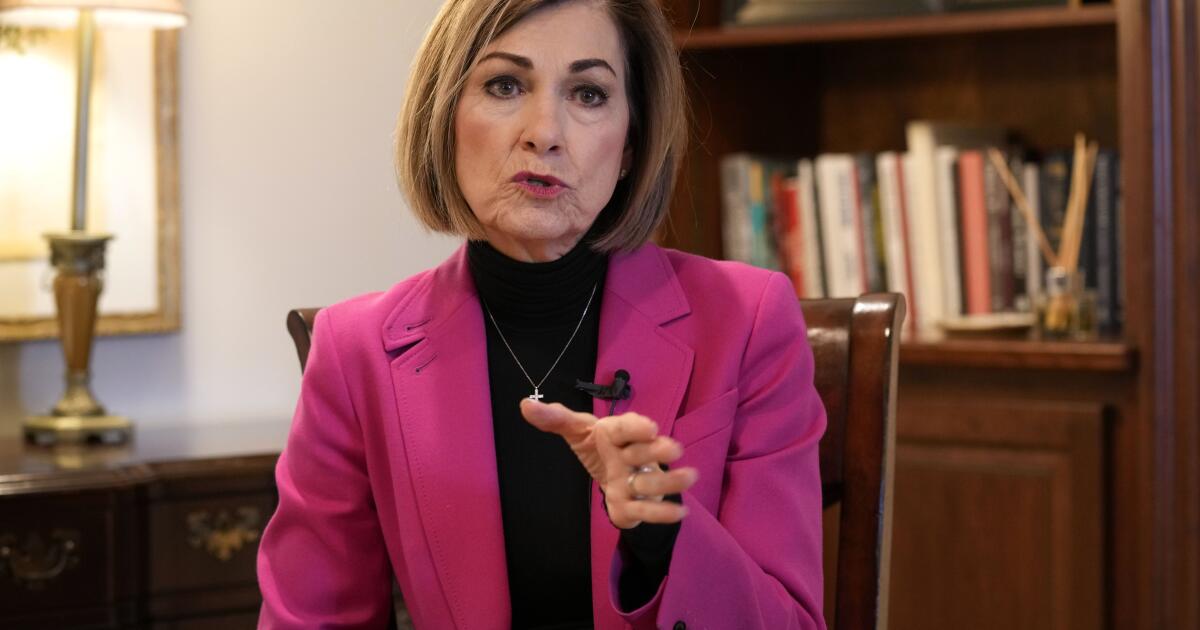
The governors didn’t see it that way. Here’s how Iowa Gov. Kim Reynolds justified her decision to reject the federal subsidy for low-income Iowans: “Federal COVID-era cash benefit programs are not sustainable and don’t provide long-term solutions for the issues impacting children and families.”
Nebraska Gov. Jim Pillen’s explanation was, “I don’t believe in welfare.”
Both governors said their states already had programs in place to address food needs for low-income families, and that was enough.
It’s worth noting that the explanations by both Reynolds and Pillen are fundamentally incoherent. What does Reynolds even mean by calling the program “not sustainable”? It would be sustained as long as Congress continues to fund it, which is almost certain as long as Republicans don’t take control of both houses and kill it.
As for Pillen’s crack about “welfare,” he didn’t bother to explain what he believes is wrong with “welfare” as such; he just uttered the term knowing that it’s a dog whistle for conservative voters aimed at dehumanizing the program’s beneficiaries.
What makes these governors’ refusals so much more irresponsible is that the federal government is picking up 100% of the tab for the benefits; the states only have to agree to pay half the administrative costs. Their shares come to $2.2 million in Iowa and $300,000 in Nebraska, according to those states’ estimates.
In return, 240,000 children in Iowa would receive a total of $28.8 million in benefits over the three summer months, and 150,000 Nebraskans would receive a total of $18 million. Sounds like a massively profitable investment in child health in those states.
The governors’ defenses smack of the same strained plausibility of those statements made by banks, streaming networks and other commercial entities that explain that their price hikes and service reductions are “efforts to serve you better.”
The politicians are asserting that they’re doing their taxpayers a big favor by watching eagle-eyed over their state expenditures, without mentioning how much they’re giving up to show themselves as budget hawks — or how many citizens will suffer in the process.
Reynolds’ defense of her action was particularly fatuous. “An EBT card does nothing to promote nutrition at a time when childhood obesity has become an epidemic,” she said.
Not only is there no evidence that family food purchases under this or any other federal program promote obesity, the truth is just the opposite. It’s universally accepted among poverty and nutrition professionals that food insecurity, which is rampant among low-income families, increases obesity rates.
Iowa and Nebraska may not be the only red states turning down the summer food program. By the Jan. 1 deadline to accept the program, 30 states had done so, including at least nine red states. But the list published by the Department of Agriculture may not be complete as of this writing. Iowa and Nebraska, however, are the only two states that have announced their opposition publicly.
The governors’ announcements drew immediate fire from anti-poverty advocates.
“Announcing three days before Christmas that we’ve deliberately chosen not to feed hungry kids? The Dickensian parallels write themselves,” said Luke Elzinga, chair of the Iowa Hunger Coalition.
These aren’t the only cases in which Republican state administrations have visited what we might call the GOP death wish upon their residents.
In 10 states, Republican governors or legislatures (or both) have blocked the expansion of Medicaid for low-income residents under the Affordable Care Act for a decade, even though the federal government picks up 90% of the benefit costs. Kansas Gov. Laura Kelly, a Democrat, has tried to implement the program in her state, but the Republican-controlled Legislature has refused to provide money for the expansion in the state budget.
Nebraska did not implement Medicaid expansion until 2020, only after voters demanded the expansion through a ballot-box measure in 2018. (Iowa accepted it upon its introduction in 2013, effective the following Jan. 1, under Republican Gov. Terry Branstad.)
The hostility of red-state political leaderships to public health measures also is evident from their records on COVID treatments, especially vaccines. COVID death rates have consistently tracked the level of the Trump vote in the 2020 election: The COVID death rate in the reddest counties (i.e., those with the largest percentage of Trump votes) is nearly three times that of the bluest counties.
COVID vaccination rates are a mirror image of the same trend: Counties that Trump won have lower vaccination rates than those that went for Biden in 2020, surely a reflection of the efforts by conservative Republican political leaders to deliberately undermine confidence in the vaccine and block vaccine mandates.
Efforts to roll back child labor laws, especially to allow children to work in hazardous conditions, have been on the rise, particularly in red states. In May, Iowa’s Gov. Reynolds signed one of the most extreme rollbacks in the country.
The new law allows employers to hire children as young as 14 to work in industrial laundries or factories; for kids aged 16 and 17 to do demolition, roofing, excavation and power-driven machine operation, all of which were previously prohibited; and to allow teens as young as 14 to work shifts as long as six hours during the school year, among other changes. Most of these changes violate federal law, the Dept. of Labor advised the Iowa Legislature. They passed anyway.
Of the 10 states that passed rollbacks of child labor protections in 2021-2023 as tracked by the union-affiliated Economic Policy Institute, seven were Republican-controlled.
The announcements by Reynolds and Pillen seem almost tailor-made to validate the adage that for Republicans, “life begins at conception and ends at birth.” Iowa and Nebraska are antiabortion states.
Iowa requires a 24-hour wait time to receive an abortion, bans coverage by state Medicaid and requires parental consent for a minor’s abortion. Nebraska is much more restrictive. Abortion is banned at 12 weeks or later, Medicaid coverage and coverage by private health plans are banned, and medication abortion (that is, by pills) must be provided in-person because mailing pills to patients is prohibited.
In other words, despite making it harder for women to terminate unwanted or dangerous pregnancies, both states make it harder for low-income mothers to care for their children. Catch-22 doesn’t begin to explain how these policies are meant to act together to “make a real commitment to family well-being,” in Reynolds’ words.



John Thune blasts Democrats’ DHS shutdown demands
Senate Majority Leader John Thune accuses Democrats of playing politics with the DHS shutdown, explaining how the Senate passed a bill to fund most agencies. He also addresses President Donald Trump’s remarks on rising gas prices.
NEWYou can now listen to Fox News articles!
A party-line tactic to ram legislation through Congress and bypass the Senate filibuster has become a dumping ground for Republicans’ legislative priorities throughout the year.
Now, as Democrats refuse to fund immigration operations, Republicans are once again readying a budget reconciliation package. The hard part will be getting enough of the GOP on the same page to craft a bill that can pass and survive the strict rules underpinning the process.
Republicans used the same process to pass President Donald Trump’s “big, beautiful bill” last year. It’s a time-consuming, labor-intensive legislative maneuver that nearly blew up and could fail unless both the Senate and House align on what exactly they want to include.
SENATE PASSES BILL TO FUND MOST OF DHS AFTER HOUSE GOP CAVES
President Donald Trump answers questions from reporters after signing an executive order in the Oval Office of the White House Tuesday, March 31, 2026, in Washington. (Alex Brandon/AP Photo)
Trump officially backed using reconciliation again this week as a way to skirt Democrats’ refusal to fund Immigration and Customs Enforcement (ICE) and Customs and Border Protection (CBP), as Congress inches closer to ending the ongoing Department of Homeland Security (DHS) shutdown.
Trump demanded that Republicans get the bill on his desk by June 1.
“We are going to work as fast and as focused as possible to replenish funding for our Border and ICE agents, and the Radical Left Democrats won’t be able to stop us,” Trump said on Truth Social.
Still, Republicans have viewed reconciliation as a vehicle to tackle fraud, affordability, Trump’s tariff authorities, additional tax provisions, healthcare, funding for the Iran war, supplemental agriculture spending, and election integrity measures in the months since passing the “big, beautiful bill.”
DHS SHUTDOWN BREAKTHROUGH COMES AT COST FOR REPUBLICANS AS FUNDING FIGHTS NEARS END
Senate Majority Leader John Thune, R-S.D., said Republicans need to “keep our expectations realistic.” (Stefani Reynolds/Bloomberg via Getty Images)
Senate Majority Leader John Thune, R-S.D., has warned that if reconciliation is going to work — especially given the limited timeframe lawmakers have to start and finish the process — Republicans need to “keep our expectations realistic.”
“Our theory of the case behind all this was to keep that thing as narrow and focused as possible, and that maximizes the speed at which we can do it and the support for it,” Thune said.
“There will probably be some attempts to add things,” he continued. “There are things out there that, obviously, many of us are interested in. But on a reconciliation vehicle like this — which we need to move with haste, as the president has pointed out — it’s probably not a likely magnet for all these other issues.”
Senate Budget Committee Chair Lindsey Graham, R-S.C., told voters at an event this week in South Carolina that he is eyeing two new reconciliation packages, which could ease concerns about cramming all the GOP’s priorities into one massive bill.
GOP RAILS AGAINST ‘S— SANDWICH’ DEAL AS ALL EYES TURN TO HOUSE TO END DHS SHUTDOWN
Sen. Lindsey Graham, R-S.C., walks to the Senate chamber for votes after meeting behind closed doors with fellow Republicans on the Homeland Security budget stalemate, at the Capitol in Washington, March 26, 2026. (J. Scott Applewhite/AP Photo)
“We want to do it quick — ICE, Border Patrol — fund it as much as you can, multi-year,” Graham said. “Then there’s another one coming. I just made news. There’s another one coming in the fall, and that’s going to be about going after fraud.”
House Republicans spent their recent policy retreat earlier this year pushing a so-called “reconciliation 2.0,” gearing up to load the package with several provisions that could drain time and struggle to earn support in the Senate — where strict guidelines could kill proposals entirely if they don’t comply with the rules.
The Republican Study Committee (RSC), which has long called for a second reconciliation bill, also wants to add proposals addressing affordability concerns.
“We support pursuing funding for military readiness and Homeland Security through this legislative process, while simultaneously codifying the president’s agenda to deliver lower costs for working families,” the RSC Steering Committee said in a statement to Fox News Digital.
Some Republicans are also pushing to include the latest policy fight: the Safeguarding American Voter Eligibility (SAVE) Act. The voter ID and citizenship verification legislation has no chance of passing the Senate given unified Democratic opposition.
CLICK HERE TO DOWNLOAD THE FOX NEWS APP
It’s also unlikely to survive the Senate’s reconciliation rules, which allow only provisions that directly impact spending.
“I think we have to set our sights a little bit lower on this reconciliation bill,” Sen. Roger Marshall, R-Kan., told Fox News Digital. “It’s got to be targeted to fund ICE for 10 years — I think that’s the number one thing for us. If we can nibble at the edges of the SAVE Act, that would be great, but the parliamentarian is not going to let us do the SAVE Act. That’s just an impossibility.”
Some of the loudest proponents of the bill in the House GOP acknowledge that adding the SAVE Act to reconciliation would be a challenge — largely because they would prefer to keep the bill intact and push it through the Senate.
“Look, it’s time for them to do a walk-and-talk and filibuster, and let’s make this thing happen,” Rep. Ralph Norman, R-S.C., said. “The American people are watching — piecing it together just to try to get a piece.”

President Trump endorsed conservative commentator Steve Hilton for California governor late Sunday night.
The endorsement could have a major impact on a race that remains up for grabs, with recent opinion polls showing Hilton and his top Republican rival, Riverside County Sheriff Chad Bianco, as top contenders in the 2026 contest.
“He is a truly fine man, one who has watched as this once great State has gone to Hell,” Trump posted on Truth Social, adding that he has known Hilton for many years.
Trump in his endorsement praised Hilton while attacking the record of California Gov. Gavin Newsom, using a derogatory name for the governor. Newsom is serving the last year of his final term as governor as he weighs running for president in 2028.
“Gavin Newscum and the Democrats have done an absolutely horrendous job. People are fleeing, crime is increasing, and Taxes are the highest of any State in the Country, maybe the World. Steve can turn it around, before it is too late, and, as President, I will help him to do so! With Federal help,” Trump said.
Hilton’s campaign called the president’s endorsement “powerful.”
“Thank you, Mr. President!” his campaign posted on the social media platform X. “This is the moment California has been waiting for!”
Despite California’s solidly Democratic electorate, a recent poll by UC Berkeley’s Institute of Governmental Studies and co-sponsored by the Times found Hilton and Bianco leading the crowded field of candidates just months before the June 2 primary — leading to the possibility of Democrats being shut out of a November election that will determine California’s next governor. The crowded field of Democrats in the race has splintered their party’s voters, providing an opening for the Republicans, the poll showed.
Under the state’s top-two primary system, the top two candidates advance to the general election, regardless of their party affiliation.
If Trump’s endorsement leads to California Republican voters coalescing behind Hilton, severely damaging Bianco’s campaign, that likely would reduce the odds of two GOP candidates finishing in first and second place in the primary.
In California’s 2018 governor’s race, Trump’s endorsement of Republican businessman John Cox helped cement him as the GOP frontrunner and led to his second place finish in the primary election. That propelled Cox to the general election, where he was trounced by Newsom.
Trump’s endorsement came the day after Hilton and Bianco squared off in a testy debate in Rancho Mirage that was moderated by Richard Grenell, Trump’s former ambassador to Germany, and days before the state GOP meets in San Diego to consider an endorsement in the race.
On Saturday, Bianco said he suspected that Trump would weigh in on the race and that his team had been in talks with the president’s advisors.
“Of course, I would want him to support me. He’s the president of the United States,” Bianco said in an interview.
Hilton on Saturday questioned whether the president would weigh in on the race.
“I’ve said that I’d be honored to have the President’s endorsement. I think that the California Governor’s race is pretty low on his [agenda] right now,” he said in an interview. “I haven’t asked for that, and I’m not expecting him to weigh in.”
Jon Fleischman, the former executive director of the California Republican Party, wrote on Substack late Sunday that he believes that Trump’s endorsement will significantly boost Hilton’s support among GOP voters.
“This Timing Is Not Accidental,” he wrote, noting that it was previously unclear whether either candidate could receive the 60% of delegate votes to secure the party nod at its upcoming convention. “Well, obviously this endorsement from the President for Hilton will supercharge his momentum going into the weekend convention”

NEWYou can now listen to Fox News articles!
Tax season is stressful enough, but avoidable mistakes can turn a routine filing into an expensive headache.
With Tax Day just 10 days away, even small errors can mean the difference between a smooth refund and frustrating delays. In some cases, they can even trigger IRS notices or unexpected penalties.
Here are five common filing missteps to watch out for and how to avoid them:
1. Choosing the wrong filing status
Tax scams have evolved from unemployment fraud to social media “tax hacks,” with the IRS warning of new threats for the 2026 filing season. (Michael Bocchieri/Getty Images)
Your filing status is one of the most important choices on your tax return because it helps determine your tax rate, your standard deduction and which credits you may be eligible to claim. Pick the wrong one, and you could end up paying more than you owe, getting a smaller refund or triggering delays if the IRS flags the return for review.
For many taxpayers, the confusion comes from life changes that happened during the year, like getting married or divorced, having a child, moving in with a partner, supporting an aging parent or sharing custody. Even if your situation feels straightforward, the IRS rules can be less intuitive, especially for taxpayers who aren’t sure whether they qualify as “head of household” or whether they can still file as “qualifying surviving spouse” after a spouse has died.
RETIRED? HERE’S WHEN THE IRS MIGHT TAKE A CLOSER LOOK AT YOUR FINANCES
Head of household, in particular, can be costly to get wrong. It typically comes with a larger standard deduction and more favorable tax brackets than filing as single – but it has strict requirements tied to paying more than half the cost of keeping up a home and having a qualifying dependent. If you don’t meet the rules and claim it anyway, you may have to pay back tax benefits later, plus penalties and interest.
When in doubt, the IRS has an online filing-status tool, and many tax software programs will walk you through the questions to help you choose the right category.
2. Leaving credits on the table
A woman preparing her taxes. (Kurt “CyberGuy” Knutsson)
One of the biggest and most expensive tax-season mistakes is failing to claim every credit or deduction you qualify for. That can mean a smaller refund or a higher bill.
“I think the top mistake people make is not fully understanding or taking the time to really research what are all the different deductions and the ways that you can put a little bit of extra money in your pocket that are available to you,” said Bill Sweeney, senior vice president of government affairs at AARP.
AVERAGE TAX REFUND TOPS $3,700 MIDWAY THROUGH FILING SEASON, TREASURY SAYS
Sweeney also warned taxpayers not to rely on last year’s return as a blueprint for filing because of recent changes to the tax code from the One Big Beautiful Bill Act.
“This would be a good year given that there are these changes to the tax code, to make sure not to assume that what you did last year will convey over to this year. Really take a fresh look at your tax situation and see if there’s money that you’re leaving on the table,” he said.
3. Missing key deadlines
A couple is seen going over tax paperwork. (iStock)
An extension can buy you time to file your paperwork, but it doesn’t give you extra time to pay. For most taxpayers, the IRS deadline to pay what you owe is April 15, 2026 – even if you request an extension to file later.
“Remember that even if you claim an extension, the money is owed on April 15,” said Mike Faulkender, co-chair of American Prosperity at the America First Policy Institute.
WHAT TRUMP’S NEXT PICK TO LEAD THE FEDERAL RESERVE MEANS FOR YOUR WALLET
Faulkender, a former Treasury official and IRS commissioner, said taxpayers who need more time should still estimate their bill and pay by the filing deadline to help avoid added costs.
“You have to actually send in a check or have the payment deducted from your account by the filing deadline,” he said.
If you can’t pay in full by April 15, pay what you can to help limit penalties and interest on top of your tax bill.
4. Entering bank account details incorrectly
If you choose direct deposit for your refund, the IRS relies on the routing and account numbers you provide. One wrong digit can lead to delays.
If you pay what you owe by direct debit, incorrect banking details can also lead to a rejected payment and potentially result in penalties and interest.
5. Filing before all your tax forms arrive
Timing matters when it comes to filing your taxes. Submitting your return before you’ve received all your key paperwork, like W-2s or 1099s, can lead to errors, missing income or a return you have to amend later.
Faulkender said there’s a simple way to double-check what’s been reported under your name before you file.
CLICK HERE TO DOWNLOAD THE FOX NEWS APP
“One of the things that I learned last year when I was IRS commissioner, was that if you create an account on irs.gov, you can see everything that’s been filed under your tax ID,” he said.
“We’re supposed to receive all of our W-2s and our 1099 forms in the mail in January and February. But if you’re missing one, or you misplaced it rather than requesting it again, you can actually go and see what was filed under your taxpayer identification number if you create an account on IRS.gov.”
Filing late can also cost you extra money, especially if you owe. The goal is to wait until you have what you need, then file as soon as you’re ready.

Iowa State basketball names veteran Tim Buckley as new assistant coach

Kansas City Chiefs heiress Gracie Hunt gets engaged to ex-NFL player’s son

Our top 5 Kentucky Derby contenders as Run for the Roses 2026 nears

Louisiana closed primary system raises voter questions ahead of May 16 election

This Maine Restaurant’s Lobster Roll Is 3 Feet Long… Yes, Really!

Florida High School Football Rankings: Top 25 teams – Oct. 21

How old is Bo Nix? What to know about Oregon quarterback ahead of 2024 NFL Draft

Cleary's 21 help Le Moyne down Central Connecticut State 69-64 in OT

99th annual Pony Swim held in Virginia

Indiana Members Credit Union announced as new anchor tenant at Bottleworks District

GOP races to pass ICE, Border Patrol funding bill as priorities pile up, divisions emerge
Jet fuel crisis: Rationing triggered at four airports in Italy

NASA’s Artemis II crew readies for Monday’s lunar flyby. Here’s what you need to know

Tax day is next week: Avoid these 5 common mistakes that can cost you money

Hamas armed wing says disarmament demands not acceptable
-

 South-Carolina1 week ago
South Carolina vs TCU predictions for Elite Eight game in March Madness
-

 Atlanta, GA1 day ago
1 teenage girl killed, another injured in shooting at Piedmont Park, police say
-

 Vermont1 week ago
Skier dies after fall at Sugarbush Resort
-

 Movie Reviews4 days ago
Vaazha 2 first half review: Hashir anchors a lively, chaos-filled teen tale
-

 Politics1 week ago
Trump’s Ballroom Design Has Barely Been Scrutinized
-
 Entertainment4 days ago
Inside Ye’s first comeback show at SoFi Stadium
-

 Atlanta, GA1 week ago
Fetishist ‘No Kings’ protester in mask drags ‘Trump’ and ‘JD Vance’ behind her wheelchair
-

 Politics1 week ago
JD Vance says he was ‘obsessed’ with UFOs, believes aliens are actually ‘demons’