Politics
Column: A lesson from Presidents Biden and Trump — the new normal is nonstop crises

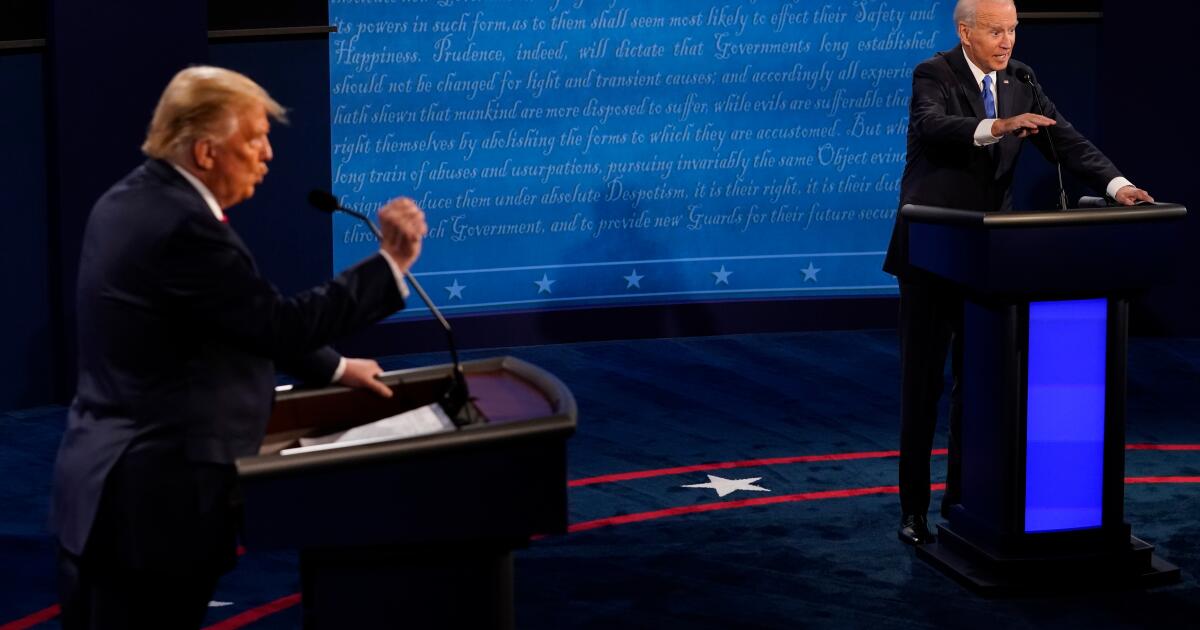
A poll published by the Economist this month included a finding that was striking yet unsurprising: Almost 7 in 10 Americans believe things in the country have spun out of control.
That’s a problem for President Biden, who campaigned in 2020 offering a return to normalcy after four years of chaos under Donald Trump.
Biden promised, in effect, to Make America Normal Again, but “normal” never quite returned. The COVID-19 restrictions ended, but the ensuing recovery brought high prices and rising mortgage rates. Wars broke out in Ukraine and Gaza; protests erupted on college campuses. And domestic politics remained bitterly polarized; the bipartisan unity Biden promised to engineer remained out of reach.
“People are reeling from the sense that we can’t get going in the right direction,” said Celinda Lake, one of Biden’s top pollsters, relating sentiments from voters in focus groups. “They’ve been shocked by events they never expected: Afghanistan, the war in Ukraine, Gaza, even the wildfires in Maui and the collapse of the bridge in Baltimore.”
Unsurprisingly, Trump has responded by blaming Biden for everything and anything that goes wrong, from surges in illegal immigration to wars overseas.
“If I was president, [the Oct. 7] Hamas attack on Israel would never have happened, the war in Ukraine would never have happened, and we would right now have peace throughout the world,” Trump wrote on his social media account, an alternative history that — lucky for him — can neither be proved nor disproved.
The combination of adverse events and Republican attacks has taken a predictable toll on Biden’s image. The Economist poll found that 58% of Americans consider Trump a strong leader, but only 36% see Biden as strong. Biden scores higher on other qualities; most voters see him as more honest and more likable than Trump. But those attributes may not be as important to voters in an era of instability.
“When people feel uncertainty or anxiety, they are looking for strong leaders,” said Doug Sosnik, a political aide to President Clinton during his 1996 reelection campaign. “Trump’s narrative, plain and simple, is … to portray Biden as weak. If that’s what the election is about, Trump will win.”
The pro-Palestinian protests on college campuses, Sosnik added, “are reinforcing Trump’s existing narrative.”
Despite Trump’s claims, Biden can’t really be blamed for the wars in Ukraine or Gaza, much less wildfires or bridge disasters. Whether he should be blamed for inflation is up for debate, although inflation in the U.S. has been lower than in most other countries.
Still, in an era of economic and political volatility, the new normal is that there is no normal. And that makes every incumbent vulnerable to bad news on his watch.
Case in point: Donald Trump in 2020.
Four years ago, amid a pandemic, a recession and the discord that followed George Floyd’s murder by police, many voters blamed Trump — if not for causing the crises, at least for mismanaging them.
In a July 2020 Economist poll, 80% of Americans said they thought things in the country had spun out of control.
That’s why many voters swung to Biden, hoping he could end the chaos and restore order.
But some scholars have concluded that incumbency, once considered an advantage for a president seeking reelection, has increasingly become a burden — mainly because in an era of polarized politics, presidents get less deference from voters on the other side.
“In the past, Democratic voters might sometimes rally around a Republican president … and Republican voters might sometimes support a Democratic president,” political scientist Lee Drutman of the New America think tank wrote recently. Now, he added, “there is simply nothing Joe Biden could ever do” to win support from GOP voters.
“No national political figure is nationally popular,” he added. “This is part of Biden’s problem. It’s not just about his age, or the economy, or his foreign policy.”
Despite voters’ sour mood, Biden and Trump appear evenly matched in most recent national polls. But two factors could move those numbers before election day.
One is the focus of the campaign. So far, it has largely been a referendum on Biden’s record. But the president and his campaign are trying to shift the lens toward Trump, turning the election into a “dual referendum” on both candidates.
“Remember when he told us, literally, inject bleach?” Biden said at a campaign stop last month, referring to one of Trump’s most memorable moments during the pandemic. (In fact, Trump didn’t tell anyone to inject bleach; during a White House news conference, he asked aides to investigate whether it would be an effective therapy.)
In another appearance, Biden said Trump was “mentally unfit to be president.”
The other factor, of course, is events. A cease-fire in Gaza, a continuing decline in illegal immigration, a Federal Reserve decision to cut interest rates or a conviction of Trump in any of his four pending criminal cases could help Biden. A new spike in inflation, an upsurge of migrants, or riots at the Democratic National Convention in Chicago could boost Trump.
But neither candidate can credibly promise to deliver “normalcy” anymore. No matter who the next president is, voters will soon be disappointed that he didn’t return life to normal.


NEWYou can now listen to Fox News articles!
Rep. Diana DeGette, D-Colo., a 30-year incumbent, lost to a Democratic Socialists of America (DSA)-backed challenger in a high-profile primary on Tuesday evening.
Melat Kiros, a 29-year-old socialist, defeated DeGette in a Democratic primary for a deep-blue House seat anchored in Denver, according to The Associated Press, scoring a major victory for the socialist left on Tuesday evening.
The DSA had been aiming to cast DeGette’s loss as evidence of its growing momentum after a slate of socialist candidates won Democratic primaries in New York City last week.
“Today, the East Coast, next week the Mountain West,” the DSA wrote in a social media post last week.
Rep. Diana DeGette speaks during a press conference outside the U.S. Capitol building in Washington, D.C., on Jan. 10, 2024. (Samuel Corum/Getty Images)
SOCIALISTS CHEER ‘SHOCKWAVE’ PRIMARY NIGHT AS DSA-BACKED CANDIDATES WIN, ADVANCE ACROSS THE MAP
If elected in November, Kiros, who was born in Ethiopia, will likely join the ranks of the far-left group known as the Squad and become one of a handful of the House chamber’s outspoken socialists.
The millennial challenger was endorsed by Sen. Bernie Sanders, I-Vt., Rep. Alexandria Ocasio-Cortez, D-N.Y., and the anti-incumbent leftist organization Justice Democrats. Controversial socialist streamer Hasan Piker, who has said Hamas is “a thousand times better” than Israel and praised the Chinese Communist Party, also backed Kiros’ insurgent primary run.
DeGette, a member of the Congressional Progressive Caucus who supports abolishing Immigration and Customs Enforcement (ICE), sought to win a 16th House term by flexing her leftist bona fides. She argued her seniority on an influential House committee would allow her to push for Medicare-for-All legislation — a longtime priority of the party’s far-left flank.
DeGette, who was endorsed by former CPC Chairwoman Pramila Jayapal, D-Wash., also spotlighted her experience as an impeachment manager during Trump’s second impeachment trial in 2021.
Though DeGette and Kiros shared few policy disagreements, they diverged sharply over Israel and antisemitism. Kiros also sharply criticized DeGette for accepting corporate PAC contributions.
Kiros, a PhD student and lawyer, was fired from a New York firm in 2023 after publishing an open letter, arguing that pro-Palestinian student protesters calling for the elimination of Israel were not antisemitic and appearing to defend Hamas.
Melat Kiros participated in a League of Women Voters Congressional District 1 candidate forum at Montview Presbyterian Church in Denver on May 28, 2026. (RJ Sangosti/MediaNews Group/The Denver Post)
WATCH: HOUSE DEMS UNLOAD ON TEXAS DEMOCRAT OVER ‘DEMENTED’ ANTISEMITIC COMMENTS
She has also described the Oct. 7, 2023, attacks against the Jewish state as the “inevitable consequence of apartheid” and declined to characterize the deadly firebombing of protesters in Boulder last year who were urging the release of hostages held by Hamas in Gaza as antisemitic.
“I don’t know what was in the heart of the perpetrator,” Kiros told Colorado’s 9News in a recent television interview. “All I know is that he went and attacked innocent people because of what they might have believed.”
A June 2025 bipartisan resolution condemning the attack as part of a “rise in ideologically motivated attacks on Jewish individuals” won every present lawmaker’s support, except for Reps. Rashida Tlaib, D-Mich., and Thomas Massie, R-Ky., who voted present.
Kiros has also suggested the United States deserved 9/11.
“Inevitable in the sense that we destabilized a lot of the Middle East that forced people to believe that another act of violence was the only response,” Kiros told 9News when asked if she thought the terror attack was “the inevitable consequence of American foreign policy.”
“And again, just like I said before, our responsibility is to get rid of those conditions that lead to violence in the first place,” Kiros continued.
DeGette argued that Kiros’ embrace of Piker and her comments about antisemitism and 9/11 were disqualifying.
“I’m shocked and disgusted that Kiros is doubling down on excusing terrorism and the murder of innocent people,” the 30-year incumbent wrote on Facebook earlier this month.
Streamer and creator Hasan Piker speaks at a press conference during day two of Web Summit Vancouver at the Vancouver Convention Centre in Vancouver, Canada, on May 13, 2026. (Sam Barnes/Web Summit via Sportsfile via Getty Images)
CLICK HERE TO DOWNLOAD THE FOX NEWS APP
Colorado’s 1st Congressional District is the most liberal seat in the state and voted for former Vice President Kamala Harris by 56 points in 2024.
The primary fight was further scrambled by University of Colorado Regent Wanda James, also running for DeGette’s seat. Though James did not pose the same threat as Kiros, her vote share could ultimately have swayed the contest.

Gov. Gavin Newsom has signed off on a 100% state tax on money any Californians receive from Trump’s $1.8-billion “anti-weaponization” fund for his political allies.
Newsom unveiled his proposal in May, after Trump’s Justice Department said it would create a fund to compensate Trump’s allies who claim they have “suffered weaponization and lawfare” under Biden’s Justice Department.
The settlement fund was criticized by politicians on both sides of the aisle, including Sen. Mitch McConnell (R-Ky.), who described it as a “slush fund to pay people who assault cops.”
The fund remains in legal limbo. Earlier this month, a federal judge in Virginia extended a court-ordered block on the plan, which critics warned could be used to pay pardoned Jan. 6 rioters.
Fast-tracked into law as part of Senate Bill 122, Newsom’s plan imposes “a tax on any settlement fund payment from the federal Anti-Weaponization Fund, or any subsequent fund, settlement, or agreement, as provided, at a rate of 100%,” according to the bill text. The tax applies to all tax years between 2026 and 2030.
Newsom signed the bill Tuesday. In a statement, his office said the tax is meant to ensure that, should Trump’s fund proceed, California recipients won’t “receive favorable state treatment on those payments.”
“We believe democracy is worth defending, the rule of law matters, and public dollars should support victims—not those who attacked the very institutions that protect our freedoms,” Newsom said in the statement.
University of Southern California law professor Ariel Jurow Kleiman, an expert on tax law and policy, said that while Newsom’s tax is a “novel legal strategy,” she believes there is “no categorical legal restriction” preventing California from implementing it.
States have a “wide degree of discretion” to design their tax systems — including how they define income — so long as they do not violate their constitutions, Jurow Kleiman said.
If a California resident wanted to challenge the tax in court, they would need to show they were harmed by it to have standing to sue, according to Jurow Kleiman. That would mean receiving a payment from Trump’s settlement fund and then paying the 100% California tax. Unless the settlement fund is established and distributes payments, that scenario is unlikely.
While there have been proposals to levy a 100% tax on income above certain thresholds — Sen. Bernie Sanders (I-Vt.) in 2023 said he supports a 100% tax on income exceeding $1 billion — Jurow Kleiman said she is not aware of any governments that have adopted such a policy.

NEWYou can now listen to Fox News articles!
The House has officially shipped a colossal bipartisan housing package to President Donald Trump, and lawmakers are hoping that, at the very least, he doesn’t veto it.
Trump was supposed to sign the 21st Century ROAD to Housing Act last week, but his last-minute decision to ghost the signing ceremony with House Speaker Mike Johnson, R-La., and Senate Majority Leader John Thune, R-S.D., put into question whether the bill was dead.
His refusal to sign the bill, which passed with overwhelmingly bipartisan support in both chambers, was to leverage the Safeguarding American Voter Eligibility (SAVE) America Act, which doesn’t currently have the votes to succeed in the Senate.
WARREN TELLS TRUMP TO ‘SIGN THE DAMN BILL’ AS BIPARTISAN HOUSING PACKAGE REMAINS STALLED IN WASHINGTON
Trump has refused to sign the 21st Century ROAD to Housing Act. (Shawn Thew/EPA/Bloomberg via Getty Images)
Trump appears to be in no hurry to sign the bill, despite Republicans who are hungry for a win in the affordability fight ahead of the midterm elections.
“It’s so unimportant … compared to the SAVE America Act,” Trump told reporters in the Oval Office on Monday. “I think the SAVE America Act is exactly what it says. It’s saving America from crooked elections.”
“Here’s what I would like to sign, much more than a bill that — big deal, it’s a yawn,” he continued. “Some people say it’s wonderful. To me, compared to the SAVE America Act, just about everything is a big yawn.”
GOP INFIGHTING OVER TRUMP’S VOTER ID BILL ERUPTS AS TOP SENATOR CALLS STRATEGY ‘FANTASY’
It’s legislation that is loaded with nearly 60 provisions from both sides of the aisle in both chambers that’s designed to make it easier for homes to be built and for younger Americans to buy their first home. It also includes a ban on hedge funds buying up housing stock that Trump pushed Congress to include during the State of the Union earlier this year.
Sen. Elizabeth Warren, D-Mass., one of the architects behind the bill in the upper chamber alongside Sen. Tim Scott, R-S.C., charged that Congress handed the bill to Trump “on a silver platter.”
“When you ask me what happens next, if he cared about the American people, he’d have already signed the damned thing, and we’d be underway,” Warren said on WCVB’s “On the Record” on Sunday.
But Trump doesn’t have to put his signature on the bill for it to become law.
IRATE REPUBLICANS ACCUSE TRUMP OF HANDING DEMOCRATS A WIN AFTER BLOWING UP HOUSING PACKAGE
The Senate advanced a massive, Trump-backed housing package geared toward lowering the costs of homes and supercharging the housing supply. Sen. Elizabeth Warren, D-Mass., pitched it as legislation to prevent America from becoming a “nation of renters.” (Jemal Countess/Getty Images for Protect Borrowers; Anna Moneymaker/Getty Images)
The Constitution grants presidents the ability to veto a bill within 10 days of it being transferred over to the White House. In that scenario, Congress could override a veto of the housing package.
It’s happened before under the Trump administration. In early 2021, Congress overrode Trump’s veto of the annual National Defense Authorization Act — a massive Pentagon funding authorization package that some House Republicans are trying to use as a vehicle to pass the SAVE America Act.
But during that 10-day period, if Trump doesn’t sign the bill, it would automatically become law. That’s unless Congress completely adjourns, in which case a “pocket veto” could happen. The Senate is currently in recess and the House is scheduled to leave town by week’s end, but neither count as a full adjournment.
CLICK HERE TO DOWNLOAD THE FOX NEWS APP
Johnson, who spent the last few days meeting with Trump at the White House about the housing bill and the SAVE America Act, said: “I hope he does sign it.”
“If he doesn’t, it’s still law,” Johnson said. “We’ll still celebrate it, but he’s trying to make a point, and I think he’s making it very effectively. And the fact that you all ask me every three steps down the hallway illustrates that he has achieved the desired objective, and that is to make SAVE America the number one thing, because if we don’t get that right, everybody’s concerned about what happens next.”
-

 Atlanta, GA5 minutes ago
Conference offers safe space for gay men to unpack the stigmas, challenges of adoption and surrogacy
-

 Minneapolis, MN8 minutes ago
Westbound I-94 reopens in Minneapolis after fatal crash
-

 Indianapolis, IN13 minutes ago
Edwards Checks Out At Indianapolis – SPEED SPORT
-

 Pittsburg, PA14 minutes ago
Analysis: Here’s why the Pittsburgh Symphony’s budget just jumped by $7 million to $42 million
-

 Augusta, GA20 minutes ago
Augusta’s role in the American Revolution: An underdog story 250 years in the making
-

 Washington, D.C23 minutes ago
Looking for indoor July 4 plans in DC? Try these America250 exhibits
-

 Cleveland, OH28 minutes ago
Rangers capitalize on costly Guardians mistake, extend winning streak to six
-

 Austin, TX35 minutes ago
Apptronik opens robot training hub in Austin, Texas and debuts Apollo 2

