Politics
Challenges to Pelosi part of broader movement to replace the Democratic Party’s old guard


SAN FRANCISCO — State Sen. Scott Wiener couldn’t wait any longer. The once-in-a-generation political opening he’d eyed for years had arrived, he decided — whether the grand dame of San Francisco politics agreed or not.
On Wednesday, Wiener, 55, a prolific and ambitious lawmaker, formally announced his candidacy for the San Francisco congressional seat held for nearly four decades by Rep. Nancy Pelosi, 85, who remains one of the party’s most powerful leaders and has yet to reveal her own intentions for the 2026 race.
“The world is changing, the Democratic Party is changing, and it’s time,” Wiener said in an interview with The Times. “I know San Francisco, I have worked tirelessly to represent this community — delivering housing, health care, clean energy, LGBTQ and immigrant rights — and I have a fortitude and backbone to be able to deliver for San Francisco in Congress.”
State Sen. Scott Wiener (D-San Francisco) announced Wednesdat that he will run for the congressional seat currently held by former Speaker Nancy Pelosi.
(Josh Edelson/For The Times)
Wiener’s announcement — which leaked in part last week — caught some political observers off guard, given Wiener had for years seemed resigned to run for Pelosi’s seat only once she stepped aside. But it stunned few, given how squarely it fit within the broader political moment facing the Democratic Party.
In recent years, a long-simmering reckoning over generational power has exploded into the political forefront as members of the party’s old guard have increasingly been accused of holding on too long, and to their party’s detriment.
Long-serving liberal Supreme Court Justice Ruth Bader Ginsburg ruffled many Democratic feathers by declining to step down during Barack Obama’s presidency despite being in her 80s. She subsequently died while still on the court at the age of 87 in 2020, handing President Trump his third appointment to the high court.
Californians watched as the late Sen. Dianne Feinstein, another D.C. power player from San Francisco, teetered into frailty, muddled through her final chapter in Washington and then died in office at 90 in 2023. The entire nation watched as President Biden, another octogenarian, gave a disastrous debate performance that sparked unrelenting questions about his age and cognitive abilities and cleared the way for Trump’s return to power last year.

Visitors walk past a bust of U.S. Sen. Dianne Feinstein at San Francisco City Hall. The former mayor of San Francisco served in the Senate until she died in 2023 at age 90.
(Stephen Lam/San Francisco Chronicle via Getty Images)
As a result, age has become an unavoidable tension point for Democrats heading into next year’s midterm elections.
It has also been an issue for Republicans, including Sen. Mitch McConnell (R-Ky.), 83, the former Senate majority leader who has faced health issues in recent years and is retiring in 2026 after more than 40 years in the Senate. Other older Republicans are facing primary challenges for being perceived as too traditional or insufficiently loyal to Trump or the MAGA movement — including Sen. John Cornyn (R-Tex.), 73 and in office since 2002, and Sen. Bill Cassidy (R-La.), 68 and in the Senate since 2015.
For decades, many conservatives have called for congressional term limits in opposition to “career politicians” who cling to power for too long. Florida Gov. Ron DeSantis, a Republican, and David Trone, a Maryland Democrat, renewed those calls on Wednesday, announcing in an op-ed published in the New York Times that they would co-chair a national campaign to push for term limits.
However, perhaps because they are in power, the calls for a generational shake-up in 2026 have not been nearly as loud on the Republican side.
Democratic Party activists have sounded the alarm about a quickening slide into gerontocracy on the political left, blamed it for their party’s inability to mount an energetic and effective response to Trump and his MAGA movement, and called for younger candidates to take the reins — while congressional leaders in their 70s and 80s have increasingly begun weighing their options in the face of primary challenges.
“It’s fair to say the political appetite for octogenarians is not high,” said Eric Jaye, a veteran Democratic strategist in San Francisco.
“The choice in front of people is not just age,” said Saikat Chakrabarti, a 39-year-old tech millionaire and Democratic political operative who is also running for Pelosi’s seat. “We need a whole different approach and different candidates.”
“There’s like this unspoken rule that you don’t do what we’re doing in this moment. You sit out and wait your turn,” said Sacramento City Councilmember Mai Vang, 40, who has launched a primary challenge to Rep. Doris Matsui (D-Sacramento), who is 81 and has been in Congress since 2005. “But I’m not going to wait on the sidelines, because there is an urgency of now.”
A national trend
The generational shift promises to reshape Congress by replacing Democrats across the country, including some who are leaving without a fight.
Sen. Jeanne Shaheen, 78 and a senator representing New Hampshire since 2009, said in March that it was “time” to step aside.
In Illinois, Sen. Richard Durbin, 80 and a senator since 1997, and Rep. Jan Schakowsky, 81 and in the House since 1999, both announced in May that they would not run again. Durbin said it was time “to pass the torch,” while Schakowsky praised younger “voices” in the party as “so sharp.”
Rep. Jerry Nadler of New York, 78 and in the House since 1992, announced his retirement last month, saying that “watching the Biden thing really said something about the necessity for generational change in the party.”

New York City mayoral candidate Zohran Mamdani speaks at a news conference.
(Michael Nagle/Bloomberg via Getty Images)
Other older Democrats, meanwhile, have shown no intention of stepping aside, or are seeking out new roles in power.
Maine Gov. Janet Mills, 77, recently announced she is running to challenge Republican Sen. Susan Collins, who is 72 and has been in the Senate since 1997. Mills has tried to soften concerns about her age by promising to serve just one term if elected.
Sen. Ed Markey of Massachusetts, 79 and in the Senate since 2013, has stiffly rebuffed a primary challenge from Rep. Seth Moulton, 46, accusing Moulton of springing a challenge on him amid a shutdown and while he is busy resisting Trump’s agenda.
In Connecticut, Rep. John Larson, 77, who has been in office since 1999 and suffered a complex partial seizure on the House floor in February, has mocked his primary challengers’ message of generational change, telling Axios, “Generational change is fine, but you’ve got to earn it.”

David Hogg, a survivor of the 2018 mass shooting at Marjory Stoneman Douglas High School in Parkland, Fla., speaks at the 2022 March for Our Lives.
(Leigh Vogel / Getty Images for March For Our Lives)
David Hogg, a 25-year-old liberal activist who was thrust into politics by the 2018 mass shooting at his Parkland, Fla., high school, is among the party’s younger leaders pushing for new blood. He recently declined to seek reelection as the co-vice chair of the Democratic National Committee to bring primary challenges to older Democratic incumbents with his group Leaders We Deserve.
When he announced that decision in June, Hogg called the idea that Democratic leaders can stay in power until they die even if they don’t do a good job an “existential threat to the future of this party and nation.” His group fundraises and disperses money to young candidates it backs.
When asked by The Times about Pelosi and her primary challengers, however, Hogg was circumspect, calling Pelosi “one of the most effective and consequential leaders in the history of the Democratic Party.”
A shift in California
Pelosi is not the only older California incumbent facing a primary challenge. In addition to Matsui, the list also includes Rep. Brad Sherman (D-Porter Ranch), who is 70 and has been in office since 1997, and Rep. Mike Thompson (D-St. Helena), who is 74 and has been in office since 1999.
But Pelosi’s challenges have attracted more attention, perhaps in part because her departure from Congress would be the clearest sign yet that the generational shift sought by younger party activists is fully underway.
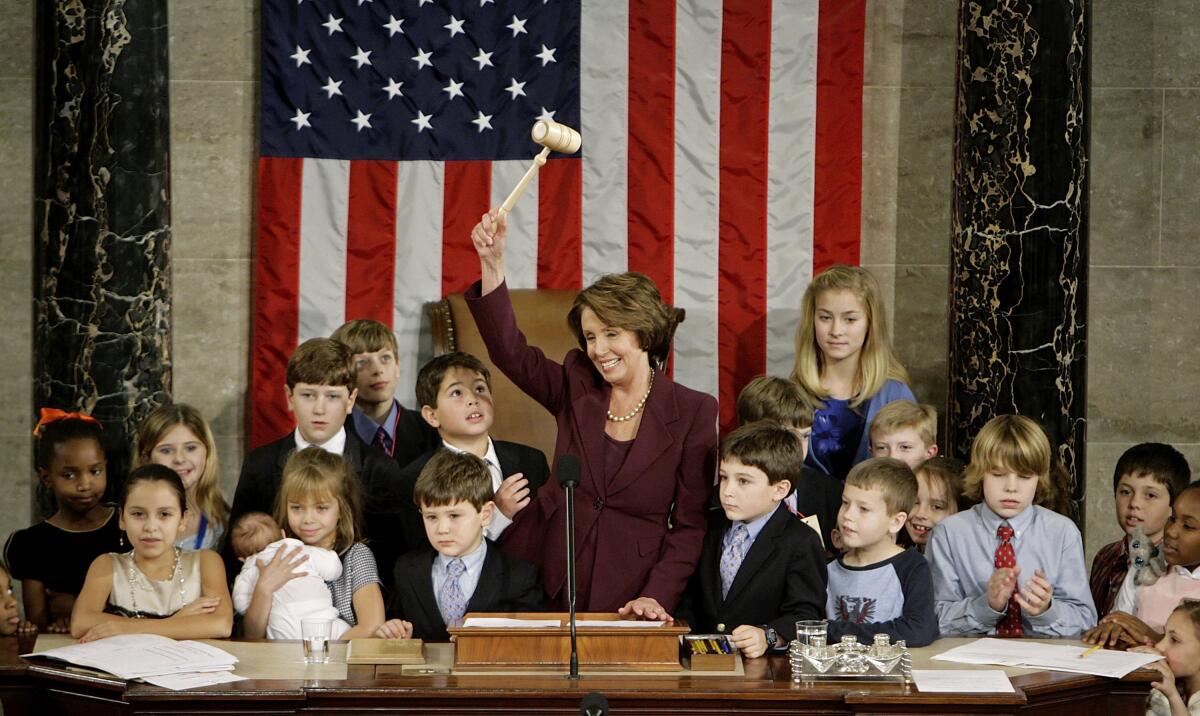
Nancy Pelosi is sworn in as House speaker in 2007, surrounded by her grandchildren and children of other members of Congress.
(Chip Somodevilla / Getty Images)
A trailblazer as the first female speaker of the House, Pelosi presided over two Trump impeachments. While no longer in leadership, she remains incredibly influential as an arm-twister and strategist.
She played a central role in sidelining Biden after his debate meltdown, and for the last couple months has been raising big money — a special skill of hers — in support of California’s Proposition 50. The measure seeks voter approval to redraw California’s congressional districts to better favor Democrats in response to Trump’s pressure campaign on Texas and other red states to redraw their lines in favor of Republicans.
Pelosi has used Prop. 50 in recent days to deflect questions about her primary challengers and her plans for 2026, with her spokesman Ian Krager saying she “is fully focused” on the Prop 50 fight and will be through Nov. 4.
Chakrabarti, who helped Rep. Alexandria Ocasio-Cortez (D-N.Y.) unseat a longtime Democratic incumbent in 2019, said he sees even more “appetite for change” among the party’s base today — as evidenced by “mainstream Democrats who have voted for Nancy Pelosi their whole life” showing up to his events.
And it makes sense, he said.
For decades, Americans have watched the cost of essentials skyrocket while their wages have remained relatively flat, Chakrabarti said, and that has made them desperate to support messages of “bold, sweeping economic change” — whether from Obama or Trump — even as long-serving, mainstream Democrats backed by corporate money have worked to maintain the status quo.

Rep. Alexandria Ocasio-Cortez leaves a news conference at the Capitol in 2019. At left is Saikat Chakrabarti, who was her chief of staff and is now a candidate for the congressional seat held by Rep. Nancy Pelosi.
(Tom Williams/CQ-Roll Call, Inc via Getty Imag)
He said it is time for Democrats to once again push bold, big ideas, which he plans to do — including Medicare for all, universal child care, free college tuition, millions of new units of affordable housing, a new economy built around climate action, and higher taxes on billionaires and mega-millionaires like him.
Wiener, who also backs Prop. 50 and would be the first out gay person to represent San Francisco in Congress, said he cannot speak to Pelosi’s thinking — or to Politico reporting Wednesday that Pelosi is considering her options and has been seen “publicly elevating” San Francisco Supervisor Connie Chan in the race — but is confident in his readiness for the role.
Wiener agreed with Chakrabarti that big ideas are needed from Democrats to win back voters and make progress. He also said that his track record in the state Legislature shows that he has “been willing to take on very, very big fights to make significant progressive change.”
“No one has ever accused me of thinking small,” he said — citing his success in passing bills to create more affordable housing, reform health insurance and drug pricing, tackle net neutrality, challenge telecommunications and cable companies and protect LGBTQ+ and other minority communities and immigrants.
“In addition to having the desire to make big progressive change, in addition to talking about big progressive change, you have to be able to put together the coalitions to deliver on that change, because words are not enough,” Wiener said. “I’ve shown over and over again that I know how to do it, and that I can deliver.”
Political analysts said a message of big ideas will clearly resonate with some voters. But they also said that Pelosi, if she stays in the race, will be hard to beat. She will also face more serious questions than ever about her age and “her ability to function at the extraordinarily high level” she has worked at in years past, Jaye said, and will “have to answer those questions.”
If Pelosi decides not to run, Chakrabarti has the benefit of self-funding and of the current party enthusiasm for fresh faces, they said, and anyone — Chan or otherwise — would benefit from a Pelosi endorsement. But Wiener already has a strong base in the district, a track record for getting legislation passed and, as several observers pointed out, a seemingly endless battery.
“Scott Wiener is an animal. The notion of work-life balance is not a concept he has ever had. He is just like a robotic working machine,” said Aaron Peskin, who served 18 years on the San Francisco Board of Supervisors, some alongside Wiener.
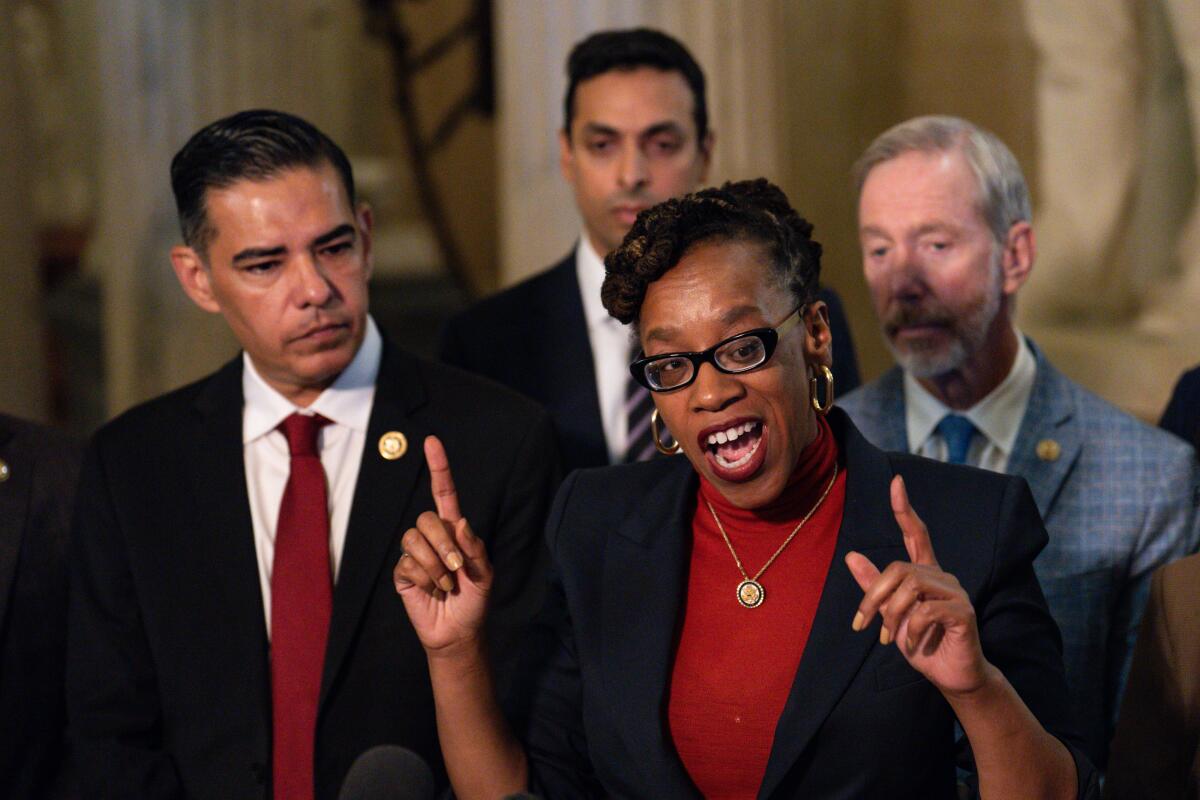
Rep. Lateefah Simon (D-Oakland) speaks to reporters at the Capitol in September.
(Kayla Bartkowski/Bloomberg via Getty Images)
Amanda Litman, the president of Run for Something, which supports young progressive candidates, said there is pent-up demand for a new generation of leaders, and “older Democrats, especially those in Congress, need to ask themselves, ‘Am I the best person to lead this party forward right now?’”
Rep. Lateefah Simon (D-Oakland), 48, won her seat in 2024 after longtime Rep. Barbara Lee, 79, who had been in the seat since 1998, decided to run for Oakland mayor. Simon said that to her, “it’s not necessarily about birthdays” but who can do the job — “who can govern, who can mentor and who can hold this administration accountable.”
As a longtime community activist who worked with youth, Simon said she is “extremely excited” by all the energy of young Democratic office seekers. But as a freshman in Congress who has leaned on Lee, Pelosi and other mentors to help her learn the ropes, she said it’s also clear Democrats need to “have some generals who are really, really tried and tested.”
“What is not helpful to me in this moment,” Simon said, “is for the Democrats to be a circular firing squad.”


WASHINGTON — Asylum seekers may be turned away without a hearing at the southern border, the Supreme Court ruled Thursday in a historic retreat from the promise of relief for those who say they are fleeing persecution.
The justices split over whether this was a simple dispute over legal wording or a moral question involving desperate families.
Siding with the Trump administration, the court’s conservatives said the Refugee Act of 1980 offers a right to seek asylum to migrants who “arrive in the United States” but not those who are turned back when they approach a border crossing or a port of entry.
“This case presents a straightforward question” that turns on the word “in,” said Justice Samuel A. Alito Jr. “In ordinary speech, no one would say that a person ‘arrives in’ a place — for example, a house, a city, or a country — before the person enters that place.”
The liberal dissenters agreed with immigration rights lawyers who saw this as a nonsensical reading of the law.
Justice Sonia Sotomayor said the asylum law arose from the “international moral reckoning that followed the Holocaust and World War II.”
She cited the infamous voyage of the MS St. Louis in 1939. More than 900 Jewish refugees attempted to flee persecution in Nazi Germany by setting sail aboard the ship, which was turned away from Cuba and the United States.
Most of the passengers were returned to Europe, and several hundred died in the Holocaust, she said.
“Congress passed the Refugee Act in 1980 because it did not want this country to repeat the mistakes of its past. Yet if the refugees on the M.S. St. Louis were to walk up to a port of entry on our southern border today, the majority’s interpretation would allow immigration officers to refuse even to consider their asylum applications by physically blocking them from stepping foot onto U.S. soil,” Sotomayor wrote.
Justices Elena Kagan and Ketanji Brown Jackson agreed.
The decision upholds a turn-back policy that began in 2016 as an emergency response to a surge of Haitian immigrants at the San Ysidro border crossing.
The Department of Homeland Security said these asylum seekers must wait on the Mexican side of the border until they could return for a scheduled interview. The policy was extended to other border crossings, but it was challenged as illegal in federal court in San Diego.
Last year, a divided 9th Circuit Court of Appeals ruled that those restrictions were illegal if they prevented migrants from applying for asylum.
“To ‘arrive’ means ‘to reach a destination,’” wrote Judge Michelle Friedland. “A person who presents herself to an official at the border has ‘arrived.’”
She said the “government’s reading would reflect a radical reconstruction of the right to apply for asylum because it would give the executive branch vast discretion to prevent people from applying by blocking them at the border.”
The 2-1 decision upheld a federal judge’s ruling in San Diego for migrants who had filed a class-action suit and said they were wrongly denied an asylum hearing.
But Solicitor Gen. D. John Sauer urged the Supreme Court to review and reverse the appellate ruling, noting 15 judges of the 9th Circuit joined dissents that called the decision “radical” and “clearly wrong.”
The administration argued federal immigration law “does not grant aliens throughout the world a right to enter the United States so that they can seek asylum.”
From abroad, they may “seek admission as refugees,” Sauer said, but the government may enforce its laws by “blocking illegal immigrants from stepping on U.S. soil.”
Defenders of the asylum system denounced the decision.
“We believe that today’s ruling violates international law, as well as the express intent of Congress,” said Erika Pinheiro, executive director of the migrant support organization Al Otro Lado, which led the legal fight. “For decades, the United States has allowed individuals and families who are fleeing persecution, torture and death to ask for protection at U.S. borders.”
“Cruelty is not a substitute for real solutions. Blocking people from seeking asylum at official ports of entry will do nothing to fix our broken immigration system,” said Rebecca Cassler, senior litigation attorney at the American Immigration Council. “It only makes things more chaotic and dangerous for vulnerable families.”
The Federation for American Immigration Reform applauded the decision.
“Our immigration laws are written to be pro-enforcement, not anti-enforcement,” said Christopher J. Hajec, deputy general counsel of FAIR. “Because of this, courts that hamstring enforcement are often forced to violate basic logic, as the 9th Circuit did here. We are pleased the Supreme Court saw that the lower court’s reading would make immigration law incoherent, and reversed.”
Politics
Jeffries welcomes Democratic Socialists into the fold as critics warn party is revealing ‘exactly who it is’

NEWYou can now listen to Fox News articles!
House Minority Leader Hakeem Jeffries publicly embraced a new crop of congressional nominees Saturday, including three Democratic Socialists of America-backed candidates whose primary victories have fueled fresh debate over the Democratic Party’s leftward shift ahead of the 2026 midterms.
The powerful New York lawmaker’s post highlights the challenge facing the top House Democrat as he works to unite his party ahead of the general election. If Democrats take back the House in November, Jeffries is expected to become the next speaker. That means he’ll likely be leading a Democratic caucus with more self-described Democratic Socialists than ever before. So far, more than a dozen Democratic Socialists of America-backed candidates have won or advanced in primaries across the country this election cycle.
In a post on X, Jeffries wrote, “Congratulations to our Democratic nominees,” before listing the party’s congressional candidates from across New York. Among those recognized were Brad Lander, Claire Valdez and Darializa Avila Chevalier, all of whom are affiliated with or backed by the Democratic Socialists of America and secured victories in closely watched Democratic primaries last week.
House Minority Leader Hakeem Jeffries has called Trump official Bill Pulte a “malignant clown.” (Aaron Schwartz/Bloomberg)
“From public servants to union organizers to community activists, the path is different but the work is the same,” Jeffries wrote. “We must decisively address the affordability crisis and crush far-right extremism!”
RISING SOCIALIST STARS ON TRACK TO CONGRESS: WHO ARE DARIALIZA AVILA CHEVALIER, BRAD LANDER AND CLAIRE VALDEZ?
Lander, Chevalier and Valdez all received backing from New York City Mayor Zohran Mamdani, whose endorsements helped cement the growing influence of the Democratic Party’s progressive wing in New York politics. Lander and Chevalier defeated Jeffries-endorsed incumbents Reps. Dan Goldman and Adriano Espaillat in their respective Democratic primaries. Jeffries did not endorse in the race won by Claire Valdez, which was an open seat.
Now, as Democrats turn their attention to the general election, he appears to be rallying behind the party’s nominees as they try to win back the House in November.
The socialist candidates have also faced scrutiny over resurfaced social media posts, support for defunding the police and anti-Israel rhetoric, positions that have put them at odds with many in the Democratic Party.
Socialist New York congressional nominees Darializa Avila Chevalier (L), Claire Valdez (C) and Brad Lander. (Michael M. Santiago/Getty Images; Michael Nagle/Bloomberg via Getty Images; Adam Gray/Bloomberg via Getty Images)
Chevalier has faced scrutiny over resurfaced social media posts, including one in which she called to “literally abolish the border.”
She has also faced renewed scrutiny over past social media posts targeting leading Democrats, including calling former President Joe Biden a “war criminal,” attacking former Vice President Kamala Harris and rebuking Sen. Bernie Sanders over Israel.
Like Chevalier, Valdez and Lander, who is Jewish, share her sentiment that Israel is committing “genocide” in Gaza.
LIBERAL MS NOW WRITER CALLS MAMDANI PRIMARY SWEEP A ‘GENUINELY SCARY NIGHT FOR NEW YORK CITY JEWS’
Jeffries’ decision to publicly congratulate the three nominees quickly drew criticism.
The Republican Jewish Coalition blasted Jeffries’ congratulatory message, warning Jewish voters that these candidates are not the Democrat “fringe” but the new faces of the party.
“To Jewish Democrats: your party is telling you EXACTLY who it is,” the Coalition wrote. “These future members of Congress, who @hakeemjeffries is welcoming with open arms, want to: Abolish prisons and borders. Defund the police. Downplay 9/11,” rattling off other serious controversies stemming from the candidates.
Jamie Metzl, a former National Security Council and State Department official and lifelong Democrat, blasted Jeffries for congratulating the nominees.
New York City Mayor Mayor Zohran Mamdani speaks at a news conference Thursday in Manhattan. (Spencer Platt/Getty Images)
“When I first read this post, I assumed it was from a spoof account. I am deeply concerned that it appears to be all too real,” Metzl wrote. “To welcome these nominees without acknowledging and criticizing their self-declared sympathies for U.S.-designated terrorist organizations, their calls to abolish the police, their stated desire to dismantle Western civilization, and their blatant anti-Americanism is to sacrifice the core principles of the Democratic Party.”
Metzl accused Jeffries of putting his bid to become House speaker ahead of the Democratic Party’s principles.
“I understand your ambition to become Speaker should Democrats retake the House, but you should not sacrifice the principles of our party to advance your own political aspirations,” Metzl wrote.
Democratic leadership has been in the hot seat this week facing questions from the media about how to reconcile support for the New York slate of socialist candidates, particularly after Valdez’s supporters were seen shouting “you’re next” at a television screen showing Jeffries on Tuesday night.
“They’re gonna eat you next Congressman – and replace you with one of their own,” conservative commentator Meghan McCain posted on X.
“This is funny,” conservative commentator Robby Starbuck posted on X. “Hakeem still doesn’t realize that the communists are going to eat him alive. Clearly not a student of history. Bless his heart.”
CLICK HERE TO DOWNLOAD THE FOX NEWS APP
In a CNN appearance on Friday, Jeffries said, “I think that what happens in a handful of primaries in one of the bluest cities in the country is not in any way indicative of what needs to happen in November, where we need to reelect every single frontline Member, common sense Democrats, authentically committed to making life better for the American people, opposing these extreme Republicans who have been nothing but a reckless rubber stamp for Donald Trump’s agenda.”
“And at the same period of time, make sure that we flip red seats blue, including in New York-17, where we have a combat veteran, incredibly patriotic American Cait Conley, who came out of a primary on Tuesday as well and is an incredibly strong candidate. She will defeat Mike Lawler in New York in November.”

Twenty-four days after the polls closed on election day, Los Angeles County officials have certified the results from the 2,227,461 ballots cast. Despite questions raised about the pace of the vote count, a Times analysis found ballots this June were tallied faster than in previous cycles.
California is known to have a slow vote count, partially because of the state’s grace period for mail-in ballots. This year, counties were required to report most of the ballots by June 15, with some exceptions, including for mail-in ballots received within seven days of election day and ballots requiring additional verification such as signature curing. The process has spurred baseless claims of fraud from President Trump and others, leading the U.S. Supreme Court to take up a case on whether mail-in ballots must be received by election day to count.
The state has reported 9.4 million processed ballots. Officials estimate about 5 ballots remain to be counted and 17,650 are waiting to cure a missing or mismatched signature.
Compared with the last time both governor and Los Angeles mayor were on the ballot, county election officials counted more ballots, and tallied them faster than in 2022, The Times found.
In Los Angeles County, turnout jumped from 28% of eligible voters in the 2022 primary to 38% this June, according to the county registrar. Meanwhile, the share of vote-by-mail ballots dropped about 3 percentage points to 82%, indicating a rise in in-person voting.
Statewide, early results show 41% of registered voters turned up for the June election, up from 33% in 2022, according to the secretary of state. County elections officials must report their final results by July 3, giving state officials a week to certify all election results.
The Los Angeles Times reports election results from the county clerk as well as from the Associated Press. The AP provides ballot counts, a calculation of the expected vote and race calls for statewide and national races.
The expected vote percentage, or EEVP, is an estimate of the total number of votes that will eventually be certified. That number can be adjusted based on new information over time.
“Before counting begins in California, our estimates are primarily informed by turnout in past similar elections plus pre-election data on ballot returns, with projections based on what percentage of ballots had already been received at the same point in past elections,” AP director of election analytics Emily Swanson said in an email.
In the gubernatorial and mayoral races, more than half of the votes were counted by the end of election day, EEVP data show.

Swanson’s team also observed a faster vote count this year than in the 2022 and 2024 primaries.
In January 2024, L.A. County consolidated its election operations into a new ballot processing center in the City of Industry. Dean Logan, head of the L.A. County registrar-recorder/county clerk’s office, told The Times earlier this month that the facility, which is open to observers, is designed for transparency, security and efficiency.
“It doesn’t take long to count. The counting process is very fast,” Logan said ahead of election day. “What extends the time period is those options that are provided under California law for voters — to allow everyone the opportunity to vote up until election day, and then allowing us the time to process those with the same level of security and integrity that we did the ballots that were received two weeks before the election.”
Despite the faster count, the Associated Press took longer to call winners, suggesting these races were more competitive. The AP makes such declarations by determining whether there is an opportunity for a trailing candidate to catch up to the race leader. It has been calling races for nearly 180 years.
Both the gubernatorial and Los Angeles mayoral race saw a 30% increase in votes from 2022. The governor’s race received more than 9.2 million votes compared with 7 million in 2022. The Los Angeles mayor’s race received more than 850,000 votes, an increase from nearly 650,000 in 2022.


The vote counting process for California, Washington, Oregon, Nevada and Alaska may change for the November midterm election, depending on which way the U.S. Supreme Court rules.
Data and graphics assistant editor Sean Greene contributed to this report.
-
 Entertainment8 minutes ago
Peter Asher has heard it all
-
Politics16 minutes ago
Asylum seekers may be turned away at the southern border, Supreme Court rules
-
 Sports26 minutes ago
Kyle Tucker and Dalton Rushing rebound with consecutive homers, Dodgers rout Padres
-

 World38 minutes ago
Serbian Vučić says he will resign in weeks and calls early elections
-

 News1 hour ago
Trump-backed Rep. Julia Letlow wins Louisiana Senate primary runoff
-

 New York2 hours ago
Metropolitan Diary Challenge Day 1: What Is Your N.Y. Story?
-

 Los Angeles, Ca2 hours ago
LASD releases video of man shot by deputy after allegedly charging them with knife
-

 Detroit, MI3 hours ago
Rick Mahorn returns to coaching Detroit basketball with BIG3 Amps

