Politics
Cause of death confirmed for Mitt Romney’s sister-in-law


NEWYou can now listen to Fox News articles!
This story discusses suicide. If you or someone you know is having thoughts of suicide, please contact the Suicide & Crisis Lifeline at 988 or 1-800-273-TALK (8255).
The death of former Sen. Mitt Romney’s sister-in-law has been confirmed to be a suicide, the Los Angeles County medical examiner’s office announced Tuesday.
Carrie Elizabeth Romney, 64, died of “blunt traumatic injuries” after plunging from a five-story parking garage in California in early October. She had been married to Mitt Romney’s older brother, George Scott Romney, 81, and the pair had been going through a months-long divorce.
“Our family is heartbroken by the loss of Carrie, who brought warmth and love to all our lives,” Mitt Romney said in a statement after Carrie’s death.
FETTERMAN’S BRUTALLY CANDID ACCOUNT OF BATTLING DEPRESSION, FEELING SUICIDAL, BEING THROWN OUT OF HIS HOUSE
Sen. Mitt Romney’s sister-in-law died in October. (Drew Angerer/Getty Images)
“We ask for privacy during this difficult time,” he added.
Carrie and George had been married since 2016. They had been separated since late May, and George filed a divorce petition in early June.
FLASHBACK: MITT ROMNEY MOCKED IN 2012 FOR SELF-DEPORTATION CONCEPT THAT HAS NOW BECOME A REALITY
George Scott Romney stands during the Pledge of Allegiance during the final day of the Republican National Convention at the Tampa Bay Times Forum on August 30, 2012 in Tampa, Florida. (Photo by Chip Somodevilla/Getty Images)
Mitt Romney served as a Utah senator until 2024, when he decided not to run for re-election.
“I have spent my last 25 years in public service of one kind or another. At the end of another term, I’d be in my mid-eighties. Frankly, it’s time for a new generation of leaders. They’re the ones that need to make the decisions that will shape the world they will be living in,” Romney said at the time.
CLICK HERE TO DOWNLOAD THE FOX NEWS APP
“We face critical challenges — mounting national debt, climate change, and the ambitious authoritarians of Russia and China. Neither President Biden nor former President Trump are leading their party to confront them,” Romney said.
“It is a profound honor to serve Utah and the nation, and I thank you for giving me the opportunity to do so.”



new video loaded: Acting Attorney General Says Only Trump Knows Why Bondi Was Fired
transcript
transcript
Acting Attorney General Says Only Trump Knows Why Bondi Was Fired
The acting attorney general, Todd Blanche, said during his first news conference on Tuesday that “nobody has any idea” why President Trump fired Pam Bondi last week.
-
Nobody has any idea why the attorney general is no longer the attorney general and I’m the acting attorney general, except for President Trump. I grow tired of people in the media saying why President Trump did or did do something, because President Trump’s only one that knows that. I did not ask for this job. And if President Trump chooses to keep me as acting, that’s an honor. If he chooses to nominate me, that’s an honor.

By Jackeline Luna
April 7, 2026

Kayleigh McEnany: AOC is not fooling anyone
Fox News host Kayleigh McEnany talks about Rep. Alexandria Ocasio-Cortez, D-N.Y., stumbling on her words while discussing foreign policy at the Munich Security Conference and more on ‘Jesse Watters Primetime.’
NEWYou can now listen to Fox News articles!
Rep. Alexandria Ocasio-Cortez, D-N.Y., continued calling for President Donald Trump’s ouster on Tuesday even after the president announced a two-week ceasefire with Iran.
“This statement changes nothing,” she asserted in a post on X, referring to the president’s Tuesday evening ceasefire announcement. “Whether by his Cabinet or Congress, the President must be removed from office.”
Prior to the ceasefire announcement, Trump, who had been threatening to unleash a devastating attack against Iranian power plants and bridges, sent the following warning in a Tuesday morning Truth Social post: “A whole civilization will die tonight, never to be brought back again. I don’t want that to happen, but it probably will. However, now that we have Complete and Total Regime Change, where different, smarter, and less radicalized minds prevail, maybe something revolutionarily wonderful can happen, WHO KNOWS?”
Ocasio-Cortez, a member of the progressive cadre of lawmakers known as “The Squad,” responded by declaring in a post on X, “This is a threat of genocide and merits removal from office. The President’s mental faculties are collapsing and cannot be trusted. To every individual in the President’s chain of command: You have a duty to refuse illegal orders. That includes carrying out this threat.”
But then on Tuesday night, Trump announced a two-week ceasefire.
TRUMP AGREES TO 2-WEEK CEASEFIRE IF IRAN OPENS STRAIT OF HORMUZ
U.S. Rep. Alexandria Ocasio-Cortez, D-N.Y., speaks during a rally on March 21, 2025, at Civic Center Park in Denver, Colo. (Chet Strange/Getty Images)
“Based on conversations with Prime Minister Shehbaz Sharif and Field Marshal Asim Munir, of Pakistan, and wherein they requested that I hold off the destructive force being sent tonight to Iran, and subject to the Islamic Republic of Iran agreeing to the COMPLETE, IMMEDIATE, and SAFE OPENING of the Strait of Hormuz, I agree to suspend the bombing and attack of Iran for a period of two weeks. This will be a double sided CEASEFIRE!” the president wrote in part of a Truth Social post. “Almost all of the various points of past contention have been agreed to between the United States and Iran, but a two week period will allow the Agreement to be finalized and consummated.”
Iranian Minister of Foreign Affairs Seyed Abbas Araghchi said in part of a statement, “If attacks against Iran are halted, our Powerful Armed Forces will cease their defensive operations. For a period of two weeks, safe passage through the Strait of Hormuz will be possible via coordination with Iran’s Armed Forces and with due consideration of technical limitations.”
But even in light of Trump’s ceasefire announcement, Ocasio-Cortez asserted that the president’s “statement changes nothing.”
“The President has threatened a genocide against the Iranian people, and is continuing to leverage that threat. He has launched a massive war of enormous risk and of catastrophic consequence without reason, rationale, nor Congressional authorization – which is as clear a violation of the Constitution as any. Each day this goes on, the risk and criminality of these actions escalate for our nation and the world,” she wrote in the post on X.
EX-TRUMP ALLY MARJORIE TAYLOR GREENE JOINS LEFT-WING CALLS FOR THE 25TH AMENDMENT AS IRAN DEADLINE NEARS
U.S. President Donald Trump speaks during a news conference in James S. Brady Press Briefing Room of the White House on April 6, 2026, in Washington, D.C. (Anna Moneymaker/Getty Images)
“Moreover, this administration’s self enrichment, insider trading, and pure corruption off this chaos – from crypto currencies to predictive trading markets to bribe ‘settlements’ – has placed the Trump administration’s pursuit of personal wealth squarely against the wellbeing of our nation and its people. All of these incidents, and plenty more, have clearly driven our country past the threshold for impeachment or invocation of the 25th amendment,” she continued.
“We cannot risk the world nor the wellbeing of our nation any longer. None of these considerations should be partisan, but shared in good faith by Americans of all backgrounds who care for the safety and stability of the United States. Whether by his Cabinet or Congress, the President must be removed from office. We are playing with the brink,” she wrote.
AOC TELLS TROOPS TO REFUSE ‘ILLEGAL’ ORDERS AHEAD OF TRUMP’S LOOMING IRAN DEADLINE
Rep. Alexandria Ocasio-Cortez (D-NY) waves to the crowd ahead of Zohran Mamdani’s inauguration as the 112th mayor at City Hall on Thursday Jan. 1, 2026 in New York, NY. (David Dee Delgado/Getty Images)
CLICK HERE TO DOWNLOAD THE FOX NEWS APP
Fox News Digital reached out to the White House for comment early on Wednesday.
SACRAMENTO — A federal judge appears willing to block a $6.2-billion merger of two large TV station groups as he evaluates whether Nexstar Media Group’s takeover of a rival violates U.S. antitrust laws.
At the conclusion of a two-hour hearing in Sacramento on Tuesday, U.S. District Court Chief Judge Troy L. Nunley signaled he was preparing to issue a preliminary injunction that would prevent Nexstar and Tegna from combining operations amid an ongoing legal challenge.
Nunley said he would draft a written order, which is expected by Friday.
Previously, Nunley had issued a temporary restraining order to pause the merger.
Last month, Nexstar raced to finalize its blockbuster purchase of Tegna — despite a lawsuit filed by California Atty. Gen. Rob Bonta and seven other state attorneys general. The state officials, all Democrats, claimed the massive merger would give Nexstar too much control over local TV stations, ultimately hurting consumers by diminishing the diversity and quality of their newscasts.
California Deputy Atty. Gen. Laura Antonini argued that when news consolidates, it results in a loss of diverse viewpoints.
“That’s extremely harmful to democracy and to the citizens of this state,” she said at the hearing.
President Trump has championed the Nexstar-Tegna merger, suggesting it would diminish the clout of the major TV networks, including those he often gripes about: ABC and NBC. Nexstar, based in Irving, Texas, owns dozens of network affiliate stations.
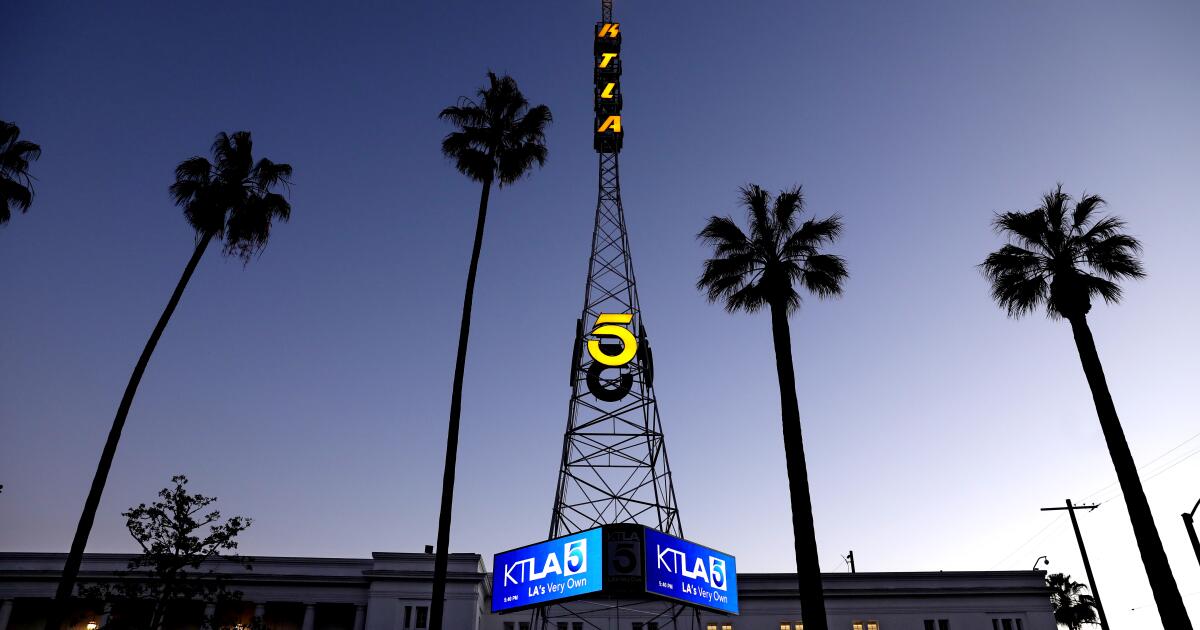
Nexstar, which also owns KTLA-TV Channel 5 in Los Angeles, already is the nation’s largest station group. The deal was expected to reshape the local television industry by extending Nexstar’s reach to 265 television stations, up from 164.
If the acquisition is finalized , Nexstar stations would cover 80% of the U.S. population, exceeding a 39% ownership cap set by Congress.
El Segundo-based DirecTV separately sued, alleging the combination of the nation’s two largest television station groups would do irreparable harm to its pay-TV business by raising prices and potentially increasing programming blackouts.
Representatives of Nexstar, DirecTV and Bonta’s office declined to comment after Tuesday’s hearing.
During the hearing, Nexstar attorney Alexander Okuliar, argued against an injunction, saying the plaintiffs had failed to demonstrate that the merger posed an immediate threat to the public. He said DirecTV and the attorneys general had offered only proposed financial harms.
In court documents, the state attorneys general and DirecTV alleged the deal would give Nexstar multiple TV stations in dozens of markets. That raised concerns about layoffs in an industry that has sustained significant downsizing in recent years as viewers and advertisers migrate to streaming options and social media platforms like TikTok.
Nexstar could “shut down local newsrooms in dozens of markets, reducing the amount, variety, and quality of local broadcast news that Americans rely on for trusted information about their communities,” DirecTV alleged.
For example, Nexstar owns the Fox station in Sacramento, while McLean, Va.-based Tegna owns the ABC affiliate.
Okuliar pushed back, saying there was no evidence that local newsrooms would be shuttered.
“One of the reasons for this deal is to protect local broadcasters, to protect local journalism,” he told the judge.
Nexstar contends the deal would strengthen TV station economics, allowing stations to bolster their news gathering and expand the number of newscasts. The company cited dozens of awards won by Nexstar journalists, including in Oklahoma City.
In addition to Bonta, the plaintiffs include state attorneys general in Colorado, Connecticut, Illinois, New York, North Carolina, Oregon and Virginia.
Nearly two dozen lawyers attended the hearing on behalf of the other plaintiffs. Eight lawyers represented Nexstar and Tegna.
Nexstar Chief Executive Perry Sook and Chief Operating officer Michael Biard also attended.
In its complaint, DirecTV argued that it would suffer financial harm because Nexstar would use its increased heft to demand significantly higher fees for the rights to carry its network-affiliate stations, which carry local news, prime-time shows and professional sports, including NFL football. Such programming disputes can lead to blackouts that infuriate customers.
Nexstar’s lawyers disputed such allegations, telling the judge the merger would ultimately increase the value of content. The company suggested the deal could lower prices for distributors like DirecTV, which has about 10 million customers nationwide.
Nunley recently combined the DirecTV and state attorneys general lawsuits into one.
The judge, who was elevated to the federal bench by President Obama, had already expressed concerns about the merger.
In his March 27 order granting the temporary restraining order, Nunley said DirecTV had demonstrated that it could prevail at a trial due to the merits of its arguments.
He then instructed Nexstar to “immediately cease all ongoing actions relating to integration and consolidation of Nexstar and Tegna.”
Instead, the Tegna unit must continue to operate independently as “an ongoing, economically viable, and active competitor,” the judge wrote.
The Nexstar-Tegna merger took on political overtones in early February after Trump threw his weight behind it, writing in a post on Truth Social that the proposed union was among the “good deals,” because it would provide competition against “THE ENEMY, the Fake News National TV Networks.”
“GET THAT DEAL DONE!” Trump wrote.
The state attorneys general sued to block the merger on March 18, when the transaction was still pending at the U.S. Justice Department, which is tasked with conducting antitrust reviews, and the Federal Communications Commission, which oversees TV station licenses.
The Justice Department and FCC blessed the deal the following day.
Within an hour, Nexstar announced that it finalized the transaction and that Tegna had been disbanded.
“It’s very rare to do what Nexstar did here,” DirecTV’s attorney Glenn Pomerantz said.
Nexstar had asked the judge to require the plaintiffs to post a $150-million bond to compensate it for damages it would suffer from any delays in closing the deal.

Rhode Island lawmakers to consider several firearm bills

19-year-old steals 32 guns from South Carolina business, police say

Rep. Dusty Johnson wants South Dakota to go tougher on drug dealers, repeat offenders

Nolan Smith receives contract extension at Tennessee State – HoopDirt

Opal Lee’s granddaughter advocates for “Grandmother of Juneteenth” to be included in Texas curriculum

Florida High School Football Rankings: Top 25 teams – Oct. 21

How old is Bo Nix? What to know about Oregon quarterback ahead of 2024 NFL Draft

Cleary's 21 help Le Moyne down Central Connecticut State 69-64 in OT

99th annual Pony Swim held in Virginia

Indiana Members Credit Union announced as new anchor tenant at Bottleworks District

AOC doubles down on call for Trump’s ouster even after ceasefire announcement

EU made ‘no diplomatic effort’ to end Iran war, says MEP Botenga

U.S. and Iran agree to 2-week ceasefire

Democrat swing candidate called Biden’s border handling ‘a huge misstep’ after backing his approach as mayor

‘Policy of abuse’: Women march in Cuba against US energy blockade
-

 Atlanta, GA3 days ago
1 teenage girl killed, another injured in shooting at Piedmont Park, police say
-

 Movie Reviews6 days ago
Vaazha 2 first half review: Hashir anchors a lively, chaos-filled teen tale
-

 Culture1 week ago
Do You Know Where These Famous Authors Are Buried?
-

 Atlanta, GA1 week ago
Fetishist ‘No Kings’ protester in mask drags ‘Trump’ and ‘JD Vance’ behind her wheelchair
-
 Entertainment6 days ago
Inside Ye’s first comeback show at SoFi Stadium
-
 Milwaukee, WI2 days ago
Potawatomi Casino Hotel evacuated after fire breaks out in rooftop HVAC system
-

 Pennsylvania2 days ago
Parents charged after toddler injured by wolf at Pennsylvania zoo
-

 Indianapolis, IN5 days ago
Fighting Illini begin Final Four preparations in Indianapolis