Politics
California Senate candidates grilled in second debate, asked if Biden and Trump are too old

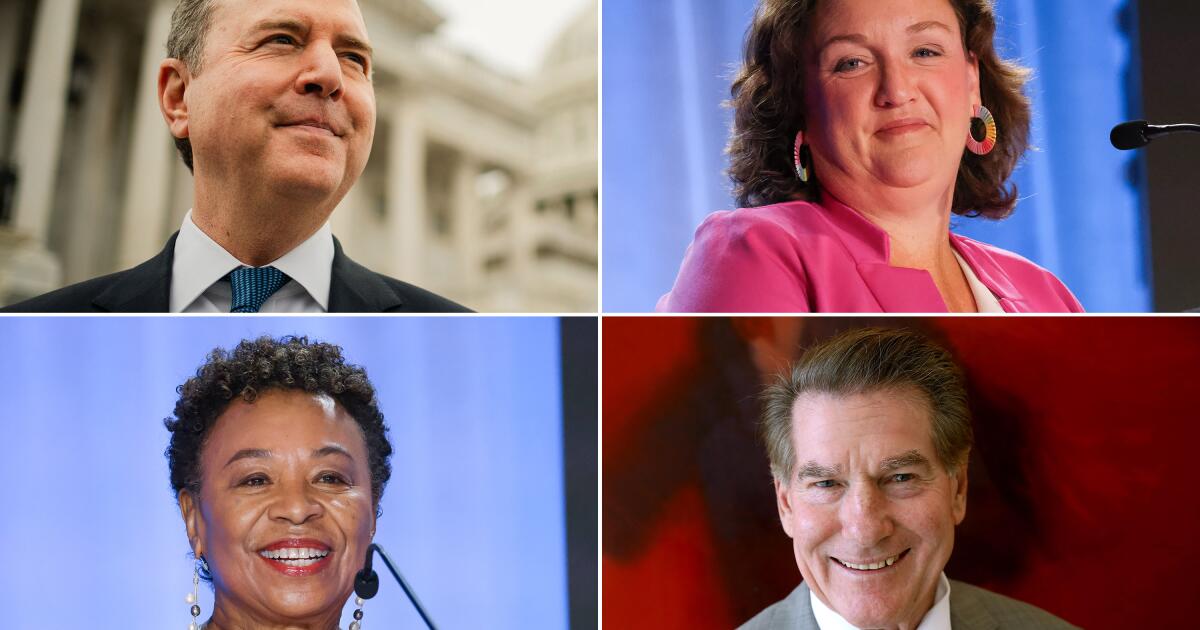
With millions of ballots already mailed out across the Golden State, the four leading candidates for the U.S. Senate in California spent their second televised debate on the defensive at times and were pressed to say whether they thought President Biden and former President Trump were too old to run for reelection.
Reps. Katie Porter (D-Irvine) and Barbara Lee (D-Oakland) and Republican candidate Steve Garvey all faced sharp questions from moderators: Porter was asked if she waited too long to propose solutions to California’s housing crisis; Lee about her support for a $50 minimum wage and whether it would be sustainable for small businesses; and Garvey pressured to say if he would accept Trump’s endorsement, were it offered.
Rep. Adam B. Schiff (D-Burbank) avoided a similarly pointed question, though he was asked whether California’s progressive criminal justice reforms have gone too far — an area in which his views have changed significantly since his earliest days as a tough-on-crime Democrat in the California Senate.
Ballots for the primary were sent out last week. More than 22 million Californians can vote in the election to replace Sen. Dianne Feinstein, who died in September.
Recent polling has shown Schiff’s lead widening. A poll conducted in January by the UC Berkeley Institute of Governmental Studies, co-sponsored by The Times, found that 21% of likely voters backed Schiff, 17% chose Porter, 13% were for Garvey and 9% picked Lee.
Garvey, who played first base for the Dodgers and the San Diego Padres, aims to appeal to the shrinking but significant number of registered Republicans across the Golden State, as well as to “no party preference” voters and registered Democrats who believe their party has failed to address homelessness, the high cost of living and other pressing issues.
“These are three career politicians who have failed the people,” Garvey said during a discussion on the state’s affordability crisis. With 60 combined years of experience among Lee, Porter and Schiff, he said, “they could have solved this issue.”
In the final weeks of the primary campaign, Porter and Schiff have unleashed a multimillion-dollar barrage of television and radio advertising. A new advertising campaign from Schiff and his supporters focuses on Garvey, calling him “too conservative for California” and loyal to Trump — a strategy likely to boost the political newcomer’s profile among Republicans.
If Garvey consolidates support from Republicans, he could finish in the top two in the primary, which is all he needs to advance to the November general election. For Schiff, boosting Garvey could help edge Porter out of the November election, easing his path to victory.
Porter’s campaign ads focus on her reputation in Congress as an irritant to Washington’s entrenched political hierarchy, touting her as having an independent streak and not being beholden to corporate interests. She mentioned Monday her work on the House Oversight Committee grilling Wall Street CEOs and said she’d bring that sort of sharp inquiry to the Senate.
All four candidates were asked whether they believed Biden, 81, and Trump, 77, were too old to be running for a second term. In as many words, all said no.
Biden’s age became a major issue in the 2024 presidential race after a special counsel investigating whether Biden mishandled classified documents during his previous positions as vice president and senator claimed that the president couldn’t remember major milestones in his life.
“Experience matters, I have to say,” said Lee, 77. “With regards to term limits, age limits, this is a democracy — people have the right to vote for who they want to vote for.”
“We all in our own minds and with our own eyes and ears have to make that determination,” said Garvey, 75.
During the fast-paced, one-hour debate, hosted by San Francisco Nexstar affiliate KRON 4 and carried by news stations statewide, Schiff said Trump was unfit for office at any age, and accused Garvey supporting the former president despite his failed attempt to overturn the results of the 2020 presidential election. Garvey has said he voted for Trump in the 2016 and 2020 elections.
Asked whether he had spoken to Trump since launching his campaign, or whether he would accept his endorsement, Garvey initially sidestepped the questions, but eventually said that he and the former president had not spoken. He declined to say whether he would accept Trump’s endorsement.
“These are personal choices,” Garvey said. “I answer to God, my wife, family and the people of California. And I hope you would respect that I have personal choices.”
Lee largely avoided the fray during the debate, but was asked to explain how her support for a $50 minimum wage — nearly seven times the national minimum wage of $7.25 per hour — would be economically viable for a small-business owners. With California’s high cost of living, she said, the wage was necessary for families to make ends meet — but implied that it would not apply nationwide.
“I’ve got to be focused on what California needs, and what the affordability factor is,” she said.
Porter was asked why she waited until last week to release a plan to fix California’s housing crisis, one of the biggest issues facing the state. She responded that she’d been working on the issue throughout her legal career advocating for consumer rights and since she first arrived in Congress in 2018, and that she has firsthand experience.
“My own children are questioning whether they’re going to be able to live in California when they graduate from high school because of the high cost of living,” Porter said.
The moderators, KTLA 5’s Frank Buckley and Fox 40’s Nikki Laurenzo, asked Schiff whether he thought progressive criminal justice reforms, including the elimination of cash bail for nonviolent crime and the reduction of some felony crimes to misdemeanors, had “gone too far.”
Schiff said there is “no question that we have a crime problem in California, particularly these smash-and-grab robberies,” but said the data do not suggest that progressive criminal justice reforms are to blame. Instead, he said, the state needs to invest more in community policing.
“I’ve been focused on trying to keep communities safe since I was a prosecutor,” Schiff said. “Back when Mr. Garvey was playing baseball, I was prosecuting cases in the U.S. attorney’s office in Los Angeles.”
A former federal prosecutor, Schiff campaigned for the state Senate in 1996 on a tough-on-crime platform and told voters he supported the state’s three-strikes law and the death penalty.
Schiff told The Times last week that while “there was certainly a time when I supported the death penalty for those who killed cops and those who killed kids,” he no longer supports capital punishment.
After the debate, Lee, who served in the California Legislature at the same time as Schiff, said their contrasting views on the subject offered a clear choice for voters. She recalled sponsoring a law that would’ve reformed the state’s “three strikes” law, which Schiff voted against.
“The difference between us is I looked at criminal justice reform and public safety in a comprehensive way and that enhanced sentences don’t necessarily mean a reduction in crime,” she said.







new video loaded: Defense Officials Give No Timeline for War in Iran as U.S. Boosts Forces
transcript
transcript
Defense Officials Give No Timeline for War in Iran as U.S. Boosts Forces
At a Pentagon news conference, top defense officials said that the U.S. military was sending more forces to the Middle East and expects to “take additional losses.” Earlier, President Trump said that the U.S. could continue striking Iran for the next four to five weeks.
-
“We didn’t start this war, but under President Trump, we are finishing it. This operation is a clear, devastating, decisive mission. Destroy the missile threat. Destroy the navy. No nukes. President Trump has all the latitude in the world to talk about how long it may or may not take. Four weeks. Two weeks, six weeks. It could move up. It could move back. We’re going to execute at his command the objectives we’ve set out to achieve.” “We expect to take additional losses. And as always, we will work to minimize U.S. losses. But as the secretary said, this is major combat operations.” Reporter: “Are there currently any American boots on the ground in Iran?” “No, but we’re not going to go into the exercise of what we will or will not do. I think — it’s one of those fallacies for a long time that this department or presidents or others should tell the American people. This — and our enemies by the way — here’s exactly what we’ll do. Why in the world would we tell you, you, the enemy, anybody, what we will or will not do in pursuit of an objective?”
By Christina Kelso
March 2, 2026

NEWYou can now listen to Fox News articles!
Americans could soon see higher gas prices as escalating tensions in the Middle East threaten a critical global oil chokepoint, raising fears of supply disruptions that could quickly reverberate across U.S. energy markets.
After joint U.S.–Israeli strikes, dubbed Operation Epic Fury, targeted Iranian sites over the weekend and killed Iran’s Supreme Leader Ayatollah Ali Khamenei, concerns quickly shifted to how Tehran might respond and whether oil infrastructure or tanker traffic could become collateral damage.
Any disruption to global crude supplies could translate into higher costs for American drivers at the pump.
“Every time we’ve had flare-ups in the Middle East like we’re seeing right now — and we’ve seen this kind of situation periodically over the last 50 years — it has caused significant disruption to energy markets,” economist Stephen Moore told Fox News Digital.
“I would expect we could see anywhere from 25 to 50 cents a gallon increase in gas prices in the short term,” he said.
Experts say Americans will likely pay more for gas due to the ongoing conflict in the Middle East. (Matthew Hatcher/Bloomberg/Getty Images)
Market data already shows prices moving higher.
Patrick De Haan, head of petroleum analysis at GasBuddy, said oil prices were up $5 per barrel, while wholesale gasoline prices had risen 11 cents per gallon.
He expects retail gas prices to begin climbing immediately, especially in areas where stations tend to adjust prices in sharp, periodic jumps.
The national average could hit $3 per gallon as soon as Monday, De Haan said, with some stations increasing prices by 10 to 30 cents this week and potentially more in markets that see larger price swings.
Moore warned that prices could climb further and remain elevated if vital transit routes or oil facilities are disrupted.
TRUMP PLEDGES TO ‘AVENGE’ FALLEN US SERVICE MEMBERS AS TENSIONS WITH IRAN INTENSIFY
The ongoing conflict in Iran is near a major energy corridor. (Contributor/Getty Images)
“Huge amounts of global oil travel through the Strait of Hormuz, so this could be incredibly disruptive, delaying delivery of oil and gas,” he said.
“The Iranians have already knocked out some oil facilities in the Middle East, and who knows what they’re up to next. When you have less supply, prices go up. The big question is whether this will be a temporary bump or something more prolonged.”
The ongoing conflict sits near the Strait of Hormuz, one of the world’s most strategically important energy corridors.
“This shipping route represents around 25% of global oil trade and 23% of liquefied natural gas trade,” explained Jaime Brito, executive director of refining and oil products at OPIS.
The Strait of Hormuz, a narrow shipping lane between Iran and Oman that has long been a flashpoint during regional crises, serves as a vital artery for global energy markets.
Roughly 20 million barrels of crude oil and petroleum products — about one-fifth of global oil supply — transit the strait each day, underscoring how disruption there can quickly send shockwaves through international energy markets.
HORMUZ ERUPTS: ATTACKS, GPS JAMMING, HOUTHI THREATS ROCK STRAIT AMID US-ISRAELI STRIKES
A satellite view of the Strait of Hormuz, a critical chokepoint for global energy supply, connecting the Persian Gulf to the Gulf of Oman. (Gallo Images/Orbital Horizon/Copernicus Sentinel Data 2025/Amanda Macias/Fox News Digital)
Highlighting the growing concern, Maersk, widely regarded as a bellwether for global ocean freight, said it will suspend all vessel crossings through the Strait of Hormuz until further notice and cautioned that services to Arabian Gulf ports may be delayed.
Still, not all price movements are immediate.
“Developments over the weekend in the Middle East should hypothetically take time to ripple into the global supply chain. An initial assessment would suggest no specific price impacts should be seen in the gasoline market across the world, including the U.S.,” Brito told Fox News Digital.
However, Brito said prices could climb quickly if markets expect trouble ahead, even before supplies are actually affected.
As a result, Brito said, developments in Iran may have already translated into higher gasoline, diesel and other fuel prices in parts of the U.S., depending on regional supply dynamics and individual company pricing strategies.
CLICK HERE TO DOWNLOAD THE FOX NEWS APP
Experts say the increase in gas prices will be largely determined by how long the conflict in the Middle East lasts. (John McCall/South Florida Sun Sentinel/Tribune News Service via Getty Images)
From a domestic standpoint, Brito added that gasoline prices follow a seasonal pattern, typically climbing during the summer travel months.
“March prices are not expected to be significantly high,” he said, noting that spring break travel could support demand in certain areas — but not at the level seen during peak summer driving season.
Ultimately, the direction of gasoline prices will depend less on seasonal demand and more on how the geopolitical situation unfolds in the days ahead.
Related Article

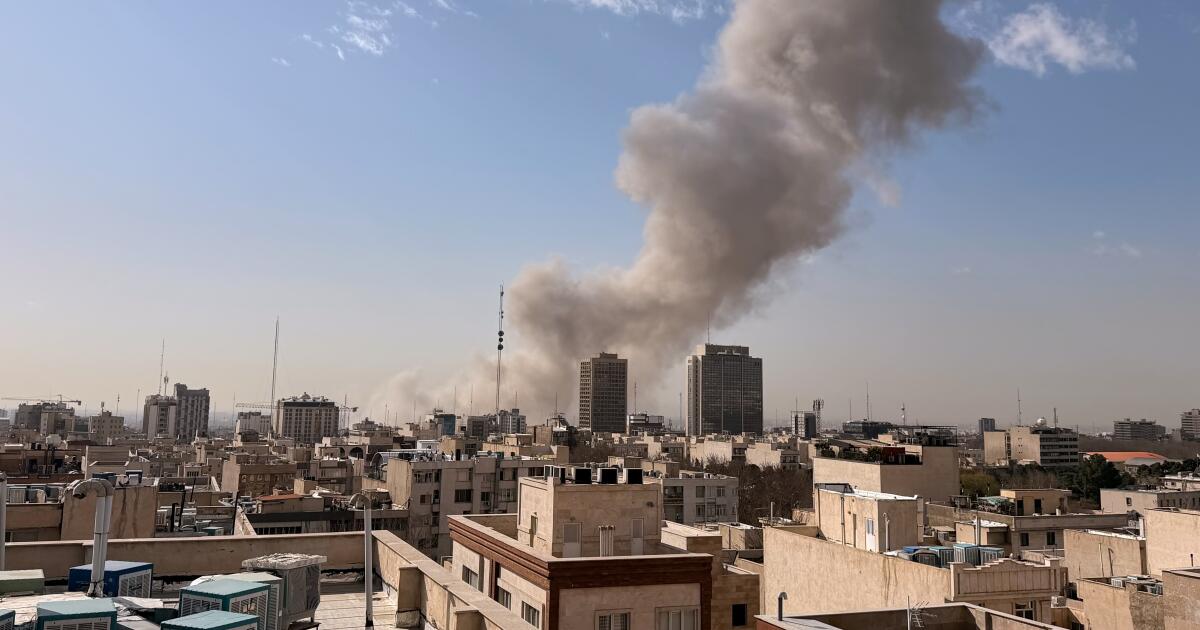
TEHRAN — The U.S. and Israel pummeled Iran early Saturday in an attack aimed at razing the Islamic Republic’s nuclear ambitions and thwarting its efforts to influence the Middle East though proxies such as Hezbollah and Hamas.
Iran’s Supreme Leader Ayatollah Ali Khamenei was killed in the attack, according to President Trump, who in a post on Truth Social wrote that “one of the most evil people in History, is dead. This is not only Justice for the people of Iran, but for all Great Americans.”
More than 200 people were killed in Iran and hundreds more injured, according to Iran’s Red Crescent.
The attacks spurred a furious Iranian retaliation, with multiple barrages striking Israel, a number of Gulf nations and Jordan; and fulfilled long-standing fears that a confrontation with Iran would plunge the entire region into war.
Reports of Khamenei’s death prompted diverse reactions worldwide: In portions of Tehran and Los Angeles, home to a large Persian population, people took to the streets to celebrate. In New York, protesters gathered at Times Square to denounce the attack.
The attack came eight weeks after U.S. forces deployed by Trump toppled Venezuelan President Nicolás Maduro, and Trump said Saturday’s operation also presented a chance for regime change.
Addressing the Iranian people, Trump said, “When we are finished, take over your government. It will be yours to take.”
Trump made the comments in an eight-minute prerecorded video. “This will be probably your only chance for generations,” Trump said, adding, “For many years, you have asked for America’s help, but you never got it. No president was willing to do what I am willing to do tonight.”
The Iranian government confirmed Khamenei’s death.
The attacks began with Israeli strikes Saturday morning — a workday in Iran — on Tehran, the capital, with residents speaking of attacks near Khamenei’s compound, the presidential palace, Iran’s National Security Council, the ministries of defense and intelligence, the Atomic Energy Organization and a military complex.
-
Share via
In Tehran there were scenes of panic, with residents racing to stock up on supplies, leaving shelves bare in grocery stores across the city. Others, heeding warnings from authorities of further strikes, decided to leave the capital. Images on social media showed highways leading out of Tehran choked with traffic.
“It’s going to take 10 hours at least, but it doesn’t matter,” said Zainab, who was loading her car with whatever she could stuff inside for the drive to her sister’s home in Iran’s northeast.
By the end of the day, the streets of Tehran appeared all but abandoned, with residents hunkering down for a night punctuated by the sounds of blasts reverberating across the capital.
Israeli Prime Minister Benjamin Netanyahu, a vociferous advocate for attacking Iran — and who has spent years urging Washington to do so — said the campaign would continue “as long as needed.”
Trump, who long insisted Iran cannot have nuclear weapons, also addressed Iran’s efforts in the Middle East in his video message.
“We are going to ensure that the region’s terrorist proxies can no longer destabilize the region or the world, and attack our forces,” he said. “And we will ensure that Iran does not obtain a nuclear weapon.”
Trump also said U.S. military forces “may have casualties,” adding, “That often happens in war.”
The Iranian Foreign Ministry, in a statement, said that “Iranians have never surrendered to aggression.”
Iranian Foreign Minister Abbas Araghchi, who was leading Iran’s delegation in Oman-brokered negotiations, said the war on Iran was “wholly unprovoked, illegal and illegitimate.”
“Our powerful armed forces are prepared for this day and will teach the aggressors the lesson they deserve,” he wrote on X.

Iranians protest on Saturday in Tehran against attacks on Iran by Israel and the United States.
(Majid Saeedi / Getty Images)
Israel’s military said its attacks were the largest military flyover in its history, with some 200 warplanes dropping hundreds of munitions on about 500 objectives.
Outside of Tehran, explosions could be heard in other cities, including Isfahan, Karaj, Kermanshah, Qom and Urmia, according to Iranian state media. An attack on the city of Minab struck a girls’ school, killing at least 85 students and injuring dozens of others, state-run media said.
Iran’s Red Crescent later said 201 people were killed in attacks across the country, and that 24 out of Iran’s 32 provinces were hit. More than 700 people were injured.
Cellphone and internet communications were disrupted shortly after the attacks began but have since been restored.
Iran struck back across the Middle East, with barrages reported on U.S. bases in the United Arab Emirates, Qatar, Bahrain, Kuwait, Iraq, Saudi Arabia and Jordan. Debris from one of those missiles killed one person in the UAE; another struck a hotel in Dubai. A Kuwaiti airport was hit, but no injuries were reported.
Iran also dispatched multiple waves of missiles to Israel, with residents in Jordan, Syria and Lebanon seeing vapor trails crisscrossing the skies above and the explosive sounds of interceptions.
The waves of ordnance spurred airspace closures across the region, with many airlines suspending service to affected countries and leaving tens of thousands of people stranded.
Araghchi informed his Iraqi counterpart, Fuad Hussein, on Saturday that Tehran will limit its response to U.S. military bases in the region, and that Iran was acting in self-defense.
But the attacks nevertheless infuriated Arab governments. Many came out with statements excoriating Iran for what they described as an unprovoked attack on their sovereignty.
Russia, whose ties with Iran have deepened in recent years, demanded Israel and the U.S. halt military operations. According to the Associated Press, U.N. Ambassador Vassily Nebenzia said, “We insist on the immediate resumption of political and diplomatic settlement efforts … based on international law, mutual respect and a balance of interests.”
In a sign of the rapidly expanding impact of the war, messages purporting to be from Iran’s Islamic Revolutionary Guard Corps were sent to ships ordering them to stay away from the Strait of Hormuz with “immediate effect.”
Shutting the strait, a strategic passageway through which one-fifth of global oil supplies pass, would probably lead to an immediate spike in energy prices and disrupt other shipping.
The opening salvos of what promises to be a lengthy campaign come two days after the U.S. and Iran concluded a third round of Oman-brokered negotiations in Geneva aimed at reducing tensions and stopping the prospect of war.
On Friday, Trump expressed displeasure with the pace of the talks, saying the Iranian side was not negotiating in “good faith” or giving in to U.S. demands. But Oman’s Foreign Minister Badr Albusaidi said a deal was “within reach.”
On Saturday, Albusaidi expressed dismay that “active and serious negotiations have yet again been undermined.”
“Neither the interests of the United States nor the cause of global peace are well served by this. And I pray for the innocents who will suffer,” he said in a statement on X.
The American strikes on Iran drew immediate reaction on Capitol Hill as Democrats and a small bloc of Republicans accused the White House of sidelining Congress on actions they fear will trigger a broader conflict in the Middle East.
“By the president’s own words, ‘American heroes may be lost.’ That alone should have demanded the highest level of scrutiny, deliberation, and accountability, yet the president moved forward without seeking congressional authorization,” Sen. Mark Warner (D-Va.), the vice chair of the Senate Intelligence Committee, said in a statement.
Rep. Ro Khanna (D-Fremont) called on lawmakers to back a measure he is co-sponsoring with Rep. Thomas Massie (R-Ky.) that would compel the administration to seek congressional approval before engaging in any further activity in Iran.
“The American people are tired of regime change wars that cost us billions of dollars and risk our lives,” Khanna said in a video posted on X.
As Democrats warned of constitutional overreach, other lawmakers rallied behind the president.
Sen. Roger Wicker (R-Miss.), the Senate Armed Services Committee chairman, said in a statement that Trump had taken “decisive action against the threat posed by the world’s leading proliferator of terrorism, the Iranian regime.”
“This is a pivotal and necessary operation to protect Americans and American interests,” Wicker said.
Secretary of State Marco Rubio notified some members of Congress’ Gang of Eight, which are the top four leaders in the House and Senate and top Democrats and Republicans on the House and Senate intelligence committees, according to CBS News.
Bulos reported from El Obeid, Sudan, Ceballos from Washington, D.C., and special correspondent Mostaghim from Tehran.

Unexpected birth brings hope to near-extinct Amazon tribe

Supreme Court blocks redrawing of New York congressional map, dealing a win for GOP

Oregon Dems block effort to alert ICE before illegal immigrant murderers are released

Terrifying moment caught on camera as road collapse suddenly swallows vehicles at busy intersection

Jasmine Crockett campaign reportedly kicked Atlantic writer out of rally for being a ‘top-notch hater’

Florida High School Football Rankings: Top 25 teams – Oct. 21

Cleary's 21 help Le Moyne down Central Connecticut State 69-64 in OT

How old is Bo Nix? What to know about Oregon quarterback ahead of 2024 NFL Draft

99th annual Pony Swim held in Virginia

Indiana Members Credit Union announced as new anchor tenant at Bottleworks District
Unexpected birth brings hope to near-extinct Amazon tribe
Supreme Court blocks redrawing of New York congressional map, dealing a win for GOP

Map: Earthquake Shakes Central California

Gas prices could jump as Middle East tensions threaten global oil supply

Pakistan calls troops, orders 3-day curfew as 24 killed in pro-Iran rallies
-

 World5 days ago
Exclusive: DeepSeek withholds latest AI model from US chipmakers including Nvidia, sources say
-

 Massachusetts5 days ago
Mother and daughter injured in Taunton house explosion
-

 Denver, CO5 days ago
10 acres charred, 5 injured in Thornton grass fire, evacuation orders lifted
-

 Louisiana1 week ago
Wildfire near Gum Swamp Road in Livingston Parish now under control; more than 200 acres burned
-

 Technology1 week ago
YouTube TV billing scam emails are hitting inboxes
-

 Politics1 week ago
OpenAI didn’t contact police despite employees flagging mass shooter’s concerning chatbot interactions: REPORT
-

 Technology1 week ago
Stellantis is in a crisis of its own making
-

 News1 week ago
World reacts as US top court limits Trump’s tariff powers