Politics
California businesses are reeling from Trump's on-again, off-again tariffs

Tariffs haven’t yet hit the supply chain at Anawalt in Malibu, but the hardware store and lumber seller is bracing for steep price hikes in the coming weeks.
The majority of the lumber that the store sells comes from Canada and nearly all of its steel products are made in China, general manager Rieff Anawalt said. Those countries, along with Mexico, have been targeted in sweeping tariffs imposed by President Trump during his second term, sparking a global trade war that intensified this week.
“These tariffs are 100% going to impact us,” Anawalt said. Wholesale reps for the family-run hardware company, which has five locations around Los Angeles County, have warned him to expect prices to go up by April 1 — costs that he said he’ll have to pass on to customers.
“We’re going to see major increases: 15% to 25% across the board in this industry,” he said. “It’ll make COVID prices seem cheap.”
Across California, businesses of all kinds — farmers, automakers, home builders, tech companies and apparel retailers — are reeling from weeks of on-again, off-again tariff chaos as Trump has announced a slew of levies against the country’s top three trading partners, implementing some while modifying, delaying or reversing others.
“It’s a day-by-day soap opera, and just like a soap opera, you get relief, then it heats up again,” said Jonathan D. Aronson, a professor of international communication and international relations at USC.
As a result, business owners “don’t know what’s going to happen,” he said. “They can’t plan. They don’t know how much to produce. They don’t know who their business partners are going to be.”
This month has been particularly tumultuous. On March 4, Trump’s 25% tariffs on imports from Canada and Mexico kicked in, with a limit of 10% on Canadian energy; he also doubled the tariff on all Chinese imports to 20%. All three countries vowed to strike back with their own measures.
A lumber yard in British Columbia, Canada, last month. Canada is the largest foreign supplier of lumber to the U.S.
(Bloomberg via Getty Images)
The next day, Trump granted a one-month exemption for U.S. automakers on his new tariffs on imports from Canada and Mexico. The day after that, he said he was postponing many of the tariffs on Canadian and Mexican imports for a month.
On Monday, in a blow to farmers in California and across the U.S., China imposed retaliatory duties of up to 15% on American agricultural products including chicken, corn, beef, pork, wheat and soybeans. Then on Wednesday, Trump’s 25% tariffs on all steel and aluminum imports went into effect.
To counterbalance the effects of the tariffs on their bottom lines, businesses may have to overhaul their operations, said Jerry Nickelsburg, faculty director of the UCLA Anderson Forecast.
“The way in which firms react to that uncertainty is to not put all their eggs in one basket,” he said. “So they cut back on how much they would order, which means they’re going to produce less and they need fewer people — or if not fewer people, fewer hours for the people they have.”
The latest volley came Thursday morning, when Trump threatened to place a 200% tariff on wine and liquor from the European Union in response to the EU proposing a 50% tariff on American whiskey. About an hour later, he wrote in a follow-up post on Truth Social that the U.S. “doesn’t have Free Trade. We have ‘Stupid Trade.’”
“The Entire World is RIPPING US OFF!!!” he said.
Bolstering the economy was one of Trump’s core promises during the election, and tariffs are key to his strategy. He threatened to slap tariffs on Mexico, Canada and China on his first day back in office, explaining the decision as a way to crack down on illegal immigration and drugs.
But the escalating trade tensions have pummeled Wall Street for three weeks. On Thursday, the S&P 500 closed in correction territory, ending the day down 1.39%; the index is now 10.1% below its record close Feb. 19. The Dow Jones Industrial Average fell 537.36 points, or 1.3%, closing at 40,813.57.
The fallout for farmers
The prolonged back-and-forth has also unsettled companies, both those that import goods from abroad and those that sell their products to foreign clients. California’s economy could be especially hard hit because of its heavy reliance on trade with China and Mexico, and because of its position as a global agricultural powerhouse.

Farmer Joe Del Bosque holds a raw almond in Firebaugh, Calif.
(Robert Gauthier / Los Angeles Times)
California farmers grow the largest share of the nation’s food — more than a third of the country’s vegetables and more than three-quarters of its fruits and nuts are grown here — and the state’s fertile ground is a major supplier of produce to countries around the world. Farmers also rely heavily on fertilizer from Canada, which could cost more as the tariffs take hold.
“Farmers in California are going to be hurt particularly badly because almonds, soybeans and things like that are huge exports of the United States,” Aronson said.
The state also accounts for about 85% of wines produced in the United States and is home to thousands of grape growers and wineries, many of them small and generations-old. The Wine Institute says the industry supports employment for more than 420,000 Californians and generates $73 billion in economic activity in the state. Canada is the largest market for California wine.
A flurry of activity at the ports
Some L.A.-area companies have been stockpiling inventory to get ahead of expected price hikes tied to the tariffs, said Stephen Cheung, chief executive of the Los Angeles County Economic Development Corp.
“A lot of them were hit pretty hard during the last trade war with China,” he said, “so they knew better than to wait and hope for the best.”
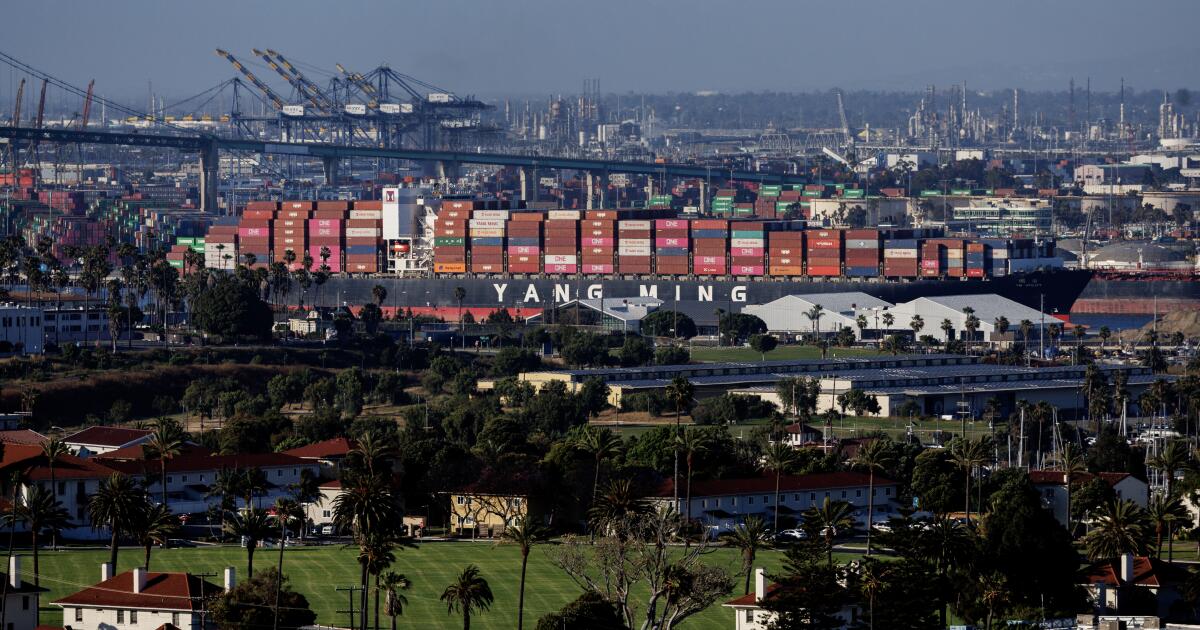
That has been reflected in shipping data from the ports in Long Beach and Los Angeles, which continue to record huge numbers thanks to several months of front-loading cargo ahead of Trump’s inauguration.
The Port of Long Beach moved 765,385 twenty-foot equivalent units, or TEUs, in February, a 13.4% increase from the previous year. January’s year-over-year growth was even larger: 952,733 TEUs — a unit of measurement based on the volume of a standard shipping container — were moved, representing a 41.4% increase.

An aerial view of the Port of Long Beach.
(Allen J. Schaben / Los Angeles Times)
After Trump launched a trade war with China during his first term, the Port of Long Beach lost about 20% of expected Chinese cargo in 2019, Chief Executive Mario Cordero said. That was supplemented by a 10% increase in imports from countries in Southeast Asia including Vietnam, Indonesia and Thailand. He expects the same thing to happen this time around.
In the coming months, Cordero said, the local economy could see supply chain disruptions, similar to what occurred during the pandemic, “if we continue on the path of aggressive and high” tariffs.
The Port of Los Angeles expects a 10% reduction in volume from last year amid Trump’s tariffs against China, Executive Director Gene Seroka said.
It’s a day-by-day soap opera, and just like a soap opera, you get relief, then it heats up again.
— Jonathan D. Aronson, a professor of international communication and international relations at USC
One of the largest seaports in the country, the L.A. port has seen sharp increases in cargo since last summer as businesses stocked up in anticipation of potential Trump tariffs. Just under 10.3 million TEUs, a near record, passed through the port last year.
Those numbers are likely to trend downward as tariffs take hold and the economy adjusts, Seroka said. “Fewer containers mean fewer jobs.”
L.A. businesses try to adjust
Economists say it’s difficult for companies to quickly change suppliers, and some may be loath to upend their supply chains given the ever-changing nature of Trump’s trade policies.
Some are trying anyway.
Francesca Grace, an interior designer and home stager in Los Angeles, said tariffs have already affected the availability and price of items including fabrics, wood and other building materials, and smaller decor pieces.
Supply chain delays have extended her project timelines in some cases to three to six weeks from immediate availability, and she’s contending with “at least a 25% rise” in costs for materials from China. As a result, she’s now trying to source all of her products locally, up from 75%.
“While this shift aligns with our values, it will also cause our pricing to increase,” Grace said. “We are doing everything we can to avoid increasing our pricing too much. The last thing we want is for these changes to negatively impact our business or make our designs inaccessible.”
Other businesses say they have little choice when it comes to where they get their merchandise.
“Lumber prices are what they are. There’s no sourcing it somewhere else, so we’re going to have to deal with it as it comes,” said Anawalt, the general manager at the Malibu hardware store. “It’s so beyond my control, there’s nothing I can do. I was panicked at first, but now I’m just going to wait.”



Construction workers unfurled a large printed tarp to cover scaffolding installed at the White House’s front entrance. Doug Burgum, the interior secretary, said President Trump had ordered the repairs after noticing damage to columns.
Politics
WATCH: Trump’s Energy chief reveals what escalating Iran tensions could mean for gas prices

NEWYou can now listen to Fox News articles!
Energy Secretary Chris Wright is telling Americans not to be concerned about the possibility of another surge of sharp increases in gasoline prices as tensions with Iran have started to escalate once again.
Asked whether Americans should worry about higher prices at the pump and how the Trump administration is preparing to keep the economy stable if the conflict continues to worsen, Wright told Fox News Digital: “It has not been any good behavior from Iran that’s allowed oil to flow. It’s been the United States military.”
“That’s not changing,” he assured, speaking from the Great American State Fair on the National Mall this week.
US CLAWS BACK KEY CONCESSION TO IRAN AFTER FRESH ATTACKS ON COMMERCIAL SHIPS IN STRAIT OF HORMUZ
(Mario Tama/Getty Images) (Mario Tama/Getty Images)
With Iran striking three commercial vessels transiting the Strait of Hormuz on Monday and Tuesday, Wright doubled down in urging citizens to not credit Iran for the U.S. military’s work to ensure oil shipments continue flowing through the strait.
“Look, the U.S. Military has been the key asset here,” he said. “They have assured the flow of oil and gas through the Strait of Hormuz throughout. Not at the beginning of this conflict, but through the last six weeks.”
Wright said the administration is closely monitoring global oil supplies as the tentative ceasefire with Iran seemingly came to come to a halt, with President Donald Trump telling Secretary-General Mark Rutte the call for peace with Iran is “over” at the NATO Summit in Turkey on Wednesday.
But, he pointed to the continued shipping through the Strait as evidence that markets should remain stable.
TRUMP SAYS IRAN CEASEFIRE IS ‘OVER’ AFTER IRANIAN ATTACKS TRIGGER MASSIVE US RESPONSE
President Donald Trump speaks at the White House on Tuesday, April 22. (AP/Alex Brandon)
“We’re of course constantly watching the supply of oil, the supply of refined products and what’s going on there,” Wright said. “And I think still all positive trends.”
Beyond geopolitical concerns, Wright also praised the new chain of discounted gas stations across Pennsylvania and New Jersey, Freedom Fuel, which promises customers prices below the national average.
The Trump administration, though not involved with the network, has heavily endorsed the new chain and its 25 locations.
“We love it,” Wright said when asked about Freedom Fuel. “I mean, look, any mechanism we can to lower energy costs for Americans of all kinds, we’re all in on.”
“With Freedom Fuels, they’re just lowering it down to their wholesale price of gasoline,” Wright said. “So they’re not making any money selling gasoline, but they’ve got convenience stores. That’s how most gas stations make money.”
NEWSOM UNDER FIRE AS CALIFORNIA GAS TAX HIKE SENDS PUMP PRICES EVEN HIGHER
Gasoline costs are a known concern for many Americans, and amid surging prices there has been a considerable increase in those opting to purchase electric vehicles to save money long-term at the pump — with Tesla dominating the market for these types of models.
Wright argued one of the benefits to living in America is having the option to choose what type of vehicle you drive.
CLICK HERE TO DOWNLOAD THE FOX NEWS APP
“We just want people to buy what they would prefer,” he told Fox News Digital when asked his thoughts on increasing calls for support of the electrification of cars. “Consumer choice — you wanna buy an electric car, you wanna buy a gas powered car, diesel powered car, buy a big truck. That’s the choice.”
“That’s why you live in America. You get the choice of all those.”

In 2023, California regulators levied more than $100,000 in fines against the private operator of a federal immigration facility, kicking off a three-year battle over whether detainees who do work at the facilities should be considered employees.
The question went beyond semantics: If considered employees, the detainees would be subject to state worker protection laws.
A legal settlement announced this week now affirms that private immigrant detention facilities are subject to California’s workplace safety and health requirements.
“Every worker deserves a safe and healthy workplace and should be able to report workplace hazards without fear of retaliation,” said Denisse Gómez, spokesperson for the California Division of Occupational Safety and Health or Cal/OSHA.
“Individuals who perform work in these facilities are entitled to workplace safety protections, and this settlement reinforces Cal/OSHA’s commitment to enforcing those protections and safeguarding vulnerable workers,” she added.
Under the settlement between California and the GEO Group, a Florida-based private prison company, the company recently withdrew its legal challenges and agreed to pay more than $100,000 in the fines.
The GEO Group did not respond to requests for comment.
Back in 2023, Cal/OSHA issued $104,510 in fines against the GEO Group. The agency had found six violations of state code by the company after detainees complained about a lack of protective equipment and proper training while cleaning the facility for $1 per day.
Detainees alleged they routinely wiped black mold off shower walls at the facility, saw black dust spew from air vents and used cleaning solutions that lacked instructions during the COVID-19 pandemic.
The biggest fine levied against the GEO Group was for failure to establish and maintain “effective written procedures to reduce employee risk of exposure to aerosol transmissible disease.”
Advocates viewed Cal/OSHA’S recognition of the detainees as workers as a victory that could pave the way for future labor rights fights at other detention centers in the state.
But the GEO Group appealed, arguing that detainees participating in ICE’s voluntary work program make their own schedules and aren’t employees, so hazard exposure couldn’t be “as a result of assigned duties,” as California law states. Plus, the company argued, there wasn’t enough evidence that detainees were exposed to any hazard.
Early last year, the state’s Occupational Safety and Health Appeals Board rejected the GEO Group’s argument and found that detainees should be considered “affected employees.”
The GEO Group sued, but three days before a California Superior Court hearing in May, the company and Cal/OSHA reached the settlement.
Along with paying the fines, the GEO Group agreed to draft plans for avoiding aerosol transmissions at 12 secure and reentry facilities in California, including five detention centers that hold immigrants.
“GEO ensures detainees are afforded the necessary tools, equipment, and personal protective equipment … to safely and effectively perform any necessary tasks,” the settlement states.
Gómez said the settlement also leaves intact the appeals board’s ruling that civil immigration detainees who participate in work programs can participate in proceedings anonymously, “acknowledging the potential for retaliation when individuals raise workplace safety concerns.”
But the question of whether detainees are employees and deserve certain protections isn’t entirely resolved — at least not for the federal government.
Last month, U.S. Immigration and Customs Enforcement released new standards for detention facilities across the country. The revised guidelines “emphasize that detainee volunteers participating in the voluntary work program are not considered facility and/or government employees” and thus not entitled to labor regulations.
Attorney Mariel Villarreal said the timing of the new detention standards made her question whether the GEO Group had asked ICE to specify in its standards that detainees are not workers in response to its battle with Cal/OSHA.
“To me, it’s a reaction to this very settlement,” she said. Villarreal works for the California Collaborative for Immigrant Justice, which filed the original complaint on behalf of detainees who said they worked in unsafe conditions.
Villarreal pointed to a Washington Post report that GEO Group executives privately asked ICE to specify that detainees are not employees of the facilities where they work. Two top Trump administration officials, border czar Tom Homan and acting ICE director David Venturella, previously worked for the GEO Group.
New versions of ICE detention standards take effect as contracts are established or modified, so this year’s rules won’t immediately apply to every facility.
An ICE spokesperson did not comment about the settlement. The spokesperson, who did not provide their name in an emailed statement Wednesday, said the agency has begun transitioning detention facilities to meet the 2026 standards, “building on its longstanding commitment to safe, secure, and professional detention operations.”
“ICE has consistently implemented many of these best practices independently, reinforcing its role as the leader in detention operations,” the spokesperson added.
The GEO Group and other immigrant detention center operators have faced other legal battles over workers’ rights, including lawsuits in Washington, Colorado and California over the $1-per-day payment.
Villarreal said she’s confident that the Cal/OSHA settlement would continue to hold even if California facilities incorporated the new standards. But she said she believes the statements are an attempt by the GEO Group to “sidestep responsibility” and avoid the possibility of being fined under similar circumstances in other states.
“These statements in the new standards are a way for them to try and preserve profits as much as possible,” she said. “GEO and ICE are so intertwined at this point that they have the same motives.”
-

 Dallas, TX2 minutes ago
FC Dallas Forward Logan Farrington Inks Contract Extension
-

 Boston, MA10 minutes ago
Red Sox face lengthy travel issues ahead of series vs. Mets
-

 Denver, CO17 minutes ago
What’s going on with the Nuggets? Unpacking an NBA offseason on hold
-

 Seattle, WA20 minutes ago
Seattle Kraken Sign Goaltender Victor Östman and Defenseman Ville Ottavainen to One-Year Deals | Seattle Kraken
-

 San Diego, CA25 minutes ago
An executive shuffle at San Diego’s Sempra
-
Milwaukee, WI32 minutes ago
Survey finds less than half of Jews in Milwaukee identify as Zionists | The Jerusalem Post
-

 Atlanta, GA35 minutes ago
Atlanta Hawks Showing Interest In Denver’s Peyton Watson, But Is The Price Too High?
-

 Minneapolis, MN40 minutes ago
Uptown businesses push to delay Lyndale Avenue project

