Politics
AA meetings in the White House? Kennedy, a recovering addict, says it's just one of changes he'd make

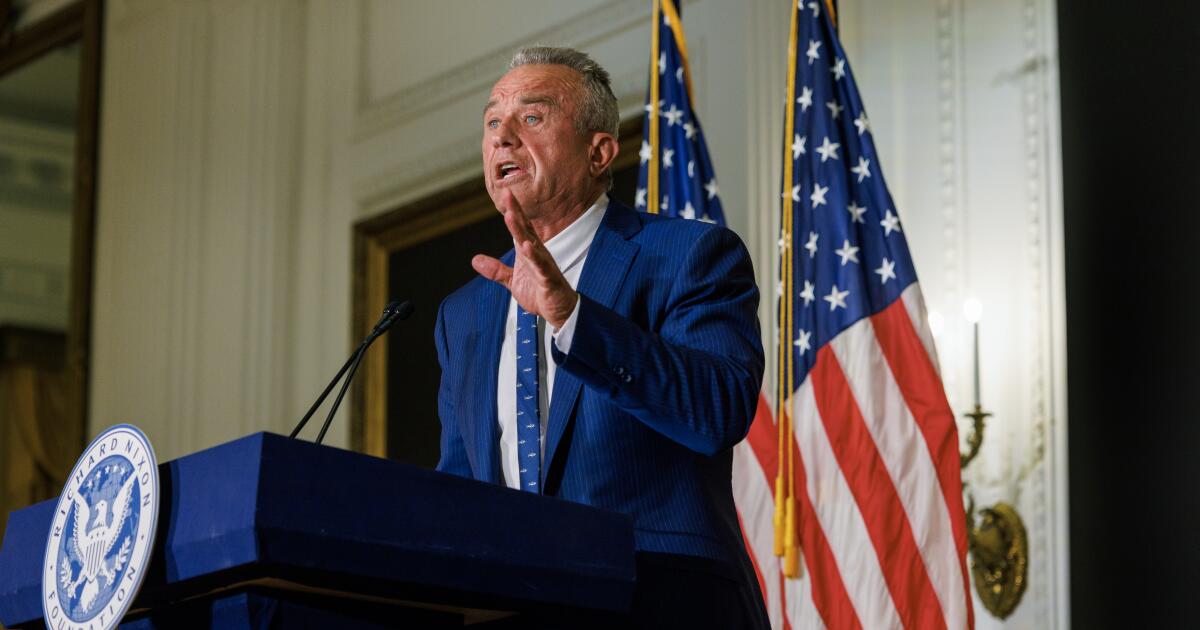
Is America ready to elect a recovering addict as president? How about one who wants to hold 12-step recovery meetings in the White House?
Robert F. Kennedy Jr. hopes to be that president, the onetime heroin user saying he long ago left behind his dependency on “drugs, sex, alcohol or extreme behavior” to balm a wounded psyche. Thanks in large part to more than 40 years of 12-step meetings, Kennedy says, “I don’t have a big empty hole that I’m trying to fill with things outside of me.”
The independent presidential candidate in recent days has said he wants to use his own 14-year addiction to heroin and more than four decades of recovery to help bring a new level of attention to the nation’s addiction crisis.
Kennedy recently premiered a documentary, “Recovering America,” in which he tours the country looking for programs that show the most promise of helping the nearly one in seven people who report having a substance use disorder.
“Today, twice as many Americans die of addiction every year as died during the entire Vietnam War,” Kennedy has said. Nearly 110,000 died in the U.S. last year of overdoses, not quite double the 58,000 Americans who died in Vietnam. “And while there have been incredible innovations in recovery programs, as a nation we have failed to address the staggering magnitude of the crisis.”
Dating back to almost its founding, the United States has had presidents who drank to excess and at least a handful who reportedly used drugs, mostly before they entered the White House. But none of the nation’s chief executives acknowledged abusing drugs or being in recovery from addiction.
The former environmental lawyer is yet to qualify for the ballot in many states. And he is fighting a thus-far-losing battle to win a spot onstage for the nationally televised debates that will feature former President Trump and President Biden.
Kennedy, 70, has spoken about his addictive personality many times over the years. By his account, his recovery taught him humility and opened his heart toward God. But the redemption stories were preceded by years of darker media accounts about his reckless behavior — his serial adultery during his second marriage and claims that he helped lead his younger brother David into what became a fatal heroin addiction.
The candidate says his struggles have made him more empathetic and launched him on a life of service.
“My job as president of the Untied States will be to remind Americans that we’re all part of a community,” he said during a panel discussion after the documentary premiered in Albuquerque on June 15. “We’ve got to go back and figure out how we include everybody and how we amplify and multiply the opportunities for service with each other.”
Kennedy said his heroin addiction began at 15, not long after his father was assassinated on the night that he claimed victory in the California primary, as he campaigned for the 1968 Democratic presidential nomination.
Thrown out of two boarding schools, the younger Kennedy managed to make it through Harvard and the University of Virginia law school, despite multiple relapses. The cycle finally ended, by Kennedy’s account, after he overdosed on a flight to South Dakota and was arrested for heroin possession. He was 29.
“I feel like I was a one-dimensional human being. I was like a collection of appetites that needed to be fed all the time and that becomes like a full-time job,” Kennedy told YouTube host Sage Steele.
After a rehabilitation stay in New Jersey, Kennedy said 12-step meetings became key to his recovery. At one of the first sessions he asked a veteran how long he would have to attend.
“He said, ‘Just keep coming until you like it,’“ Kennedy recalled in an interview. “And I’ve been going for 40 years and I still don’t like it. But I go because the rest of my life works when I go.”
“I am careful about using any substance or behavior that tries to fix the uneasiness, the emptiness and the restlessness inside of myself with something outside,” he said. “And that’s really what the addictive mind is constantly looking for.”
He said he tries to attend nine meetings a week when he is home — seven morning sessions in Pacific Palisades and Tuesday and Thursday meetings at the Mandeville Canyon home he shares with his wife, actress Cheryl Hines.
While on the campaign trail, Kennedy said, he has made clear to his security detail that they need to make time every day for an AA meeting and a gym workout. Just hours before the premiere of his recovery documentary, he participated in an AA meeting at Monte Vista Christian Church in Albuquerque.
”As long as I’m unannounced at places, I can go almost anywhere,” Kennedy said. “The problem is, when you’re announced you have to screen people and do all of that.”
He said he “absolutely” would hold AA meetings in the White House, if elected. And he might even try to slip out occasionally to attend sessions in the community.
But he said his AA attendance is not meant to score political points. “The moment you are doing it out of material self-interest, the whole thing will turn on you,” he said.
Such regular AA attendance is not unusual for people who recently entered recovery. A maxim of 12-step programs is “90 meetings in 90 days.” Experts said it is unusual for someone far into recovery to attend sessions religiously, but likely indicates Kennedy views himself as a mentor to younger addicts.
Kennedy described his recovery as part of a “spiritual awakening,” in which he willed himself to believe in God, a faith that was later fulfilled by finding “synchronicity,” a confluence of meaningful events in the universe. He was introduced to the concept after reading Carl Jung, one of the fathers of psychotherapy.
“With a spiritual awakening, you have to renew it every day by helping somebody else,” Kennedy said. “And the meetings are an organized framework that gives everybody there an opportunity to help somebody else. … That’s why people go long after their compulsion to drink or drug has passed.”
He said he would take several steps to improve drug and alcohol treatment in the U.S. One would be trying to increase Medicaid funding for rehabilitation programs. He said that would be cheaper than funding later care for chronic disease, or in emergency rooms.
“Recovering America” featured several successful nonprofits, including Simple Mission Farms, a Texas rehabilitation program where former addicts engage in “therapeutic farming and animal-assisted therapy,” according to the nonprofit’s website.
As a centerpiece of his anti-addiction program, Kennedy said he would open hundreds of such “healing farms” — places “where American kids can reconnect to America’s soil, where they can learn the discipline of hard work, to rebuild self-esteem.”
He said these centers would be built with government support but have substantial freedom to find their own best practices. “I don’t want to come in micromanaging it,” he said, “because government never gets anything right.”
He said he would fund the farms by putting a federal tax on sales of legal marijuana, which he estimated would bring in $8 billion a year.
“There is hope for our nation to heal the scourge of addiction,” he concludes in the documentary. “We just have to make it an actual priority and when I’m in the White House, we will.”

Politics
RFK Jr. responds to snake-handling critics with new video showing him wrangling a venomous rattlesnake

NEWYou can now listen to Fox News articles!
Health and Human Services Secretary Robert F. Kennedy Jr. shared another snake-handling video Wednesday after social media users raised concerns over his earlier encounter with a pair of black racer snakes.
Kennedy Jr. posted an Instagram video captioned, “In response to the many comments about venomous snakes, this video shows how Cheryl and I handled a recent rattlesnake rescue.”
The clip begins with Kennedy Jr. sitting in his home office before someone alerts him to a snake in the driveway.
“Hold on, guys. I’ll be back in a flash,” he says before grabbing a bucket and a small net and heading outside.
RFK JR BAREHANDS A PAIR OF SNAKES ON DR. OZ’S PATIO IN WILD VIDEO
RFK Jr. wrangles a Western Diamondback rattlesnake during a rescue video shared to Instagram Wednesday. (Instagram/RFKJr.)
The HHS secretary then carefully scoops up the rattlesnake as onlookers react in amazement.
After placing the snake in a bucket, Kennedy Jr. later pins it behind the head and lifts it toward the camera while explaining how to identify the reptile.
“His fangs are in there. I don’t want to touch them,” he said. “This is a beautiful snake. This is a Western Diamondback. You can tell by these rings at the end of his tail.”
Kennedy Jr. then asked his wife, actress Cheryl Hines, to bring him a pillowcase before transporting and releasing the snake back into the wild.
ACTRESS CHERYL HINES CLASHES WITH ‘THE VIEW’ OVER HER HUSBAND RFK JR’S RECORD SERVING AMERICANS
Health and Human Services (HHS) Secretary Robert F. Kennedy Jr. proudly displays a pair of black North American racer snakes he caught on Dr. Oz’s patio. (Robert F. Kennedy Jr.)
The Instagram post appeared to respond directly to criticism and concern sparked by another snake video Kennedy Jr. shared Tuesday on X.
In that clip, Kennedy Jr. grabbed two black North American racer snakes with his bare hands while visiting Dr. Mehmet Oz’s patio as Hines watched in apparent horror.
“Honey, honey … why?” Hines yelled as Kennedy Jr. cornered the snakes.
Kennedy Jr. then lunged at the reptiles and eventually lifted both by their tails as they repeatedly bit his hands.
CHERYL HINES SHARES HARROWING EVACUATION FROM WHITE HOUSE CORRESPONDENTS’ DINNER AS GUNSHOTS RANG OUT
U.S. Secretary of Health and Human Services Robert F. Kennedy Jr. and Cheryl Hines attend the 2026 White House Correspondents’ Dinner at the Washington Hilton in Washington, D.C., on April 25, 2026. (Taylor Hill/WireImage)
“Black snakes, they’re biting me,” Kennedy Jr. said with a smile.
The snakes continued striking at his hands as Hines pleaded, “Bobby, please! Bobby, Bobby, please,” before later telling him, “You are nuts.”
Kennedy Jr. later posted the video to X with the caption, “Cheryl cheerleads the removal of a pair of Black Racers from Dr Oz’s patio.”
According to the Florida Museum of Natural History, black racer snakes are nonvenomous and generally harmless to humans, though they will “readily bite to defend themselves.”
CLICK HERE TO DOWNLOAD THE FOX NEWS APP
The earlier video showed Kennedy Jr. handling nonvenomous snakes, while Wednesday’s Instagram clip focused on a venomous Western Diamondback rattlesnake, prompting some social media users to question whether the HHS secretary was taking unnecessary risks.
Fox News Digital’s Robert McGreevy contributed to this report.

SACRAMENTO — Gov. Gavin Newsom has threatened to tax 100% of the money Californians receive from President Trump’s “anti-weaponization” fund for his political allies.
Trump’s Justice Department had announced last week that it would establish a $1.776-billion fund to compensate allies of the president who claim they have “suffered weaponization and lawfare” under the Biden administration’s Justice Department.
“Anyone from California that receives any of those funds, we want to tax 100% of those proceeds,” the governor told reporters Thursday.
“That’s an action the state of California can take …[and] it’s an action we look forward to taking.”
Just how Newsom would do so remains unclear. He indicated that he would need action from the Democratic-led California Legislature to impose the new tax. If adopted, the measure would likely face legal challenge.
The fund has prompted outrage from Democrats and some Republicans — including Sen. Mitch McConnell (R-Ky.), who said in a statement that the “slush fund,” which would “pay people who assault cops,” was “utterly stupid.”
Newsom’s remarks about Trump’s settlement fund came on Thursday as he signed a bill designed to prevent election interference ahead of Tuesday’s primary.
The bill, Senate Bill 73, restricts law enforcement agencies and officers — including those from federal agencies — from interfering with state and local election officials, such as confiscating ballots, voter rolls or voting machines without a warrant.
The governor said the bill is meant to address “legitimate anxiety” over threats to election integrity after Riverside County Sheriff Chad Bianco’s decision to seize ballots from the county’s voter registrar as part of a fraud probe. Bianco, a long-time Trump supporter, is one of the top Republicans running to succeed Newsom after the end of his second and final term as governor.
Newsom also pointed to ICE and Border Patrol’s decision last November to stage an event near Dodger Stadium, calling it a “show of force designed to intimidate free expression and free speech.”
“That’s why we have to step up and we have to draw the line,” Newsom said. “We have to clarify the rules of engagement… there are fines associated with this, criminal fines and jail time of three years, so that’s a warning [to] the folks out there that think they can do the bidding of the Trump administration.”
Newsom said he expects Trump to interfere with the upcoming election — noting that the president has falsely claimed that he “won” California in the last election.
“Every single thing that Donald Trump is saying only suggests that he will do more, not less, to intimidate and to impact the outcome of this election,” Newsom said. “I absolutely expect the worst again, because we’ve been on the receiving end of it.”

The nationwide gerrymandering battle has escalated in recent weeks, after a landmark Supreme Court ruling in April weakened the Voting Rights Act and set off a scramble to redraw maps in some Southern states that have yet to hold primaries.
Eight states have redrawn their congressional districts since President Trump pressured Texas lawmakers last summer to pass a new map favoring Republicans. Republican lawmakers in two states are pushing to use a new map ahead of November’s midterm elections.
Here is a look at how district lines have changed in each of the states that have redrawn maps, and how the new maps would have fared in the 2024 presidential election.
Tap on a district for details.
2024 presidential vote margin
Number of districts
2024
2026
Change
+20 Dem. and greater
27
21
–6
+10 to +20 Dem.
6
16
+10
0 to +10 Dem.
8
10
+2
0 to +10 Rep.
6
1
–5
+10 to +20 Rep.
3
2
–1
+20 Rep. and greater
2
2
0
 Tap on a district for details.
Gov. Gavin Newsom and Democratic state lawmakers moved quickly to redraw California’s congressional districts in response to Texas’ gerrymandered map. The new California map, which lawmakers approved in August and voters passed in November of last year, was designed to flip five red districts.
The Supreme Court upheld the map in February, dismissing Republican claims that the state’s new district boundaries illegally favored Latino voters.
Tap on a district for details.
| 2024 presidential vote margin | Number of districts | ||
|---|---|---|---|
| 2024 | 2026 | Change | |
| +20 Dem. and greater | 3 | 3 | 0 |
| +10 to +20 Dem. | 0 | 1 | +1 |
| 0 to +10 Dem. | 5 | 0 | –5 |
| 0 to +10 Rep. | 0 | 1 | +1 |
| +10 to +20 Rep. | 9 | 16 | +7 |
| +20 Rep. and greater | 11 | 7 | –4 |
Florida’s Legislature passed a new map just days after the Supreme Court ruling on the Voting Rights Act. The map creates four more Republican-leaning House seats, splitting up a Democratic-leaning district in the Tampa area and eliminating a Democratic-leaning district in the Orlando area.
Tap on a district for details.
2024 presidential vote margin
Number of districts
2024
2026
Change
+20 Dem. and greater
2
1
–1
+10 to +20 Dem.
0
0
0
0 to +10 Dem.
0
0
0
0 to +10 Rep.
1
0
–1
+10 to +20 Rep.
0
3
+3
+20 Rep. and greater
5
4
–1
In late September, Gov. Mike Kehoe, a Republican, signed into law a new map that slices the Democrat-leaning core of Kansas City into districts with heavily Republican rural areas. Republicans hope to add one Republican seat, ousting longtime Representative Emanuel Cleaver and leaving the state with just one solidly Democratic district in the St. Louis area.
Tap on a district for details.
2024 presidential vote margin
Number of districts
2024
2026
Change
+20 Dem. and greater
3
3
0
+10 to +20 Dem.
0
0
0
0 to +10 Dem.
0
0
0
0 to +10 Rep.
2
1
–1
+10 to +20 Rep.
8
10
+2
+20 Rep. and greater
1
0
–1
In North Carolina, Republicans control both houses of the legislature and approved a new map in October of last year. The new map could give Republicans an extra seat in the First Congressional District, which previously included all eight of the state’s majority Black counties and was redrawn to include more conservative-leaning counties.
Gov. Josh Stein, a Democrat, cannot veto redistricting plans, per the state Constitution.
Tap on a district for details.
2024 presidential vote margin
Number of districts
2024
2026
Change
+20 Dem. and greater
2
2
0
+10 to +20 Dem.
0
0
0
0 to +10 Dem.
2
1
–1
0 to +10 Rep.
3
3
0
+10 to +20 Rep.
2
3
+1
+20 Rep. and greater
6
6
0
Ohio’s bipartisan redistricting commission approved a new map in October of last year that could add up to two Republican seats. The new map dilutes Democrat-held districts near Toledo and Cincinnati.
Unlike many other states pursuing maps ahead of the normal timeline, Ohio had been required under its state Constitution to redraw its congressional maps before the 2026 midterms.
Tap on a district for details.
| 2024 presidential vote margin | Number of districts | ||
|---|---|---|---|
| 2024 | 2026 | Change | |
| +20 Dem. and greater | 1 | 0 | –1 |
| +10 to +20 Dem. | 0 | 0 | 0 |
| 0 to +10 Dem. | 0 | 0 | 0 |
| 0 to +10 Rep. | 0 | 0 | 0 |
| +10 to +20 Rep. | 1 | 0 | –1 |
| +20 Rep. and greater | 7 | 9 | +2 |
Tennessee Republicans moved swiftly after the Supreme Court decision that weakened the Voting Rights Act. Gov. Bill Lee signed a new map into law in early May that carves up the only Democratic district in the state, a majority Black district encompassing the Memphis area, splitting it into three neighboring districts.
A coalition of voters and Democratic candidates sued Tennessee officials in federal court over the new map, arguing that it was unconstitutional to implement new district lines this close to the state’s Aug. 6 primary.
Tap on a district for details.
2024 presidential vote margin
Number of districts
2024
2026
Change
+20 Dem. and greater
10
7
–3
+10 to +20 Dem.
1
1
0
0 to +10 Dem.
0
0
0
0 to +10 Rep.
2
0
–2
+10 to +20 Rep.
4
8
+4
+20 Rep. and greater
21
22
+1
Texas was the first state to redistrict last year, after President Trump urged Republican leaders to redraw maps ahead of the midterm elections.
The new map, signed into law by Gov. Greg Abbott in August of last year, could add up to five Republican seats in the state. Democrats argued that the new lines cut into majority Black and Hispanic districts in violation of the Voting Rights Act, but the Supreme Court upheld the map in December.
Tap on a district for details.
2024 presidential vote margin
Number of districts
2024
2026
Change
+20 Dem. and greater
0
1
+1
+10 to +20 Dem.
0
0
0
0 to +10 Dem.
0
0
0
0 to +10 Rep.
0
0
0
+10 to +20 Rep.
1
0
–1
+20 Rep. and greater
3
3
0
A Utah state judge in November tossed out a congressional map proposed by the state’s Republican Legislature, instead adopting a map offered by a centrist coalition. That map adds a Democratic-leaning district surrounding Salt Lake City.
Tap on a district for details.
2024 presidential vote margin
Number of districts
2024
2026
Change
+20 Dem. and greater
1
0
–1
+10 to +20 Dem.
0
1
+1
0 to +10 Dem.
1
0
–1
0 to +10 Rep.
0
0
0
+10 to +20 Rep.
0
1
+1
+20 Rep. and greater
5
5
0
Alabama had faced a ban on middecade redistricting until after the 2030 census. But after the Supreme Court ruling on the Voting Rights Act, Republicans in Alabama sought to revert back to a map first proposed in 2023 that had previously been rejected as a violation of the act.
The Supreme Court removed a critical obstacle for the use of that map in May, which would most likely do away with one of two majority-Black districts in the state.
Still, legal challenges remain. A panel of federal judges on May 26 rejected the new map, saying that the districts discriminated against Black people and could not be used so shortly before a vote. Alabama has appealed the ruling to the Supreme Court.
Gov. Jeff Landry, a Republican, delayed House primary elections after the Supreme Court’s decision on the Voting Rights Act tossed out Louisiana’s current maps. Ballots cast in the state’s primaries, where early voting began just days after the decision, did not count. New primary elections will be held in November.
The Louisiana Legislature is continuing to debate a new map, but is expected to eliminate at least one of the state’s two majority-Black districts.
-

 Los Angeles, Ca32 minutes ago
Loved ones search for 80-year-old woman missing in Westlake for nearly a week
-

 Detroit, MI56 minutes ago
Detroit PWHL team names Michigan native Josh Sciba head coach
-

 San Francisco, CA1 hour ago
World Cup dining guide near Levi’s Stadium and in San Francisco
-

 Dallas, TX1 hour ago
North Texas doughnut shops named among best in U.S.
-

 Miami, FL1 hour ago
Miami’s Jai Lucas Tackles Year Two With A New Roster and New Goal
-

 Boston, MA1 hour ago
A look inside Joan Bennett Kennedy’s Back Bay condo, listed for $2.6m
-

 Denver, CO2 hours ago
Denver Fashion Week Responds To Community Demand With Second Model Audition Date – 303 Magazine
-

 Seattle, WA2 hours ago
The Sale Of The Seattle Seahawks Gets A Big News Update

