Northeast
What's next for Karen Read?

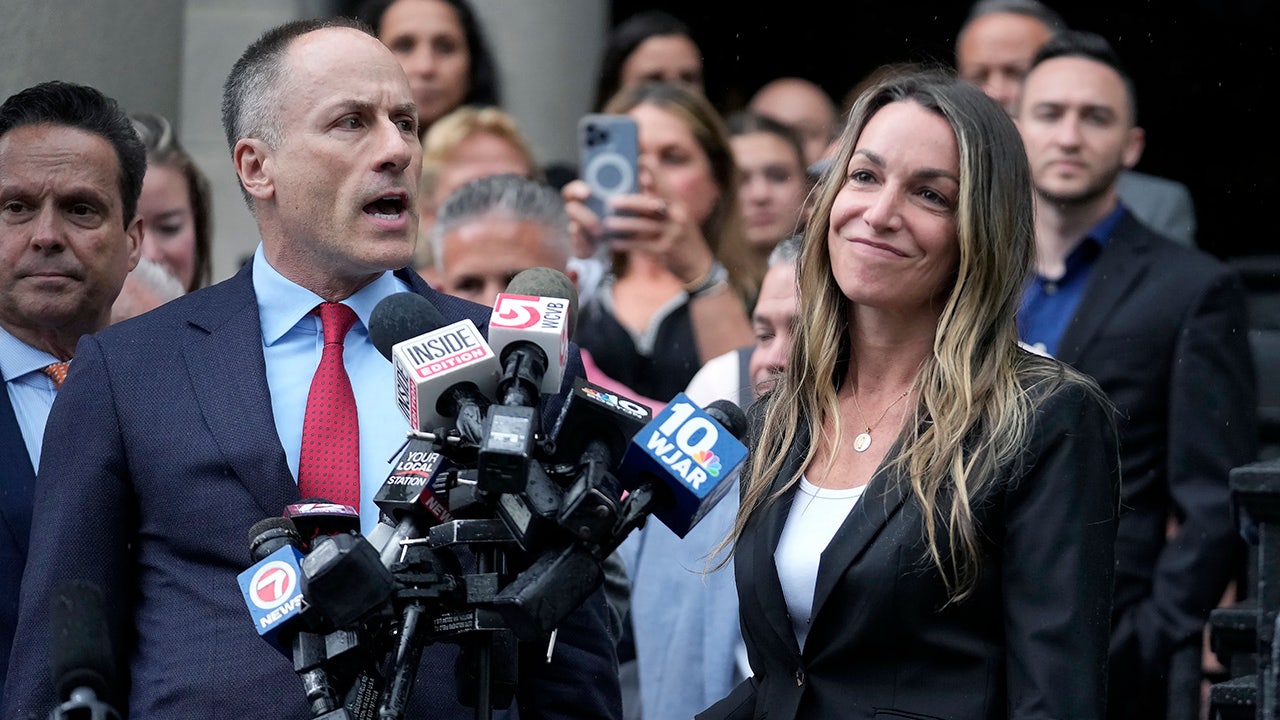
Karen Read turned and hugged her father and embraced her family after Judge Beverly Cannone declared a mistrial.
The 44-year-old financial analyst accused of killing her Boston cop boyfriend, John O’Keefe, walked out of the Dedham, Massachusetts, courthouse a free woman after two years.
The jubilation on Read’s side of the courtroom was a stark contrast to O’Keefe’s mom’s tears, as family and friends rubbed her shoulders and tried to console her.
But the saga isn’t over. “The Commonwealth intends to re-try the case,” prosecutors said before a smiling Read and her lawyers were done speaking to her supporters and news outlets.
KAREN READ MURDER CASE ENDS WITH ‘DEEPLY DIVIDED’ JURY’S DECISION
Karen Read gets a long hug from her dad William before the jury breaks for lunch at Norfolk Superior Court in Dedham, Mass., Wednesday, June 26, 2024. (Greg Derr/The Patriot Ledger via AP, Pool)
The Massachusetts jury deliberated for nearly 26 hours and had been deadlocked for days.
They were “deeply divided” because of “deeply held convictions” and a “consensus is unattainable,” according to the first of two notes to the presiding judge on Monday.
Cannone issued a controversial dynamite charge (or Allen charge), which is a last-resort option to force jurors to go continue deliberations and try to reach a unanimous verdict.
KAREN READ TRIAL COULD SINK OTHER HIGH-PROFILE MURDERS, EXPERT WARNS: ‘HARD TO SEE HOW IT DOESN’T’
Karen Read smiles during a news conference in front of Norfolk Superior Court, Monday, July 1, 2024, in Dedham, Mass. A judge declared a mistrial Monday after jurors deadlocked in the case of Read, who was accused of killing her Boston police officer boyfriend by striking him with her SUV and leaving him in a snowstorm. (AP Photo/Steven Senne)
The dynamite charge’s “effectiveness in breaking deadlocks and securing verdicts is well-documented,” according to a blog post by Texas-based law firm Varghese and Summersett.
But it’s not used in about two dozen states, as opponents argue “it can lead to verdicts that are not truly unanimous, as jurors may change their votes due to peer pressure rather than genuine conviction,” the firm said.
The result was the same. “Despite our commitment to the duty entrusted in us, we find ourselves deeply divided by fundamental differences in our opinions and state of mind,” the jury wrote in its final note to the judge.
Karen Read smiles as defense attorney David Yannetti speaks to reporters in front of Norfolk Superior Court, Monday, July 1, 2024, in Dedham, Mass. A judge declared a mistrial Monday after jurors deadlocked in the case of Read, who was accused of killing her Boston police officer boyfriend by striking him with her SUV and leaving him in a snowstorm. (AP Photo/Steven Senne)
Karen Read talks with her legal team at the Norfolk Superior Court in Dedham, Mass., Monday, July 1, 2024. This is their fifth day of deliberations in the murder trial for Read. Read is accused of backing her SUV into her Boston Police officer boyfriend, John O’Keefe, and leaving him to die in a blizzard in Canton, in 2022. (Pat Greenhouse/The Boston Globe via AP, Pool)
Judge Beverly Cannone looks over the verdict slip the jurors have to fill out when they reach a verdict in Karen Read’s murder trial, Wednesday, June 26, 2024, at Norfolk Superior Court in Dedham, Mass. The defense has asked for some modifications. Read is charged with second-degree murder in the January 2022 death of her boyfriend, Boston Police Officer John O’Keefe. (Greg Derr/The Patriot Ledger via AP, Pool)
The jury sat for weeks during a trial that included 74 witnesses and nearly 700 pieces of evidence.
Prosecutors argued a shouting match turned deadly during a booze-infused fight in January 2022, when Read allegedly backed into O’Keefe with her SUV and left him to die during a nor’easter.
WATCH: DASHCAM FROM THE NIGHT JOHN O’KEEFE WAS FOUND DEAD
His body was found on the front lawn of an influential family with deep ties to law enforcement and prosecutors. Read claimed that the family framed her for O’Keefe’s death in an elaborate cover-up.
The deadlocked jury was as torn as the otherwise quiet Boston suburb of Canton. And the opposing jurors weren’t backing down.
“Despite our commitment to the duty entrusted in us, we find ourselves deeply divided by fundamental differences in our opinions and state of mind,” the jury said before Cannone declared a mistrial.
Since Read wasn’t found guilty or not guilty, here’s what could happen next, according to experts.
Flags, flowers and remembrances flank the headstone of John O’Keefe, a Boston police officer, at Blue Hill Cemetery, Thursday, June 27, 2024, in Braintree, Mass. A judge declared a mistrial Monday, July 1, 2024, after jurors deadlocked in the case of O’Keefe’s girlfriend, Karen Read, who was accused of killing him by striking him with her SUV and leaving him in a snowstorm. Prosecutors said in a statement that they intend to retry the case. (AP Photo/Charles Krupa, File)
Before the jury enters, Judge Beverly J. Cannone, right, speaks to the defense and prosecution during the Karen Read trial at the Norfolk Superior Court in Dedham, Mass., Monday, July 1, 2024. (Pat Greenhouse/The Boston Globe via AP, Pool)
Option 1: The case is over, no more charges
Read beat the charges of second-degree murder, motor vehicle manslaughter while driving under the influence and leaving the scene of a collision causing injury and death because the jury couldn’t come to a unanimous decision, not because they thought they believed she was innocent.
That puts the ball in the prosecutors’ hands.
They can choose to end the two-year saga now.
Karen Read, center, listens as Judge Beverly J. Cannone greets the jury at the start of the third day of deliberations in her murder trial, in Norfolk Superior Court on Thursday, June 27, 2024 in Dedham, Massachusetts. (Pat Greenhouse/The Boston Globe via AP, Pool)
Prosecutor Adam Lally speaks in court during jury selection of the Karen Read trial at Norfolk County Superior Court on Thursday, April 18, 2024, in Dedham, Massachusetts. Read, 44, was accused of running into her Boston police officer boyfriend with her SUV in the middle of a nor’easter and leaving him for dead after a night of heavy drinking. (David McGlynn/New York Post via AP, Pool)
Karen Read speaks with lawyers in court during jury selection at Norfolk County Superior Court on Thursday, April 18, 2024 in Dedham, Massachusetts. Read, 44, was accused of running into her Boston police officer boyfriend with her SUV in the middle of a nor’easter and leaving him for dead after a night of heavy drinking. (David McGlynn/New York Post via AP, Pool)
Option 2: New trial, new jury with same charges
The Norfolk County District Attorney’s Office quickly fired off a statement that said it intends to retry the case.
And Read’s lawyer, Alan Jackson, said, “We will not stop fighting.”
That puts the two sides on another collision course, although experts pointed out pitfalls that could doom the DA’s office again.
WATCH: EXPERT REACTS TO PROCTOR’S TESTIMONY AND EXPLAINS ITS FAR-REACHING IMPACT
Daniel Medwed, Northeastern University professor of law and criminal justice, believes the prosecution needs to bring more evidence, if this is the route they choose.
“I think they might talk a big game in the immediate aftermath about retrying her,” Medwed told Northeastern Global News.
“But ultimately, unless new evidence emerges, I think it might be a tough hill to climb, and they might not pursue it.”
Supporters of Karen Read gather outside the courthouse in Dedham, MA on Friday, June 28, 2024. (Patriot Pics/Backgrid for Fox News Digital)
Supporters of Karen Read gather outside the courthouse in Dedham, MA on Friday, June 28, 2024. Read faced three charges in the death of her Boston police officer boyfriend John O’Keefe in January 2022. (Patriot Pics/Backgrid for Fox News Digital)
There’s also added layers of complication, with investigations into Massachusetts State Trooper Michael Proctor, whose sexist and vulgar texts may have destroyed the prosecution’s case, as well as an ongoing audit of potential misconduct in the Canton Police Department.
“You know that trooper’s testimony really blew up in the commonwealth’s face,” Suffolk Law professor Rosanna Cavallaro told NBC 10 Boston.
“If in fact he is suspended or any kind of consequence for his misconduct, then that’s going to make it really hard for the commonwealth to decide how to present their case.”
GO HERE FOR MORE TRUE CRIME FROM FOX NEWS DIGITAL
Massachusetts State Trooper Michael Proctor testifies during Karen Read’s trial on Wednesday, June 12, 2024 in Norfolk Superior Court in Dedham, Massachusetts. (Greg Derr/The Patriot Ledger via AP, Pool)
Option 3: New trial, new jury, new charges
A possible way around some of the potential pitfalls of retrying Read for murder is to file different charges, law expert Shira Diner told Fox News Digital.
Diner is a lecturer and clinical instructor at Boston University School of Law and the president of the Massachusetts Association of Criminal Defense Lawyers.
7M AND THE DANCING TIKTOK CULT: EXPERT DISCUSSES POPULAR NETFLIX SERIES AND ITS LARGER THREAT
Karen Read speaks with her lawyer as the jury deliberates in her murder trail, Wednesday June 26, 2024, at Norfolk Superior Court in Dedham, Mass. (Greg Derr/The Patriot Ledger via AP, Pool)
“(The prosecution) is entirely in control of the charges, so I think they could recharge in a different way,” she said.
What those charges could be remains to be seen, if this is the route the prosecution takes.
WATCH: DINER EXPLAINS HOW PROCTOR’S TESTIMONY COULD BLOW UP ANOTHER MURDER CASE
For now, the case is over. Read is free.
The two sides – along with their warring supporters – will retreat into their respective corners of the ring. The families will have to regroup.
The next court appearance is scheduled for July 22 for a conference.
Read the full article from Here


ATTLEBORO, Mass. (WJAR) — U.S. Immigration and Customs Enforcement Boston said Friday that it arrested a Barbados national during targeted operations in Attleboro.
ICE Boston said Irijah Jabarri Stowe Marshall is “a criminal illegal alien.”
According to officials, his criminal history includes a pending charge for failing to register as a sex offender in Massachusetts.
He was also previously convicted of attempted rape and aggravated sexual contact, ICE Boston said.
Pittsburg, PA
Pittsburgh’s air quality considered “unhealthy for everyone” on Friday due to wildfire smoke

The air quality will remain poor today. Officially, the air quality will be in the “very unhealthy” to “hazardous” range.
Friday’s forecast and air quality warnings
How hazardous are things? Wildfire smoke, like what we are dealing with today, really gives you a double whammy when it comes to impacting your health. The first is that you may notice when talking about air quality that we label it with a number, and then we put behind it PM2.5 or maybe 10.
The 2.5 is important because it is talking about the size of the particles that we are describing as parts per million. The unit for 2.5 is microns. 1 micron is the same as 0.00003937 inches or 0.001 mm. So 2.5 microns is around a fourth the width of a single wool fiber or around 1/7th the width of a human hair. It’s tiny and grating.
It’s small enough to get deep into your lungs but hard enough to irritate, like very fine sandpaper. For those with respiratory issues already in place, this increased irritation causes shortness of breath and frequent coughing spells. Not good.
The good news is that our air quality will rapidly improve overnight, with us returning to more normal air quality on Saturday morning. The bad news is that another plume of smoke is expected to roll in on Sunday, but that plume is not expected to be as bad as this current one.
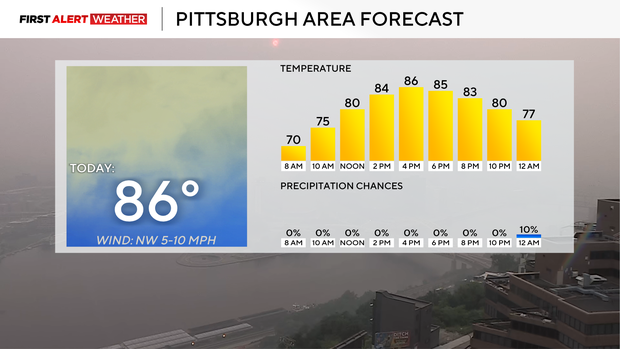
Getting to today’s forecast, it is going to be hot with highs in the mid-80s today. There will be a haze sitting over the city all day long. I have noon temperatures near 80 degrees with light winds of around 5 mph.
Kennywood and Sandcastle close due to air quality
Both Kennywood and Sandcastle announced on Friday morning that the parks will be closed due to the air quality alert issued by the Pa. Department of Environmental Protection.
According to both parks, patrons who purchased tickets for July 17 will be valid on one operating day throughout the rest of the season.

According to Love Food, the best bowl of ramen in Connecticut isn’t tucked away in one of the state’s larger cities. Instead, you’ll have to make your way to Granby, where Tiger Belly Noodle Bar has earned national recognition for serving what the publication says is Connecticut’s top ramen.
If you’re expecting a massive menu with dozens of choices, that’s not what you’ll find here. Tiger Belly keeps things relatively simple, focusing on a handful of carefully crafted noodle dishes that have developed a loyal following. The standout, according to Love Food, is the restaurant’s aptly named Darkness Ramen.
This isn’t your average bowl of noodles. The star of the dish is a rich tonkotsu broth that’s simmered for more than 25 hours to develop its deep, savory flavor. It’s then topped with tender pork belly, enoki mushrooms, plenty of garlic, and finished with black garlic oil for an extra layer of richness. The result is a bowl that’s hearty, comforting, and packed with bold flavors.
Ramen has exploded in popularity across the United States over the past decade, with restaurants putting their own spin on the classic Japanese comfort food. Whether you prefer a traditional pork-based broth, spicy variations, seafood, or vegetarian options, there’s no shortage of great places to grab a bowl these days. But when it came to picking just one restaurant in Connecticut, Love Food says Tiger Belly Noodle Bar stands above the rest.
So, if you’re the type of person who’s willing to take a road trip for great food, Granby might deserve a spot on your list. A slow-simmered broth, fresh ingredients, and a little black garlic magic were apparently enough to earn this Connecticut restaurant some well-deserved national bragging rights.
Classic Rock Songs That Describe Each Greater Danbury Town…
10 of the Best Waterfalls in Connecticut
Did a White Plains Researcher Get Too Close to the Truth About UFOs?
Leon Davidson of White Plains, NY, had a résumé packed with top-level science work — from IBM and Union Carbide to atomic research and sci-fi writing. But when he turned his focus to UFOs, what followed was a strange paper trail that linked him to the CIA, classified communications, and government efforts to shut him down. The story you’re about to see reveals what those efforts looked like — and why they may have gone to such great lengths.
Gallery Credit: Lou Milano
-

 Finance3 minutes ago
Butterfield Readies CIBC Caribbean Purchase
-

 Fitness9 minutes ago
The bridge variation women over 40 need to build deep core strength – without a single crunch
-

 Movie Reviews21 minutes ago
‘3 Weeks After’ Review: A High-School Field Trip Goes Off the Rails in a Skillful but Sadistic Serbian Shocker
-

 World33 minutes ago
Sitges Film Festival’s Monica Garcia at the Costa Rica Media Market: ‘We’re Waiting for the Next Issa Lopez’
-
News39 minutes ago
How ICE’s Traffic Stops Led to Fatal Confrontations
-

 Science57 minutes ago
The Latest Texas Floods Tested Warning Systems. This Time, They Passed.
-
 Lifestyle1 hour ago
‘I Want You to Be Happy’ takes on modern-day dating
-

 Technology2 hours ago
Apple’s plot to crush OpenAI

