Vermont
Green Mountain Club celebrates rehabilitation of a popular Camel’s Hump trail – VTDigger


HUNTINGTON — After three years of seasonal restoration work on the popular Burrows hiking trail on Camel’s Hump, the Green Mountain Club and Vermont Department of Forests, Parks and Recreation have announced its completion.
On Wednesday morning, a group of hikers, including University of Vermont staff and state officials, gathered at the trailhead as yellow and orange leaves swirled through the air. The celebration included speeches from members of the Green Mountain Club and an educational hike along the trail.
“This rehabilitation project is the largest trail project the GMC has undertaken in modern history,” said Mike DeBonis, the executive director of Green Mountain Club, during the event in Huntington. “The Burrows Trail, based on its level of use, which is exceedingly high, and its condition and climate risk, made it the perfect candidate for this kind of large scale investment.”
 100vw, 1200px”><figcaption class=) Kathryn Wrigley of the Vermont Department of Forests, Parks and Recreation speaks during a tour of a rebuilding project of the Burrows Trail at Camel’s Hump State Park in Huntington on Wednesday, October 23. Photo by Glenn Russell/VTDigger
Kathryn Wrigley of the Vermont Department of Forests, Parks and Recreation speaks during a tour of a rebuilding project of the Burrows Trail at Camel’s Hump State Park in Huntington on Wednesday, October 23. Photo by Glenn Russell/VTDigger
The Burrows Trail, built over 100 years ago, before sustainable trail design principles were developed, is among Vermont’s busiest hiking routes. Its popularity is largely due to its location near Burlington and the relatively short hike it offers to the summit of Camel’s Hump, one of the state’s tallest and most iconic mountains.
“Thinking of this project, two key attributes of success stand out,” DeBonis said. “First, the impact of the state’s financial investment and second is the power of partnerships.”
Planning for the project began in 2018, and work on the 2.1-mile trail started in June 2022, targeting more than 300 areas on the trail that needed improvements. The effort, led by the club and the department, included various partners, such as the Vermont State Trail Crew, Vermont Youth Conservation Corps, Northwoods Stewardship Center, National Civilian Conservation Corps and several volunteer groups.
“It was an amazing opportunity to bring together a bunch of different groups who work in outdoor recreation already on state lands onto one project,” said Kathryn Wrigley, an outdoor recreation specialist at the Department of Forests, Parks and Recreation, during Wednesday’s event.
 100vw, 1200px”><figcaption class=) Keegan Tierney of the Green Mountain Club points to a section of the Burrows Trail, left, that was re-routed, center, during a tour of a rebuilding project at Camel’s Hump State Park in Huntington on Wednesday, October 23. Photo by Glenn Russell/VTDigger
Keegan Tierney of the Green Mountain Club points to a section of the Burrows Trail, left, that was re-routed, center, during a tour of a rebuilding project at Camel’s Hump State Park in Huntington on Wednesday, October 23. Photo by Glenn Russell/VTDigger
One of the key improvements to the trail included the strategic placement of large branches, tree trunks and natural debris along its edges, a technique referred to as “brush-ins” by the Green Mountain Club. These brush-ins are used to prevent trail-widening and the creation of “social trails,” which are unofficial paths made by hikers seeking shortcuts or bypasses around obstacles or people. These unauthorized trails contribute to the loss of vegetation and increased trail erosion.
The club and the department identified 117 sections along the trail where the path had widened excessively. The trampled areas were more noticeable after the Covid-19 pandemic reached Vermont because people were staying far apart from each other, according to Wrigley.
“So the sticks are intended to keep people off and allow vegetation to start regrowing,” she said.
Keegan Tierney, the Green Mountain Club’s director of field programs, pointed out other harder-to-see changes during Wednesday’s hike: for instance, hardened crossings, which involve fortifying the banks of a stream so it doesn’t become a mud pit.
 100vw, 1200px”><figcaption class=) Keegan Tierney of the Green Mountain Club explains how two thirds of a rock used in a waterbar is underground during a tour of a rebuilding project at Camel’s Hump State Park in Huntington on Wednesday, October 23. Photo by Glenn Russell/VTDigger
Keegan Tierney of the Green Mountain Club explains how two thirds of a rock used in a waterbar is underground during a tour of a rebuilding project at Camel’s Hump State Park in Huntington on Wednesday, October 23. Photo by Glenn Russell/VTDigger
The club also installed 150 waterbars to reduce trail erosion. The structures are designed to channel water off the trail, helping to prevent further damage caused by water runoff.
The project, which cost nearly $700,000, was funded through a combination of sources, including a one-time allocation of state general funds for outdoor recreation improvements; the department’s Enhancement of Recreation Stewardship and Access Grant, and private donations to the club.
The cost of the project was impacted by the lack of access to mechanized equipment. Tierney said all of the work had to be done manually, pointing at the rocks to create the treadway.
“It’s labor intensive,” said Tierney. “It’s probably two weeks of brute time right here.”
Both Wrigley and Tierney emphasized the magnitude of the partnerships. The club has recently started to train its 250 volunteers to recognize trail structures and clean them to keep trails open in the long run.
“We’re investing the time in those folks so they can go out and be like ‘oh I see this, I need to clean it’,” said Tierney. “That’s a huge investment on their part as volunteers. They’re given their time and money to get here.”



Powerball, Mega Millions jackpots: What to know in case you win
Here’s what to know in case you win the Powerball or Mega Millions jackpot.
Just the FAQs, USA TODAY
The Vermont Lottery offers several draw games for those willing to make a bet to win big.
Those who want to play can enter the MegaBucks and Lucky for Life games as well as the national Powerball and Mega Millions games. Vermont also partners with New Hampshire and Maine for the Tri-State Lottery, which includes the Mega Bucks, Gimme 5 as well as the Pick 3 and Pick 4.
Drawings are held at regular days and times, check the end of this story to see the schedule.
Here’s a look at July 6, 2026, results for each game:
Winning Powerball numbers from July 6 drawing
17-44-63-66-67, Powerball: 04, Power Play: 2
Check Powerball payouts and previous drawings here.
Winning Gimme 5 numbers from July 6 drawing
04-12-30-34-38
Check Gimme 5 payouts and previous drawings here.
Winning Pick 3 numbers from July 6 drawing
Day: 5-7-2
Evening: 5-7-8
Check Pick 3 payouts and previous drawings here.
Winning Pick 4 numbers from July 6 drawing
Day: 7-9-1-6
Evening: 9-8-4-1
Check Pick 4 payouts and previous drawings here.
Winning Megabucks Plus numbers from July 6 drawing
01-06-24-32-37, Megaball: 04
Check Megabucks Plus payouts and previous drawings here.
Winning Millionaire for Life numbers from July 6 drawing
02-08-32-54-56, Bonus: 03
Check Millionaire for Life payouts and previous drawings here.
Feeling lucky? Explore the latest lottery news & results
Are you a winner? Here’s how to claim your lottery prize
For Vermont Lottery prizes up to $499, winners can claim their prize at any authorized Vermont Lottery retailer or at the Vermont Lottery Headquarters by presenting the signed winning ticket for validation. Prizes between $500 and $5,000 can be claimed at any M&T Bank location in Vermont during the Vermont Lottery Office’s business hours, which are 8a.m.-4p.m. Monday through Friday, except state holidays.
For prizes over $5,000, claims must be made in person at the Vermont Lottery headquarters. In addition to signing your ticket, you will need to bring a government-issued photo ID, and a completed claim form.
All prize claims must be submitted within one year of the drawing date. For more information on prize claims or to download a Vermont Lottery Claim Form, visit the Vermont Lottery’s FAQ page or contact their customer service line at (802) 479-5686.
Vermont Lottery Headquarters
1311 US Route 302, Suite 100
Barre, VT
05641
When are the Vermont Lottery drawings held?
- Powerball: 10:59 p.m. Monday, Wednesday, and Saturday.
- Mega Millions: 11 p.m. Tuesday and Friday.
- Gimme 5: 6:55 p.m. Monday through Friday.
- Lucky for Life: 10:38 p.m. daily.
- Pick 3 Day: 1:10 p.m. daily.
- Pick 4 Day: 1:10 p.m. daily.
- Pick 3 Evening: 6:55 p.m. daily.
- Pick 4 Evening: 6:55 p.m. daily.
- Megabucks: 7:59 p.m. Monday, Wednesday and Saturday.
- Millionaire for Life: 11:15 p.m. daily
What is Vermont Lottery Second Chance?
Vermont’s 2nd Chance lottery lets players enter eligible non-winning instant scratch tickets into a drawing to win cash and/or other prizes. Players must register through the state’s official Lottery website or app. The drawings are held quarterly or are part of an additional promotion, and are done at Pollard Banknote Limited in Winnipeg, MB, Canada.
This results page was generated automatically using information from TinBu and a template written and reviewed by a Vermont editor. You can send feedback using this form.

Authorities have identified the girl and her older brother who died in a Vermont river after going missing last week.
Sandro Lala, 25, had jumped into the Lamoille River to save his sister, 11-year-old Yazmin Yupangui, when she fell into the Lamoille River near Arrowhead Mountain Lake in Georgia, Vermont, on Wednesday, according to the Vermont State Police.
Autopsies determined that the siblings, who both lived in Cambridge, Vermont, died in accidental drownings, according to police.
Yazmin’s body was found Thursday by a police underwater recovery team, while Lala’s body was found in Arrowhead Mountain Lake on Saturday morning.
Police had previously said a group of relatives were fishing along the shore when a young girl fell into the water, and a man jumped in to try to rescue her. Neither resurfaced after that, prompting a large search, including multiple agencies, on the water near where Lamoille River empties into the lake.

Mountain bike enthusiasts have been working for years on an ambitious 485-mile multi-use trail known as the Velomont that will span the length of Vermont.
When finished, the collaborative project will knit together existing trail networks, connect 27 communities, and include 30 new huts and five downtown hostels for overnight stays.
New trail construction is finally ramping up after years spent on permits, plans and public input. And organizers say they’re focused on ensuring the Velomont is accessible for everyone.
“For us, it’s not a huge lift to just be mindful when we’re trying to build trail or improve trail to think about the adaptive rider,” said Angus McCusker, the Velomont trail director with the nonprofit Vermont Huts and Trails.
McCusker is referring to the growing number of athletes with disabilities who mountain bike with specially designed equipment.
“The challenge,” he said, “is we’re connecting to existing trail networks that were never intended for adaptive bikes. So, where we can, we’re trying to do adaptive assessments.”
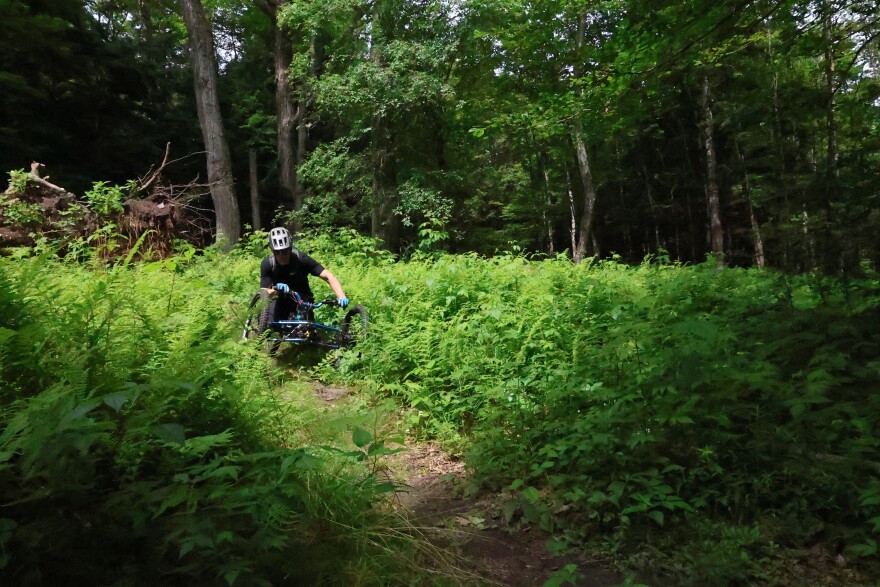
Louis Arevalo of Essex Junction is one of several adaptive athletes helping with that, most recently on some slightly overgrown trails in the Randolph Town Forest.
Zoe McDonald
/
Vermont Public
Arevalo was paralyzed in a skiing accident six years ago. An avid mountain biker before, he now rides a recumbent-style three wheeler that sits low to the ground. Arevalo pedals and steers with his arms, and gets a boost from an electric motor.
“Once you realize what these bikes are capable (of) or this equipment actually opens up, it kind of blows your mind,” he said.
But adaptive rigs like Arevalo’s are wider and heavier than regular mountain bikes, and not all trails are user-friendly.

Zoe McDonald
/
Vermont Public

Zoe McDonald
/
Vermont Public
Nick Bennette, who tested a different type of adaptive bike that day, got hung up on several tight turns.
Bennette is executive director of the Vermont Mountain Bike Association, another nonprofit spearheading efforts around the Velomont. He and others involved in the assessment have been taking detailed notes on ways to make the trails more accessible.
“Just scalloping out a bit of material on the outside of that corner,” said Bennette, pointing to the area the bike got caught. “That will allow adaptive bikes to make that corner without really changing the way the trail rides.”
This type of work is not just happening on the trails. Organizers are also trying to reduce barriers at overnight accommodations along the network.

Zoe McDonald
/
Vermont Public
This summer, contractors are turning an old office building near the trail in downtown Randolph into an ADA accessible hostel. And two remote huts along the trail in Stratton and Chittenden will have locked sheds with off-road wheelchairs so bikers don’t have to haul their own.
At the Chittenden Brook Hut, McCusker highlighted a new ramp and wider driveway.
“So if you’re an adaptive rider, you can imagine rolling right up here and you can transfer to your chair that’s available here, and then roll down the ramp and go down to the fireplace, to the privy, to make your meal,” he said.

Zoe McDonald
/
Vermont Public
Louis Arevalo stayed at the hut last summer with other adaptive riders — his first camping trip since his accident.
“It was really refreshing to have easy access to a beautifully built hut that was easy to navigate, and then have these world-class trails right out the door,” he said. “And with these Velomont trails, I can actually plan a hut-to-hut trip with other people.”
Jeff Alexander is counting on it. He’s director of strategic partnerships with Vermont Adaptive Ski and Sports, a nonprofit that helps people with disabilities access outdoor recreation.
An economic impact analysis the group commissioned estimates their programming generated more than $10 million last year.
“So the adaptive community has money, they travel, they want to travel and they want to play with everybody,” Alexander said. “We just need to level the playing field so that everyone can play together.”
Zoe Mcdonald
/
Vermont Public
-

 News2 minutes ago
Top Senate Democrats push Trump-affiliated companies for answers about IRS settlement
-

 Los Angeles, Ca1 hour ago
Missing 13-year-old with autism last seen at Los Angeles beach
-

 Videos2 hours ago
Charlie Kirk’s alleged killer appears in court
-
Detroit, MI2 hours ago
GET TO KNOW: Wide receiver Kendrick Law
-

 San Francisco, CA2 hours ago
Multiple people lose eyes, hands in illegal fireworks-related injuries in San Francisco
-
 Dallas, TX2 hours ago
Texas took this Dallas couple’s newborn baby for 3 weeks. A judge says their rights were violated
-

 Miami, FL2 hours ago
South Florida foundation empowering thousands of young girls through education, mentorship, community support
-

 Boston, MA2 hours ago
Where to watch Boston Red Sox vs Chicago White Sox: TV channel, start time, streaming for July 7


