Copley Hospital in Morrisville on Oct. 19, 2023. File photo by Carly Berlin/VTDigger and Vermont Public
Support staff at Morrisville’s Copley Hospital voted to unionize last Thursday. The formation, which came through a decisive 68-44 vote, joins together the hospital’s nearly 150 staff with its almost 100 nurses in the regional United Nurses and Allied Professionals union.
“I wanted to form a union to be able to have a voice at the table,” Leta Karasinksi, an emergency department technician, said in a press release.
“Up until a few years ago, we had the same healthcare plan as the nurses. Now the union nurses have a better health plan than us,” she said. “I want to see equality with benefits. I want to see safe staffing patterns to be able to deliver the quality of care our patients deserve.”
The yes vote comes on the heels of a similar unionization drive by support staff at Central Vermont Medical Center in early September. They chose to unionize as a chapter of AFT-Vermont, joining support staff at the University of Vermont Medical Center and Porter Medical Center.
Advertisement
Sarah Bray, a patient engagement specialist at Copley who voted in favor of the union, said in a press release that she thinks the staff should be taken seriously. “I think this union will unite the nurses and support staff for years to come and benefit the community at large.”
Mountain bike enthusiasts have been working for years on an ambitious 485-mile multi-use trail known as the Velomont that will span the length of Vermont.
When finished, the collaborative project will knit together existing trail networks, connect 27 communities, and include 30 new huts and five downtown hostels for overnight stays.
New trail construction is finally ramping up after years spent on permits, plans and public input. And organizers say they’re focused on ensuring the Velomont is accessible for everyone.
“For us, it’s not a huge lift to just be mindful when we’re trying to build trail or improve trail to think about the adaptive rider,” said Angus McCusker, the Velomont trail director with the nonprofit Vermont Huts and Trails.
Advertisement
McCusker is referring to the growing number of athletes with disabilities who mountain bike with specially designed equipment.
“The challenge,” he said, “is we’re connecting to existing trail networks that were never intended for adaptive bikes. So, where we can, we’re trying to do adaptive assessments.”
Louis Arevalo of Essex Junction is one of several adaptive athletes helping with that, most recently on some slightly overgrown trails in the Randolph Town Forest.
Zoe McDonald
/
Advertisement
Vermont Public
Louis Arevalo, front center, and his dog Azul joined Angus McCusker and his two kids Galen, 13, and Elet, 11 (back center); Jeff Dickson and Nick Bennette with the Vermont Mountain Bike Association (from left); Jeff Alexander with Vermont Adaptive Ski and Sports (back center); and Thatcher Hinman with Ridgeline Outdoor Collective (right) for an accessibility assessment of the mountain bike trail network in the Randolph Town Forest.
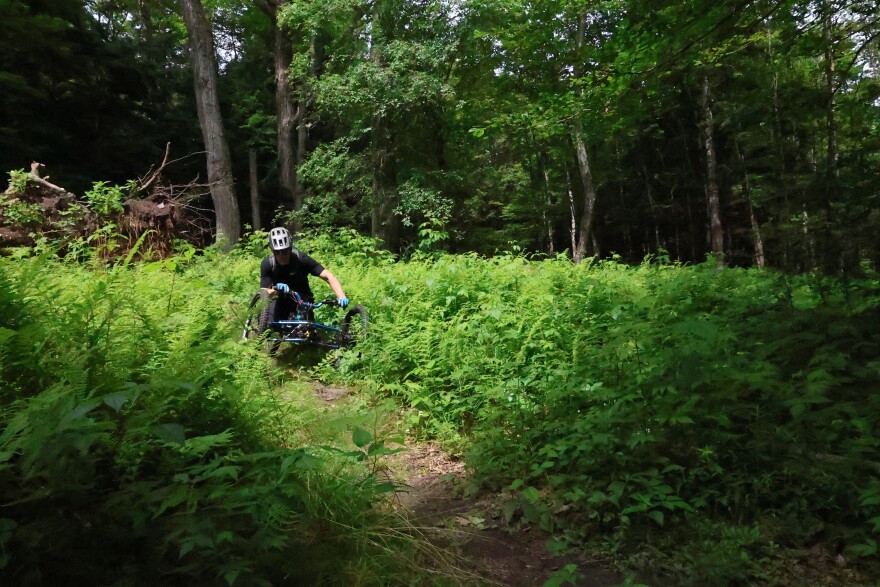
Arevalo was paralyzed in a skiing accident six years ago. An avid mountain biker before, he now rides a recumbent-style three wheeler that sits low to the ground. Arevalo pedals and steers with his arms, and gets a boost from an electric motor.
“Once you realize what these bikes are capable (of) or this equipment actually opens up, it kind of blows your mind,” he said.
But adaptive rigs like Arevalo’s are wider and heavier than regular mountain bikes, and not all trails are user-friendly.
Zoe McDonald
Advertisement
/
Vermont Public
Nick Bennette, of the Vermont Mountain Biking Association, guides an adaptive bike over a narrow bridge, pointing out that other adaptive riders may have trouble getting across.
Zoe McDonald
/
Vermont Public
Advertisement
Making a trail more accessible can entail moving rocks, improving bridges, or clearing trees that make the trail too narrow. Nick Bennette moves a rock to help a trail in Randolph Town Forest become more easily passable.
Nick Bennette, who tested a different type of adaptive bike that day, got hung up on several tight turns.
Bennette is executive director of the Vermont Mountain Bike Association, another nonprofit spearheading efforts around the Velomont. He and others involved in the assessment have been taking detailed notes on ways to make the trails more accessible.
“Just scalloping out a bit of material on the outside of that corner,” said Bennette, pointing to the area the bike got caught. “That will allow adaptive bikes to make that corner without really changing the way the trail rides.”
This type of work is not just happening on the trails. Organizers are also trying to reduce barriers at overnight accommodations along the network.
Zoe McDonald
Advertisement
/
Vermont Public
Angus McCusker with Vermont Huts and Trails is working to create accessible accommodations along the Velomont Trail, including a multi-group space in Randolph and a hut in Chittenden that has been outfitted with accessibility in mind.
This summer, contractors are turning an old office building near the trail in downtown Randolph into an ADA accessible hostel. And two remote huts along the trail in Stratton and Chittenden will have locked sheds with off-road wheelchairs so bikers don’t have to haul their own.
At the Chittenden Brook Hut, McCusker highlighted a new ramp and wider driveway.
“So if you’re an adaptive rider, you can imagine rolling right up here and you can transfer to your chair that’s available here, and then roll down the ramp and go down to the fireplace, to the privy, to make your meal,” he said.
Advertisement
Zoe McDonald
/
Vermont Public
The Chittenden Brook Hut includes accessible ramps, storage for adaptive bikes and specialized off-road wheelchairs for visitors.
Louis Arevalo stayed at the hut last summer with other adaptive riders — his first camping trip since his accident.
“It was really refreshing to have easy access to a beautifully built hut that was easy to navigate, and then have these world-class trails right out the door,” he said. “And with these Velomont trails, I can actually plan a hut-to-hut trip with other people.”
Advertisement
Jeff Alexander is counting on it. He’s director of strategic partnerships with Vermont Adaptive Ski and Sports, a nonprofit that helps people with disabilities access outdoor recreation.
An economic impact analysis the group commissioned estimates their programming generated more than $10 million last year.
“So the adaptive community has money, they travel, they want to travel and they want to play with everybody,” Alexander said. “We just need to level the playing field so that everyone can play together.”
Zoe Mcdonald
/
Advertisement
Vermont Public
Nick Bennette rides the trail at the Randolph Town Forest on VMBA’s adaptive mountain bike.
RUTLAND, Vt. (WCAX) – Vermont State Police are asking the public for help locating a 71-year-old Rutland man who has not been seen since Thursday evening.
Mark P. Herring was last seen between 6:30 and 7 p.m. on July 2. He was last connected to the area around Coolidge State Park Road in Plymouth but is believed to have returned to Rutland City.
Investigators said the circumstances do not appear suspicious, but they are concerned about Herring’s health.
Anyone who has seen Herring or knows his whereabouts is asked to contact the Vermont State Police Rutland Barracks.
Senate Minority Leader Scott Beck, R-Caledonia, listens to discussion on the floor of the Senate on the opening day of the legislature at the Statehouse in Montpelier on Wednesday, January 8, 2025. Photo by Glenn Russell/VTDigger
Political parties are quick to declare victory when the bills they support make it into law. But for Vermont’s Republican minority in the Legislature, it was the laws they succeeded in rolling back this year that seem to have the party celebrating just as much.
In a newsletter to supporters last month, Paul Dame, chair of the Vermont Republican Party, adopted a sweeping tone as he reflected on the 2026 legislative session that had ended just days before.
“If Vermont’s Republicans are not the most effective minority in any legislature in the country, then I’d like to hear who is,” Dame wrote in the email. The GOP accomplished its goals, he went on, “in ways that seemed impossible just two years ago.”
Two years ago, Vermont’s 2023-24 legislative biennium ended with Democrats enacting six bills into law that Republican Gov. Phil Scott had vetoed and that Scott’s GOP allies in the House and Senate broadly opposed. Democrats were able to do so because they had a supermajority of seats in both chambers.
Advertisement
But then, voters elected a wave of additional Republicans to the House and Senate that November — many if not all of them maligning some of those new laws on the campaign trail — and the political dynamic in the Statehouse changed.
In the two years since, Republicans enjoyed more committee leadership roles, which dictate which bills get airtime, and found an easier path to get some of their party’s priorities into law. Dame pointed, for example, to a 2025 law expanding state tax breaks for military retirees, something Scott had backed for years with no success.
READ MORE
Advertisement
Democrats still held a majority of seats in both chambers and so could set the agenda as they liked. They had their own priorities that they pursued, at times over many Republicans’ opposition, such as a new legal avenue for Vermonters to sue federal agents whom they allege have violated their constitutional rights.
But Republican leaders said that one of, if not their biggest, win of the 2025-26 biennium, which started last January and ended this May, was slowing or reversing some of the policies passed in the prior two-year period.
“Most of what Republicans did was apply the brakes,” Dame wrote in another newsletter last month. Even if the party succeeded in some ways, though, “there is still work to do in order to turn the car around and start moving toward prosperity instead of away from it,” he added.
Advertisement
Senate President Pro Tempore Phil Baruth, D/P-Chittenden Central, said the results of the 2024 election made it clear to him that his GOP colleagues would try to change some of what his caucus passed before.
“And that’s part of the democratic process,” he said in an interview. “The voters are the ones who decide. And so, given the change in the chamber, I think they accomplished some of their goals.”
Baruth agreed Republicans had a stronger voice in the Statehouse the past two years, but said he didn’t think that meant the legislative process was more confrontational.
“By and large it was not, every day, a struggle with an emboldened minority,” he said. “We worked very smoothly together — on what amounted to the Democrats’ agenda.”
The policies Republicans repealed was a focus for Gov. Scott at a press conference the week after the Legislature adjourned.
Advertisement
“We’ve now spent an entire session undoing harmful policies passed by the previous supermajority rather than making meaningful progress,” he said in early June.
‘The highlights of the session’
The most significant reversal Republicans say they won this year was to a slate of conservation measures included in a 2024 land use law, Act 181. That was one of the laws Democrats passed over Scott’s veto and opposition from the GOP.
Parts of the law aimed to loosen state reviews for new housing in already-developed areas. But at the same time — in response to climate change and habitat loss — the law added environmental protections for building projects in sensitive areas.
As state officials rolled out draft maps of these areas, ire from rural landowners, local officials and housing proponents bubbled up. Their opposition, which was echoed by Republican Lt. Gov. John Rodgers and GOP members of the House and Senate, also drew a large protest on the Statehouse steps in March.
After the Senate passed a bill delaying the implementation of some of those provisions, Democratic House leadership went a step further, and in an unexpected about-face approved a rollback of those measures entirely. That’s what lawmakers ultimately passed in May and Scott then signed into law.
Advertisement
Dame also pointed, in an interview, to how the 2025-26 biennium marked the end for the Clean Heat Standard, a 2023 law that Democrats also enacted over Scott’s red pen aimed at reducing the carbon emissions that come from heating and cooling buildings.
READ MORE
byCarly Berlin
Advertisement
Democrats came into the 2025 session understanding the policy was dead. The state’s Public Utilities Commission had recommended against moving it forward over concerns about its cost to consumers and the fact Vermont had little to model the initiative on.
Many Republicans, who cited concerns over costs of the policy on the campaign trail in 2024, pushed for a formal repeal over the past two years, which would have been largely symbolic but that they argued would show a spirit of compromise. Language repealing the policy passed the Senate, but the House did not take it up before adjournment.
“Things like the Clean Heat Standard would have made things more expensive for Vermonters,” Senate Minority Leader Scott Beck, R-Caledonia, said in an interview. “So the ability to knock back those types of increases, and actually move the other direction a little bit — and then also to get (parts of Act 181) repealed — were probably the highlights of the session for Republicans.”
Republicans also flexed their legislative numbers in at least one other key instance this year. That was over a bill that sought to largely bar federal law enforcement officers, including U.S. Immigration and Customs Enforcement agents, from wearing masks.
Advertisement
When House Democratic leaders tried to bring a final version of the bill up for a vote on the final day of the session in May, House Republicans used a procedural move to block its consideration, killing the legislation. The move drew ire from Democrats, though not all of them supported the bill due to concerns a judge would find it unconstitutional.
Scott’s veto pen
At the same time, because Democrats could no longer override Scott’s vetoes on their own over the past two years, the likelihood of a bill getting rejected was at times enough for lawmakers not to advance it. A veto threat, for instance, was the reason at least some legislative leaders gave for why they did not pursue any policies that would help the state get on track to meet its carbon emissions reduction goals this year.
Scott leveraged that power throughout this year’s session. He spent months threatening to veto the state budget and key property tax rate-setting legislation if lawmakers did not advance a version of this year’s marquee legislation — an education reform plan — that he liked. Democratic lawmakers for a time contemplated whether the state government might shut down as a result, but they reached an education deal with time to spare.
The veto threat loomed over lawmakers’ decision to use more state revenue this year to again reduce property tax increases — a move backed by Scott. Lawmakers put $101 million in the coming fiscal year’s budget to “buy down” the average education property tax rate increase statewide.
Beck said Republicans’ increased numbers in the House and Senate could be directly tied to lower average increases in property tax bills. He contrasted the tax-rate setting legislation that Democrats enacted over Scott’s veto in 2024, which resulted in a 13.8% average increase in bills, to the versions of the annual bill enacted in 2025 and 2026, which set out an average increase of 1.1% and 3.5%, respectively. (Actual tax rate increases — or even decreases — have and will vary widely by town.)
Advertisement
“I think those are huge, huge wins,” he said Thursday.
To be sure, some Democrats, particularly in the Senate, voiced support for buying down property tax rates to the greatest extent possible from the beginning of this year’s legislative session.
“I told people on election night that I heard the message — and I do believe the message was primarily around the burden of the property tax,” Baruth said, referring to 2024.
The governor ultimately vetoed fewer bills over the 2025-26 biennium than he did in 2023 and 2024. In the more recent period, he rejected 13 bills, though one was over a technical error in how the bill was drafted and not a policy disagreement. Over the two years before that, he rejected 17. In 2023, that included the state budget bill, which lawmakers overrode.
Democrats came close to succeeding on one veto override attempt this year, over a bill that proposed a new regulatory framework for large data centers. Scott said he rejected the bill, which passed both chambers with overwhelming bipartisan support, because he thought the state’s existing land use regulations would be sufficient.
Advertisement
The House came just seven votes short of the threshold needed to overturn Scott’s veto. Senators did not attempt an override vote. Beck — who voted for the bill — said in a post-session newsletter to his constituents that he understood the governor’s decision, and that he was OK letting the legislation fall by the wayside.
The bill could well be an issue on the campaign trail this year. The Vermont Democratic Party slammed Scott’s decision in a social media post in early June, saying that the governor “sided with big tech and corporations over Vermonters.”
Baruth, who is not running for reelection, echoed that criticism.
“I think the Legislature should go hard on that next session,” he said.