Northeast
Subway mayhem spurs Cuomo to urge halt to new NYC driving tax

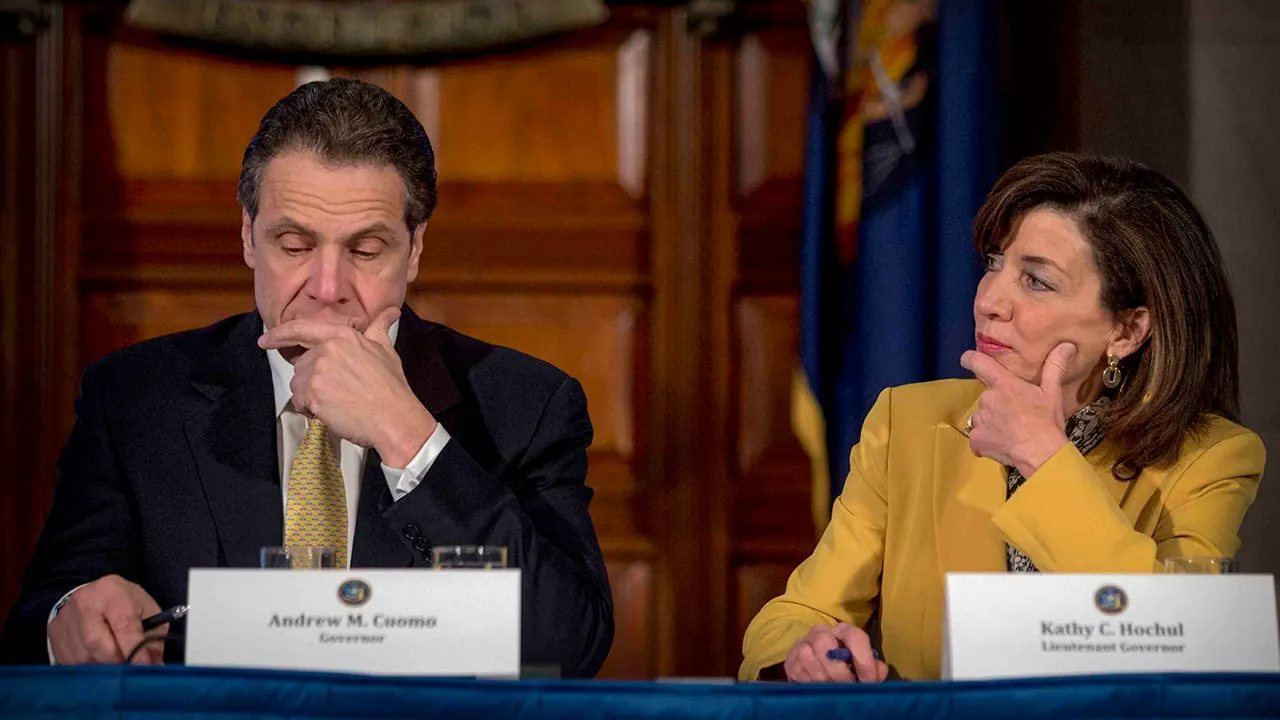
As New York’s “congestion pricing” inner-city tolling plan takes effect Sunday, one of its major proponents is questioning whether the timing is right for a policy meant to drive people to an increasingly dangerous mass transit system.
Through a spokesman, former Gov. Andrew Cuomo confirmed that he still backs the system that now tolls drivers $9 to cross below Central Park or enter Lower Manhattan from Brooklyn and New Jersey – but questioned whether now is best to implement it.
“Governor Cuomo believes congestion pricing is ultimately the right policy, which is why he fought and succeeded in passing it after more than a decade of failed attempts,” longtime spokesman Rich Azzopardi told Fox News Digital on Friday.
Azzopardi said that Cuomo’s original plan, which found agreement from then-Mayor Bill de Blasio, was based on a “safe and reliable subway system” and a thriving city core. Prior Mayor Michael Bloomberg had proposed a similar plan in 2007, but it died in Albany.
HOCHUL SPARKS BIPARTISAN OUTRAGE OVER CONGESTION PRICING REBOOT AS DEMS WORRY TRUMP WILL BLOCK
“[G]iven the obvious lack of confidence the public currently has in the subway system – combined with the tenuous state of New York City post-COVID, [Cuomo] called for a data-driven study on the impact of congestion pricing to inform the timing of such a major policy change and to ensure New York was not creating additional obstacles to its comeback.”
Cuomo previously wrote in a March op-ed that congestion pricing’s success hinges on confidence in the MTA and mass transit, which he noted has also statistically still not recovered from COVID levels.
He noted how congestion pricing is meant to “incentivize” subway use – but that that is hard to do when people are getting brutally attacked underground – and noted that it was his father, Gov. Mario Cuomo, who first beefed-up police presence after the “bad old days.”
At the time of a prior column in the Post, Cuomo cited a conductor with 24 years of service to the MTA vowing never to go back underground after he was slashed in the neck and required 34 stitches while operating an A train in Bedford-Stuyvesant, Brooklyn.
NEW ‘DRACONIAN’ LAWS TAKING EFFECT IN 2025: FROM SHAMPOO TO IMMIGRANT CARE
MTA Chairman Janno Lieber and Gov. Hochul (Getty)
More recently, an Ocean County, N.J., woman was burned alive in Coney Island, and there have been several near-fatal cases of people being randomly shoved in front of trains, occurring from Morningside Heights to TriBeCa, since Christmas.
“It is undeniable that New York is in a dramatically different place today than it was in 2019, and without a study forecasting its consequences based on facts, not politics, it could do more harm than good to New York City’s recovery,” Cuomo’s spokesman said Friday.
But Cuomo’s onetime deputy, Gov. Kathy Hochul, appeared full-steam-ahead in enacting the policy, which is intended to drive commuters and residents to consider mass transit to head to work or play in Midtown.
FEDERAL JUDGE RULES ON NYC CONGESTION PRICING
In a recent statement lauding her current plan, Hochul’s office said the reduction of the congestion toll from its original $15 will save drivers $1,500 per year, and that commuters will see “new and improved subway services.”
“By getting congestion pricing underway and fully supporting the MTA capital plan, we’ll unclog our streets, reduce pollution and deliver better public transit for millions of New Yorkers,” Hochul said.
MTA Chairman Janno Lieber, who oversees the state-run metro subway, bus and rail network, said that Hochul is “stepping up” for people who want cleaner air, safer streets and less gridlock.
CUOMO JOINS NETANYAHU’S LEGAL DEFENSE TEAM, MULLS 2025 NYC MAYORAL RUN
The FDR Drive on Manhattan’s East Side; one of few roadways exempt from tolling. (Getty)
He also noted that upgrades have already taken place on the 7 subway from Times Square to Flushing, Queens, and the L train from Union Square to Canarsie.
However, Cuomo’s camp maintains that it was he who envisioned and oversaw the upgrades to New York’s transit network without the added tolls in effect – and ripped Hochul and Lieber for claiming that he had gotten cold feet.
When the New York Post asked Hochul for comment on Cuomo suggesting she “hit the brakes” on congestion pricing, the governor directed comment to a Lieber spokesman, who blasted Cuomo for “flip-flopping.”
“What would really harm New York’s continuing recovery is starving subways of a desperately needed source of funding after decades of underinvestment,” the MTA’s Aaron Donovan said.
“The $15 fee was passed by the MTA under Hochul’s watch, but please gaslight away,” Azzopardi told Fox News Digital. “New Yorkers aren’t stupid.”
Cuomo previously told WNYW that people have the option to work from home, which they didn’t have when he first pushed the plan in 2019 – and that if he were a commuter, he would likely balk at the idea of added costs at a time of “high crime and homelessness.”
Cuomo’s camp also said that Hochul likes to take credit for the achievements of his three-term administration that presaged the new tolls.
“The difference here is that Governor Cuomo built the [new Amtrak/MetroNorth] Moynihan Train Hall and the Second Avenue Subway [extension to East Harlem], as well as fixed the L train and did the hard work to get [Grand Central’s] East Side Access and the LIRR Third-Track done. All Hochul wanted to do was cut the ribbons,” Azzopardi said.
Cuomo’s calls for a pause were joined by several New York Republicans, yet the former governor and potential 2025 mayoral candidate remains supportive of congestion pricing, while the GOP wants it nixed entirely.
Commuters from New Jersey must still pay Port Authority tolls to cross the Hudson River, and outer-borough commuters the same via the East River – albeit with a slight credit toward their “congestion” fee.
Drivers who remain on the FDR Drive or Joe DiMaggio West Side Highway will not be charged unless they turn onto surface streets.
Read the full article from Here

Boston, MA
Jaylen Brown says Celtics showed ‘lack of respect’ after trade to 76ers – The Boston Globe

Amid several reports that said Brown didn’t request a trade and that Boston actually thought Derrick White was the best player on the 2025-26 roster, an already motivated Brown now has an even larger chip on his shoulder after the Celtics dealt him away.
“The message was received,” Brown said. “I wasn’t thrilled with the amount of respect that was shown throughout this process. I think there was a bit of a lack of respect. I think it was fine at one point, then out of nowhere, things just went left. I think Brad [Stevens] is getting a lot of the criticism. I wasn’t thrilled with the way he facilitated some of the conversations.”
After the Celtics fell short in their pursuit of Giannis Antetokounmpo — Brown was the centerpiece of Boston’s trade package — Stevens was noncommittal when asked about Brown’s future in Boston.
“Jaylen Brown is a big part of us,” Stevens said. “I’m never going to predict the future, but every indication, everything that I think about over the past few years has been building around those guys, right? So obviously, you never know. But at the same time, the one thing I want to make very clear is how valued he’s always been.”
“He’s been amazing. He’s been an amazing teammate, a great person to be around. And whether that run ends 10 years from now when he retires, or before, there’s a lot to celebrate. We have a great relationship, an open relationship where we talk about everything. But I don’t want to predict the future. I look at it as, this is our team.”
Stevens traded Brown to the 76ers on Wednesday in exchange for Paul George, two first-round picks, and two second-round picks. The deal was widely criticized.
For Brown, the most puzzling aspect was the lack of an explanation.
“I definitely think there’s more to it,” Brown said. “I just wish that more to it could’ve been explained to me. Because I think if more to it was explained, I would’ve understood. I thought I earned the respect to get that explanation. But hey, obviously, I was wrong. That’s life. You move on.”
Brown will now join a 76ers team that, with Tyrese Maxey, Joel Embiid, and V. J. Edgecombe already in place, could be poised to leapfrog Boston in the Eastern Conference.
“I don’t want [any] special treatment, I don’t need no handouts … I plan on earning my respect one day at a time by putting in the work,” Brown said of playing for Philadelphia. “I’m looking forward to getting in the gym, the whole process.”
“The hard part is, the last 10 years, I’ve been programmed to hate Philadelphia. The history of the rivalry, the playoff battles … I’ve been programmed to think like, ‘[Expletive] The Process’. It’s funny, now I’ve got to reverse-engineer it. But I’ll be ready to go by the time the season starts.”
Conor Ryan can be reached at conor.ryan@globe.com.

The 90-foot tall Ferris wheel will run from July 1 through July 5 on the North Shore. Tickets are on sale now and 50% of all proceeds will be donated to the Veterans Leadership Program. Tickets can be purchased at: pittsburghpa.gov/july4.
The BNY Main Stage at Point State Park will have entertainment starting at 4 p.m. Headlining the performances will be Grammy- and Tony-Award nominated national pop rock band the Plain White T’s. Shows are free,
As part of the National Flag Foundation’s Light to Unite, the city’s skyscrapers will be illuminated in red, white and blue across Downtown at 9 p.m.
The city’s fireworks spectacular is set to be the city’s largest fireworks display in decades. For the first time, there will be a drone performance immediately before the fireworks start.
The fireworks show will utilize six barges on all three rivers – and some rooftops. Fireworks will begin at 9:35 PM on July 4.
Connecticut
Motorcyclist seriously injured after crashing into parked, unoccupied vehicle in Meriden

MERIDEN, Conn. (WTNH) — A motorcyclist has serious injuries after a crash early Friday morning in Meriden, according to police.
The crash happened just after 3:00 a.m. in the area of Lincoln Street. The motorcyclist was navigating a turn when they struck a parked, unoccupied vehicle, police said.
The motorcyclist was taken to an area trauma center, according to police.
A section of Lincoln Street is blocked for the investigation, police said.
Meriden’s accident investigation team responded to the scene.
Additional information was not immediately available.
Download the News 8 app to get breaking news and weather alerts.
Watch News 8 on WTNH.com or the free WTNH News 8 streaming app on Roku, Apple TV, Amazon Fire TV and select Samsung Smart TVs.
-
 Lifestyle3 minutes ago
L.A. Affairs: He wanted L.A. I wanted New York. A panic attack changed everything
-
 Politics7 minutes ago
Trump refashions America’s 250th as a celebration of himself
-
 Sports22 minutes ago
How Dodgers’ Max Muncy, vying for his third All-Star selection, continues to evolve
-

 World34 minutes ago
Germany’s Merz defends NATO spending after Trump calls it ‘ridiculous’
-
 News57 minutes ago
Oregon ER doctors win a ‘David and Goliath’ battle against a national company
-

 Videos2 hours ago
Iran gets ready for Khamenei’s funeral • FRANCE 24 English
-

 Los Angeles, Ca2 hours ago
2 arrested after 3 LASD deputies injured during East L.A. World Cup celebration
-

 Detroit, MI3 hours ago
Ex-girlfriend in custody after Taylor man found fatally stabbed, police say

