Rhode Island
Half of Massachusetts residents support legalizing teachers’ strikes • Rhode Island Current

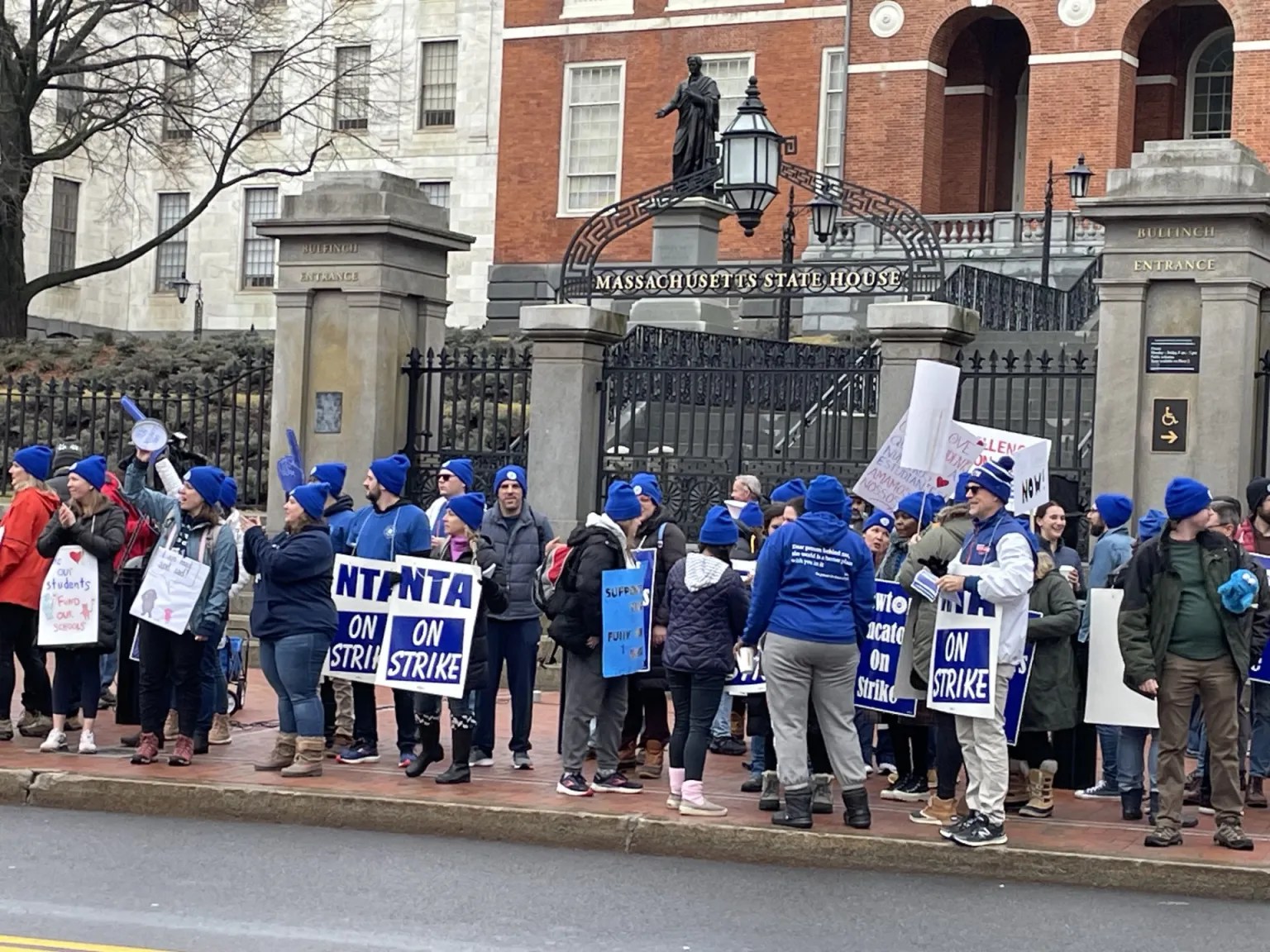
Massachusetts state leaders have said they have no appetite for changing Massachusetts law to make it legal for public teachers to go on strike, but public opinion is more on the union side. In a new CommonWealth Beacon/GBH News poll, 50% of state residents favored legalizing teachers’ strikes, while 34% said strikes should remain illegal, and 16% said they were unsure or did not answer (toplines, crosstabs).
The survey, conducted by the MassINC Polling Group, comes on the heels of strikes in five Massachusetts school districts over the last two years. It is illegal for public sector employees to strike in the state, but that hasn’t stopped a wave of walkouts signaling a more militant posture on the part of teachers’ unions. The longest – and most recent – strike closed schools in Newton for two weeks in late January and early February.
The poll results point to a strong degree of sympathy for teachers’ efforts to secure better pay and other changes, even if it means shutting down schools to get there.
“Even though strikes are disruptive and inconvenient for families, the polling suggests people in Massachusetts recognize that the ability to strike is a primary point of leverage that teachers have,” said Richard Kahlenberg, director of the American Identity Project at the Progressive Policy Institute, a Washington, DC-based think tank.
The push to change state law to legalize teachers’ strikes, which is being led by the Massachusetts Teachers Association, the state’s largest teachers’ union, is taking place amid a surge of favorable public opinion toward organized labor. Since the 1930s, Gallup has polled Americans on the broad question of whether they approve or disapprove of unions. The approval rating hit 71% in Gallup’s 2022 poll and was 67% in 2023, levels not seen since the mid-1960s.
Layered over that rise in sympathy for unions, said Michael Hartney, an associate professor of political science at Boston College, is the positive view many people hold of educators. “I think teachers are generally one of the professional groups that have a lot of latent trust among the public, maybe up there with physicians,” said Hartney, author of the 2022 book How Policies Make Interest Groups: Governments, Unions, and American Education.
The poll, conducted among 1,002 Massachusetts residents from March 22 to March 29, showed a strong partisan divide on the issue, with 60% of Democrats supporting legalizing teachers’ strikes and 26% opposed, compared with 42% of Republicans who favor legalizing strikes and 44% who oppose such a change. There was also stronger support for changing the law among Black respondents (63%) and Latino residents (62%) than among Whites (48%) or Asians (41%).
The widest demographic difference was by age, with 64% of those aged 18-29 in favor of making strikes legal compared with only 39% of those 60 and older, a 25-point swing. Among those 30 to 44, 55% support legalizing strikes and among those 45 to 59, 46% do so.
Part of the explanation for the strong support for legalizing strikes among younger people is that, as a group, they skew more Democratic. But young people have also been hit hard by rising economic inequality, the high cost of housing, and have been part of a new union push, still in its infancy, in sectors ranging from Amazon warehouse workers to Starbucks baristas.
While they have a much bigger presence in the public sector, unions represent only 10% of US workers today, half the rate of 40 years ago. Because of that steady decline, young people are “much less likely to have an uncle, an aunt, a parent – someone they know – who is in a union,” said Kahlenberg. “Union leaders feared that would translate into less sympathy for unions, but the economic conditions on the ground have shifted such that young people are rediscovering the importance of unions,” said Kahlenberg, author of a 2007 biography of Albert Shanker, a major figure in the US teachers’ union movement, who led the New York City teachers’ union and the national American Federal of Teachers from the 1960s to the 1990s.
Kahlenberg said teachers’ unions have also effectively sought to link their grievances when they strike with issues parents care about, such as smaller class sizes or more guidance counselors. “Obviously, in the short term, it’s not great for kids who are out of schools, but the argument teachers will advance is, the working conditions of teachers are the learning conditions of children,” he said.
How questions about teachers’ strikes are framed can have a big impact on poll results.
Just over a year ago, in March 2023, MassINC Polling Group asked about teachers’ strikes in a statewide survey commissioned by Democrats for Education Reform. Using wording similar to the new CommonWealth Beacon/GBH News poll, it explained that some teachers unions have gone on strike recently despite it being illegal under state law. Asked whether they favor legislation that would make it legal for teachers to strike, 45% of respondents said yes, while 40% said strikes should remain illegal.
A poll commissioned at the same time by Northwind Strategies, a Boston-based political consulting firm that generally works with left-leaning candidates and causes, found much stronger support for legalizing strikes when Massachusetts residents were asked whether they favor allowing teachers to strike “to fight for higher wages and improved working conditions.” When the question was posed with that language, 67% favored legalizing strikes and just 29% of respondents were opposed.
The Democrats for Education Reform poll revealed considerable confusion about basic facts concerning the teacher strike issue. Fully one-third of respondents thought it was already legal for teachers to strike compared with 45% who correctly said it was illegal.
While their unions are pushing legislation that would make it legal for teachers to strike, the prospects for the bill seem dim. The Democratic troika that sets the agenda on Beacon Hill – Gov. Maura Healey, House Speaker Ron Mariano, and Senate President Karent Spilka – all oppose changing the law.
“I think there’s a pretty clear rationale for not allowing public sector unions to strike, because they play a key role in the provision of public services and interruption of those can be pretty disruptive,” said Marty West, a professor at the Harvard Graduate School of Education and member of the state Board of Elementary and Secondary Education.
Paul Reville, a former state education secretary, said despite the fines handed out to striking teacher’s unions, the incentives not to engage in walkouts don’t appear to be strong enough to prevent them, and he thinks there will be more strikes in the future, even without a move to legalize them.
“Teachers have legitimate grievances and legitimate demands to be paid reasonably,” said Reville, a professor at Harvard Graduate School of Education. He said a new structure should be developed that “creates disincentives for school committees to drag the process out” in negotiating contracts and “at the same time, puts pressure on unions to bargain in good faith and not consider striking as an option.” Reville said such a system could involve a judge assigning an arbitrator to decide the terms of a new contract if no agreement is reached after a specified period of time.
“It’s in the public interest to avoid these kinds of strikes,” he said. “So if we create a policy that, in effect, mandates that they come to the table to settle or, if they can’t, turns over that power to an arbitrator, that would be best.”
This article first appeared on CommonWealth Beacon and is republished here under a Creative Commons license.
GET THE MORNING HEADLINES DELIVERED TO YOUR INBOX



Here are five ways how you can save some money when food shopping.
Here are five ways how you can save some money when food shopping.
Your household can earn more than $160,000 a year and still be considered part of the “middle class” in Rhode Island, according to a recent study by SmartAsset.
Rhode Island is the state with the 17th-highest income range for households to be considered middle class, based on SmartAsset’s analysis using 2024 income data from the U.S. Census Bureau. The Pew Research Center defines the middle class as households earning roughly two-thirds to twice the national median household income.
According to a 2022 Gallup survey, about half of U.S. adults consider themselves middle class, with 38% identifying as “middle class” and 14% as “upper-middle class.” Higher-income Americans and college graduates were most likely to identify with the “middle class” or “upper-middle class,” while lower-income Americans and those without a college education generally identified as “working class” or “lower class.”
Here’s how much money your household would need to bring in annually to be considered middle class in Rhode Island.
How much money would you need to make to be considered middle class in RI?
In Rhode Island, households would need to earn between $55,669 and $167,008 annually to be considered middle class, according to SmartAsset. The Ocean State has the 17th-highest income range in the country for middle-class households.
The state’s median household income is $83,504.
How do other New England states compare?
Rhode Island has the fourth-highest income range for middle-class households in New England. Here’s what households would have to earn in neighboring states:
- Massachusetts (#1 nationally) – $69,885 to $209,656 annually; median household income of $104,828
- New Hampshire (#6 nationally) – $66,521 to $199,564 annually; median household income of $99,782
- Connecticut (#10 nationally) – $64,033 to $192,098 annually; median household income of $96,049
- Rhode Island (#17 nationally) – $55,669 to $167,008 annually; median household income of $83,504
- Vermont (#19 nationally) – $55,153 to $165,460 annually; median household income of $82,730
- Maine (#30 nationally) – $50,961 to $152,884 annually; median household income of $76,442
Which state has the highest middle-class income range?
Massachusetts ranks as the state with the highest income range to be considered middle class, according to SmartAsset. Households there would need to earn between $69,900 and $209,656 annually. The state’s median household income is $104,828.
Which state has the lowest middle-class income range?
Mississippi ranks last for the income range needed to be considered middle class, according to SmartAsset. Households there would need to earn between $39,418 and $118,254 annually. The state’s median household income is $59,127.

“Nationally there are 59 million Americans who are providing care for a loved one and that is 49.5 billion hours of care annually. It’s valued at a trillion dollars,” said Catherine Taylor, the director of AARP Rhode Island; AARP, the nation’s largest non- profit, dedicated to empowering people 50 and older.
In Rhode Island, the report shows 155,000 people serve as caregivers, providing 111 million hours of care.
Barbara Morse reports on unpaid caregivers. (WJAR)
“The total impact is $2.8 billion a year,” said Taylor.
It’s not just babysitting a loved one.
Catherine Taylor, the director of AARP Rhode Island, spoke with NBC 10’s Barbara Morse about the value of caregiving. (WJAR)
“People are doing a lot more nursing tasks, you know–wound care, injections and things like that and they’re doing a lot more intensive daily care, like bathing, and dressing and feeding than we used to,” she said.
Its latest report–“Valuing the Invaluable.”
“The whole point of this report is to draw attention to how many family care givers there are and what the magnitude of what the need is for their support,” said Taylor.
That includes financial support and respite care.
AARP wants you to know this:
An older man using equipment in a gym. (FILE)
In Rhode Island, temporary caregiver insurance or TCI is available to folks who qualify, for up to eight weeks.
There are federal tax credits you may qualify for. There is help.
BE THE FIRST TO COMMENT
“All you have to do is call 211 and say you’re a family caregiver and they will connect you to all of AARP’S trusted information, including a Rhode Island specific guide on resources for caregivers,” she said.
Rhode Island
A new safety role at Rhode Island College comes into sharper focus after Brown shooting – The Boston Globe

Lawrence was recently named RIC’s first emergency management director, a role college leaders had been planning before the December mass shooting across town at Brown University, but which took on new urgency after the tragedy.
Few resumes are better suited to the job.
A 20-year career in the New York Police Department. Commanding officer of the NYPD’s Employee Assistance Unit. A master’s degree from Harvard.
Lawrence got to Rhode Island the way a lot of people do: through someone who grew up here and never really left, at least not in spirit. Her husband, Brooke Lawrence, grew up in West Greenwich, and is director of the town’s emergency management agency.
“I couldn’t imagine retiring in my 40s,” Lawrence told me. “And I couldn’t imagine not giving back to my community.”
Public service has been part of Lawrence’s life for as long as she can remember. A New Jersey native, she dreamed of following in the footsteps of her mentor, a longtime FBI agent. She graduated from Monmouth University and earned a master’s degree in forensic psychology from John Jay College in 2001, shortly before the Sept. 11 attacks.
There was high demand for police in New York at the time, so Lawrence raised her hand to serve. She worked her way up the ranks from patrol to lieutenant, eventually taking charge of the department’s Employee Assistance Unit, a peer support program that helps rank-and-file officers navigate the most traumatic parts of the job. She later earned a second master’s degree from Harvard’s Kennedy School.
“It’s making sure our officers are getting through their career in the same mental capacity as they came on the job,” Lawrence said.
There’s a version of Lawrence’s new job that feels routine, especially at a quiet commuter campus like Rhode Island College. And when Lawrence was initially hired part-time last fall, it probably was.
Then the shooting at Brown University changed the stakes almost overnight.
On Dec. 13, Claudio Manuel Neves Valente, a Portuguese national and one-time student at Brown, opened fire inside the Barus and Holley building, killing two students and injuring nine others. Neves Valente also killed an MIT professor before he was found dead in a New Hampshire storage unit of a self-inflicted gunshot wound.
In eerie videos recorded in the storage unit, Neves Valente admitted that he stalked the Brown campus for weeks prior to his attack. He largely went unnoticed by campus security, which led the university’s police chief to be placed on leave and essentially replaced by former Providence Police Chief Colonel Hugh Clements.
Lawrence assisted with the response at Brown. She leads the trauma response team for the Rhode Island Behavioral Health Medical Reserve Corps, which staffed the family reunification center in the hours after the shooting.
RIC’s campus is more enclosed than Brown’s — there are only two major entryways to the college — but there are unique challenges.
For one, it’s technically located in both Providence and North Providence, which requires coordination between multiple public safety departments in both communities.
More specifically, Lawrence noted that every building on campus has the same address, which can present a challenge in an emergency. Lawrence has worked with RIC leadership and local public safety to assign an address to each building.
Lawrence stressed that she doesn’t want RIC to overreact to the tragedy at Brown, and she said campus leaders are committed to keeping the tight-knit community intact.
But she admits that the shooting remains top of mind.
“Every campus community sees what happened at Brown and says ‘please don’t let that happen to us,’” Lawrence said.
Lawrence said everyone at RIC feels a deep sense of responsibility to keep students safe during their time on campus.
And she already feels right at home.
“I want to come home from work every day and feel like I made a difference,” she said.
Dan McGowan can be reached at dan.mcgowan@globe.com. Follow him @danmcgowan.

Michigan women’s basketball vs. Louisville in Sweet 16: Time, TV, stream

First Submarine Named After Massachusetts Joins the Navy Fleet

No. 6 Minnesota-Duluth 3, No. 10 Penn State 1: Goalied

Mother, her 2 daughters among 5 killed in collision between train and van
Missouri Lottery Mega Millions, Pick 3 winning numbers for March 27, 2026

Florida High School Football Rankings: Top 25 teams – Oct. 21

How old is Bo Nix? What to know about Oregon quarterback ahead of 2024 NFL Draft

Cleary's 21 help Le Moyne down Central Connecticut State 69-64 in OT

99th annual Pony Swim held in Virginia

Indiana Members Credit Union announced as new anchor tenant at Bottleworks District

Dem senators dodge crucial question on illegal alien accused of killing Chicago college student

EU Parliament unblocks key political hurdle in digital euro talks

Man arrested in plot to firebomb Palestinian activist’s home after undercover op

WATCH: Senate hearing goes silent after Angel Father confronts top Dem over daughter’s death

US diplomat Marco Rubio denounces settler violence, tolls in Hormuz strait
-

 Detroit, MI1 week ago
Drummer Brian Pastoria, longtime Detroit music advocate, dies at 68
-

 Movie Reviews1 week ago
‘Youth’ Twitter review: Ken Karunaas impresses audiences; Suraj Venjaramoodu adds charm; music wins praise | – The Times of India
-

 Sports7 days ago
IOC addresses execution of 19-year-old Iranian wrestler Saleh Mohammadi
-

 New Mexico6 days ago
Clovis shooting leaves one dead, four injured
-
 Business1 week ago
Disney’s new CEO says his focus is on storytelling and creativity
-

 Technology6 days ago
YouTube job scam text: How to spot it fast
-

 Tennessee5 days ago
Tennessee Police Investigating Alleged Assault Involving ‘Reacher’ Star Alan Ritchson
-

 Texas1 week ago
How to buy Houston vs. Texas A&M 2026 March Madness tickets