Rhode Island
A more complex picture of Rhode Island’s first couple, Roger and Mary Williams – The Boston Globe


And she discusses a new Rhode Island Historical Society exhibit that provides fresh insights into Williams’s wife, Mary, who has received a fraction of the attention and credit given to her husband.
“I hope with reading these sources yourself, you get a sense of Roger in all of his complexity, with all of those nuances,” Carrington-Farmer said. “And the same for Mary, too. I hope from the book and from the exhibit, you see that she played a really important role.”
In the book, Carrington-Farmer demonstrates that the story of Roger Williams is complicated, filled with contradictions.
“He proclaimed Indigenous People were equal in God’s eyes, but also referred to them as proud and filthy barbarians,” she wrote. “He described how he longed to convert Indigenous Peoples to Christianity, but later changed his mind and declared that forced religious worship was so offensive to God it stunk in His nostrils.”
And while Williams is famous for creating “Rhode Island’s bold experiment in religious freedom for all,” she said he “detested the Quaker religion.”
In the 17th century, Quakers were considered some of the most dangerous people of that time, Carrington-Farmer explained. “We tend to think of Quakers in the 18th and 19th century as being these pacifists,” she said. But they were then challenging the hierarchy of the church and state, and some Quakers “turn up to church naked, protesting established religion by taking their clothes off,” she said.
Williams considered Quakers “clownish,” she said, but he allowed them to practice their religion in Providence “for better or worse.”
The contradictions in Williams are clear, Carrington-Farmer said, when he founds Providence in part on “this ideal of Indigenous land rights,” but later “takes a young Pequot boy as an unfree person in his house.” She said it’s unclear if the boy was enslaved, but Williams later described him as his Native servant.
The book also tells the story of how Roger Williams fell in love with a woman named Jane Whalley before he met Mary. Williams went to Whalley’s aunt, Lady Joan Barrington, and asked for her hand in marriage.
“But he was not of the gentry status, and so she forbids the marriage on that ground, and those letters are cringeworthy,” Carrington-Farmer said. “I’ve included them in my book because I think they really humanize Roger Williams.”
Carrington-Farmer wrote that Roger Williams “is arguably the most written-about person of 17th-century New England,” and the traditional “great man” narrative depicts him as “a lone hero in the grand founding of Providence.” But, she wrote, “none of his accomplishments would have been possible without Mary Williams.”
For example, she noted Roger Williams returned to England twice to secure a royal charter for his colony.
“And it’s Mary who’s left running the show,” Carrington-Farmer said. “Roger, whilst he’s in England in the 1650s, writes these desperate letters begging Mary to join him in England, and she refuses. She’s got a job to do in keeping Providence going.”
Mary Williams’s independent streak was also clear when she continued to participate in services at the Salem Church after her husband stopped attending, and he refused to pray or give thanks at meals with her.
“It must have been awkward, right?” Carrington-Farmer said. “We don’t have Mary’s account of what that was like, but again, it’s these small glimmers of Mary’s agency.”
But telling the story of Mary Williams can be challenging, she said, because there’s only one surviving copy of her handwriting — an unsent letter she addressed to “My dear and loving husband.”
Carrington-Farmer curated the exhibit about Mary Williams that will be on display at the John Brown House Museum, in Providence, for the next three years.
“It is the first public history display telling the important and overlooked role of Mary in the founding of Providence and later Rhode Island,” she said.
The Rhode Island Report podcast is produced by The Boston Globe Rhode Island in collaboration with Roger Williams University. To get the latest episode each week, follow the Rhode Island Report podcast on Apple Podcasts, Spotify, and other podcasting platforms, or listen in the player above.
Edward Fitzpatrick can be reached at edward.fitzpatrick@globe.com. Follow him @FitzProv.



WARWICK, R.I. (WJAR) — The local community hosted a send-off celebration for Special Olympics Rhode Island athletes on Friday.
Twenty-four athletes, along with partners, coaches, and medical personnel, are traveling to Minneapolis for the 2026 Special Olympics USA Games.
The local community hosted a send-off celebration for Special Olympics Rhode Island athletes on Friday. (WJAR)
Textron hosted the team in a private jet for travel to the games, officials said.
“The USA Games represent months of dedication, hard work, and perseverance for our athletes,” President and CEO of Special Olympics Rhode Island Ed Pacheco said. “Our athletes, Unified partners, and coaches carry with them the hopes and aspirations of achieving gold while representing the very fabric of our great state. This journey would not be possible without Textron, and we are incredibly grateful for their support in creating a once-in-a-lifetime experience for Team Rhode Island as they travel to compete on the national stage.”
BE THE FIRST TO COMMENT
Officials said the 2026 Special Olympics USA Games will be held from Saturday through next Friday.

“They were truly the unrelenting voices of their time, and made sure that this was something that happened because they knew it was important,” Jess Motyl-Szary, director of Rhode Island Pride, said in an interview on Thursday.
The 1976 pride march came after local Bicentennial Committee organizers “refused meeting space for the group of community members hosting the Congress of People with Gay Concerns,” according to research by Matthew Lawrence and published on the Providence Public Library’s website.
“Calling themselves Toward a Gayer Bicentennial Committee, the group sued the official Bicentennial Committee and won the right to assemble at the Old State House, where about 30 people met in June 1976 to discuss civil rights concerns,” according to Lawrence.
But the contingent also had to fight to join the Bicentennial Parade after they were initially denied the right to do so by officials who pointed to the state’s anti-sodomy law at the time, according to Motyl-Szary.
The 76ers “knew that being a part of an existing parade meant there was a little bit of safety there, because it was an existing infrastructure,” Motyl-Szary said.
“But it also meant that there was a much higher visibility for them to be able to be out there, be proud, and show other people who might not have been out that there is a safe space for them,” Motyl-Szary said.
With the assistance of the American Civil Liberties Union, they won the right to march, she said.
“It wasn’t safe to be out in the ’70s,” Motyl-Szary said. “Incredibly great people marched. Some had to march with paper bags on their heads because there were no legal protections to protect their jobs, their home, their families, but [it was] still incredibly brave to go out there, create visibility, and create this organization.
“Being here 50 years later, and being a part of their legacy has been so incredible,” she said.
A lot has changed for LGBTQIA+ Rhode Islanders in the decades since, Motyl-Szary said.
“But the closeness of it still feels relevant because we’re seeing these continued attacks in our community, and a very real resurgence of attacks on the LGBTQIA+ community, especially our trans brothers, sisters, and siblings,” Motyl-Szary said.

Since returning to office last year, the Trump Administration has taken aim at transgender rights across the country, especially after President Donald Trump signed an executive order recognizing two sexes, male and female. Among other actions, Trump has often sought to tie adherence to the order with federal funding requirements, and the administration has also attempted to gather private medical records from hospitals that provided gender-affirming care to transgender children and teens.
Reflecting on what pride means to her right now, Motyl-Szary said pride festivities are new to at least somebody every year.
“Someone is coming and getting to feel this embrace, this huge hug of their community for the first time every year,” she said. “And in a time like this, when our community is being told that we are hated by the rest of our community, by the rest of our country, when we are told we should hate ourselves, coming out and celebrating ourselves, loving ourselves, loving each other is so incredibly important. Our community creates the space that we need.”
Motyl-Szary said she also believes that “queer joy is resistance.”
“There is a real need for us to have a space and a celebration of who we are and to remind ourselves that we are worthy of love and that we are worthy of being a part of a community that gathers, celebrates, and fights for ourselves and our rights,” she said.
Rhode Island Pride kicks off on Friday night with the “Golden Anniversary Eve” party from 6 to 8 p.m. at the 195 District Park in Providence, Motyl-Szary said.
Festivities continue at the park on Saturday with yoga at 10 a.m. and PrideFest entertainment beginning at 11 a.m., alongside approximately 260 vendors, she said. A rally at 2 p.m. will focus on “what’s happening, get people motivated to be involved in [the] community to speak up and be an activist in whatever way is right for their path of activism,” Motyl-Szary said.
The Illuminated Night Parade steps off at 7:30 p.m. at Washington and Empire streets before moving through downtown Providence, according to organizers.
Christopher Gavin can be reached at christopher.gavin@globe.com.

(WJAR) — While Rhode Island prepares for its 50th Pride celebration, many are looking back on the history of the event and remembering the people who launched the movement.
“Being in the first parade in 1976, it was the bicentennial year,” said Billy Mencer Ackerly. “It was absolutely very scary and we didn’t know what was going to happen.”
Mencer Ackerly was among a group of between 70 and 100 people who marched in Providence’s first pride parade in June of 1976, at the time of the nation’s bicentennial celebration.
“People on the sidelines were still looking at us like we just came off of a spaceship,” Mencer Ackerly said. “It was almost like they didn’t believe that we would have enough courage to be able to say who we were.”
Billy Mencer Ackerly was among a group of between 70 and 100 people who marched in Providence’s first pride parade in June of 1976, at the time of the nation’s bicentennial celebration. (WJAR)
For some, it was a chance to come out and be seen. For others, like Billy’s family members who took part in the parade, it was an opportunity to show their support.
“My mother was in a car with two other mothers, and it was driven by a gay guy. And on each side of the car it said, ‘I’m proud to say my child is gay,’” Mencer Ackerly said. “It was the best thing my mother ever did for me.”
But the parade itself was almost shut down before it began.
“They were denied the parade by the police chief who said there would be no parade in providence over his dead body,” retired judge and former civil rights attorney Stephen Fortunato said.
First, the bicentennial commission rejected a proposal to include the pride parade in the bicentennial celebrations.
“They can be gay. I have no qualms about their activity or their private habits. We denied endorsement primarily because their activities do not sufficiently relate to the bicentennial,” said Patrick Conley in 1976. He was the Chairman of the Bicentennial Commission at the time.
Stephen Fortunato, who was a civil rights attorney at the time, took on the case.
“This group was ostracized, hated, discriminated against,” Fortunato said. “These civil rights and civil liberties cases depend on the courage of individual people or groups of people like the gay community at the time.”

Billy Mencer Ackerly’s mother, among other mothers, were in a car that read ‘I’m proud to say my child is gay’ during the first parade.
They took the case to federal court and won, paving the way for not just one parade, but five decades of love, acceptance and visibility.
“This movement is based on love,” said Rodney Davis, the current president of Rhode Island Pride. “I want people to come and experience themselves. Their whole selves, who they are.”
This year, organizers are honoring those who came before as well as the tens of thousands of people who show up every year to continue to carry the torch.
“Our theme for this year is ‘We are the people,’ because without everyone America isn’t America,” Davis said.
NBC 10 asked Davis what he hopes to see in the future.
“I want to get to a point where we don’t have to fight to exist,” Davis said. “It’s gotten better, but it’s not there yet.”
Since 1976, Mencer Ackerly has attended Rhode Island’s Pride celebration nearly every year. This coming weekend, he’s once again looking forward to participating.
“When I’m in the parade, I will also be thinking of all those ’76ers that have passed away over the years and about their bravery and their courage,” Mencer Ackerly said. “And I just believe they’ll be clapping up in heaven and celebrating for all of us.”
This year’s PrideFest kicks off Saturday morning at 10:00 a.m. at District Park in Providence.
-
 Science3 minutes ago
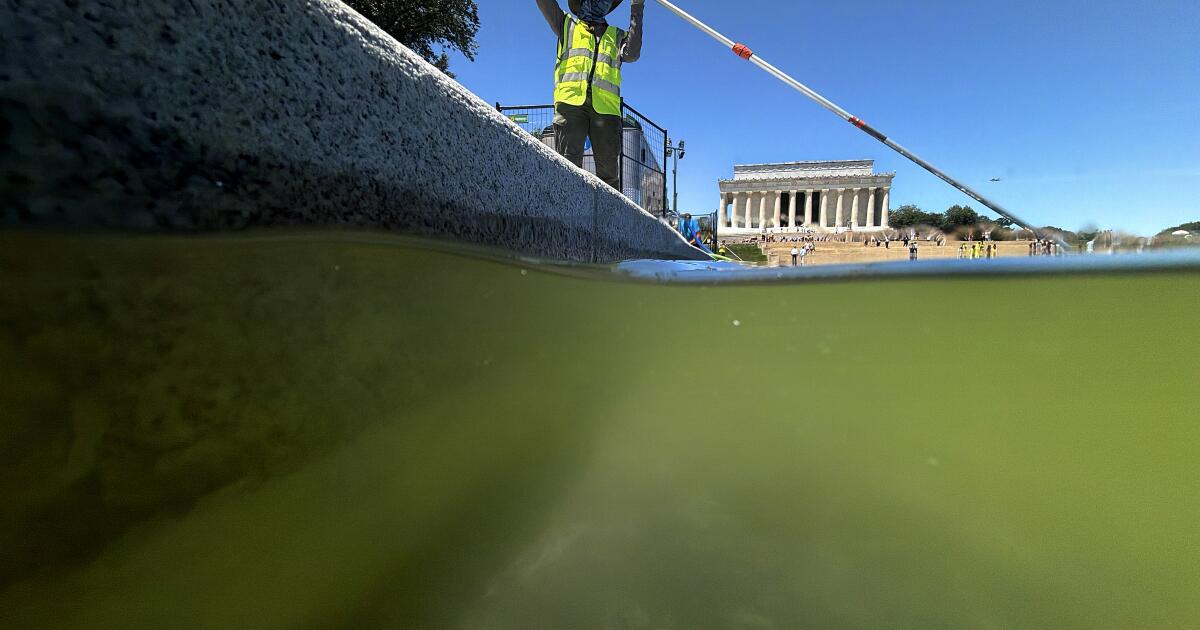
Here’s why the Lincoln Memorial Reflecting Pool went green so fast
-
 Sports6 minutes ago
Shohei Ohtani out of Dodgers’ lineup vs. Orioles for birth of his second child
-

 World18 minutes ago
Lebanese influencer organises World Cup event amid Israel’s attack on Leban
-
 News41 minutes ago
Air Force One, gifted to Trump from Qatar, arrives at Joint Base Andrews
-

 New York2 hours ago
Video: Fans Show Up to the Parade in Their Best Knicks-Themed Attire
-

 Los Angeles, Ca2 hours ago
Victims sought after man allegedly points gun at passing cars in Santa Clarita Valley
-

 Detroit, MI2 hours ago
Best barbershop in Metro Detroit: Finalists for this year’s Vote 4 The Best
-

 San Francisco, CA3 hours ago
How to watch San Francisco Giants vs. Miami Marlins

