Northeast
Ramaswamy: 2025 GOP wins in New Jersey, Virginia, would ‘set the table for…more decisive victories’ in 2026
NEWYou can now listen to Fox News articles!
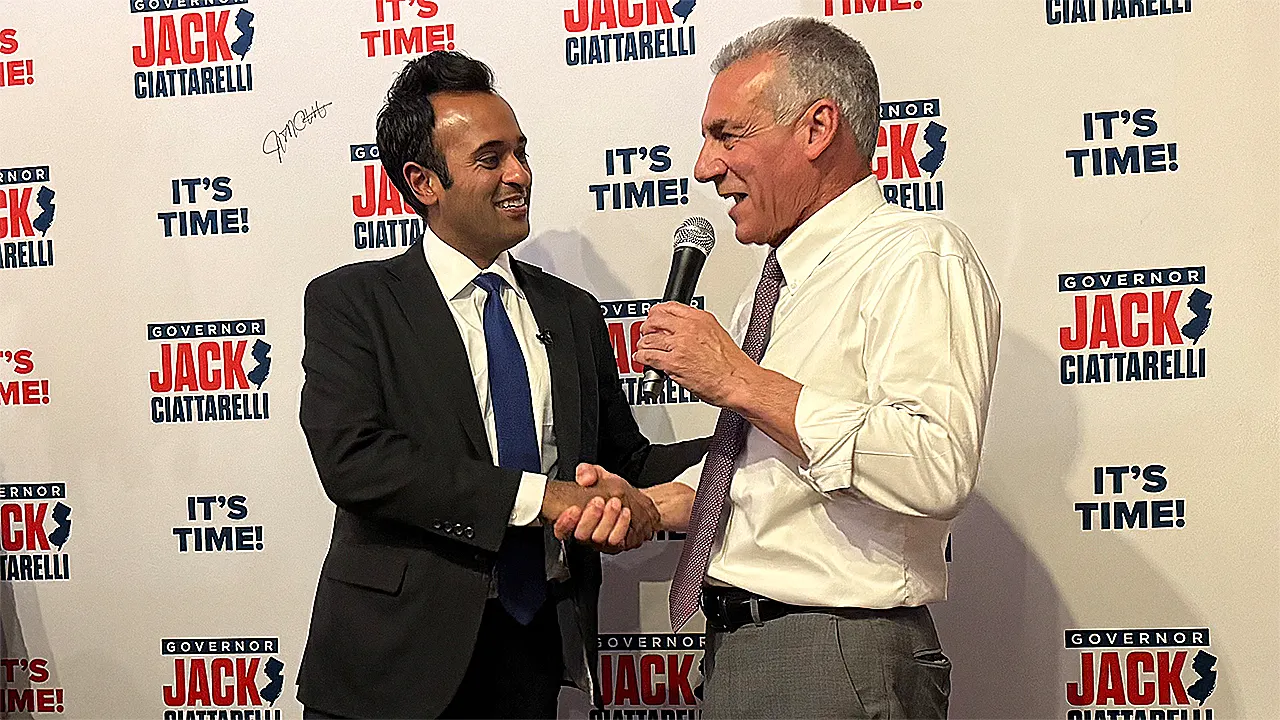
EXCLUSIVE – SADDLE BROOK, N.J. – GOP gubernatorial candidate Vivek Ramaswamy of Ohio was a long way from home on Wednesday night, as he briefly left his own race to help another Republican running for governor.
But Ramaswamy’s campaign trail stop in New Jersey’s competitive and combustible gubernatorial election, where he teamed up with GOP nominee Jack Ciattarelli at a packed diner full of supporters, could pay dividends next year in his own race back home.
New Jersey and Virginia are the only two states to hold gubernatorial showdowns in the year after a presidential election, and the contests traditionally grab outsized attention and are viewed as political barometers ahead of the following year’s midterm elections.
And this year, they’re being viewed to a large degree as ballot box referendums on President Donald Trump’s unprecedented second-term agenda.
CIATTARELLI WELCOMES TRUMP’S HELP IN BATTLE FOR NEW JERSEY GOVERNOR
Republican gubernatorial candidate in Ohio Vivek Ramaswamy headlines a campaign event for New Jersey GOP nominee for governor Jack Ciattarelli on Oct. 15, 2025 in Saddle Brook, N.J. (Paul Steinhauser – Fox News)
Pointing to New Jersey and Virginia, Ramaswamy said in an exclusive interview with Fox News Digital that GOP victories in both elections would “set the table for even bigger and more decisive victories, hopefully in places like Ohio next year.”
Ramaswamy arrived in New Jersey hours after the latest poll in the governor’s race indicated Ciattarelli narrowing the gap with Rep. Mikie Sherrill, the Democratic Party nominee in the race to succeed term-limited Democratic Gov. Phil Murphy.
The MAGA world rock star’s stop in New Jersey could help Ciattarelli energize many in the party’s base – low propensity voters who often skip casting ballots in non-presidential election years.
NATION’S ONLY TWO 2025 RACES FOR GOVERNOR ROCKED WITH THREE WEEKS UNTIL ELECTION DAY
“If you want to bring down costs in this state, back Jack,” Ramaswamy told the boisterous crowd. “If you want to make New Jersey great again, back Jack. We are ready, Jack, for change. This state is hungry for it.”

And Ramaswamy, the multimillionaire biotech entrepreneur and conservative commentator who pushed an “America First 2.0” platform as he ran for the 2024 Republican presidential nomination before ending his bid and becoming one of Trump’s top supporters and surrogates, told Ciattarelli, “We’re going in Ohio next year, but you’ve got to pave the path this year. We’re counting on you.”
Jack Ciattarelli, the Republican nominee for governor in New Jersey, speaks to a raucous crowd of supporters at a diner in Saddle Brook, N.J., on Oct. 15, 2025 (Paul Steinhauser/Fox News)
Ramaswamy, who’s been endorsed by Trump, is the only major Republican candidate right now in the 2026 race to succeed term-limited GOP Gov. Mike DeWine.
Former Democratic Rep. Tim Ryan, who spent two decades representing a large swath of northeastern Ohio, including Akron and Youngstown, is likely to launch a gubernatorial campaign in the coming days. Ryan, his party’s Senate nominee in Ohio’s 2022 election, would become the second major Democrat in the 2026 gubernatorial race, joining former state Health Director Amy Acton.
FINAL FACEOFF: CIATTARELLI, SHERRILL, CLASH ON DEBATE STAGE
“It doesn’t matter who we’re running against,” Ramaswamy said when asked what a Ryan candidacy would mean to him. “The beauty of our side of this election in Ohio is we’re more united than we’ve ever been as a Republican Party. I’m running unopposed in the Republican primary. But even more importantly, we have widespread labor support in Ohio. This is unprecedented.”
Ohio Republican gubernatorial candidate Vivek Ramaswamy teams up with New Jersey GOP nominee for governor Jack Ciattarelli at a campaign stop in Saddle Brook, N.J., on Oct. 15, 2025 (Paul Steinhauser – Fox News)
Ramaswamy, as he spoke at the Ciattarelli event in New Jersey, which included an overflow crowd of a couple of hundred people outside the diner, received encouragement to make another White House run down the road.
“I’m 100% focused on Ohio,” Ramaswamy told Fox News Digital. “You can’t make long-run plans. Life never goes according to your plan.”
But he added, “We’re gonna do our part in Ohio, and that’s my next step for how we save the country.”
HEAD HERE FOR THE LATEST FOX NEWS REPORTING ON THE 2025 ELECTIONS
Ramaswamy’s stop in New Jersey, with less than three weeks until Election Day, came hours after multiple sources confirmed to Fox News that Trump will hold tele-rallies with Ciattarelli.
In what’s expected to be a low-turnout election, Trump’s backing could prove crucial for Ciattarelli, who’s making his third run for governor after narrowly losing to Murphy four years ago.
“There’s obviously a whole lot of people across the state of New Jersey that are pleased with the job the president’s doing,” Ciattarelli said earlier Wednesday in an exclusive Fox News Digital interview.
Pointing to the president’s push to temporarily halt wind farms off the Jersey Shore, his vow to kill New York’s congestion pricing, tax cuts, deductions, and credits in the GOP’s massive domestic policy measure, and his efforts to secure the nation’s southern border, Ciattarelli said that people “are very pleased with the president, what he’s done for New Jersey.”
Trump endorsed Ciattarelli earlier this year in the GOP gubernatorial nomination race. And the president headlined a tele-rally for Ciattarelli ahead of the June primary.
While Trump isn’t on the ballot, he’s loomed large over the New Jersey gubernatorial election.
At last week’s second and final debate, Sherrill charged that her GOP rival had “shown zero signs of standing up to this president. In fact, the president himself called Jack 100% MAGA, and he’s shown every sign of being that.”
New Jersey Democratic gubernatorial nominee Rep. Mikie Sherrill, right, and Republican nominee Jack Ciattarelli, on the stage moments at the start of their second and final debate, on Oct. 8, 2025, in New Brunswick, N.J. (Paul Steinhauser/Fox News Digital)
Asked whether he considered himself part of the MAGA movement, Ciattarelli said he was “part of a New Jersey movement.”
When asked to grade the president’s performance so far during his second term, Ciattarelli said, “I’d certainly give the president an A. I think he’s right about everything that he’s doing.”
“I think that tells us all we need to know about who Jack Ciattarelli’s supporting. I give him an F right now,” Sherrill responded, as she pointed to New Jersey’s high cost of living.
Rep. Mikie Sherrill, the Democratic gubernatorial nominee in New Jersey, takes questions from reporters following a debate on Oct. 8, 2025, in New Brunswick, N.J. (Paul Steinhauser/Fox News)
While Democrats have long dominated federal and state legislative elections in blue-leaning New Jersey, Republicans are very competitive in gubernatorial contests, winning five out of the past 10 elections.
And Trump made major gains in New Jersey in last year’s presidential election, losing the state by only six percentage points, a major improvement over his 16-point deficit four years earlier.
Ciattarelli said in a Fox News Digital interview last month that he was “really pleased that the White House has offered to help us in any way that we see fit,” and that he and his campaign were “in constant communication with the White House about different ways they can help.”
And while there’s no indication, as of now, that Trump will join Ciattarelli in person in New Jersey, campaign strategist Chris Russell told Fox News, “We’re appreciative of all the help we’ve received from the president and his team so far, and grateful for any support they provide down the stretch.”
But the Democratic National Committee (DNC), in a release after word of the Trump tele-rally was first reported by Axios, claimed that Ciattarelli was “desperate.”
“It’s clear that this election comes down to one major truth: Jack is 100% for Trump, while Mikie Sherrill is 100% for New Jersey,” DNC Deputy Communications Director Abhi Rahman said in a statement.
Read the full article from Here
Maine
After feds cut key food insecurity survey, Maine lawmaker urges state to fill data void
Massachusetts
Mass. unveils $250 million in subsidies to protect residents from premium hikes – The Boston Globe
Audrey Morse Gasteier, executive director of the Massachusetts Health Connector, said the financial bulwark that benefited 270,000 residents is “part of the reason that we’re hanging in there in terms of enrollment and keeping people covered.”
But Thursday’s announcement won’t translate into any additional help.
Healey’s news conference coincided with the beginning of an election year in which three Republicans are vying for her job and voters are expected to be particularly focused on the state’s high cost of living. One survey last year found Massachusetts had the second highest cost of living in the country. People who saw their insurance premiums increase this year said it was one pricey bill amid an onslaught of growing expenses.
“I can’t believe how much it is when we go to the grocery store. Our electricity has gone up,“ said Judith O’Gara, whose family was hit with a $400 increase a month in insurance premiums for their ACA plan in January. ”We were just bracing ourselves to try to stretch the paycheck further.”
O’Gara, of Millis, is a part-time editor at community newspapers, and her husband is a self-employed computer animator and mural artist. She has added hours at work, she said, but it still wasn’t enough to qualify for health coverage through her employer, leaving the couple to buy insurance through the connector.
Healey also used the news conference to weigh in on a high-profile effort in Congress to revive the federal subsidies. Also on Thursday, the US House, with help from 17 Republican defectors facing competitive reelection races, passed a bill that would extend the subsidies for another three years. A small group of senators is considering proposing their own extension of the subsidies.
“We need to see people in Congress step up and take action and fight the president on this and get him to focus on the domestic agenda and how to make life more affordable for people,” Healey said.
The governor said she didn’t announce the influx of funds earlier because she had hoped Congress would act before the end of 2025.
“We gave up until the deadline to see if they take action,” she said.
ACA open enrollment extends through Jan. 23.
The infusion of funds from the Commonwealth Care Trust Fund brings the state’s total commitment to the insurance marketplace to $600 million, which Healey said is the largest support from any state in the country.
Federally subsidized insurance policies were first made available to people making less than 400 percent of the federal poverty level, or about $128,600 for a family of four, in 2009 under President Barack Obama’s ACA, also known as Obamacare. In 2021, Congress made those subsidies more generous for many recipients and extended them to people earning up to 500 percent of the federal poverty level. The expanded tax credits doubled participation in the ACA exchanges over the past four years, and by last year 337,000 people in Massachusetts received subsidized insurance through ConnectorCare.
The increases were slated to expire after four years, and without congressional action to preserve them, premiums reverted to pre-2021 levels for this year. People earning more than 400 percent of the poverty level became ineligible to receive subsidized insurance. State officials have estimated roughly 300,000 people could become uninsured statewide over the next decade, in part due to the expiration of the tax credits.
Democrats staged a 43-day shutdown last fall, the longest in US history, in an unsuccessful effort to preserve the expanded subsidies.
The Commonwealth Care Trust Fund predates the 2021 coverage expansion, said Doug Howgate, president of the Massachusetts Taxpayers Foundation, a nonprofit budget watchdog, and was established to support ConnectorCare programs. Massachusetts has long had a robust public insurance program, and the 2021 expansion essentially allowed the state to shift the cost of subsidies it had been paying to the federal government. Tapping the trust fund now essentially returns Massachusetts to the support levels it provided prior to 2021, Howgate said.
Regardless of the timing of Healey’s announcement, it is a reality that Massachusetts has a uniquely robust commitment to health insurance access, Howgate said.
“I do think that the idea that the state is able to offset some of those impacts is an important message to get out there,” he said. “This is real money.”
According to Healey’s office, a 45-year-old couple with two kids making $75,000 in Fall River previously paid $166 per month for the lowest-cost coverage. Without state action, their premium would have more than doubled. But with the infusion from the trust fund, they will pay $206 per month.
There’s only so much the state can do to mitigate the impacts of the expired subsidies, though. Because Congress didn’t extend them, people between 400 and 500 percent of the federal poverty level simply are ineligible to sign up for subsidized policies through the ACA marketplace. There are roughly 27,000 people statewide who cannot benefit from the state’s effort to compensate for the lost federal money, and those people are among those facing the biggest new insurance expenses.
Christa, 56, a hair dresser, and her husband, Gary, 69, a truck driver, earn less than $105,750 annually combined, just shy of 500 percent of the poverty level. The couple, who asked not to be named to protect their privacy, went from paying $282-a-month for Christa’s insurance with no deductible, to a private plan costing $725 a month with a $2000 deductible.
Gary, who is enrolled in Medicare, is still counting on Congress for a reprieve.
“I believe the Senate will be forced to do something, and we’re hoping,” he said.
Jason Laughlin can be reached at jason.laughlin@globe.com. Follow him @jasmlaughlin.
New Hampshire
The weight of caregiving in NH. Why we need SB 608: Sirrine
Recently, I met with a husband who had been caring for his wife since her Alzheimer’s diagnosis. Her needs were escalating quickly — appointments, medications, meals, personal care — and he was determined to keep her at home. But the cost to his own wellbeing was undeniable. He was sleep‑deprived, depressed, and beginning to experience cognitive decline himself.
As director of the Referral Education Assistance & Prevention (REAP) program at Seacoast Mental Health Center, which supports older adults and caregivers across New Hampshire in partnership with the CMHC’s across the state, I hear stories like his every week. And his experience is far from unique.
Across the country, 24% of adults are family caregivers. Here in New Hampshire, 281,000 adults provide this essential care, often with little preparation or support. Only 11% receive any formal training to manage personal care tasks — yet they are the backbone of our long‑term care system, helping aging parents, spouses, and loved ones remain safely at home. (AARP, 2025)
REAP provides short‑term counseling, education, and support for older adults, caregivers, and the professionals who support them. We address concerns around mental health, substance use and cognitive functioning. After 21 years working with caregivers, I have seen how inadequate support directly harms families. Caregiving takes a serious toll — emotionally, physically, socially and financially. Many experience depression, chronic stress, and increased risk of alcohol or medication misuse.
In REAP’s own data from 2024:
- 50% of caregivers reported moderate to severe depression
- 29% reported suicidal ideation in the past two weeks
- 25% screened positive for at‑risk drinking
Their responsibilities go far beyond tasks like medication management and meal preparation. They interpret moods, manage behavioral changes, ease emotional triggers, and create meaningful engagement for the person they love. Their world revolves around the care recipient — often leading to isolation, loss of identity, guilt, and ongoing grief.
The statistics reflect what I see every week. Nearly one in four caregivers feels socially isolated. Forty‑three percent experience moderate to high emotional stress. And 31% receive no outside help at all.
Compare that to healthcare workers, who work in teams, receive breaks, have coworkers who step in when overwhelmed, and are trained and compensated for their work. Even with these supports, burnout is common. Caregivers receive none of these protections yet are expected to shoulder the same level of responsibility — alone, unpaid, and unrecognized.
Senate Bill 608 in New Hampshire would finally begin to fill these gaps. The bill provides access to counseling, peer support, training, and caregiver assessment for family caregivers of individuals enrolled in two Medicaid waiver programs: Acquired Brain Disorder (ABD) and Choices for Independence (CFI). These services would address the very needs I see daily.
Professional counseling helps caregivers process the complex emotions of watching a loved one decline or manage the stress that comes with it. Peer support connects them with others navigating similar challenges. Caregiver assessment identifies individual needs before families reach crisis.
When caregivers receive the right support, everyone benefits. The care recipient receives safer, more compassionate care. The caregiver’s health stabilizes instead of deteriorating from chronic stress and neglect. And costly options, which many older adults want to avoid, are delayed or prevented.
There is a direct and measurable link between caregiver training and caregiver wellbeing. The spouse I mentioned earlier is proof. Through REAP, he received education about his wife’s diagnosis, guidance on communication and behavior, and strategies to manage his own stress. Within weeks, his depression decreased from moderate to mild without medication. He was sleeping through the night and thinking more clearly. His frustration with his wife dropped significantly because he finally understood what she was experiencing and how to respond compassionately.
The real question before lawmakers is not whether we can afford SB 608. It is whether we can afford to continue ignoring the needs of those who hold our care system together. In 1970, we had 31 caregivers for every one person needing care. By 2010, that ratio dropped to 7:1. By 2030, it is projected to be 4:1. Our caregiver supply is shrinking while needs continue to grow. Without meaningful support, our systems — healthcare, long‑term care, and community supports — cannot function. (AARP, 2013)
Caregivers don’t ask for much. They want to keep their loved ones safe, comfortable, and at home. They want to stay healthy enough to continue providing care. SB 608 gives them the tools to do exactly that.
I urge New Hampshire lawmakers to support SB 608 and stand with the 281,000 residents who are quietly holding our care system together. We cannot keep waiting until caregivers collapse to offer help. We must provide the support they need now — before the burden becomes too heavy to bear.
Anne Marie Sirrine, LICSW, CDP is a staff therapist and the director of the REAP (Referral Education Assistance & Prevention) program at Seacoast Mental Health Center.
-
Detroit, MI5 days ago2 hospitalized after shooting on Lodge Freeway in Detroit
-
Technology3 days agoPower bank feature creep is out of control
-
Dallas, TX4 days agoDefensive coordinator candidates who could improve Cowboys’ brutal secondary in 2026
-
Health5 days agoViral New Year reset routine is helping people adopt healthier habits
-
Nebraska2 days agoOregon State LB transfer Dexter Foster commits to Nebraska
-
Iowa3 days agoPat McAfee praises Audi Crooks, plays hype song for Iowa State star
-
Nebraska3 days agoNebraska-based pizza chain Godfather’s Pizza is set to open a new location in Queen Creek
-
Entertainment2 days agoSpotify digs in on podcasts with new Hollywood studios