


The Brewers were rained out last night! I hope you’ll forgive that instead of rewriting an entire new game discussion, I’m just going to (mostly) copy and paste what I wrote before yesterday’s game, because both teams are using the same lineups they announced last night.
Pittsburg, PA
Kozora: In 2027, Pittsburgh’s Wallet Will Open Wide For Its Offensive Line


Like the offseasons that have preceded it, 2027 will be about the quarterback. Do the Pittsburgh Steelers bank on Will Howard or Drew Allar as the future? Is the answer in the 2027 draft? Is there another door to open? Until there’s a long-term solution, it will always dominate the conversation.
Putting aside the obvious, the other top storyline centers on the men asked to protect the quarterback. Pittsburgh’s 2027 offseason will be defined by paying its offensive line, a good but expensive problem to have.
Even knowing Broderick Jones isn’t likely to receive a new deal, Omar Khan will have discussions with virtually everyone else. The 2023 draft class all could be in line for summer extensions: OT Troy Fautanu, C Zach Frazier and OG Mason McCormick. None will hit free agency until 2028, and Fautanu has the fifth-year option, but all three will be first-time eligible for a deal, and deserving of one. The longer teams wait, the more they pay.
McCormick might be the cheapest, but even that is a relative term. The guard market’s heated up the past two offseason cycles. His going rate could be $20 million per season.
Robert Hunt signed a five-year, $100 million deal with the Carolina Panthers in 2024. This past offseason, Will Fries inked a five-year, $87.72 million, that’s $17.5 mil per year, with the Minnesota Vikings.
Given the salary cap’s projected increase, McCormick could be looking at a similar figure. Perhaps a slightly shorter deal, a four-year extension with his final rookie year rolled into the agreement, but a big money pact all the same.
Although McCormick hasn’t received the fanfare of Frazier or Fautanu, he broke out in 2025. His run and pass blocking improved. He was durable and didn’t miss a single snap.
Frazier’s market has spiked. Thank Tyler Linderbaum for that. He didn’t just reset but shattered the center market this offseason, leaving the Baltimore Ravens for the Las Vegas Raiders on a three-year, $81 million deal. His $27 million APY blows away second place Creed Humphrey and his $18 million mark. Now, every center next to get paid will want to get near that figure.
Unless Frazier truly has an All-Pro seasons, he probably won’t surpass him. Something in the 20-million range, say $22 million per year, is realistic. Frazier’s been steady and solid in the middle, and Pittsburgh won’t want to start its pivot search again.
Then there’s Fautanu. Flipping and likely staying at left tackle, he’s playing a premium position. Even if the thinking is antiquated, blindside protectors still get paid more than their right side counterparts. The Colts’ Bernard Raimann signed a four-year, $100 million contract in July, 2025. In January, Charles Cross went for an average of $26.1 million.
Fautanu will be looking for the same if not more. He’ll definitely want more than whatever Frazier commands at center. Fautanu could push for upwards of $30 million per year if his season is good enough.
There is a caveat. Fautanu’s fifth-year option is due next May, and it’s likely to get be exercised. If so, he’ll be the first by a homegrown Steeler since T.J. Watt. But that also could extend out the timeline of an extension by one season. Minkah Fitzpatrick and Watt had to wait one year from their option due dates to receive their extension. If Fautanu follows the same, his contract won’t come until 2028.
It would be rare for Pittsburgh to get a deal done with Fautanu two years out, but the longer the team waits, the more he’ll cost. And if he has a great year, Pittsburgh, under Omar Khan and Mike McCarthy, who have never been in charge of a fifth year option situation in Pittsburgh before, might think about things differently. Age is a factor, too. Fautanu was an older prospect coming out of school. If Pittsburgh waits until 2028, Fautanu will be 27-going-on-28. Hardly old but the sooner he plays out an extension, the better the odds are for the Steelers to get good return on the deal.
Either way, there will be at least some level of financial component to Fautanu next offseason. Either just his fifth-year option, an amount likely worth over $20 million, and the chance of a long-term pact.
Naturally, this all presumes McCormick, Frazier, and Fautanu stay healthy and play well this season. Health is unpredictable, but it’s reasonable to think all three will continue thriving on the field. Pittsburgh’s invested so much in its offensive line and deserves credit for it. Soon will come the time to keep the group together. The “retain” part of draft, develop, retain.
Fautanu and McCormick are shifting back to their college homes. Frazier has been nothing but excellent out of the gate. Pittsburgh won’t want to break the band up.
In average value, the deals could look like this:
Mason McCormick: $20 million per season
Zach Frazier: $22-23 million per season
Troy Fautanu: $28 million per season (potentially $30 million-plus if his timeline waits another season).
Big, big money.
They aren’t the only ones to think about. Dylan Cook might be one of the most interesting debates next year. He’s slated to become a restricted free agent that can pay him the first substantial money of his NFL career.
A refresher: teams can place a tender on a RFA: first, second, or original round. The other 31 teams can still submit a contract offer. If Pittsburgh declines to match, they lose the player but gain the pick corresponding to the tender.
Here’s 2027’s tender projections:
First Round: $8.735 million
Second Round: $6.261 million
Original Round: $3.822 million
Because Cook went undrafted, the original round tender would only give Pittsburgh the right of first refusal and the opportunity to match the contract. If not, they won’t receive a draft pick back.
That puts the team in an interesting position. Apply the original round tender and the team could save money. But it also opens themselves to teams submitting an offer for a still-young tackle without getting any compensation in return.
Applying the second round tender makes more sense. But it will cost more. Likely behind Max Iheanachor and Fautanu, he’ll be an expensive backup.
What’s the right answer? Hard to say. But paying for good offensive linemen is worth it, and the money “saved” by declining Broderick Jones’ fifth-year option can be applied to Cook.
There’s other names to consider. Spencer Anderson is in the final year of his rookie deal. Gennings Dunker appears to be the long-term hope, but what if Anderson wins the starting right guard job and holds onto it? It won’t be so easy to just let him walk. Brock Hoffman signed a one-year deal and will be a free agent next year. Will Pittsburgh re-sign him for depth? They could.
Then, there’s Jones. His future with the team looks bleak, but is there a scenario in which he returns? As Dave Bryan outlined on the podcast, Jones’ contract, in theory, could toll and roll over into 2027 if, and it’s a big if, he spends the entire 2026 season on Reserve/PUP due to his neck injury.
If not and he becomes a free agent, would Pittsburgh sign him back as a swing tackle? Probably not, but if Jones walks, and Cook gets poached on the tender, the team’s depth will have taken a big hit.
Pittsburgh’s 2027 offseason could be similar to 2014. That June, Maurkice Pouncey signed a five-year extension to become the NFL’s highest-paid center. Two months later, Marcus Gilbert signed his own five-year deal. It was part of an effort to keep the group intact.
This time around, Pittsburgh could pay three players and for substantially more money. Combined, Pouncey and Gilbert’s contracts amounted to about $74 million. Any one of Frazier’s, McCormick’s, or Fautanu’s deals could surpass that.
These aren’t complaints. Having talented draft picks to pay is welcome news for a team who has missed far too often. Only one selection of the 2020 class, EDGE Alex Highsmith, saw a multi-year second contract.
Ditto with the 2021 group – TE Pat Freiermuth. The 2022 class had none. Opening up the wallet for these names is what a team wants. But it’s a storyline and projection that hasn’t been discussed much, and one worth getting in front of.
It’s also relevant for national talking heads like Colin Cowherd who criticize the team for spending so much on defense. Those scales will tip back if these deals get done.
McCormick. Fautanu. Frazier. Cook. Anderson. Jones. Hoffman. All offensive line decisions to work through.
Answers will come in time. There’s an entire season to play, and what we expect now versus next year’s reality are often different things. But the last time we did this, we noted George Pickens’ future would come into focus in the 2025 offseason. It did by Pittsburgh trading him to Dallas.
General managers have to be forward-thinking, especially with these large contracts that will impact the cap. Having a quarterback on a cheap contract will help, and Pittsburgh should have the money to sign whoever they want.
Next offseason will be a busy one. Quarterback will grab the national headlines, but the offensive line will be where the money, and important decisions, will be made.


Today we are seasonable with partly cloudy skies and highs in the mid-80s.
There are a few isolated showers this afternoon and evening, but not a washout, and nothing severe is expected.
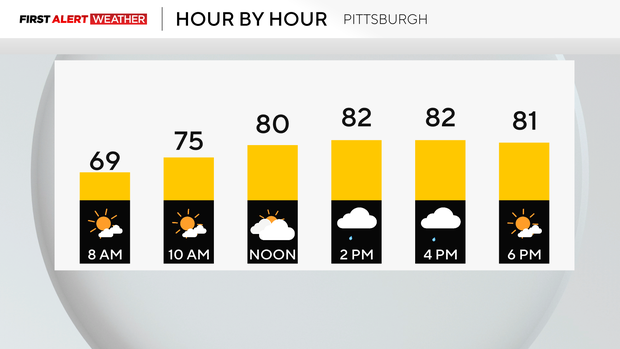
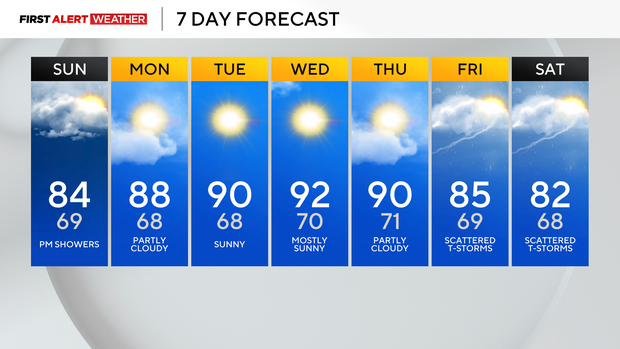
Most will be mainly dry, and the dry weather carries into the week with highs near 90 and plenty of sunshine.
Hourly Conditions:
- 9 a.m.: 74° Mostly Sunny
- Noon: 80° Mostly Cloudy
- 3 p.m.: 82° Showers
- 6 p.m.: 81° Mostly Sunny
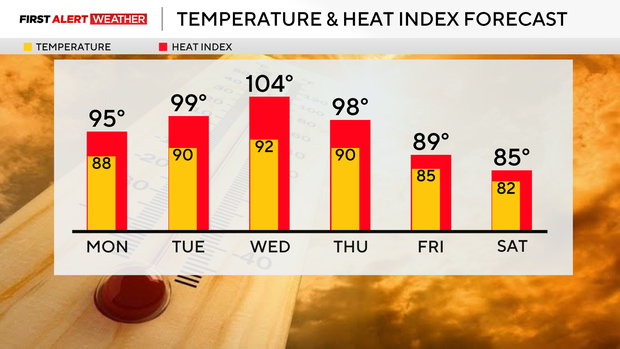
We could see our 6th 90-degree day of the year on Tuesday, with two more following through Thursday, plus it could feel in the triple digits for some areas. Wednesday will be the hottest!
Our next best chance of rain and storms is Friday and throughout the weekend!

A motorcyclist has died following a crash in North Huntingdon Township, Westmoreland County.
Charles McCutcheon, 59, of Jeannette, was traveling west on Lincoln Highway when his motorcycle collided with a Kia sedan traveling east and attempting to turn into a local business, according to a public information report from Westmoreland County Coroner John Ackerman.
The crash, reported around 11:30 a.m. Saturday at 12259 Lincoln Highway, was described as a head-on collision. McCutcheon was pronounced dead approximately one hour later.
McCutcheon’s cause and manner of death are pending toxicology results, the coroner’s office said.
North Huntingdon Township police were handling the investigation.
Pittsburg, PA
Game Discussion (Let’s Try This Again): Milwaukee Brewers (59-34) @ Pittsburgh Pirates (47-47)

However, there are two new pieces of information today. The first is minor, and that’s that Garrett Stallings has been spotted in Pittsburgh and is presumably the 27th man for today’s doubleheader (he should be available in the nightcap). The second is more troubling: Kyle Harrison has been placed on the 15-day injured list with forearm tightness, with Robert Gasser getting recalled to replace him on the roster.
Harrison himself has reiterated what he said a couple of days ago: that he’s not too worried. Plus, a 15-day stint on the IL right now isn’t the worst thing in the world — 15 days from July 9 means he could be eligible to return after missing only six games on the other side of the All-Star break, and he wasn’t going to pitch this weekend anyway. It sounds like the Brewers already had some sort of plan in this respect:
Hopefully, this is just a precautionary short stint for Harrison. The Brewers have proved remarkably flexible when it comes to replacing their injured starters this season, but if Harrison is lost for a longer period, it would be a real blow.
In any case, today’s game starts at 11:05 a.m., and we’ll see you for some morning baseball! The rest of the preview, as written last night, is below.
It’s the start of the last series before the All-Star break (weather permitting) and the Brewers are in Pittsburgh to wrap things up with a three-game set with the Pirates. Brandon Sproat takes the mound for the Brewers, while first-time All-Star Braxton Ashcraft will pitch for the Pirates.
Before we get to tonight’s starters, we’ve got a transaction to tell you about. Since time is, as they say, a flat circle, the Brewers have signed Bryse Wilson to a major league deal. To make room for him, they’ve sent Drew Rom to Triple-A Nashville and they’ve designated Easton McGee for assignment.
Wilson pitched for the Brewers in 2023 and 2024, serving mostly as a long-relief, semi-mop-up option. In 2023 he had quite a nice year: in 53 outings, Wilson pitched to a 2.58 ERA and went 6-0. He struggled more in 2024, but he pitched over 100 innings in a swingman role and was slightly above league average via ERA+. However, in both seasons, Wilson vastly outperformed his peripheral numbers, and since leaving the Brewers, things have been a struggle. He made 20 appearances for the White Sox in 2025 and had a 6.65 ERA in 47 1/3 innings; in three big-league appearances in 2026 (two with the Cubs, one with the Phillies), he’s allowed seven runs, all earned, in 9 2/3 innings. Wilson’s role with the Brewers, for however long it lasts (likely not long), will surely be similar to what it was when he last pitched for them in 2024: mop-up duty. (For those who are optimists, Wilson is generally good at not walking guys, but he doesn’t really strike them out, either, and over the last couple of seasons he has been eminently hittable, with about 12.5 hits per nine innings.)
Back to tonight’s action. Sproat will look to get into the break on a high note. Sproat’s last outing was a mixture of good and bad: he was not pitching well, needed 92 pitches, and allowed eight baserunners to get through just four innings pitched. But the good news is that he was mostly able to work his way out of trouble, too, and he somehow allowed just one run in those four innings, a game which Milwaukee eventually won 3-2 against the Diamondbacks. It was an encouraging sign of maturation that he didn’t just implode when things weren’t going well. Since the beginning of June, Sproat has a very solid 3.30 ERA in 30 innings pitched, and the team is 5-1 in his starts, a stark contrast to his 6.24 ERA and 5-6 team record prior to last month.
Ashcraft has been quite good for Pittsburgh, as evidenced by his status as an All-Star injury replacement. He’s just 26 and in his second season, and he’s done nothing but pitch well since his debut in late May of last season. This year, Ashcraft is 9-3 with a 3.24 ERA (134 ERA+) and even better 3.16 FIP. He’s got sterling peripherals (10.1 K/9, 2.1 BB/9) and is a hard thrower who plays a curveball and sinker off a four-seamer that sits around 97 mph. The curveball, especially, is one of the better ones in the league.
The Brewers continue to rotate through their position players as they reach the end of this 18-games-in-17-days stretch. Christian Yelich is back in the leadoff spot, while the outfield goes Luis Lara, Garrett Mitchell, and Sal Frelick from left to right. William Contreras is behind the plate, while the infield is Joey Ortiz, Cooper Pratt, Brice Turang, and Jake Bauers.
After last night’s rainout, first pitch has been scheduled for 11:05 a.m. CT, with game two coming either at 3:05 p.m. or one hour after the end of game one, if that’s later than 3:05.
-

 Kentucky1 minute ago
Kentucky sheriff warns residents of rental scam circulating TikTok
-

 Louisiana7 minutes ago
DeRidder man found dead in Sabine River
-

 Maine10 minutes ago
The Maine Bureau of Highway Safety urges Mainers to drive to save lives
-

 Maryland15 minutes ago
Maryland lawmakers express condolences after sudden death of Sen. Lindsey Graham
-

 Michigan22 minutes ago
Michigan churches strengthen safety after recent attacks on houses of worship
-

 Massachusetts25 minutes ago
Fire spreads to 3 multi-family buildings in Lawrence, Massachusetts
-

 Minnesota30 minutes ago
Police seeking suspect in Eagan road rage shooting incident
-

 Mississippi37 minutes ago
Mississippi State signee, top 100 prospect Landon Brown withdraws from 2026 MLB Draft

