
Connect with us

Pennsylvania

Trump administration's mass deportation plan would hurt Pennsylvania, immigrant advocates warn • Pennsylvania Capital-Star

Published

on

Trump administration's mass deportation plan would hurt Pennsylvania, immigrant advocates warn • Pennsylvania Capital-Star


President-elect Donald Trump’s plan to carry out mass deportations of undocumented immigrants would lead to population loss, exacerbate workforce shortages and increase tax burdens for Pennsylvania residents and businesses, the Democratic state lawmakers heard Wednesday.

Advocates for the immigrant community testified before the state House Democratic Policy Committee that although the federal government maintains exclusive authority over immigration policy, which is expected to take a draconian shift under a second Trump administration, state lawmakers can make Pennsylvania a more welcoming place.

“It’s been laid out very clearly. Unfortunately, it’s going to be immigrant detention and deportations on the horizon,” Julio Rodriguez, political director of the Pennsylvania Immigration and Citizenship Coalition, said. “So now it’s crucial that this legislature not only has welcoming policies to support immigrants, but to fight back against these proposals.”

The hearing on the last day of the 2023-2024 legislative session was convened by state Rep. Danilo Burgos (D-Philadelphia), who serves as chairperson of the Pennsylvania Legislative Latino Caucus.

Advertisement

Pennsylvania ranks fourth in the nation in population loss, Rodriguez said. In 2021, the net decrease in population between births and deaths was more than 23,000.

“We didn’t see that impact, because net international migration, also known as immigrants moving here, was 25,721,” Rodriguez said “Had it not been for immigrants, we would have seen a drastic population decline.”

A state’s population determines its number of representatives in Congress. Rodriguez noted that Pennsylvania lost one congressional seat after the 2020 census and could lose another in 2030. It would also result in Pennsylvania receiving less federal funding.

But more immediately, the loss of a portion of the commonwealth’s 978,000 immigrant residents would worsen the labor shortage in the agricultural sector, driving up grocery store prices. Undocumented workers also contribute billions in taxes and in the state’s gross domestic product, Rodriguez said.

Immigration groups brace for a second Trump administration

Advertisement

Cathryn Miller-Wilson, executive director of HIAS Pennsylvania, a nonprofit organization that provides aid to immigrants and advocates on their behalf, said history strongly suggests that the effects of an immigration crackdown will be severe.

Miller-Wilson noted that the United States has gone through several cycles of liberal and conservative immigration policies. After Congress passed the National Origins Act in 1924, which severely limited immigration, the country entered a period of stagnation that resulted in the Great Depression. 

“Now that wasn’t only because immigrants were kept out, but it certainly was in large part. We stopped creating patents, we stopped inventing, we stopped innovating, we stopped creating new businesses, we stopped hiring, we stopped increasing wages, and disaster ensued,” she said. 

“People voted because they can’t afford groceries. That’s fine. We can all understand that. We can all empathize with that,” Miller-Wilson said. “The problem is they don’t understand that what they voted for will increase prices and plunge our country into an economic crisis such as we haven’t seen for 100 years.”

House Speaker Joanna McClinton (D-Philadelphia) said the apprehension of what will come during the Trump administration is evident, and noted that her district office recently received a question about what can be done at the state level to protect immigrants.

Advertisement

“If you had to tell us your top three legislative goals for 2025 to 2026 — no, we don’t actually regulate immigration — but what do you think we can do?” McClinton asked Rodriguez.

Rodriguez said state lawmakers should oppose any measure that requires state or local agencies to contact U.S. Immigration and Customs Enforcement (ICE) regarding residents who are suspected of being in the country without permission. The American Civil Liberties Union of Pennsylvania recently published a report that details unlawful tactics and civil rights violations by the agency against immigrants living in Pennsylvania, he noted.

…what they voted for will increase prices and plunge our country into an economic crisis such as we haven’t seen for 100 years.

– Cathryn Miller-Wilson, executive director of HIAS Pennsylvania

Advertisement

Rodriguez also highlighted legislation sponsored by Rep. Joe Hohenstein (D-Philadelphia) that would clarify the process for an undocumented immigrant to apply for a U visa, which is available to victims who assist in the prosecution of a crime and creates a pathway to legal residence. House Bill 1371, which was awaiting final consideration in the House, would establish duties and procedures for law enforcement, prosecutors and judges in the application process.

Julissa Morales, of the Movement of Immigrant Leaders in Pennsylvania, said her organization is focused on passing legislation that would allow undocumented immigrants to obtain driver’s licenses, to do so with a taxpayer identification number and to protect information in PennDOT’s database from access by ICE. House Bill 769, sponsored by Burgos, was introduced in March 2023, but did not receive consideration.

Rep. Greg Scott (D-Montgomery) noted that in his previous office as a district judge, he had seen defendants who were stopped for driving without a license multiple times because there is no way for them to get one. That has an impact on county jails where undocumented immigrants are often held on ICE detainers before being transported to immigration detention centers. 

Advertisement

Morales, who shared that both of her parents currently have no path to citizenship, said such policies affect people who are not just numbers, but family members.

“My parents are business owners, and part of the system that we are calling an economic workforce,” Morales said. “These are the people who are being impacted day to day for not being able to access something as simple as mobility.”


Source link

Advertisement

Pennsylvania

Pennsylvania man who brought gun to

Published

on

Pennsylvania man who brought gun to


Advertisement

A Pennsylvania man who brought a gun and other weapons to a rally in West Chester last year has been sentenced to more than three years behind bars. 

A federal judge sentenced Kevin Krebs, 32, of Malvern, Pennsylvania, to 37 months in prison and three years of supervised release for possessing unregistered explosive devices, officials announced Tuesday. 

Krebs was arrested on June 14, 2025, in the area of North High Street in West Chester, near a “No Kings” protest against President Trump’s deportation policies and other actions by his administration.

Police arrested Krebs with a fully loaded concealed Sig Sauer P320 handgun under a yellow raincoat, an M9 bayonet, a pocket knife, pepper spray, a ski mask and gloves. Court documents showed police also found an AR-15-style rifle on the floor of Kreb’s SUV. Investigators said Krebs did not have a concealed carry permit.

Investigators found over a dozen improvised explosive devices, including pipe bombs, at his home on Conestoga Road days after his arrest. 

Advertisement

Krebs pleaded guilty to the federal charges in December. 

A state case against Krebs is still pending. 


Source link

Continue Reading

Pennsylvania

Here’s what’s in — and not in — Pennsylvania’s $50.8 billion state budget

Published

on

Here’s what’s in — and not in — Pennsylvania’s .8 billion state budget


HARRISBURG — Pennsylvania’s new $50.8 billion state budget was sprawled across more than 600 pages of legislation and signed into law on Sunday. New data center regulations, new education funding, and more were approved in the wide-ranging spending package.

But some of the most pressing issues facing the General Assembly were noticeably absent from the final deal, as Gov. Josh Shapiro and lawmakers in the split legislature were unable to reach a compromise — or didn’t want to touch the contentious issues until after they are up for election in November, sidelining some of Shapiro’s top budget priorities.

Here’s a look at what’s in — and what was left out — of the 2026-27 Pennsylvania state budget.

» READ MORE: Pa. lawmakers and Gov. Josh Shapiro have approved a $50.8 billion state budget, delaying action on key issues

Advertisement

Pennsylvania took another jump toward filling a multibillion-dollar funding gap between wealthy and poor school districts, after a court found that the state’s old system of funding education was unconstitutional. Since 2024, when the state first implemented new adequacy and tax equity formulas in efforts to fill the state’s $4.5 billion “adequacy gap,” lawmakers have put nearly $1.9 billion toward funding lower-income districts, with plans to fill it by 2032.

“It keeps our promise to our school districts,” said State Rep. Jordan Harris (D., Philadelphia), who serves on the powerful appropriations committee responsible for allocating state dollars, in remarks on the House floor Sunday.

The latest installment of adequacy and tax equity payments — $565 million — will largely go to low-income districts that already have high property taxes. The School District of Philadelphia, Pennsylvania’s largest school district and the only one in the state that is unable to raise its own revenue, will get $136 million of that funding increase.

Shapiro proposed generating new revenue streams to help the state fix its multibillion-dollar structural deficit in his last four budget addresses. But the ways he wants to raise that cash have been met with resistance by Senate Republicans, who argue they aren’t policies that will improve the state’s economic standing — or can’t reach agreement within their caucus on how to address the issues.

Shapiro this year didn’t get the hefty minimum wage increase he asked for, raising the hourly minimum from $7.25 to $15 — and counting on the higher wage for $80 million in higher income tax revenues. Nor was he able to get the split General Assembly, where Democrats control the House and Republicans lead the Senate, to approve adult-use cannabis, which his office estimated would bring in $729.4 million in its first year, largely through licensing. (House Democrats have approved plans for a minimum wage increase and recreational marijuana legalization, but the Senate has not voted on the bills.)

Advertisement

» READ MORE: Could recreational marijuana really bring $1.3 billion in revenue to Pa. over five years? Here’s how other states are faring.

Screen shows skill games and cannabis regulation and reform as Gov. Josh Shapiro makes his annual budget proposal in the state House chamber in Harrisburg Tuesday, Feb. 3, 2026.Read moreTom Gralish / Staff Photographer

Shapiro, in his February budget proposal, also called on the General Assembly to regulate and tax skill games at the same rate as casinos, a move which he has estimated could generate nearly $800 million in revenue in its first year. But any regulation of skill games — slot-machine lookalikes that the state Supreme Court ruled last month are a form of gambling — was left out of the budget.

Lawmakers still have until October to decide whether skill games will be taxed and regulated, part of a grace period in the high court’s ruling. Otherwise, they will become illegal gambling machines found in many corner stores, gas stations, and bars. The issue has been the target of more than $8 million in lobbying and $9 million in campaign spending in Harrisburg, mostly funded by one company.

» READ MORE: How ‘skill games’ exploded across Pennsylvania — and sparked a multimillion-dollar political fight
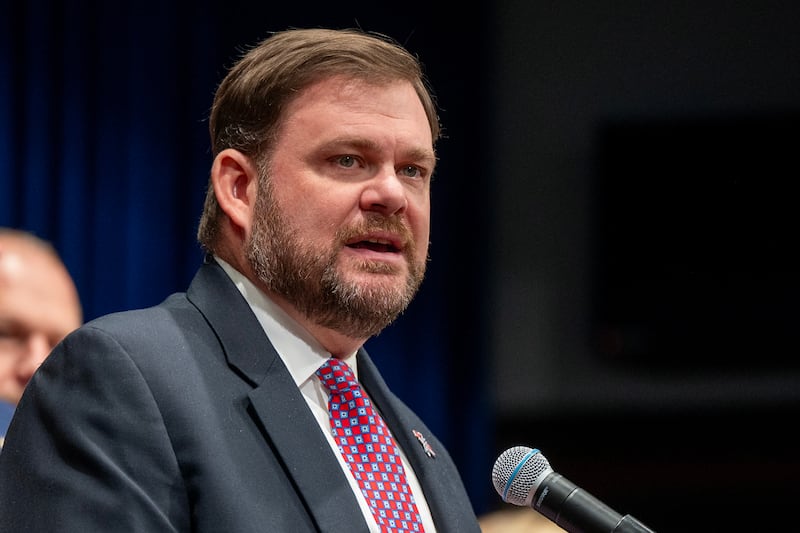
State Senate Majority Leader Joe Pittman (R., Indiana) during a press conference at the Capitol in Harrisburg Feb. 3, 2026.
State Senate Majority Leader Joe Pittman (R., Indiana) during a press conference at the Capitol in Harrisburg Feb. 3, 2026.Read moreTom Gralish / Staff Photographer

“We can act within the 120 days, we can act after the 120 days,” Senate Majority Leader Joe Pittman (R., Indiana) said on Sunday. “But the choice is now quite simple. These machines are illegal, and in less than 120 days, they will be leaving the marketplace.”

Data centers — which are seeing a boom in Pennsylvania as artificial intelligence usage increases and communities are pushing back on where they are being built — will be required to submit information about their energy and water usage.

Advertisement

Beginning next summer, data centers in the state with a peak energy demand greater than 10 megawatts will be required to submit information annually to the Department of Environmental Protection.

Outlined as part of this year’s fiscal code, those reports will be publicly-accessible. Data centers that do not submit information about their resource usage will be fined $10,000 a day.
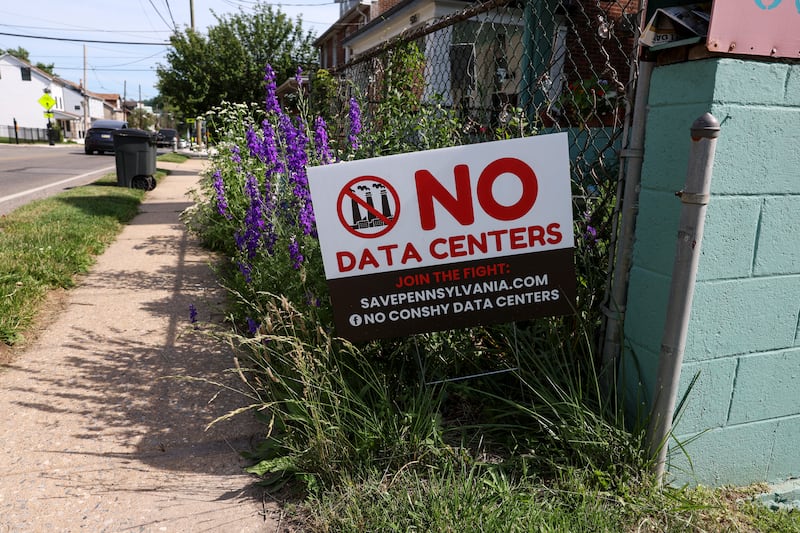
A yard sign protests the proposed data center on New Elm Street near the Closed Cleveland-Cliffs steel mill photographed on Thursday, June 4, 2026 in Conshohocken, Pa.
A yard sign protests the proposed data center on New Elm Street near the Closed Cleveland-Cliffs steel mill photographed on Thursday, June 4, 2026 in Conshohocken, Pa.Read moreMonica Herndon / Staff Photographer

A data center regulation bill, which would have limited state benefits for data center developers and was championed by Shapiro, was not included in the final budget deal. The governor called for limiting a sales and use tax exemption and expediting permitting to projects that comply with a set of transparency and environmental standards.

And several other data center regulation efforts that have received bipartisan support in recent weeks were also absent from the final spending package.

That included efforts to repeal the existing sales tax exemption afforded to data center developers and attempts to enact a local or statewide moratorium on new data center development.

Both chambers passed language repealing the tax exemption and advanced differing bills to freeze development. One Democratic-sponsored bill would have given municipalities the option to implement a 180-day moratorium on new centers. The other, a Republican-sponsored measure, would allow for local moratoriums up to 18 months.

Advertisement

“Compromise” was the word of the day around the Pennsylvania Capitol on Sunday, when the legislature swiftly passed the more than 600-page budget deal hashed out behind closed doors between Shapiro, Pittman, and House Majority Leader Matt Bradford (D., Montgomery) and passed with bipartisan support in both chambers.

The legislative leaders and Shapiro emphasized that they didn’t get exactly what they wanted in the budget, as a symptom of dealing with divided government. And leaders were proud to have reached the deal less than two weeks after their July 1 deadline, rather than the nearly five months that it took to hash out an agreement last year.
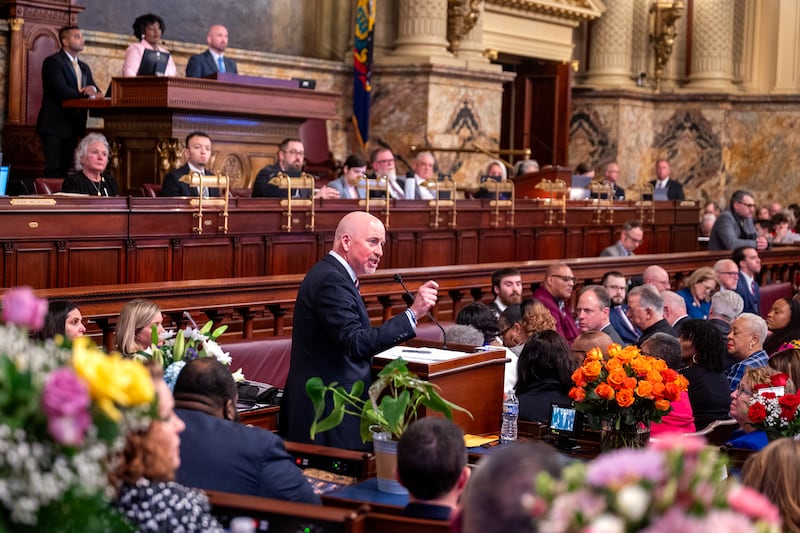
House Majority Leader Matt Bradford (D., Montgomery) speaks on Tuesday, Jan. 7, 2025.
House Majority Leader Matt Bradford (D., Montgomery) speaks on Tuesday, Jan. 7, 2025.Read moreTom Gralish / Staff Photographer

Lawmakers also agreed to work over the weekend to hurriedly approve the budget deal, with members of the Senate coming in on Saturday night to begin advancing parts of the budget deal and the House joining them Sunday afternoon. By 6:15 p.m. on Sunday, Shapiro had signed it.

Among the inspirations for the weekend of productivity: Making it to the MLB All-Star Game in Philadelphia, Bradford said, for which he has tickets.

Leaders returned to some old accounting maneuvers to address the state’s multibillion-dollar structural deficit and avoid pulling from the state’s emergency savings account.

They spent down unused and underused dedicated funds, and rolled some of the state’s Medicaid payments totaling $1.3 billion to the next fiscal year, a move lawmakers typically resorted to before the state saw an influx of federal dollars during the COVID pandemic.

Advertisement

Without those delayed payments, the state budget would total closer to $52.1 billion, and several GOP members criticized the total as being disingenuous.

More than 80,000 retired public-sector employees will receive a cost-of-living adjustment to their pensions, something advocates have sought for years.

» READ MORE: More than 80,000 Pa. retired teachers, police officers, and firefighters will get a pension bump — some for the first time in decades

Public school teachers and other state employees who retired before July 1, 2002 will receive a tiered monthly payment based on the date of their retirement. Similarly, police officers and firefighters who retired more than five years ago will receive monthly payments ranging from $50 to $300 dollars, depending on how long they have been retired.

Lawmakers from both parties had called for the cost-of-living increase.

Advertisement

Legislators also agreed to close a loophole that allowed online sellers to avoid paying Philadelphia’s local 2% sales tax on purchases made in the city.

Mayor Cherelle L. Parker had asked the General Assembly to close it as part of her own city budget pitch in a move estimated to bring an additional $1.5 million to Philadelphia.
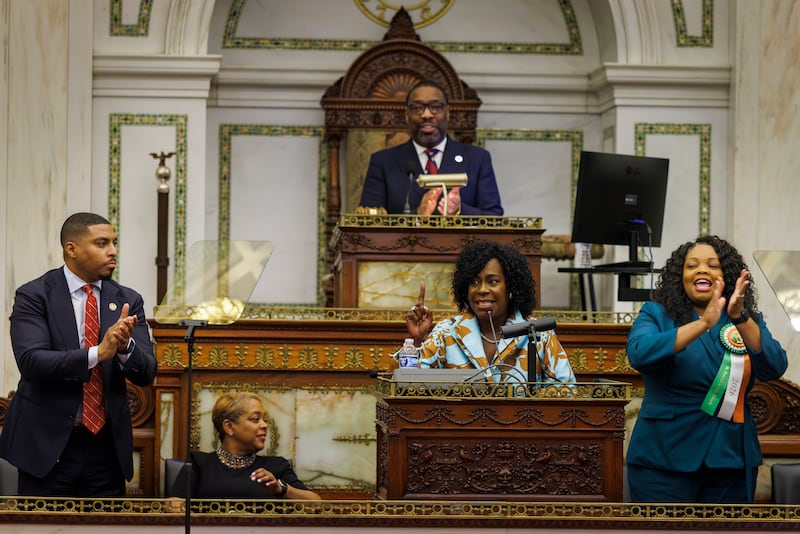
Philadelphia Mayor Cherelle L. Parker is cheered by members of Philadelphia City Council at conclusion of her budget address, Thursday, March 12, 2026.
Philadelphia Mayor Cherelle L. Parker is cheered by members of Philadelphia City Council at conclusion of her budget address, Thursday, March 12, 2026.Read moreAlejandro A. Alvarez / Staff Photographer

Twenty-nine states have bell-to-bell cell phone bans. This year, Pennsylvania will not join them, despite the passage of two separate phone ban bills — one in each chamber of the legislature.

In: Mandatory recess for students K-5

Recess is now law in Pennsylvania.

Another education policy change championed by Shapiro, a mandatory, 30-minute recess for students in grades kindergarten through fifth was established in this year’s budget as a way to improve learning outcomes.

Advertisement

Several Pennsylvania funding issues that have gone years without being addressed were left out of the latest budget, some with more pressing deadlines than others.

Lawmakers did not address a need for mass transit funding — which led to last year’s bitter budget stalemate among legislators — but are expected to identify a long-term funding stream for the transit agencies next year when a two-year fail-safe runs out.

» READ MORE: Public transit is in trouble all across Pennsylvania, including in GOP districts
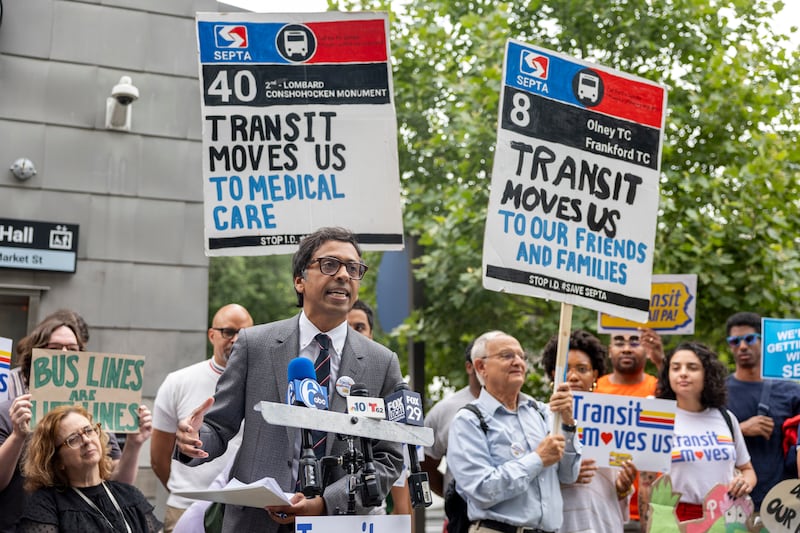
Senator Nikil Saval, speaks at a press conference calling for more SEPTA funding from the state at Independence Hall in Philadelphia, Pa., on Friday, June 26, 2026.
Senator Nikil Saval, speaks at a press conference calling for more SEPTA funding from the state at Independence Hall in Philadelphia, Pa., on Friday, June 26, 2026.Read moreTyger Williams / Staff Photographer

Other local governments and service providers said their needs are more urgent.

The County Commissioners Association of Pennsylvania released an urgent plea after the state budget was signed that counties still have not received the critical mental health funding they need, or a surcharge increase used to fund 911 call systems. Home-health service providers also continued their calls for increased state funding they say is needed, as the industry faces serious staffing issues due to low state reimbursement rates.

» READ MORE: Pennsylvania’s home care industry is in crisis, with low pay and unfilled shifts driving it toward collapse

Advertisement

Rape crisis centers got a much-needed funding increase, doubling how much the centers receive from $12 million to just over $24 million.

Philadelphia’s only rape crisis center had to lay off its employees and rely on volunteer work during last year’s monthslong state budget impasse.

Republican and Democratic lawmakers championed the organizations in this budget, making the largest single-year increase for the critical services in state history, according to the Pennsylvania Coalition to Advance Respect.

“Today marks a turning point for survivors and rape crisis centers across Pennsylvania,” said Joyce Lukima, the organization’s coalition director, in a news release.

Ethan Young is an intern with the Pennsylvania Legislative Correspondents’ Association.

Advertisement


Source link

Continue Reading

Pennsylvania

Governor Josh Shapiro signs overdue Pennsylvania state budget with bipartisan support

Published

on

Governor Josh Shapiro signs overdue Pennsylvania state budget with bipartisan support


HARRISBURG, Pa. (WPVI) — Pennsylvania Governor Josh Shapiro signed the state’s overdue 2026-2027 budget on Sunday.

The $50.8 billion spending plan was passed by state lawmakers with bipartisan support.

It is smaller than Shapiro’s initial $53 billion plan proposed back in February.

“We managed, as the math indicates, to find compromise without compromising our core values,” said Shapiro. “If you go back and look at the goals we all set together way back in 2023 – funding our schools, making our communities safer, growing our economy….four years later, this budget reflects those continued priorities.”

Advertisement

Lawmakers say this spending plan expands workforce development initiatives, devotes significant new funding for basic education, and increases funding for special education and early intervention services.

Copyright © 2026 WPVI-TV. All Rights Reserved.


Source link

Continue Reading
Advertisement

Trending
