Pennsylvania
Pennsylvania Must Count Provisional Votes From Those Who Submitted “Naked” Mail-in Ballots
The Pennsylvania Supreme Court ruled that counties must count provisional ballots cast in person by voters who mistakenly submitted “naked” mail-in ballots that lacked an inner secrecy envelope.
According to the consequential 4-3 opinion, a lower court “correctly discerned, the casting of a provisional ballot is specifically authorized in the Election Code.”
“Provisional ballots exist as a failsafe to preserve access to the right to vote…[and are] intended to alleviate potential disenfranchisement for eligible voters. Counting Electors’ provisional ballots, when their mail ballots are void for failing to use a Secrecy Envelope, is a statutory right,” the opinion continues.
The ruling stems from a lawsuit brought by two Butler County voters for whom the county board of elections refused to count their provisional ballots cast in the 2024 primary election. In a Sept. 5 ruling affirmed by today’s decision, the Commonwealth Court sided with the voters, concluding that the board erred when it disenfranchised the voters by disqualifying their provisional ballots.
The Republican National Committee (RNC) and state GOP promptly appealed the Commonwealth Court’s ruling to the Pennsylvania Supreme Court, which agreed to review the case last month.
The Republican appellants argued that allowing Butler County voters to cast provisional ballots would essentially force the county to implement cure procedures for those who submit naked ballots — a proposition rejected by the court in today’s ruling. Although Butler County currently allows voters to cure defective mail-in ballots with date or signature errors, it does not provide such a remedy for naked ballots.
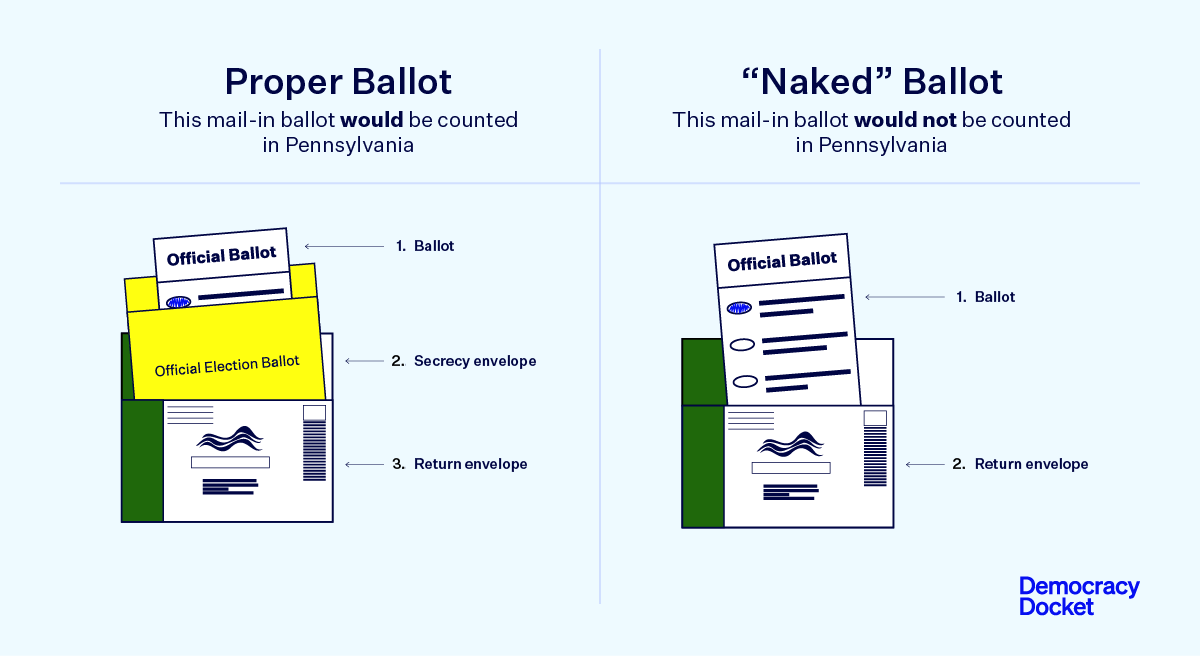

The RNC and state GOP had maintained that Pennsylvania law precludes the counting of a provisional ballot if the voter’s mail-in ballot is timely received — even in cases where the mail-in ballot is tossed out due to a disqualifying error.
Meanwhile, the voters — who inadvertently forgot to place their mail-in ballots in a secrecy envelope — alleged that the board’s rejection of their provisional ballots ran afoul of state election law and the Pennsylvania Constitution’s guarantee of “free and equal” elections.
The Democratic National Committee echoed that position and stated in a court filing that the RNC’s argument “serves no purpose but to disenfranchise mail voters.”
On appeal, the voters also emphasized that provisional voting is distinct from discretionary ballot curing, contending that the RNC “erroneously conflates ‘notice and cure’ programs with Pennsylvania’s longstanding statutory provisional ballot process.”
Under previous Pennsylvania Supreme Court precedent, counties are not legally obligated to offer notice-and-cure procedures, but many do so voluntarily. In a brief supporting the Butler County voters, Pennsylvania Secretary of the Commonwealth Al Schmidt (R) reiterated that provisional voting isn’t tantamount to curing.
Schmidt further acknowledged state law is somewhat ambiguous as to whether counties should count provisional ballots cast by voters who timely returned defective mail-in ballots. However, in line with the Commonwealth Court’s reasoning, he maintained that “arbitrarily denying provisional voting only to mail voters who timely return invalid mail ballots serves no election purpose and therefore unconstitutionally burdens the right to vote.”
A decision from the Pennsylvania Supreme Court remains pending in another case that could affect the upcoming election. In that lawsuit — stemming from Washington County — the RNC asserts that counties should not be required to notify voters if their mail-in ballots are rejected for technical errors.
Last month, the state Supreme Court rejected Republicans’ wholesale request to ban ballot curing statewide and secure a ruling to prohibit voters from voting provisionally as a means of rectifying their faulty mail-in ballots.
Read the ruling here.
Learn more about the case here.