Northeast
Pennsylvania Gov. Shapiro, potential Harris running mate, cancels weekend fundraisers ahead of VP announcement

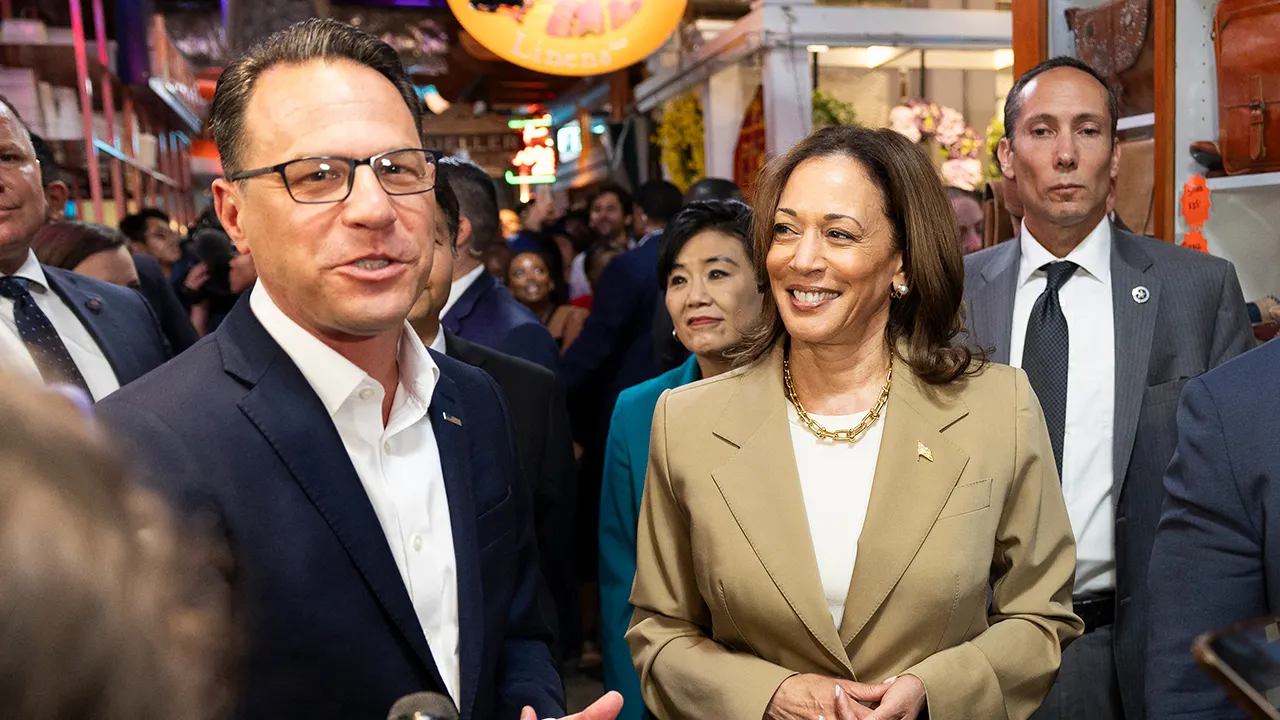
Pennsylvania Gov. Josh Shapiro, one of the front-runners to be Vice President Kamala Harris’s running mate, has canceled three appearances at weekend fund-raising events in the Hamptons, a cluster of wealthy New York towns.
The cancelations came just days before Harris is expected to announce her running mate at a Philadelphia rally on Tuesday. It was unclear why the trips were canceled.
“The governor’s trip was planned several weeks ago and included several fund-raisers for his own campaign committee,” Manuel Bonder, a spokesman for Shapiro, told The New York Times. “His schedule has changed, and he is no longer traveling to the Hamptons this weekend.”
TWO OUTRAGEOUS BILLS KAMALA HARRIS SPONSORED WOULD CRUSH TAXPAYERS
Vice President Kamala Harris and Pennsylvania Governor Josh Shapiro (L) speak to the press while making a stop at the Reading Terminal Market in Philadelphia, Pennsylvania, July 13, 2024. (RYAN COLLERD/AFP via Getty Images)
Fox News Digital has reached out to Shapiro’s office.
One of the events was a “summer soiree” to be held for The Next 50, a liberal youth-advocacy organization, where Shapiro, 51, was marketed as a “special guest,” the Times reported.
Shapiro’s potential VP candidacy has come under scrutiny. The National Women’s Defense League is urging Harris to think twice about choosing Shapiro because of how he handled a sexual harassment case in his office involving former cabinet secretary Mike Vereb.
“Governor Shapiro’s office should have done a better job preventing sexual harassment happening in his own office by former cabinet secretary Mike Vereb, including protecting the survivor who bravely came forward, ensuring that any other potential survivors felt safe in speaking up, and ensuring the harasser didn’t have the opportunity to do further harm after the complaint,” NWDL Director Emma Davidson Tribbs said in a statement.
2024 SHOWDOWN: TRUMP CAMPAIGN REJOICES AFTER HARRIS LEANS IN ON KEY ISSUE HAUNTING HER VICE PRESIDENCY
Josh Shapiro, governor of Pennsylvania, speaks during a campaign event with US President Joe Biden, not pictured, at the Scranton Cultural Center at the Masonic Temple in Scranton, Pennsylvania, US, on Tuesday, April 16, 2024. Biden’s home state of Pennsylvania is taking center stage as he seeks to capitalize on Donald Trump’s absence from the trail, targeting a 2024 swing state where a contentious steel deal and persistent unease over the economy have magnified voter concerns about his agenda. Photographer: Hannah Beier/Bloomberg (Hannah Beier/Bloomberg)
“As the Harris Campaign and the Democratic Party consider their options for Vice Presidential candidates, we urge them to consider the handling of past complaints of sexual harassment inside the Pennsylvania Governor’s office,” Tribbs added. “The American people deserve to know that, if called to a higher office, Governor Shapiro will do more to ensure the safety and dignity of employees, volunteers and constituents in his office.
Vereb stepped down in September 2023 after Shapiro’s administration quietly agreed to pay $295,000 to settle claims from a governor’s office employee who said Vereb made unwanted sexual advances toward her and spoke openly about her, other staff members, and a female state senator, The Philadelphia Inquirer reported.
“Although the Commonwealth does not comment on specific personnel matters, it takes allegations of discrimination and harassment seriously,” Bonder told Fox News in a statement.
US President Joe Biden, First Lady Jill Biden (L) and Pennsylvania Governor Josh Shapiro (R) visit a coffee shop in Harrisburg, Pennsylvania, on July 7, 2024. (SAUL LOEB / AFP)
“Robust procedures are in place for thoroughly investigating reports of discrimination and harassment – and these procedures are implemented whenever complaints of discrimination or harassment are made and provide detailed guidance to help ensure that allegations are promptly and fully investigated and that employees feel comfortable to report misconduct,” he added.
Read the full article from Here

New Hampshire
Nashua Man Indicted On 8 Child First-Degree Assault Charges: Hillsborough County Superior Court Indictments

Matthew Mann, 40, of no fixed address in Nashua, on felon in possession and two controlled drug acts; acts prohibited-intent to sell, fentanyl and cocaine charges, all felonies. He was accused of possessing a switchblade knife, more than half an ounce of cocaine, and three baggies of fentanyl. Mann is a felon due to a possession of a controlled substance with intent to distribute conviction in Middlesex County Superior Court in October 2007.
Adam Money, 37, of Cathedral Lane in Hudson, on a felony controlled drug act; acts prohibited-methamphetamine charge on Jan. 5, 2024, in Nashua. Previously, according to the indictment, he was convicted of possession in January 2019 in Rockingham County Superior Court.
Antwaun Roach-Baptiste, 37, of Park Street in West Haven, Connecticut, on a felony theft by unauthorized taking charge. He acted in concert with Tyler Paolini to steal more than $1,500 worth of merchandise from Home Depot in Nashua, according to the indictment.
Marques Stanford, 37, of no fixed address in Nashua, on two felony counts of controlled drug act; acts prohibited-cocaine and fentanyl, and a felony count of controlled drug act; acts prohibited-buprenorphine-with intent to sell on Feb. 9 in Nashua. Previously, according to the indictment, he was convicted on a possession charge in January 2018 in Hills South.
Do you have a news tip? Email it to tony.schinella@patch.com. View videos on Tony Schinella’s YouTube or Rumble channels. Patch in New Hampshire is now in 227 communities and neighborhoods — and expanding every day. Also, follow Patch on Google Discover.

The anticipated pain of a massive property tax increase in Jersey City has been alleviated somewhat.
Mayor James Solomon announced on Monday a proposed 20% increase has been reduced to a 15% after the city secured $120 million in state aid earlier in the day.
“Solving a deficit this size was never going to be easy”
The tax increase is necessary because the city is facing a $255 million budget deficit, Solomon said.
“Fifteen percent is better than 20, but I cannot tell you this solves our problem without consequences,” Solomon said in a statement. “We know how difficult these increases are, and in combination with the historic amount of state aid we secured in Trenton, my team went back and cut even more city spending. Solving a deficit this size was never going to be easy, and the Administration and City Council must make hard decisions in the coming weeks and months to make the budgets for 2026 and 2027 work without further large tax increases.”
Solomon, who was elected last fall, has blamed the budget deficit on his predecessor, Steven Fulop. The former mayor, who decided not to run again after serving more than 12 years, has vehemently pushed back against the assertion that he left the finances in disarray.
The proposed 15% increase will be submitted to the City Council on July 15 for its approval.
Residents left in constant state of dread over expected tax increase
Prior to receiving the state aid, Jersey City attempted to take some of the onus off of its residents by enacting some cuts, including daily maintenance at seven parks and eliminating its composting program, saving about $1 million per year.
Obviously, that’s not nearly enough to eliminate the need for a property tax hike, so Solomon had been preparing city residents for more than a week about the likelihood that they were going to have to ante up significantly more. He held a meeting on Sunday that was attended by about 150 residents, who expressed fear and dismay over the city’s dire financial situation.
“It means maybe losing my home,” one resident said. “I’m tired of this. This is happening everywhere and it’s not fair that there’s so many boots on our necks and that people just can’t get ahead right now.”
And even with the aid from Trenton and a 15% property tax hike, the city is going to have to figure out how to generate another $20 million, Solomon said, so more cuts are coming.
Pennsylvania
Pennsylvania Roundup: State takes action to contain spread of measles, bolstering public health

The Pennsylvania Department of Health (DOH) is working directly with local health care and community partners to address the increasing number of measles cases statewide among people who are not fully vaccinated, particularly in the Lancaster-Lebanon region.
The Department is working around the clock to mitigate the spread of this highly contagious virus, with experts and medical professionals ready to respond to any new cases that may emerge.
“The single most effective way to avoid contracting or spreading measles is to get fully vaccinated. We know Pennsylvanians care about their communities, and doing their part to protect our youngest and most vulnerable residents creates the immunity we need in every city and town to keep this disease at bay,” said Secretary of Health Dr. Debra Bogen. “High rates of vaccination in a community reduce the spread of the highly contagious measles virus. The Department of Health is working hand in hand with a host of community partners to ensure people across the state have access to accurate information and to vaccines close to home.”
In 2026 so far, 84 measles cases have been identified in Pennsylvania, with 72 cases in the Lancaster-Lebanon region alone, beginning in late April, including: Berks (2), Dauphin (2), Lancaster (41), Lebanon (20), Northumberland (6), and York (1) counties. Earlier in the year, cases were identified in Lancaster (8), Montgomery (3), and Chester (1).
The Department, along with many partners, is increasing vaccine information and access across the Commonwealth. This year, state health center staff administered more than 1,300 doses of the measles, mumps, and rubella (MMR) vaccine to Pennsylvanians. DOH continues to host pop-up MMR vaccine clinics, providing more than 430 doses to residents in the Lancaster-Lebanon region since cases were first identified there in late April.
Making vaccine accessible
Two doses of the MMR vaccine provide the best protection against measles, as it is 97% effective at preventing a person from ever contracting it. The vaccine has long proven effective over several decades. Since the vaccine was introduced in the early 1960s, measles cases and deaths in the U.S. have decreased by more than 97% compared to the pre-vaccine era.
Educating health care providers
According to the Centers for Disease Control and Prevention (CDC), people most at risk are:
• Unvaccinated
• Infants too young to have received the MMR vaccine.
• People from parts of the world where there is low vaccination coverage or where there is circulating measles.
More information on measles is available at — www.pa.gov/measles.
L&I preparing students for life
The Pennsylvania Department of Labor & Industry (L&I) this week showcased the ongoing success and impact of its Summer Academies for high school students who are blind or visually impaired, and for students who are deaf or hard of hearing.
These week-long programs — hosted annually by L&I’s Office of Vocational Rehabilitation (OVR) and held at Penn State’s University Park campus — provide students the tools and training needed to live independently, pursue higher education, and secure meaningful employment.
L&I Secretary Nancy A. Walker met with 18 students attending the Summer Academy for Students who are Deaf and Hard of Hearing. Last week, she visited 18 students participating in the Summer Academy for Students who are Blind and Visually Impaired. Both programs are offered at no cost to students or families through federal Pre-Employment Transition Services (Pre-ETS) funding.
“These summer academies provide students with disabilities an immersive experience on a college campus where they can socialize with peers and develop the practical skills needed for a successful transition to college and the workforce,” said Secretary Walker. “Every student faces unique challenges, and we know students with disabilities often benefit from additional support.”
Gov. Josh Shapiro’s proposed 2026-27 budget calls for an additional $1 million investment in OVR, which helps people of all ages with disabilities find employment through personalized services such as vocational counseling and guidance, goal setting, training, and job placement.
Each year, OVR engages with more than 76,000 students and adults with disabilities across all programs. Last year, nearly 18,000 students with disabilities received Pre-ETS, and OVR placed more than 6,400 individuals into competitive integrated employment.
Students participating in OVR’s Summer Academies experience authentic college living, including dormitory accommodations, dining hall meals, and team-building activities. The curriculum covers mobility training, requesting accommodations, use of assistive technology, emotional and social development, career planning, and adaptive sports.
Highlighting plan to improve health
Pennsylvania Department of Human Services (DHS) Secretary Dr. Val Arkoosh and Pennsylvania Department of Agriculture Secretary Russell Redding this week shared the Shapiro Administration’s proposal to demonstrate how consistent access to healthy foods can have a tangible impact on a person’s health and well-being.
Programs that use food as medicine in Pennsylvania and around the country have been shown to improve the trajectory of chronic illness and help shift health care spending – a strategy the Shapiro Administration is looking to expand here in Pennsylvania.
“Our health is so much more than access to care – what we eat, where we live, and our sense of community and support affect how healthy we are, how we manage illness and disease, and our overall quality of life,” said Secretary Arkoosh. “Investments in Health is our opportunity to make strategic investments in proven prevention efforts like ‘Food Is Medicine’ that will help Pennsylvanians be healthier and improve our state’s financial health as well by using strategies that lower Medicaid spending. When we take a positive, proactive approach to improve Pennsylvanians’ health and quality of life, everyone benefits.”
Food-as-medicine strategies can significantly reduce hospital admissions among people with diet-sensitive conditions and lower health care spending by an average of 16%. Currently, PA DHS works with community-based organizations to provide medically tailored meals under Medicaid on a limited basis.
With a $900,000 investment in state funds, Pennsylvania could leverage additional federal matching funds, bringing total funding to $2.3 million.
“Fresh, high-quality food can be our best preventative medicine,” Pennsylvania Agriculture Secretary Russell Redding said. “That makes Pennsylvania farmers our best pharmacy. The Shapiro Administration is committed to investing in a strong, resilient food system as an investment in increased health and food security for the future of all Pennsylvanians.”
Investments in Health will provide funding in three key areas:
• Food Is Medicine: $900,000 in state funds to leverage federal investment for a total of $2.3 million to support a pilot program that will bring medically tailored meals to Medicaid recipients with diet-sensitive health conditions;
• Reentry Supports: $900,000 in state funds to leverage additional federal funding for a total of $2.7 million that will support pre-release Medicaid coverage for incarcerated individuals returning to their communities from State Correctional Institutions; and
• Housing Stability: $1 million in state funding to leverage additional federal funding for a total of $2.5 million to launch a pilot that will help Pennsylvanians experiencing homelessness connect to stable housing and services.
Targeted budget investments in these proven services can improve people’s health and quality of life, reduce health care costs and hospital visits, improve public safety, support economic and workforce development, and reduce recidivism.
Reach Bill O’Boyle at 570-991-6118 or on X @TLBillOBoyle.
-

 Nevada47 seconds ago
An ‘orchestrated dance’: Nevada moves bighorn sheep to help restore northern herd
-

 New Hampshire6 minutes ago
Nashua Man Indicted On 8 Child First-Degree Assault Charges: Hillsborough County Superior Court Indictments
-

 New Jersey13 minutes ago
Jersey City, N.J. revises proposed property tax increase to 15%. Here’s why.
-

 New Mexico16 minutes ago
Gila National Forest: Sacaton Fire in Gila Wilderness Remains Active
-
North Carolina21 minutes ago
North Carolina is hot, dry, and about have fireworks everywhere. Why isn’t there a burn ban?
-

 North Dakota28 minutes ago
Toddler who survived cardiac arrest and was left at hospital finds forever home
-

 Ohio31 minutes ago
2 found dead in vehicle in Ohio park, police say
-

 Oklahoma36 minutes ago
Nonprofit Pike Off OTA sues to halt East-West Connector turnpike over environmental claims


