Connect with us

Northeast

On this day in history, February 15, 1903, the first Teddy bear goes on sale

Published

on

On this day in history, February 15, 1903, the first Teddy bear goes on sale
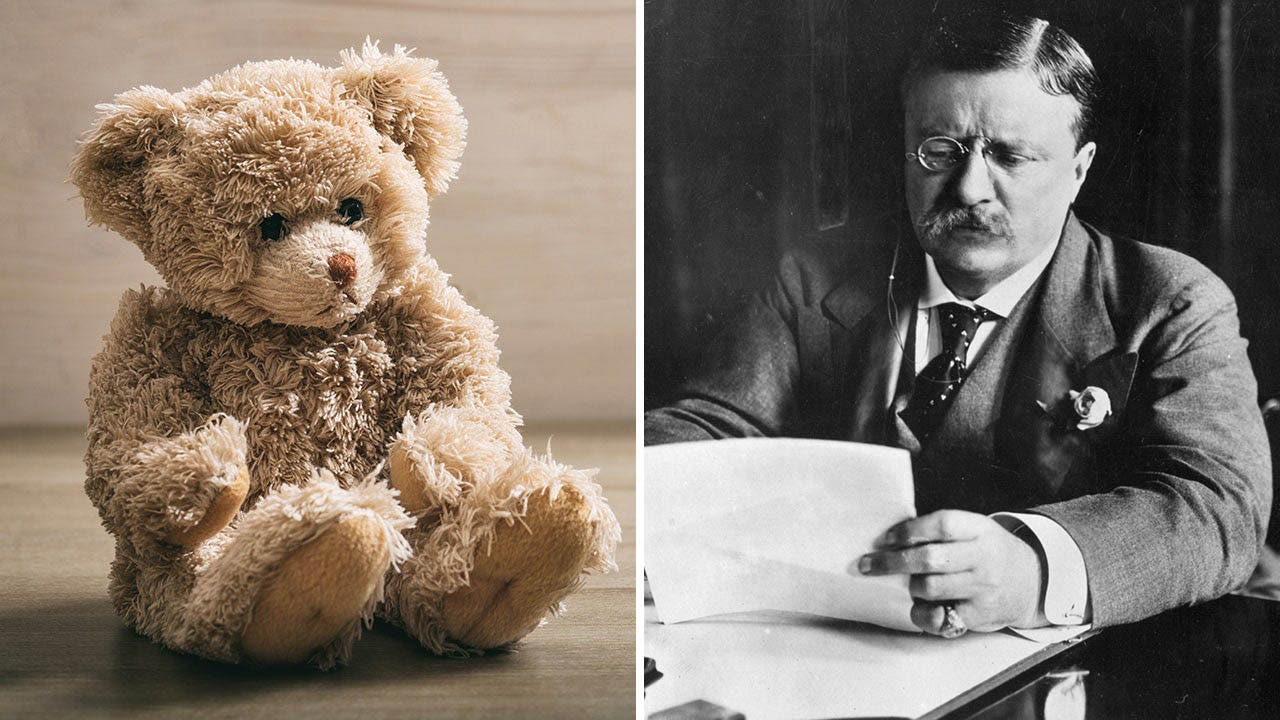
The first “Teddy bear” was put on sale on this day in history, Feb. 15, 1903.

Named after President Theodore Roosevelt, the stuffed bear was first sold by Morris Michtom, a Brooklyn, New York, resident who owned a candy shop, the website for the National Parks Service (NPS) says.

Michtom’s wife, Rose, who made stuffed animal toys, actually created the first teddy bears. 

ON THIS DAY IN HISTORY, FEBRUARY 14, 270 AD, VALENTINE BEATEN, BEHEADED FOR DEFYING EMPEROR’S MARRIAGE BAN

Michtom was inspired to call the toys “Teddy’s bear” after reading a political cartoon published in the Washington Post on Nov. 16, 1902, notes the parks service website. 

Advertisement

The cartoon was drawn by artist Clifford Berryman. It satirized an incident on a hunting trip in Mississippi in which Roosevelt refused to shoot and kill a black bear that had been tied to a willow tree. 

The first Teddy bear was put on sale on this day in history, Feb. 15, 1903.  (iStock)

Roosevelt was known to be a skilled hunter. 

He thought it was “extremely unsportsmanlike” to shoot a bear that had been tied up, says the NPS website. 

“I’ve hunted game all over America and I’m proud to be a hunter. But I couldn’t be proud of myself if I shot an old, tired, worn-out bear that was tied to a tree,” Roosevelt reportedly said at the time. 

Advertisement

ON THIS DAY IN HISTORY, FEBRUARY 9, 1942, FEDS ENACT DAYLIGHT SAVINGS TIME IN DARKEST HOURS OF WORLD WAR II

The news of Roosevelt’s refusal to shoot the bear spread quickly around the country, resulting in the cartoon — and, eventually, the stuffed toy. 

“Michtom decided to create a stuffed toy bear and dedicate it to the president who refused to shoot a bear,” says the site. 

President Theodore Roosevelt gave permission to Morris Michtom to use his nickname, “Teddy,” for the new stuffed bear toys.  (Hulton Archive/Getty Images)

Rose Michtom “cut out some pieces of fabric and sewed on some button eyes and put it in the window with the name, ‘Teddy’s Bear.’ It was an overnight hit,” says the website for the Carnegie Museum of Natural History. 

Advertisement

The president later gave Michtom permission to use his nickname for the new product — and the toys quickly became popular, notes the museum. 

QUEEN ELIZABETH AND PADDINGTON BEAR: WHY ARE PEOPLE LEAVING THE BOOK CHARACTER AT TRIBUTE SITES?

The success of the Teddy bear resulted in a career shift for the Michtoms. 

The president later gave Michtom permission to use his nickname for the new product.

In 1907, Michtom and his wife founded the Ideal Novelty and Toy Co. 

Advertisement

Although initially the company focused on Teddy bears, it eventually became known for producing a series of collectible dolls, the website Collector’s Weekly says. 

The success of the Teddy bear resulted in a career shift for the Michtoms, who had previously owned a candy shop. They soon switched to making and selling toys, according to Collector’s Weekly. (iStock)

The Teddy bear’s popularity over traditional dolls also drew concerns from at least one figure, notes the Smithsonian Museum of American History’s website. 

In 1908, five years after the toy was first sold, a minister in Michigan “warned that replacing dolls with toy bears would destroy the maternal instincts in little girls,” said the Smithsonian. 

In 1963, for the Teddy bear’s 60th birthday, Benjamin Michtom — the son of Rose and Morris Michtom — attempted to unite the original bear with a descendant of its namesake. 

Advertisement

“What does a 79-year-old doll want with a 60-year-old bear?” 

“He first contacted Mrs. Alice Roosevelt Longworth, Teddy Roosevelt’s daughter, to offer her one of the original Teddy Bears if she would pose with it,” says the Smithsonian. 

WHO IS ALICE ROOSEVELT LONGWORTH? WHITE HOUSE WILD CHILD AND ORIGINAL ‘WIT OF WASHINGTON,’ SAYS HISTORIAN

Longworth apparently declined the offer, reportedly asking, “What does a 79-year-old doll want with a 60-year-old bear?” 

Undeterred, Benjamin Michtom then reached out to Kermit Roosevelt, Theodore Roosevelt’s grandson, and asked if he would allow his children to be photographed with the bear, the Smithsonian reported. 

Advertisement

Theodore Roosevelt’s grandchildren participated in a photo shoot with the original Teddy bear and refused to part with it — taking it home, according to the Smithsonian. (iStock; Getty)

Benjamin Michtom intended for the bear to be given to the Smithsonian Institution after the photo shoot, but Mark and Anne Roosevelt had other plans. 

They took a liking to the bear and hid it from their parents. 

“A letter from Mrs. Roosevelt to Mr. Michtom said, ‘I was about to get in touch with the Smithsonian about presenting them with the original bear when the children decided they didn’t want to part with it yet,’” said the Smithsonian.

Advertisement

Eventually, the original Teddy bear was given to the Smithsonian Institution in January 1964, the website notes. 

For more Lifestyle articles, visit www.foxnews.com/lifestyle.

Read the full article from Here

Continue Reading
Click to comment

Leave a Reply

Your email address will not be published. Required fields are marked *

This site uses Akismet to reduce spam. Learn how your comment data is processed.

Boston, MA

Poor Clares’ monastery a case study in why Boston is short on housing – The Boston Globe

Published

on

Poor Clares’ monastery a case study in why Boston is short on housing – The Boston Globe


But the story of the Poor Clares’ monastery — or as it’s known on the books of the Boston Planning Department, 920 Centre Street — is, at least for now, a case study on how housing doesn’t get built in this city.

It’s a story about how one midsized project with everything going for it — a world-class architect, a brilliant landscape designer, and a developer willing to make one compromise after another to the size and layout of the plan — still can’t move the needle in the face of one powerful opponent.

Advertisement

Well, make that one powerful opponent who has the ear of City Hall.

Faced with dwindling numbers in their order (they were down to 10 in 2022) and a Vatican mandate to consolidate, the sisters decided to sell their 2.8-acre parcel and the aging monastery building to developer John Holland. The building, which they had occupied since 1934, was expensive to heat and in need of extensive repairs.

They relocated to Westwood in 2023, hoping to expand those quarters to accommodate another 10 nuns from around the country as soon as the sale of the Jamaica Plain property became final, contingent on the approval of its redevelopment.

They’re still waiting.

The former monastery is neighbor to the Arnold Arboretum, land owned by the city but under a renewable 1,000-year lease to Harvard University. And no question, the 281-acre parcel is a tree-filled treasure for researchers and picnickers alike. Just try getting near the place on Lilac Sunday.

Advertisement

But the Arboretum, or rather its director, William Friedman, a Harvard evolutionary biology professor, has emerged as a powerful foe.

“The development has been part of the city’s planning process for nearly five years and has undergone several revisions,” Sr. Mary Veronica McGuff, the order’s abbess, wrote in a letter to Mayor Michelle Wu in January and shared with the editorial board. “We are very disappointed to learn that the main obstacle is … the Arnold Arboretum.”

She revealed that the order had earlier offered to sell the property to the Arboretum, but was rebuffed.

“It’s upsetting that our progress is now being hindered by an institution that declined the opportunity to take stewardship of the land and is now making unreasonable demands for its redevelopment,” she said in the letter.

In fact, its market rate condo component, once slated to be five stories high, has been reduced to four stories. Those 38 senior rental units planned for the monastery building will include 25 affordable units.

Advertisement

Project architect David Hacin, winner of the Boston Preservation Alliance’s 2022 President’s Award for Excellence, is equally bewildered.

“I don’t understand how a project that is so good on so many levels is being held up for years, literally, over asks that seem, to me, completely unreasonable,” Hacin told Globe business reporter Catherine Carlock. “If we can’t build five-story buildings, how are we going to solve the housing crisis?”

How indeed.

The developers have done shadow studies, a sunlight analysis, and tree root studies to convince Arboretum officials that the planned housing would do no damage to the magnolia tree roots on the perimeter of Harvard’s grounds, which seem to be their main bone of contention.

The project’s landscape architect Mikyoung Kim has surely not acquired her international reputation for “ecological restoration” by murdering magnolia trees.

Advertisement

Friedman has met with Boston’s planning chief, Kairos Shen, but as of Thursday the sisters have not yet been granted a similar opportunity. Nor have they heard from either Wu or Shen (who was copied in on the Jan. 12 letter) since they made their appeal for help “in finding a solution that allows this project to move forward and for our community to finally settle into our new home.”

In a statement to the Globe editorial board, Wu said, “Large properties like 920 Centre Street are significant housing sites for Boston, and we are working actively with all parties to advance a plan that would deliver homes our city needs.”

For the past year, experts have been warning that the slumping number of building permits in Greater Boston — down 44 percent last year from four years ago — do not bode well for an increase in the future housing supply. That dearth in supply is driving up prices and rents.

And while the Wu administration is quick to blame President Trump’s tariffs and rising costs for the construction slump, it fails to look in the mirror. Enabling the kind of Not In My Back Yard obstructionism that is keeping a good project on the drawing boards for years will never get Boston the kind of housing it needs to keep pace with demand and allow this city to thrive.


Editorials represent the views of the Boston Globe Editorial Board. Follow us @GlobeOpinion.

Advertisement


Source link

Continue Reading

Pittsburg, PA

Plum Borough parents charged with supplying alcohol for underage drinking party

Published

on

Plum Borough parents charged with supplying alcohol for underage drinking party


Two parents are facing charges after police say more than 60 teenagers were drinking at a large party in their Plum Borough home.

According to court paperwork, Ian and Corrine Dryburgh have been charged with endangering the welfare of children, corruption of minors, and furnishing liquor to minors stemming from the incident that happened at a home in Plum Borough late last month.

Police said that officers went to the home after receiving a tip about a large party involving high school aged children.

Advertisement

When officers arrived at the home, they found numerous teenagers, empty beer cans and empty seltzer cans, and multiple bottles of vodka.

The parents told police that a birthday party for their 17-year-old daughter got out of hand and that some kids has been kicked out, but more came and they didn’t know what to do.

According to the criminal complaint, officers said they had been called to the home two previous times for similar reasons. 

Police said a total of 66 underage kids were at the home.

Court records show that both parents have been cited via summons and preliminary hearings are scheduled for mid-April. 

Advertisement


Source link

Advertisement
Continue Reading

Connecticut

Connecticut to receive $154 million for rural health

Published

on

Connecticut to receive 4 million for rural health


Connecticut is set to receive more than $154 million aimed at improving health care in rural communities.

The funding comes from the Centers for Medicare & Medicaid Services’ Rural Health Transformation Program, according to a community announcement.

The Connecticut Department of Social Services will lead the initiative, partnering with other state agencies to implement projects across four core areas: population health outcomes, workforce, data and technology, and care transformation and stability, according to the announcement.

Advertisement

The program will include several innovative projects, such as a mobile clinic pilot with four primary care and four dental vans, a health workforce pipeline through the Area Health Education Center and UConn Health Center, and community health navigators.

“Rural Connecticut has unique challenges, and its residents deserve the same access to high-quality care and support as anyone who lives anywhere else,” Lamont said. “This investment allows us to tackle those challenges head-on – from expanding mental health services and building a stronger health care workforce to modernizing our technology infrastructure and connecting residents to the services they need. This is about making sure every corner of Connecticut has the opportunity to thrive.”

The program was developed through extensive public engagement, including more than 250 written comments, meetings with health care providers, local government officials and community organizations, as well as in-person and virtual listening sessions held across the state, according to the announcement.

Andrea Barton Reeves, commissioner of the state Department of Social Services, highlighted the program’s long-term vision.

Advertisement

“This program reflects our commitment to building systems that work for rural residents over the long term,” she said in the release. “We are excited and grateful to CMS for this opportunity to make sure that our investments are coordinated, impactful, and built to last.”

The program aims to bring health care closer to rural residents while supporting the workforce that provides care, said Dr. Manisha Juthani, commissioner of the state Department of Public Health.

“Every person in rural Connecticut deserves good health care close to home, and the people who provide that care deserve real support too,” Juthani said. “This funding helps us bring care to where people are and build the healthcare workforce our communities need. When we invest in both, we give everyone a better chance at staying healthy.”

Additional information about the Rural Health Transformation Program, including opportunities for public engagement, will be made available as implementation proceeds.

For more information, visit the Connecticut Department of Social Services website at ct.gov/dss.

Advertisement

This story was created with the assistance of Artificial Intelligence (AI). Journalists were involved in every step of the information gathering, review, editing and publishing process. Learn more at cm.usatoday.com/ethical-conduct.


Source link

Continue Reading

Trending