Republican Kelly Ayotte’s support for former President Donald Trump was a flash point Wednesday in her final debate with Democrat Joyce Craig in the race to become New Hampshire’s next governor.
As a U.S. senator in 2016, Ayotte initially said she supported Trump as the GOP nominee for president but wouldn’t endorse him. She later withdrew her support and wrote in Mike Pence instead after Trump was caught on videotape making crude comments about grabbing women. Eight years later, her support for Trump this election cycle has been “unwavering,” WMUR-TV debate panelist Steve Bottari said.
“As a former prosecutor and a former attorney general, do his criminal convictions just not matter to you?” Bottari asked.
Advertisement
“It’s not that,” she said. “It’s just that this is the choice that we have in this election. And certainly, I think the country was better off just in terms of costs, what we’re paying, and safety when he was in office.”
Get N.H. Morning Report
A weekday newsletter delivering the N.H. news you need to know right to your inbox.
After Ayotte repeatedly declined to comment on Trump’s criminal convictions specifically, Craig jumped in, using her time on her next question to return to the topic.
“Where do you draw the line, Kelly, with Donald Trump? Is it when he sexually assaults women? Is it when he posts about Hitler? Or is it when he tries to overthrow democracy?” said Craig, the former mayor of Manchester. “There is no line with Kelly Ayotte.”
Advertisement
Ayotte responded with questions of her own.
“Who’s going to fight for New Hampshire no matter what? Who’s going to even stand up to their party when it’s hard?” she said. “I’ve done it. I was the third most bipartisan senator in the United States Senate. I never hesitated to cross the aisle to do the right thing for New Hampshire.”
Ayotte pointed to Craig’s frequent campaigning with Massachusetts Gov. Maura Healey as evidence that Craig prioritizes her party and what she characterized as its “higher taxes, less freedom” philosophy.
“Why is she spending so much time with the governor of Massachusetts when she wants to represent the people of New Hampshire?” Ayotte said.
Craig described her commitment to New Hampshire by saying she is a fourth-generation resident who joined the governor’s race to help New Hampshire families. As for Healey, she said part of being governor is working with other governors throughout New England on important topics, such as energy. But neither was willing to stop there, at one point talking over each other.
Advertisement
“You’re never going to stand up because you’re a party line person. I’ve stood up to my party and I’ll do it again,” Ayotte said, as Craig said, “You support a convicted criminal for president. He’s unfit to be president.”
Ayotte and Craig are vying to be the third woman elected governor of New Hampshire, filling the seat being left open by Republican Gov. Chris Sununu, who is not seeking a fifth two-year term.
A bill that would add elements to judicial performance evaluations for all state judges and make those evaluation reports public, cleared the New Hampshire House along party lines Thursday.
The bill’s backers, including Rep. Bob Lynn of Windham, former Chief Justice of New Hampshire Supreme Court, promoted the new requirements as a way to “invigorate” judicial performance, and said fully disclosing the reports is crucial.
“I have to emphasize this provision in the bill as well as the other provisions of the bill were adopted in consultation with the Chief Justice of the Supreme Court,” Lynn said
Under the bill, which was written with input from Supreme Court Chief Justice Gordon MacDonald, all judges – including part-time judges and retired judges who sometimes hear cases – would undergo evaluation at least every three years. Evaluations would include courtroom observations and analyses of how efficiently they process cases. Right now, judicial performance reviews remain confidential unless a judge receives two consecutive subpar evaluations.
Advertisement
The proposal comes at a time of tension between the judicial branch and lawmakers, spurred by recent court rulings finding the state isn’t meeting school funding obligations, and by judicial branch spending and management practices.
Democrats who criticized the new judicial evaluation bill say it goes too far and that the legislature should resist the urge to meddle in court operations.
“Many of us have been frustrated by recent activities coming out of the judicial branch – this is probably a bipartisan sentiment,” said Rep. Mark Paige of Exeter. “But to the extent that this bill appeals as a means to scratch your judicial frustration itch, consider other available remedies.”
Democrats also argued that making judicial reviews public could pose safety risks in an era of increased political violence including against judges.
“Publication would do real harm, inviting harassment of judges as violent threats against U.S judges have surged 327 percent since last year,” said Rep. Catherine Rombeau of Bedford, citing research from the Global Project Against Hate and Extremism.
Advertisement
But Republicans disputed such arguments, and said public reviews are also one of the few tools lawmakers have to make sure judges are performing their duties effectively.
“Judges are appointed once and serve until the age of 70,” said Rep. Ken Weyler of Kingston.
“All employees, including judges, benefit from constructive evaluation.”
The New Hampshire State House, where tradition often reigns supreme, is scarcely more technologically savvy than a couple of still cameras streaming hearings to YouTube.
But like a lot of places these days, political power — and attention — there is increasingly shaped by what’s happening online.
And while plenty of New Hampshire lawmakers maintain busy Facebook feeds and X accounts, perhaps no public official better exemplifies the high speed, high volume, digital-ready approach to politics than Republican Rep. Joe Sweeney.
As the House’s deputy majority leader, Sweeney’s job is to make sure fellow Republicans show up in Concord and support caucus priorities. In many ways, it’s about as old-fashioned as political work gets in 2026. And to see Sweeney in action is to observe a politician who still embraces plenty of his party’s traditional priorities.
Advertisement
“Let the voters see that we oppose income taxes now and forever,” Sweeney proclaimed from the House floor earlier this month.
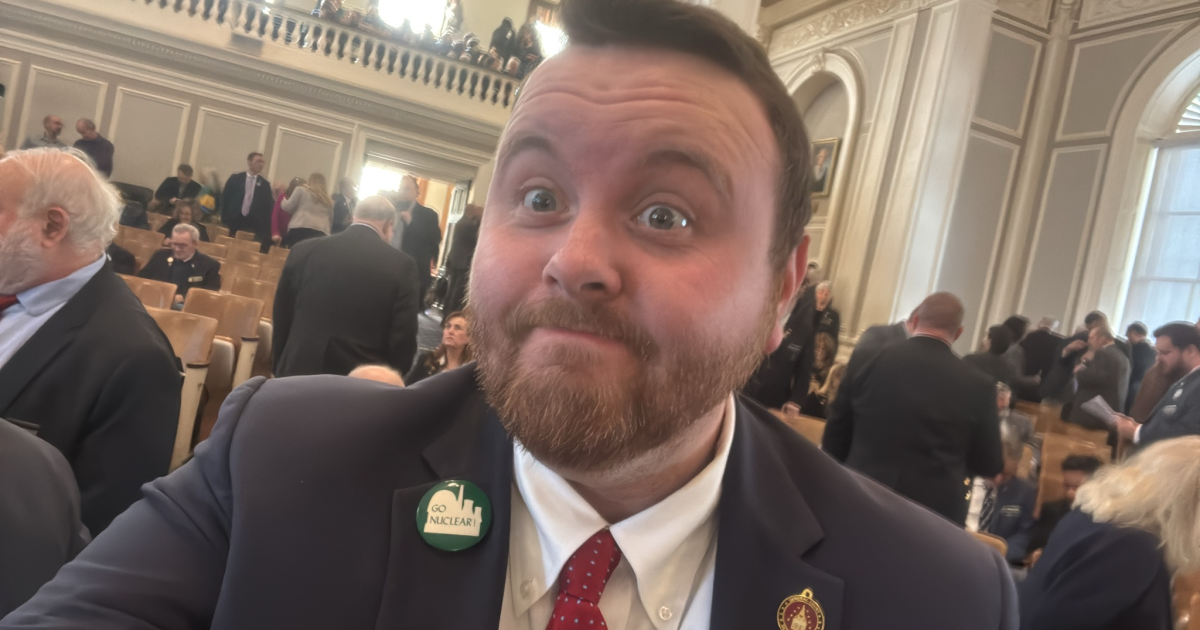
But Sweeney didn’t stop at merely pledging to oppose income taxes inside the walls of the State House. Soon after, he also posted the video of himself doing so to social media. Sweeney isn’t the first — or only — state politician bent on cultivating an online presence. But his position of power in the Republican Party means he is well-positioned to amplify what he chooses. It could be AI-generated graphics promoting nuclear power, photoshopped images supporting ICE, or Sweeney himself talking straight into a camera.
According to Sweeney, to succeed on social media in politics, it’s best to keep messages short, sharp — and sometimes trollish.
“It’s kind of this perverse incentive to present that sort of profile online, because that’s what’s going to get people engaged,” Sweeney said in an interview last week.
Facebook is one of several platforms where Rep. Joe Sweeney maintains a robust online presence.
Politics as personal
At 32, Sweeney came of age in politics and on the internet. He started earning paychecks for political work in 2012, on the campaign of former Congressman Charlie Bass. Sweeney was a University of New Hampshire student at the time, and won election to the New Hampshire House that same year. Back then, he courted voters on social media with an earnestness that seems far removed from the politics of 2026, welcoming voters of all stripes to reach out and support his candidacy.
Advertisement
“I am running as a Republican, but I promise to represent all of my Salem constituents when elected,” a baby-faced Sweeney said in a YouTube video from that race.
A lot has changed for Sweeney since then. He’s now a top Republican lawmaker in Concord, vice chair of Salem’s town council, and also operates Granite Solutions, a political advocacy and fundraising group.
According to filings with the state, Granite Solutions’ purpose is “Electing Fiscal Conservatives in New Hampshire.” It essentially operates as Sweeney’s personal PAC, raising money, running ads, pushing policies, and urging lawmakers to sign pledges.
As New Hampshire PACs go, Granite Solutions is not exactly flush with cash: It’s reported raising about $60,000 over the past few years. Notable receipts include a $10,000 donation from a trust connected to Joe Faro, the developer of Salem’s Tuscan Village; a contribution from Churchill Downs, which owns the casino at the Rockingham Park Mall; and a smattering of Concord lobbyists.
A state lawmaker running what amounts to a one-man political advocacy organization is unusual, to say the least. But Granite Solutions also serves to boost Sweeney’s personal brand.
Advertisement
Last week, after Sweeney debated tax policy on WMUR’s political talk show, he sent an email to the Granite Solutions’ mailing list, urging people to stream the debate and donate to Granite Solutions.
Sweeney says he sees the work of his personal political committee as an extension of his public service: “I view Granite Solutions as supporting the economic agenda of Republicans in the state.”
‘Until the voters don’t want me’
The GOP fiscal agenda — from tax cuts to eliminating red tape for development projects — is a steady focus for Sweeney.
On other political issues, his social media-forward approach can serve to capture attention, more than enact measurable change. When lawmakers debated higher education funding last year, Sweeney strenuously alleged that undocumented students were depriving eligible Granite Staters from admission to UNH. After university officials released data that undercut his claims, Sweeney moved on.
Last fall, Sweeney told reporters to expect him and other Republicans to target specific state judges for misconduct. But such plans never materialized.
Advertisement
There was also Sweeney’s push to impeach Democratic Executive Councilor Karen Liot Hill over her use of a state email account to assist a legal challenge to a voter registration law — even though the New Hampshire Attorney General had cleared Liot Hill of any wrongdoing. Just hours before a public hearing on Sweeney’s impeachment effort, he scuttled the bill without bothering to show up for the hearing.
To hear Sweeney tell it, when his political ideas lose traction, he’s willing to let them slide.
“Some things can start off with a lot of fire and passion and then as it goes through the system it just sort of dies out,” he said.
But as Sweeney’s shown in Concord, and as a town councilor, he can also push policies that others see as provocative or radical — or even theatrical. When Salem’s town council and budget committees were at odds over the town budget, Sweeney proposed eliminating the budget committee altogether.
“I thought it was the most ridiculous proposal I’ve ever heard. It was a bad idea, said Steve Goddu, a Republican who sits on Salem’s budget committee, and generally considers Sweeney a political ally. “It was a bad idea, and sometimes we make bad ideas and suggestions, and I think this was just his folly on this one.”
Advertisement
But not everybody who’s been on the receiving end of Sweeney’s politics, folly or otherwise, is as forgiving. Liot Hill says she had to waste time and money to prepare for potential impeachment proceedings that she always saw as frivolous, and believes Sweeney’s style of politics is destructive.
“There is a price to our politics when politics becomes more focused on spectacle than on substance and really it’s really the public that pays,” Liot Hill said.
Sweeney, for his part, says he sees himself pursuing his approach to politics — in real life and online — for the foreseeable future.
“I have an ability to create solutions for folks. I have an ability to sort of understand things and kind of communicate with people on it, Sweeney said. “I feel this responsibility to continue to be involved until the voters don’t want me to be involved anymore.”