New Hampshire
Cartoons on an IPA can? These NH teens say frothy beer labels need to sober up


Last month, the members of an after-school club called Dover Youth 2 Youth took a field trip to the State House in Concord. They arrived armed with empty beer cans, part of their planned testimony before lawmakers.
“For example, we have this brand of beer from Concord Brewing Company that has cans designed like the kids animated movie we’ve all seen: ‘Finding Nemo,’ ” explained Megan Merrigan, 12, during public testimony on the bill.
State senators were handed a can with an illustration of a brightly colored fish resembling a character in the Disney movie.
Merrigan, along with her teenage peers, contend that alcohol-makers are using imagery on their labels–whether intentional or not–that appeals to minors. They offered this as Exhibit A for why the laws needed to change.
“They’re most likely not going to pick something that’s like a big, boring bottle of beer,” said Dani Lynn Somer, 14, another member of the Dover after-school program. “Kids go for something that’s more enticing to the eye.”
The legislation these students are backing seeks to provide more clarity to both the alcohol industry and state regulators about what’s acceptable on a label of beer, wine or spirits. Cartoons, toys and other fictional characters that a kid may associate with would be prohibited.
But local craft brewers contend their labels, which are often designed by local artists and rooted in the individual culture of the business, are at risk of getting caught up in any enhanced regulations. These beers are being brewed for adults, they contend, and only available for purchase by people 21 and up.
Real dog, illustrated dog
Under current New Hampshire law, the state Liquor Commission has the power to block any alcohol label that regulators believe is designed to induce minors to drink. Alcoholic products that also falsely imply through labeling that they improve athletic performance are also prohibited.
In total, the agency reviews 5,400 labels annually — every bottle of wine, can of beer, or spirit sold in the state — approving 96% of them.
Senate Bill 335 would add clarifying language to the statute, spelling out that cartoons, toys, robots, fictional animals and creatures that are consistent with other products marketed at minors are a no-go. It would also create a new board to handle appeals from rejected applicants.

(The Liquor Commission said, in a statement to NHPR, its approval of the “Finding NEIPA,” Nemo-themed label was done in error, and that after a “constructive conversation with the brewer, Concord Craft agreed to change the imagery, according to a spokesperson.)
Last November, To Share Brewing based in Manchester submitted four labels that were initially rejected by the Liquor Commission. Two of those labels included illustrations by a local artist of the co-owner’s pet.
“It’s the face of my dog with her tongue sticking out,” said Aaron Share, holding up a can inside of his brewery on a recent morning. He said he has submitted more than 80 labels since founding the brewery, and that these were the first to be rejected.
“I don’t see anything on this label that would be considered a cartoon, or that would induce a minor to drink,” he said.
Share said the Liquor Commission later notified him, without explanation, that it had reversed course and approved the labels.
He fears that under the proposed legislation, regulators would have to make subjective calls about products, and may lack the qualifications to do so.
“Do they have a background in art? You know, are they a child psychologist?” he said.
As well known as Mickey Mouse
The debate now going on in the New Hampshire State House is in some ways a throwback to the 1990s, when it was tobacco, and not alcohol, coming under scrutiny. Federal regulators determined that much cigarette advertising — including Camel’s cartoon spokesperson, Joe Camel — was designed to appeal to children.
Dr. James Seargent, a behavioral epidemiologist at Dartmouth’s Geisel School of Medicine, was a young researcher at Joe Camel’s peak, and said the ads were so ubiquitous and seductive that a study found the camel was “recognized as commonly as Mickey Mouse” amongst children.
There were eventually stricter labeling and marketing rules applied to cigarettes in the United States, and some parts of Europe have gone farther with tobacco packaging restrictions.
“I don’t think we’re ready to do that for beer,” Sergeant said, “but I certainly think the New Hampshire law to do away with cartoon-like characters is not unreasonable.”
But during the legislative hearing last month, some lawmakers, including Republican state Sen. Dan Innis, seemed skeptical that any new guidance or regulation could be done in a way that’s consistent.
“The hard part for me is how are these decisions going to be made,” he said. “And that’s where it just gets messy.”
Take for example other boozy offerings now available on store shelves: alcoholic Monster energy drinks, spiked Sunny D, and Eggo Waffles branded liquors. What do you do with those products? Are they aimed at kids? Nostalgic adults?
Mia Mozzoni, 18, from the Dover Youth 2 Youth group, said she doesn’t appreciate how the broader industry views people her age and wants to see adults take steps to protect her and other young people.
“I don’t like being targeted by the industry. I don’t like seeing my peers ruin their brains and their livers at like 14 and 15 because they’re binge drinking,” she said, adding, “It’s just a problem.”



Hillary Clinton is set to return to New Hampshire for a Democratic Party fundraiser while a progressive leader criticizes the party for being ‘tone-deaf’ by inviting her.
Hillary Clinton is returning to New Hampshire next month to headline the state’s Democratic Party’s annual spring fundraising dinner. A progressive leader criticizes the party as ‘tone-deaf’ for inviting Clinton, stating she’s ‘yesterday’s news.’ Fox News contributor Joe Concha weighs in on Clinton’s perceived comeback tour and discusses President Trump’s recent remarks about John F. Kennedy Jr.’s political ambitions.

A bill that would add elements to judicial performance evaluations for all state judges and make those evaluation reports public, cleared the New Hampshire House along party lines Thursday.
The bill’s backers, including Rep. Bob Lynn of Windham, former Chief Justice of New Hampshire Supreme Court, promoted the new requirements as a way to “invigorate” judicial performance, and said fully disclosing the reports is crucial.
“I have to emphasize this provision in the bill as well as the other provisions of the bill were adopted in consultation with the Chief Justice of the Supreme Court,” Lynn said
Under the bill, which was written with input from Supreme Court Chief Justice Gordon MacDonald, all judges – including part-time judges and retired judges who sometimes hear cases – would undergo evaluation at least every three years. Evaluations would include courtroom observations and analyses of how efficiently they process cases. Right now, judicial performance reviews remain confidential unless a judge receives two consecutive subpar evaluations.
The proposal comes at a time of tension between the judicial branch and lawmakers, spurred by recent court rulings finding the state isn’t meeting school funding obligations, and by judicial branch spending and management practices.
Democrats who criticized the new judicial evaluation bill say it goes too far and that the legislature should resist the urge to meddle in court operations.
“Many of us have been frustrated by recent activities coming out of the judicial branch – this is probably a bipartisan sentiment,” said Rep. Mark Paige of Exeter. “But to the extent that this bill appeals as a means to scratch your judicial frustration itch, consider other available remedies.”
Democrats also argued that making judicial reviews public could pose safety risks in an era of increased political violence including against judges.
“Publication would do real harm, inviting harassment of judges as violent threats against U.S judges have surged 327 percent since last year,” said Rep. Catherine Rombeau of Bedford, citing research from the Global Project Against Hate and Extremism.
But Republicans disputed such arguments, and said public reviews are also one of the few tools lawmakers have to make sure judges are performing their duties effectively.
“Judges are appointed once and serve until the age of 70,” said Rep. Ken Weyler of Kingston.
“All employees, including judges, benefit from constructive evaluation.”
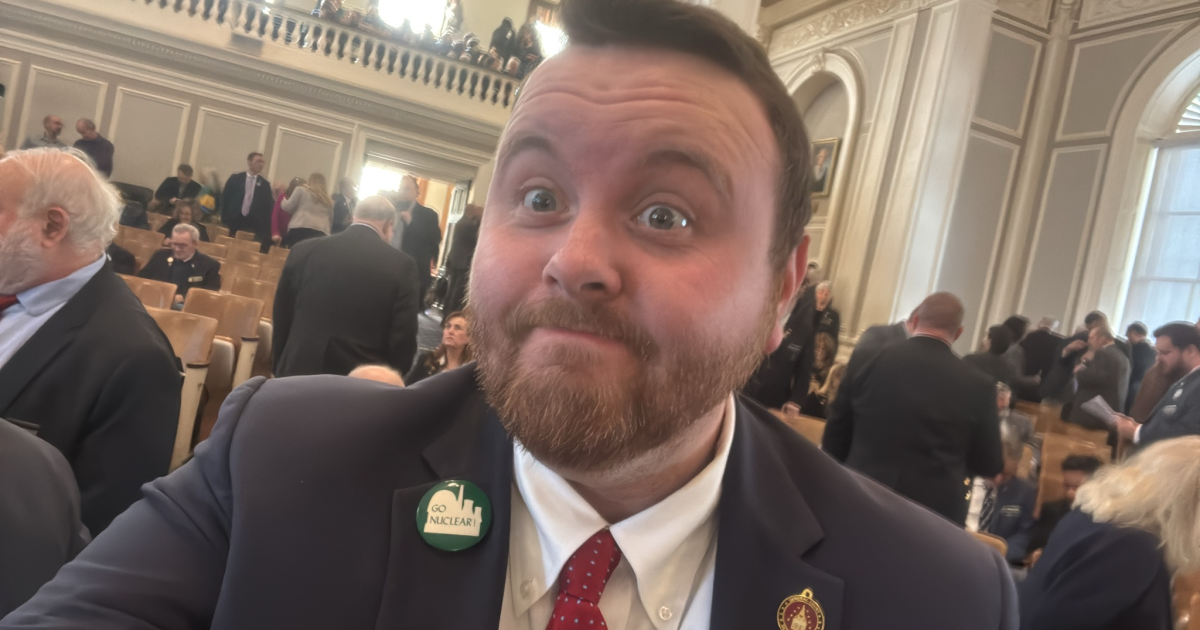
The New Hampshire State House, where tradition often reigns supreme, is scarcely more technologically savvy than a couple of still cameras streaming hearings to YouTube.
But like a lot of places these days, political power — and attention — there is increasingly shaped by what’s happening online.
And while plenty of New Hampshire lawmakers maintain busy Facebook feeds and X accounts, perhaps no public official better exemplifies the high speed, high volume, digital-ready approach to politics than Republican Rep. Joe Sweeney.
As the House’s deputy majority leader, Sweeney’s job is to make sure fellow Republicans show up in Concord and support caucus priorities. In many ways, it’s about as old-fashioned as political work gets in 2026. And to see Sweeney in action is to observe a politician who still embraces plenty of his party’s traditional priorities.
“Let the voters see that we oppose income taxes now and forever,” Sweeney proclaimed from the House floor earlier this month.
But Sweeney didn’t stop at merely pledging to oppose income taxes inside the walls of the State House. Soon after, he also posted the video of himself doing so to social media. Sweeney isn’t the first — or only — state politician bent on cultivating an online presence. But his position of power in the Republican Party means he is well-positioned to amplify what he chooses. It could be AI-generated graphics promoting nuclear power, photoshopped images supporting ICE, or Sweeney himself talking straight into a camera.
According to Sweeney, to succeed on social media in politics, it’s best to keep messages short, sharp — and sometimes trollish.
“It’s kind of this perverse incentive to present that sort of profile online, because that’s what’s going to get people engaged,” Sweeney said in an interview last week.
Politics as personal
At 32, Sweeney came of age in politics and on the internet. He started earning paychecks for political work in 2012, on the campaign of former Congressman Charlie Bass. Sweeney was a University of New Hampshire student at the time, and won election to the New Hampshire House that same year. Back then, he courted voters on social media with an earnestness that seems far removed from the politics of 2026, welcoming voters of all stripes to reach out and support his candidacy.
“I am running as a Republican, but I promise to represent all of my Salem constituents when elected,” a baby-faced Sweeney said in a YouTube video from that race.
A lot has changed for Sweeney since then. He’s now a top Republican lawmaker in Concord, vice chair of Salem’s town council, and also operates Granite Solutions, a political advocacy and fundraising group.
According to filings with the state, Granite Solutions’ purpose is “Electing Fiscal Conservatives in New Hampshire.” It essentially operates as Sweeney’s personal PAC, raising money, running ads, pushing policies, and urging lawmakers to sign pledges.
As New Hampshire PACs go, Granite Solutions is not exactly flush with cash: It’s reported raising about $60,000 over the past few years. Notable receipts include a $10,000 donation from a trust connected to Joe Faro, the developer of Salem’s Tuscan Village; a contribution from Churchill Downs, which owns the casino at the Rockingham Park Mall; and a smattering of Concord lobbyists.
A state lawmaker running what amounts to a one-man political advocacy organization is unusual, to say the least. But Granite Solutions also serves to boost Sweeney’s personal brand.
Last week, after Sweeney debated tax policy on WMUR’s political talk show, he sent an email to the Granite Solutions’ mailing list, urging people to stream the debate and donate to Granite Solutions.
Sweeney says he sees the work of his personal political committee as an extension of his public service: “I view Granite Solutions as supporting the economic agenda of Republicans in the state.”
‘Until the voters don’t want me’
The GOP fiscal agenda — from tax cuts to eliminating red tape for development projects — is a steady focus for Sweeney.
On other political issues, his social media-forward approach can serve to capture attention, more than enact measurable change. When lawmakers debated higher education funding last year, Sweeney strenuously alleged that undocumented students were depriving eligible Granite Staters from admission to UNH. After university officials released data that undercut his claims, Sweeney moved on.
Last fall, Sweeney told reporters to expect him and other Republicans to target specific state judges for misconduct. But such plans never materialized.
There was also Sweeney’s push to impeach Democratic Executive Councilor Karen Liot Hill over her use of a state email account to assist a legal challenge to a voter registration law — even though the New Hampshire Attorney General had cleared Liot Hill of any wrongdoing. Just hours before a public hearing on Sweeney’s impeachment effort, he scuttled the bill without bothering to show up for the hearing.
To hear Sweeney tell it, when his political ideas lose traction, he’s willing to let them slide.
“Some things can start off with a lot of fire and passion and then as it goes through the system it just sort of dies out,” he said.
But as Sweeney’s shown in Concord, and as a town councilor, he can also push policies that others see as provocative or radical — or even theatrical. When Salem’s town council and budget committees were at odds over the town budget, Sweeney proposed eliminating the budget committee altogether.
“I thought it was the most ridiculous proposal I’ve ever heard. It was a bad idea, said Steve Goddu, a Republican who sits on Salem’s budget committee, and generally considers Sweeney a political ally. “It was a bad idea, and sometimes we make bad ideas and suggestions, and I think this was just his folly on this one.”
But not everybody who’s been on the receiving end of Sweeney’s politics, folly or otherwise, is as forgiving. Liot Hill says she had to waste time and money to prepare for potential impeachment proceedings that she always saw as frivolous, and believes Sweeney’s style of politics is destructive.
“There is a price to our politics when politics becomes more focused on spectacle than on substance and really it’s really the public that pays,” Liot Hill said.
Sweeney, for his part, says he sees himself pursuing his approach to politics — in real life and online — for the foreseeable future.
“I have an ability to create solutions for folks. I have an ability to sort of understand things and kind of communicate with people on it, Sweeney said. “I feel this responsibility to continue to be involved until the voters don’t want me to be involved anymore.”

Retired Detroit sergeant faces new sexual assault charge involving 14-year-old victim from 2002

Trump floats sending federal agents to San Francisco to tackle crime

Dallas ISD will offer free pre-K starting next school year

Norwegian Cruise Line offers a first look at Luna, new cruise ship setting sail from PortMiami – WSVN 7News | Miami News, Weather, Sports | Fort Lauderdale

Live: CPAC 2026 Day 2

Florida High School Football Rankings: Top 25 teams – Oct. 21

How old is Bo Nix? What to know about Oregon quarterback ahead of 2024 NFL Draft

Cleary's 21 help Le Moyne down Central Connecticut State 69-64 in OT

99th annual Pony Swim held in Virginia

Indiana Members Credit Union announced as new anchor tenant at Bottleworks District
Live: CPAC 2026 Day 2

Video: Will ICE Change Under Its New Leader?

DHS shutdown breakthrough comes at cost for Republicans as funding fights nears end

Rubio joins crucial G7 talks as Iran war set to dominate second day

A surprise resignation could open the door for an independent to win a Montana Senate seat
-

 Detroit, MI1 week ago
Drummer Brian Pastoria, longtime Detroit music advocate, dies at 68
-

 Science1 week ago
How a Melting Glacier in Antarctica Could Affect Tens of Millions Around the Globe
-

 Movie Reviews1 week ago
‘Youth’ Twitter review: Ken Karunaas impresses audiences; Suraj Venjaramoodu adds charm; music wins praise | – The Times of India
-

 Sports6 days ago
IOC addresses execution of 19-year-old Iranian wrestler Saleh Mohammadi
-

 New Mexico5 days ago
Clovis shooting leaves one dead, four injured
-
 Business1 week ago
Disney’s new CEO says his focus is on storytelling and creativity
-

 Technology5 days ago
YouTube job scam text: How to spot it fast
-

 Tennessee4 days ago
Tennessee Police Investigating Alleged Assault Involving ‘Reacher’ Star Alan Ritchson