Plus special access to select articles and other premium content with your account – free of charge.
By entering your email and pushing continue, you are agreeing to Fox News’ Terms of Use and Privacy Policy, which includes our Notice of Financial Incentive.
Please enter a valid email address.
John Philip Holland’s brilliance transcended time, distance — and depth.
Widely proclaimed “the father of the modern submarine,” Holland was born in Ireland and moved to the United States as a young man with the audacious idea of building a “submergible torpedo boat” that could fight silently beneath the waves.
Advertisement
He succeeded in remaking maritime history despite no formal mechanical, engineering or military training.
“He was a brilliant and instinctive engineer,” Holland biographer Lawrence Goldstone told Fox News Digital.
MEET THE AMERICAN WHO INVENTED THE FOLDING BEACH CHAIR, FREDRICK ARNOLD, WWII HERO, INNOVATOR, ARTIST, ACTOR
Goldstone chronicled Holland’s unfathomable story in his 2017 book, “Going Deep: John Philip Holland and The Invention of the Attack Submarine.”
“He figured out how to use the principals of undersea navigation to create a weapon that totally changed naval warfare,” said Goldstone.
Advertisement
John Philip Holland in one of his constructed submarines, Published by “Berliner Illustrirte Zeitung,” 1905. (W.H. Rau, ullstein bild/ullstein bild via Getty Images)
The USS Holland (SS-1), the first U.S. Navy submarine, was commissioned on Oct. 12, 1900.
The state-of-the-art American vessel, Holland’s design, inspired a revolution in military technology.
“France, Japan and Britain each … pursued their own design based on the early Holland vessels,” reports the U.K.’s Shipwreck Centre and Maritime Museum on the Isle of Wight.
“He was a brilliant and instinctive engineer.”
Advertisement
The first British submarine, HMS Holland 1, was commissioned in 1901.
The museum adds, “Germany’s own experiments had not been successful, and they decided to experiment with a Holland vessel.”
The Los Angeles-class attack submarine USS Tuscon (SSN 770) at sea. “Father of the modern submarine” John Philip Holland pioneered the principals of submarine design still used today to build America’s modern nuclear-powered submarine fleet. (Mass Communication Specialist 3rd Class Adam K. Thomas/U.S. Navy via Getty Images)
Holland became a U.S. citizen but would achieve neither fame nor fortune in the land of opportunity.
His intellect, it turned out, faced one challenge too deep to overcome.
Advertisement
“Holland was naive,” said Goldstone.
Isaac Rice, an equally brilliant but “ruthless” electric-automobile pioneer, became a business partner and outmaneuvered the inventor to gain control of J.P. Holland Torpedo Boat Co. and his intellectual property.
Rice transformed Holland’s business into Electric Boat. Now a division of General Dynamics, Electric Boat has built much of the U.S. Navy submarine fleet, as well as boats for many other nations, for nearly 125 years.
USS Holland (SS-1) in drydock, circa 1900, probably soon after she entered Navy service. (Disclaimer: “Use of released U.S. Navy imagery does not constitute product or organizational endorsement of any kind by the U.S. Navy.”)(U.S. Navy photo courtesy of Naval History and Heritage Command)
Holland died penniless and unknown.
Advertisement
“Genius is not transportable,” lamented Goldstone.
MEET THE AMERICAN WHO POPULARIZED LATIN MUSIC, TITO PUENTE, WORLD WAR II NAVY VETERAN AND KAMIKAZE SURVIVOR
When Holland’s invention, he said, “got to the point that he had to turn it into a practical product, not a practical machine but a practical product, he was totally out of his depth.”
Submersible mechanical duck
John Philip Holland was born in Liscannor, County Clare, on the west coast of Ireland, on Feb. 24, 1841.
The date of his birth is disputed.
Advertisement
Birthplace of John P. Holland at Liscannor, County Clare, Ireland. (Courtesy Clare County Library)
His father John Holland, a lighthouse keeper and coastguardsman, and his mother, Mary (Scanlan) Holland, were both native Irish speakers. It appears the submarine pioneer was a teenager before he learned English.
Ireland had suffered under British rule for centuries.
“He considered the use of the submarine to further the cause of Irish Independence.”
Holland’s father reportedly died when the future inventor was a young boy. He was just four years old when famine struck Ireland. Millions of Irish died or fled overseas.
Advertisement
Holland was stricken with poor eyesight due to malnourishment, according to the Ancient Order of Hibernians.
He was, by all accounts, an Irish patriot.
“As a youth, he considered the use of the submarine to further the cause of Irish Independence,” reports the U.S. Navy’s Naval History and Heritage Command.
The Turtle was the world’s first submarine known to be used in combat. It was built in 1775 by David Bushnell (1742-1824) and used against the British in 1776. Image from 1787. (Photo12/Universal Images Group via Getty Images)
Holland attended Christian Brothers School in Limerick and later became a mathematics and music teacher at the Christian Brothers convent in Drogheda, Co. Louth, north of Dublin.
Advertisement
“It was during his residence at Christian Brothers that he designed the submersible mechanical duck,” according to the website of Scholars Townhouse Hotel, located in Holland’s former convent.
MEET THE AMERICAN WHO ‘WON THE WAR FOR US’: ANDREW JACKSON HIGGINS, WORLD WAR II NEW ORLEANS BOATBUILDER
The duck “could walk around the garden, swim, dive underwater and then resurface.”
The source of Holland’s mechanical aptitude remains unknown even to biographer Goldstone.
Friends of Hunley archeological technician Chris Ohm straightens the hair on the facial reconstruction of Arnold Beckner, a crew member of the H.L. Hunley, before a press conference, April 16, 2004, in Charleston, South Carolina. The Hunley is a Civil War submarine that sunk in 1864 while on a mission to torpedo a Union ship in Charleston. It was raised in 2000. (Stephen Morton/Getty Images)
Advertisement
What is certain is that Holland grew up in an era bursting with innovation and filled with stories of underseas adventure.
Connecticut colonist David Bushnell built the Turtle, a primitive one-man submersible, in 1775; it was used unsuccessfully to attack the HMS Eagle in New York Harbor in 1776.
Submarine warfare gained international attention again during the American Civil War. The confederate vessel H.L. Hunley torpedoed and sunk the USS Housatonic in Charleston Harbor.
It is the first known sinking of an enemy vessel by a submersible in the history of warfare.
There was no glory to celebrate. The Hunley sunk, too. Its wreckage and the remains of its crew were discovered only in 1995.
Advertisement
Jules Verne and his famous works — French writer 1828-1905. Author of “L’Ile Mysterieuse” and “20,000 Leagues Under the Sea.”(Culture Club/Getty Images)
Holland was further inspired by fiction.
“In 1870, Jules Verne published a novel ‘20,000 Leagues Under The Sea,’” the Clare County Library reports in its history of the beloved native son.
“An excited Holland persisted in turning a dream into reality.”
‘Fantastic scheme of a civilian landsman’
Holland moved to the United States in 1873, first to Boston and then to Paterson, New Jersey.
Advertisement
He submitted his first submarine designs to the U.S. Navy in 1875.
They were turned down as unworkable.
Fenian Ram submarine, 1881, U.S., drawing. The Fenian Ram was built by Irish-American submarine pioneer John Philip Holland and funded by Irish patriots. Holland later designed the first commissioned U.S. Navy submarine, the USS Holland (SS-1). (DeAgostini/Getty Images)
“A fantastic scheme of a civilian landsman,” one member of top Navy brass reportedly said.
Holland found benefactors in like-minded Irishmen.
Advertisement
MEET THE AMERICAN WHO ROWED WASHINGTON ACROSS THE DELAWARE ON CHRISTMAS: SAILOR-SOLDIER JOHN GLOVER
“The American Fenian Society, a group of Irish patriots who hoped to undermine England’s naval power and gain independence for Ireland, commissioned Holland to build a submarine,” reports The Irish American Museum of Washington, D.C.
His first “submergible” — as he called the technology — sank during testing in the Passaic River.
His second model, dubbed the Fenian Ram, successfully launched in New York City in 1881.
John Philip Holland received the patent for his submarine design, the “submergible torpedo boat,” on April 12, 1892. The inventor was born in Ireland but stated that he was a “citizen of the United States” when he filed the patent application on Dec. 5, 1889. (U.S. Patent and Trademark Office/Public Domain)
Advertisement
“He frightened fishermen and small boating parties on Long Island Sound by sudden appearances from beneath the waves; and apparently thoroughly enjoyed himself with his first real submarine,” writes the U.S. Naval Institute.
“A full-scale vessel, the Fenian Ram had many of the features we associate with modern submarines,” notes the Irish American Museum.
“He frightened fishermen and small boating parties on Long Island Sound by sudden appearances from beneath the waves.”
Among them: a tubular cigar shape and dual power — electricity for underwater, internal combustion for operating on the surface, much like non-nuclear subs still employ today.
The Fenian Ram was armed with torpedoes and fitted with a Holland innovation that transformed submarine technology forever: rudder planes that allowed the boat to dive and rise in the water.
Advertisement
MEET THE AMERICAN WHO WROTE ‘AMERICA THE BEAUTIFUL,’ KATHARINE LEE BATES, PROFESSOR-POET PRAYED FOR UNITY
Top brass was still not impressed.
Holland spent nearly two decades working on improvements. In 1897, he launched “the first submarine with the power to run submerged for any considerable distance,” according to CHIPS, the Department of the Navy’s information technology magazine.
Naval Academy Midshipmen aboard the USS Holland (SS-1), the first official U.S. Navy submarine, commissioned in 1900. The Holland spent much of his service training Midshipmen for the future of submarine warfare. Date of image unknown. (Disclaimer: “Use of released U.S. Navy imagery does not constitute product or organizational endorsement of any kind by the U.S. Navy.”)(U.S. Navy photo courtesy Naval History and Heritage Command)
By this time, he had lost the support of the Fenian brotherhood.
Advertisement
A new business partner emerged: Isaac Rice, a pioneer in electric automobiles. Among other successes, he had filled the streets of New York City with electric taxicabs, before the internal combustion vehicles replaced those fueled by battery.
Their sixth prototype proved a triumph.
“It was 53 feet long and driven by a 45 h.p. gas engine for surface travel and a 45 h.p. gas engine for underwater travel,” reports the Clare County Library.
Holland submarine launch and christening ceremony at the Crescent Shipyard, Elizabethport, New Jersey, May 17, 1897. Her sponsor, Mrs. Lawrence, is visible beyond Holland’s bow. It was acquired by the U.S. Navy in 1900 and commissioned the USS Holland (SS-1), the first official U.S. submarine, that year. (Disclaimer: “Use of released U.S. Navy imagery does not constitute product or organizational endorsement of any kind by the U.S. Navy.”)(U.S. Navy photo courtesy Naval History and Heritage Command)
“It carried a crew of 15 and had a torpedo tube in the bow. It took its first dive on St. Patrick’s Day, 1898, in New York Harbor and was acclaimed a success.”
Advertisement
The Navy purchased what is now known as the USS Holland (SS-1) on April 11, 1900, for $150,000, about half the cost to build it.
The Holland was commissioned as the first U.S. Navy submarine on October 12.
“Holland had an awareness that he needed a business partner … he was unaware of how ruthless Rice could be.”
Holland would enjoy success in name only. Rice controlled the business, and the profits.
“Isaac Rice was ruthless, but also brilliant in his own way,” said Goldstone. “Holland had an awareness that he needed a business partner … He was unaware of how ruthless Rice could be.”
Advertisement
‘Father of the modern submarine’
John Philip Holland died on Aug. 12, 1914, after more than a month battling pneumonia, at his home on 39 Newton St. in Newark, New Jersey.
He was 73 years old.
John Philip Holland was born in Ireland in 1841, moved to New Jersey in 1873 and proved a revolutionary global figure in naval submarine design.(Courtesy The Paterson Museum)
Holland is buried at Holy Selpuchre Cemetery in Totowa, New Jersey.
“For 61 years, he lay in an unmarked grave until public attention was focused on the historical oversight in 1975 and a memorial headstone was erected,” reports the Ancient Order of Hibernians.
Advertisement
“For 61 years, he lay in an unmarked grave until public attention was focused on the historical oversight.”
“Years later, another was erected in its place, and the original stone was transferred to his hometown of Liscannor and dedicated by the U.S. Navy Submarine Force.”
MEET THE AMERICAN WHO FIRST COMMANDED THE MARINES: REVOLUTIONARY WAR HERO SAMUEL NICHOLAS
“Father of the modern submarine,” says his gravestone, beneath a relief replicating the memorable picture of Holland in his bowler hat sticking his head out of the top of his submarine and gazing off to his left.
“Although he was interested in submarines, Mr. Holland was opposed to war,” The New York Times wrote in a brief obituary the next day. “His idea of submarines was to incapacitate war ships and not to destroy them and kill the men on them.”
Advertisement
The world had other ideas.
American inventor John Philip Holland (1841-1914), circa 1880. His submarine the USS Holland (SS-1) was commissioned by the U.S. Navy. (Hulton Archive/Getty Images)
Two weeks before he died, the Austro-Hungarian Empire declared war on Serbia — plunging Europe into World War I.
Five weeks after his death, on September 22, German submarine U-9 sank three British battle cruisers in less than an hour, killing 1,400 men.
For more Lifestyle articles, visit www.foxnews.com/lifestyle
Advertisement
“It’s the battle that changed naval warfare forever,” said Goldstone, while noting that the man who made such incredible submarine power possible had just “died in obscurity.”
In addition to helping found, if not profit from, Electric Boat, Holland today enjoys acclaim on both sides of the Atlantic.
The Paterson Museum of New Jersey houses a treasure trove of Holland information and artifacts.
A model of the first ever British submarine, the Holland No. 1 (named after inventor John Philip Holland) on display in Trafalgar Square, London, a year after the launch of the actual vessel in 1901. (London Stereoscopic Company/Hulton Archive/Getty Images)
“He really changed the navies of the world and the way naval warfare developed,” museum director Giacomo DeStefano told Fox News Digital.
Advertisement
A plaque was erected in Liscannor commemorating the 50th anniversary of his death in 1964.
Castle Street in his hometown has been renamed Holland Street in his honor.
He’s also the namesake of the John P. Holland Charter School in Woodland Park, New Jersey, and the John P. Holland Centre in Liscannor.
To read more stories in this unique “Meet the American Who…” series from Fox News Digital, click here.
Advertisement
He’s been immortalized in statue in Drogheda Town, County Louth, where he lived in the Christian Brothers monastery as a young man.
He’s also remembered and lamented in song in his homeland.
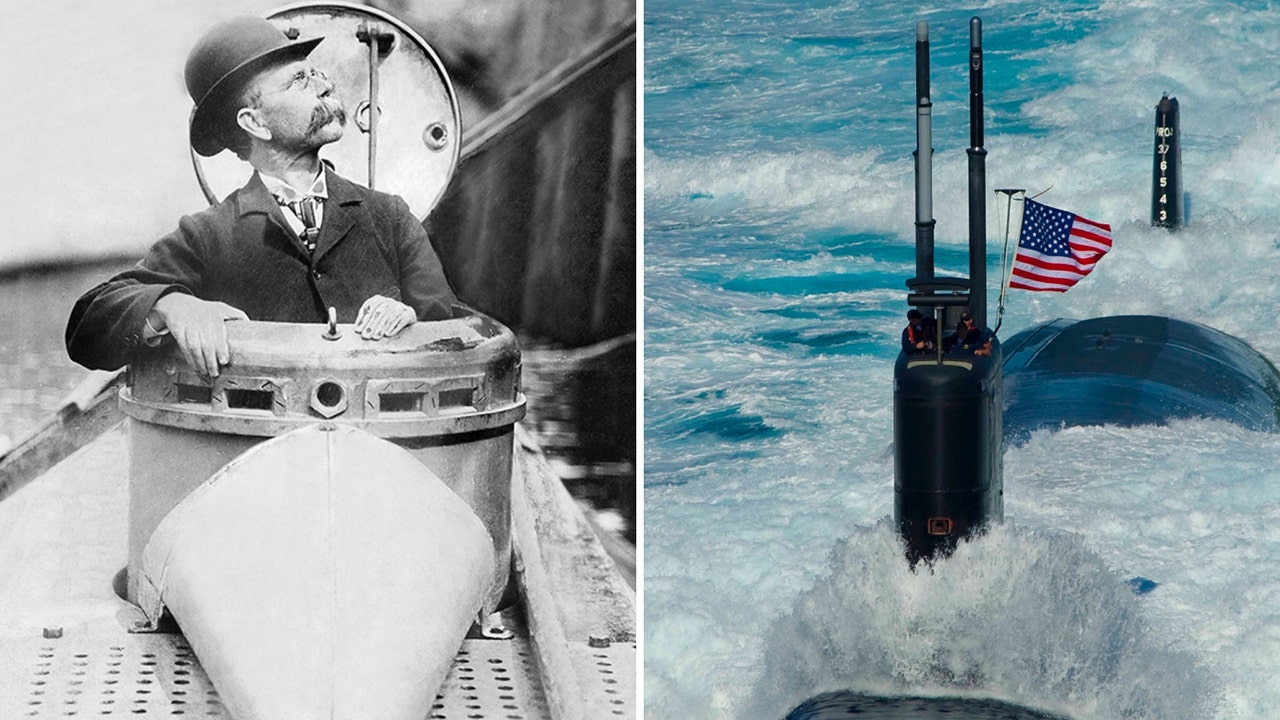
John Philip Holland is credited as the inventor of the modern submarine. Shown here in the hatch of one of his early submarines, circa 1900, and with a modern U.S. submarine in 2010.(W.H. Rau/ullstein bild and by Specialist 3rd Class Adam K. Thomas/U.S. Navy, both via Getty Images)
“In the year of 1914, the year of the Great War/A death appeared in the papers, it was read both near and far,” concludes the lyrics to “John Philip Holland,” sung to a traditional Irish tune.
Advertisement
“That man he died in poverty, but he did realize his dream/He was John Philip Holland who invented the submarine.”
A frontal system will push south of the region overnight, allowing for a brief cooldown in our New England weather on Monday before another stretch of heat this week. Overall, it’s going to be dry and significantly warmer than average. I would say that the temperatures are the bigger issue, with very warm conditions expected.
Temperatures on Monday will be in the ideal range, generally in the mid-70s. Dew points will be comfortable, and there won’t be much wind, although at times it may rustle the leaves a bit.
Winds will be noticeable at times on Monday, but will be held below 20 mph for most areas.Boston Globe
Highs across Southern New England will be coolest by the coast on Monday.Boston Globe
Monday night brings some beautiful weather with temperatures in the 50s, maybe even in the upper 40s in the cooler spots. Boston is likely to stay around 60. Certainly great sleeping weather all-around.
As high pressure pushes off the Atlantic Seaboard and the flow of warmer air returns, temperatures will quickly respond, and it’s back to approaching the upper 80s to even near 90 practically every day this week — and it could be even warmer this weekend. It’s worth remembering that an official heat wave is three days in a row of 90-degree weather. It remains to be seen if any parts of Southern New England sees a heat wave, but it’s definitely a possibility. It’s also worth noting that 90 is just random; some days at 87 degrees can certainly feel worse than a 90-degree day, so the theme here is to prepare for warmer and more humid weather this week.
The forecast across Boston for the next seven days.Boston Globe
The drought conditions are almost not worth talking about because until we have a significant shift in the weather pattern, we will continue with a drought for most areas. It may worsen, it may get a little bit better, but we’re definitely in the time of the year where rainfall is more sporadic. The best thing is to remember to water plants and lawns early in the morning, follow any town water bans or restrictions, and avoid planting in the heat.
Our next chance of precipitation comes late Wednesday.
Advertisement
Showers will return to New England on Wednesday evening.Boston Globe
Greater Boston: Sunny skies both Monday and Tuesday, with temperatures Monday in the mid-70s and Tuesday in the upper 80s.
Central/Western Mass.: Look for brilliant blue skies on Monday with temperatures in the 70s. It’s 83 to 88 on Tuesday with more sunshine.
Southeastern Mass.: Temperatures will be in the mid- to upper 70s on Monday, along with plenty of sunshine. It’ll be in the low to perhaps mid-80s away from the ocean on Tuesday with more sunny skies.
Cape Cod and the islands: Two picture perfect days are on the way with lots of sunshine. Readings will be in the 70s on Monday and approaching 80 on Tuesday except 60s on Nantucket.
Rhode Island: Sunshine on Monday and Tuesday. It’ll be in the 70s on Monday and 80s on Tuesday.
New Hampshire: With readings in the 70s, it’ll be very comfortable on Monday, but heating up to the mid-80s on Tuesday with more sunshine.
Advertisement
Sign up here for our daily Globe Weather Forecast that will arrive straight into your inbox bright and early each weekday morning.
Morgan Wallen has made plenty of headlines in recent days, but he’s been forced to speak out about “nonsense” rumours after cancelling a recent show.
The singer, 33, addressed why he cancelled his Pittsburgh show over the weekend on his Instagram stories on Sunday, days after his mid-performance meltdown.
Country singer Morgan Wallen has hit back at the ‘nonsense’ surrounding his recently cancelled show in Pittsburgh due to wind. Instagram/@morganwallen
“This morning, my team walked on the bus and told me they had been consulting with local officials and that I should cancel my show in Pittsburgh tonight and I said, ‘Why?’” the country singer explained.
Advertisement
“They said that there was going to be strong winds in the area, and I said, ‘OK.’ So, that is what I did in that moment, and I trusted my team.”
Wallen said that he was aware that the forecasted winds hadn’t hit Pittsburg, but had hit nearby areas in Pennsylvania, which was a big reason why they made the call to cancel.
“The truth of the matter is, I have a large stage that, in those conditions, could become fatal to a lot of folks around it. So, I did the best I could with the information I had in that moment,” he continued.
Wallen then hit back at rumours that have been swirling around because he wanted to clear the air.
“I’ve been seeing a lot of nonsense about me that is simply not true, and I just wanted to clear the air,” he continued.
Advertisement
“I think my true fans know that that’s not how I operate in general, but I had to say it.”
Wallen’s video came hours after it was announced that the second Pittsburgh show of his Still The Problem Tour was cancelled.
“After talking with local officials and my team, there is no choice but to cancel tonight’s show due to severe adverse weather conditions expected throughout the rest of the day and night,” he wrote online.
“Safety for my fans and crew is the highest priority.”
Wallen added that refunds would also be available for ticket holders.
Advertisement
The singer’s stadium tour will continue until August 1. Getty
But fans were not impressed and plenty of people slammed him for cancelling the show, even though the weather had reportedly cleared before he would have hit the stage.
Wallen made headlines earlier this month after an on-stage meltdown when he experienced issues with his piano on stage, flipping it and breaking it in front of the audience.
The country singer was mid-song when the piano malfunctioned, so he pushed it, flipping it. Instagram/@countrycentral
He was performing the hit Sand In My Boots when the tech issue started and decided to push it over.
The audience gasped as the piano seemingly broke, before the singer walked off and continued the song a cappella.