Sign up for the Today newsletter
Get everything you need to know to start your day, delivered right to your inbox every morning.

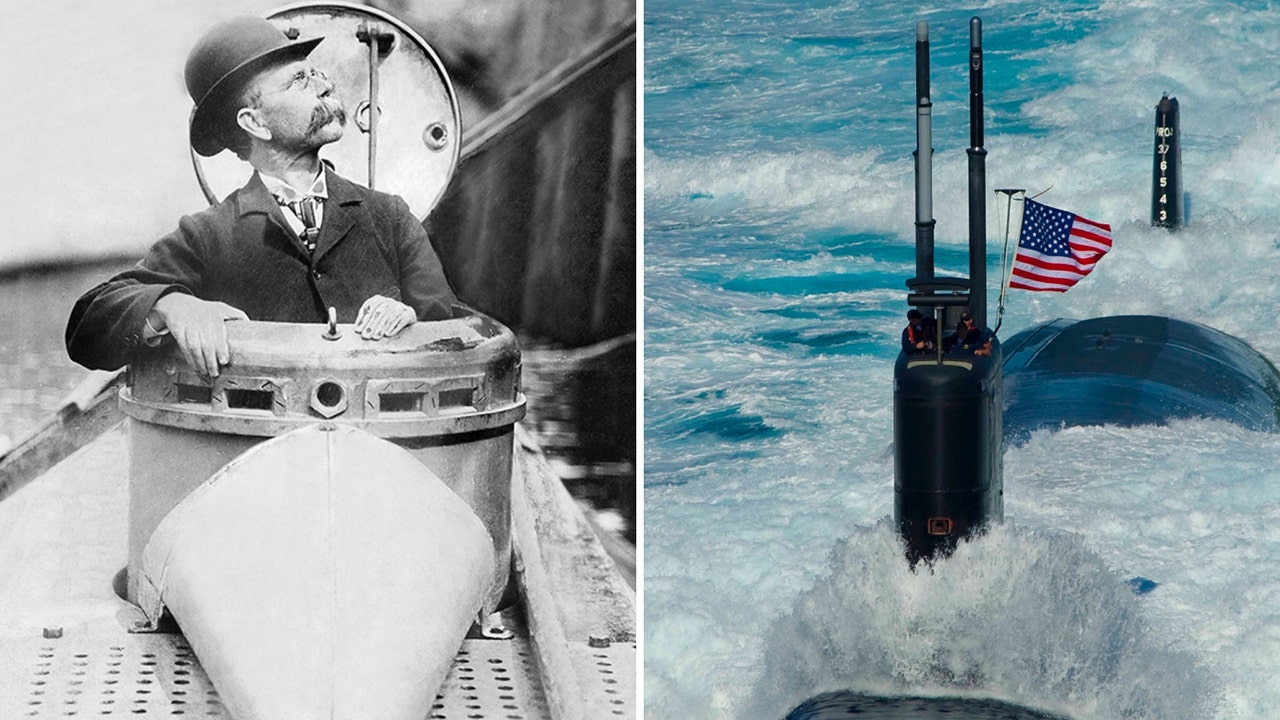
John Philip Holland’s brilliance transcended time, distance — and depth.
Widely proclaimed “the father of the modern submarine,” Holland was born in Ireland and moved to the United States as a young man with the audacious idea of building a “submergible torpedo boat” that could fight silently beneath the waves.
He succeeded in remaking maritime history despite no formal mechanical, engineering or military training.
“He was a brilliant and instinctive engineer,” Holland biographer Lawrence Goldstone told Fox News Digital.
MEET THE AMERICAN WHO INVENTED THE FOLDING BEACH CHAIR, FREDRICK ARNOLD, WWII HERO, INNOVATOR, ARTIST, ACTOR
Goldstone chronicled Holland’s unfathomable story in his 2017 book, “Going Deep: John Philip Holland and The Invention of the Attack Submarine.”
“He figured out how to use the principals of undersea navigation to create a weapon that totally changed naval warfare,” said Goldstone.
John Philip Holland in one of his constructed submarines, Published by “Berliner Illustrirte Zeitung,” 1905. (W.H. Rau, ullstein bild/ullstein bild via Getty Images)
The USS Holland (SS-1), the first U.S. Navy submarine, was commissioned on Oct. 12, 1900.
The state-of-the-art American vessel, Holland’s design, inspired a revolution in military technology.
“France, Japan and Britain each … pursued their own design based on the early Holland vessels,” reports the U.K.’s Shipwreck Centre and Maritime Museum on the Isle of Wight.
“He was a brilliant and instinctive engineer.”
The first British submarine, HMS Holland 1, was commissioned in 1901.
The museum adds, “Germany’s own experiments had not been successful, and they decided to experiment with a Holland vessel.”
The Los Angeles-class attack submarine USS Tuscon (SSN 770) at sea. “Father of the modern submarine” John Philip Holland pioneered the principals of submarine design still used today to build America’s modern nuclear-powered submarine fleet. (Mass Communication Specialist 3rd Class Adam K. Thomas/U.S. Navy via Getty Images)
Holland became a U.S. citizen but would achieve neither fame nor fortune in the land of opportunity.
His intellect, it turned out, faced one challenge too deep to overcome.
“Holland was naive,” said Goldstone.
Isaac Rice, an equally brilliant but “ruthless” electric-automobile pioneer, became a business partner and outmaneuvered the inventor to gain control of J.P. Holland Torpedo Boat Co. and his intellectual property.
Rice transformed Holland’s business into Electric Boat. Now a division of General Dynamics, Electric Boat has built much of the U.S. Navy submarine fleet, as well as boats for many other nations, for nearly 125 years.
USS Holland (SS-1) in drydock, circa 1900, probably soon after she entered Navy service. (Disclaimer: “Use of released U.S. Navy imagery does not constitute product or organizational endorsement of any kind by the U.S. Navy.”) (U.S. Navy photo courtesy of Naval History and Heritage Command)
Holland died penniless and unknown.
“Genius is not transportable,” lamented Goldstone.
MEET THE AMERICAN WHO POPULARIZED LATIN MUSIC, TITO PUENTE, WORLD WAR II NAVY VETERAN AND KAMIKAZE SURVIVOR
When Holland’s invention, he said, “got to the point that he had to turn it into a practical product, not a practical machine but a practical product, he was totally out of his depth.”
John Philip Holland was born in Liscannor, County Clare, on the west coast of Ireland, on Feb. 24, 1841.
The date of his birth is disputed.
Birthplace of John P. Holland at Liscannor, County Clare, Ireland. (Courtesy Clare County Library)
His father John Holland, a lighthouse keeper and coastguardsman, and his mother, Mary (Scanlan) Holland, were both native Irish speakers. It appears the submarine pioneer was a teenager before he learned English.
Ireland had suffered under British rule for centuries.
“He considered the use of the submarine to further the cause of Irish Independence.”
Holland’s father reportedly died when the future inventor was a young boy. He was just four years old when famine struck Ireland. Millions of Irish died or fled overseas.
Holland was stricken with poor eyesight due to malnourishment, according to the Ancient Order of Hibernians.
He was, by all accounts, an Irish patriot.
“As a youth, he considered the use of the submarine to further the cause of Irish Independence,” reports the U.S. Navy’s Naval History and Heritage Command.
The Turtle was the world’s first submarine known to be used in combat. It was built in 1775 by David Bushnell (1742-1824) and used against the British in 1776. Image from 1787. (Photo12/Universal Images Group via Getty Images)
Holland attended Christian Brothers School in Limerick and later became a mathematics and music teacher at the Christian Brothers convent in Drogheda, Co. Louth, north of Dublin.
“It was during his residence at Christian Brothers that he designed the submersible mechanical duck,” according to the website of Scholars Townhouse Hotel, located in Holland’s former convent.
MEET THE AMERICAN WHO ‘WON THE WAR FOR US’: ANDREW JACKSON HIGGINS, WORLD WAR II NEW ORLEANS BOATBUILDER
The duck “could walk around the garden, swim, dive underwater and then resurface.”
The source of Holland’s mechanical aptitude remains unknown even to biographer Goldstone.
Friends of Hunley archeological technician Chris Ohm straightens the hair on the facial reconstruction of Arnold Beckner, a crew member of the H.L. Hunley, before a press conference, April 16, 2004, in Charleston, South Carolina. The Hunley is a Civil War submarine that sunk in 1864 while on a mission to torpedo a Union ship in Charleston. It was raised in 2000. (Stephen Morton/Getty Images)
What is certain is that Holland grew up in an era bursting with innovation and filled with stories of underseas adventure.
Connecticut colonist David Bushnell built the Turtle, a primitive one-man submersible, in 1775; it was used unsuccessfully to attack the HMS Eagle in New York Harbor in 1776.
Submarine warfare gained international attention again during the American Civil War. The confederate vessel H.L. Hunley torpedoed and sunk the USS Housatonic in Charleston Harbor.
It is the first known sinking of an enemy vessel by a submersible in the history of warfare.
There was no glory to celebrate. The Hunley sunk, too. Its wreckage and the remains of its crew were discovered only in 1995.
Jules Verne and his famous works — French writer 1828-1905. Author of “L’Ile Mysterieuse” and “20,000 Leagues Under the Sea.” (Culture Club/Getty Images)
Holland was further inspired by fiction.
“In 1870, Jules Verne published a novel ‘20,000 Leagues Under The Sea,’” the Clare County Library reports in its history of the beloved native son.
“An excited Holland persisted in turning a dream into reality.”
Holland moved to the United States in 1873, first to Boston and then to Paterson, New Jersey.
He submitted his first submarine designs to the U.S. Navy in 1875.
They were turned down as unworkable.
Fenian Ram submarine, 1881, U.S., drawing. The Fenian Ram was built by Irish-American submarine pioneer John Philip Holland and funded by Irish patriots. Holland later designed the first commissioned U.S. Navy submarine, the USS Holland (SS-1). (DeAgostini/Getty Images)
“A fantastic scheme of a civilian landsman,” one member of top Navy brass reportedly said.
Holland found benefactors in like-minded Irishmen.
MEET THE AMERICAN WHO ROWED WASHINGTON ACROSS THE DELAWARE ON CHRISTMAS: SAILOR-SOLDIER JOHN GLOVER
“The American Fenian Society, a group of Irish patriots who hoped to undermine England’s naval power and gain independence for Ireland, commissioned Holland to build a submarine,” reports The Irish American Museum of Washington, D.C.
His first “submergible” — as he called the technology — sank during testing in the Passaic River.
His second model, dubbed the Fenian Ram, successfully launched in New York City in 1881.
John Philip Holland received the patent for his submarine design, the “submergible torpedo boat,” on April 12, 1892. The inventor was born in Ireland but stated that he was a “citizen of the United States” when he filed the patent application on Dec. 5, 1889. (U.S. Patent and Trademark Office/Public Domain)
“He frightened fishermen and small boating parties on Long Island Sound by sudden appearances from beneath the waves; and apparently thoroughly enjoyed himself with his first real submarine,” writes the U.S. Naval Institute.
“A full-scale vessel, the Fenian Ram had many of the features we associate with modern submarines,” notes the Irish American Museum.
“He frightened fishermen and small boating parties on Long Island Sound by sudden appearances from beneath the waves.”
Among them: a tubular cigar shape and dual power — electricity for underwater, internal combustion for operating on the surface, much like non-nuclear subs still employ today.
The Fenian Ram was armed with torpedoes and fitted with a Holland innovation that transformed submarine technology forever: rudder planes that allowed the boat to dive and rise in the water.
MEET THE AMERICAN WHO WROTE ‘AMERICA THE BEAUTIFUL,’ KATHARINE LEE BATES, PROFESSOR-POET PRAYED FOR UNITY
Top brass was still not impressed.
Holland spent nearly two decades working on improvements. In 1897, he launched “the first submarine with the power to run submerged for any considerable distance,” according to CHIPS, the Department of the Navy’s information technology magazine.
Naval Academy Midshipmen aboard the USS Holland (SS-1), the first official U.S. Navy submarine, commissioned in 1900. The Holland spent much of his service training Midshipmen for the future of submarine warfare. Date of image unknown. (Disclaimer: “Use of released U.S. Navy imagery does not constitute product or organizational endorsement of any kind by the U.S. Navy.”) (U.S. Navy photo courtesy Naval History and Heritage Command)
By this time, he had lost the support of the Fenian brotherhood.
A new business partner emerged: Isaac Rice, a pioneer in electric automobiles. Among other successes, he had filled the streets of New York City with electric taxicabs, before the internal combustion vehicles replaced those fueled by battery.
Their sixth prototype proved a triumph.
“It was 53 feet long and driven by a 45 h.p. gas engine for surface travel and a 45 h.p. gas engine for underwater travel,” reports the Clare County Library.
Holland submarine launch and christening ceremony at the Crescent Shipyard, Elizabethport, New Jersey, May 17, 1897. Her sponsor, Mrs. Lawrence, is visible beyond Holland’s bow. It was acquired by the U.S. Navy in 1900 and commissioned the USS Holland (SS-1), the first official U.S. submarine, that year. (Disclaimer: “Use of released U.S. Navy imagery does not constitute product or organizational endorsement of any kind by the U.S. Navy.”) (U.S. Navy photo courtesy Naval History and Heritage Command)
“It carried a crew of 15 and had a torpedo tube in the bow. It took its first dive on St. Patrick’s Day, 1898, in New York Harbor and was acclaimed a success.”
The Navy purchased what is now known as the USS Holland (SS-1) on April 11, 1900, for $150,000, about half the cost to build it.
The Holland was commissioned as the first U.S. Navy submarine on October 12.
“Holland had an awareness that he needed a business partner … he was unaware of how ruthless Rice could be.”
Holland would enjoy success in name only. Rice controlled the business, and the profits.
“Isaac Rice was ruthless, but also brilliant in his own way,” said Goldstone. “Holland had an awareness that he needed a business partner … He was unaware of how ruthless Rice could be.”
John Philip Holland died on Aug. 12, 1914, after more than a month battling pneumonia, at his home on 39 Newton St. in Newark, New Jersey.
He was 73 years old.
John Philip Holland was born in Ireland in 1841, moved to New Jersey in 1873 and proved a revolutionary global figure in naval submarine design. (Courtesy The Paterson Museum)
Holland is buried at Holy Selpuchre Cemetery in Totowa, New Jersey.
“For 61 years, he lay in an unmarked grave until public attention was focused on the historical oversight in 1975 and a memorial headstone was erected,” reports the Ancient Order of Hibernians.
“For 61 years, he lay in an unmarked grave until public attention was focused on the historical oversight.”
“Years later, another was erected in its place, and the original stone was transferred to his hometown of Liscannor and dedicated by the U.S. Navy Submarine Force.”
MEET THE AMERICAN WHO FIRST COMMANDED THE MARINES: REVOLUTIONARY WAR HERO SAMUEL NICHOLAS
“Father of the modern submarine,” says his gravestone, beneath a relief replicating the memorable picture of Holland in his bowler hat sticking his head out of the top of his submarine and gazing off to his left.
“Although he was interested in submarines, Mr. Holland was opposed to war,” The New York Times wrote in a brief obituary the next day. “His idea of submarines was to incapacitate war ships and not to destroy them and kill the men on them.”
The world had other ideas.
American inventor John Philip Holland (1841-1914), circa 1880. His submarine the USS Holland (SS-1) was commissioned by the U.S. Navy. (Hulton Archive/Getty Images)
Two weeks before he died, the Austro-Hungarian Empire declared war on Serbia — plunging Europe into World War I.
Five weeks after his death, on September 22, German submarine U-9 sank three British battle cruisers in less than an hour, killing 1,400 men.
For more Lifestyle articles, visit www.foxnews.com/lifestyle
“It’s the battle that changed naval warfare forever,” said Goldstone, while noting that the man who made such incredible submarine power possible had just “died in obscurity.”
In addition to helping found, if not profit from, Electric Boat, Holland today enjoys acclaim on both sides of the Atlantic.
The Paterson Museum of New Jersey houses a treasure trove of Holland information and artifacts.
A model of the first ever British submarine, the Holland No. 1 (named after inventor John Philip Holland) on display in Trafalgar Square, London, a year after the launch of the actual vessel in 1901. (London Stereoscopic Company/Hulton Archive/Getty Images)
“He really changed the navies of the world and the way naval warfare developed,” museum director Giacomo DeStefano told Fox News Digital.
A plaque was erected in Liscannor commemorating the 50th anniversary of his death in 1964.
Castle Street in his hometown has been renamed Holland Street in his honor.
He’s also the namesake of the John P. Holland Charter School in Woodland Park, New Jersey, and the John P. Holland Centre in Liscannor.
To read more stories in this unique “Meet the American Who…” series from Fox News Digital, click here.
He’s been immortalized in statue in Drogheda Town, County Louth, where he lived in the Christian Brothers monastery as a young man.
He’s also remembered and lamented in song in his homeland.
John Philip Holland is credited as the inventor of the modern submarine. Shown here in the hatch of one of his early submarines, circa 1900, and with a modern U.S. submarine in 2010. (W.H. Rau/ullstein bild and by Specialist 3rd Class Adam K. Thomas/U.S. Navy, both via Getty Images)
“In the year of 1914, the year of the Great War/A death appeared in the papers, it was read both near and far,” concludes the lyrics to “John Philip Holland,” sung to a traditional Irish tune.
“That man he died in poverty, but he did realize his dream/He was John Philip Holland who invented the submarine.”
Read the full article from Here


On March 2, Spurwink will join community partners for a special viewing of Building Hope: Ending Homelessness in Maine at the University of Southern Maine’s McGoldrick Hall.
Directed by Richard Kane and produced by Melody Lewis-Kane, the film shines a compassionate light on the realities of Maine’s homelessness crisis. Through deeply personal stories, Building Hope explores the challenges faced by unhoused individuals and families, while highlighting the hope that emerges when communities come together to create solutions. It’s been praised for its honesty, dignity, and inspiring message: change is possible when we work together.
Following the screening, a panel of local leaders and advocates will discuss the film and the ongoing effort in Maine to end homelessness. Panelists will include Katherine Rodney, Director of Spurwink’s Living Room Crisis Center; Cullen Ryan, Chief Strategic Officer at 3Rivers; Donna Wampole, Assistant Professor of Social Work at USM; and Preble Street staff. Catherine Ryder, Spurwink’s Senior Director of Strategic Initiatives, will bring her expertise in trauma-informed care and community collaboration to the panel as the moderator.
This event is free and open to the public.
McGoldrick Center, USM Portland campus
05:00 PM – 07:30 PM on Mon, 2 Mar 2026

EASTON, Mass. (WBZ) — Police body camera video shows an Easton, Massachusetts, officer rescuing a 78-year-old Raynham man from a burning car on Friday morning.
A Mack dump truck was experiencing problems on the side of Turnpike Street just after 2 a.m. when a Ford pickup truck struck the back of it, according to police.
The pickup truck then became stuck under the dump truck, trapping the driver, Francis Leverone, inside. A Toyota Camry then hit the back of the pickup truck and caught fire, police said.
Easton police officer Dean Soucie arrived at the crash and saw that the two vehicles were on fire. Video shows Soucie rushing over before breaking the driver’s side window and then, with the help of the two witnesses, freeing Leverone from the pickup truck. Soucie said he was confused but conscious.
“As I reached inside the vehicle, one of the passersby — he actually jumped into the cab of the truck, and he helped me free the individual,” Soucie said.
They then carried the driver to safety.
Leverone was taken to a nearby hospital before being transferred to a Boston hospital. He received serious but non-life-threatening injuries.
No one else was injured in the crash.
Dee Leverone told WBZ her husband is doing OK. “I’m just thankful for the people that got him out,” she said. “Very thankful.”
After watching the police body-cam video on the news she said, “I was shocked, I was like ‘Oh my God!’ I just couldn’t believe it. His truck is like melted.”
She says she realized that something was wrong last night when her husband never made it home from work.
“I kept trying to call him and call him, and I finally got a hold of him at like 4:30 a.m., and he was at (Good Samaritan Hospital) and he told me he’s gotten in an accident,” Dee said.
She says he’s recovering at the Boston Medical Center and being treated for a dislocated hip.
“He’s a trooper,” Dee said. “He’s a strong man — and you know he’s 78, but you know he’s a toughie. He definitely is a toughie.”
Soucie commended the help of the two witnesses and said that before he arrived at the crash, they had attempted to put out the flames with a fire extinguisher and removed a gasoline tank from the pickup truck before it could ignite.
“They jumped into action like it was nothing,” Soucie said. “Those two individuals were absolutely awesome.”
Easton Police Chief Keith Boone said that he is “extremely proud” of Soucie and the witnesses.
“He saved a life last night,” Chief Boone said. “He is an exemplary police officer and this is just one example. I think he’s a hero.”
Turnpike Street was closed for several hours following the crash. Easton Police are investigating.
=htmlentities(get_the_title())?>%0D%0A%0D%0A=get_permalink()?>%0D%0A%0D%0A=htmlentities(‘For more stories like this one, be sure to visit https://www.eastidahonews.com/ for all of the latest news, community events and more.’)?>&subject=Check%20out%20this%20story%20from%20EastIdahoNews” class=”fa-stack jDialog”>

Local News
A new photo has been released of the victim in a nearly 30-year-long unsolved murder case, in the hope of finding any new potential witnesses in the cold case, New Hampshire officials said.
“Our family wants to know what happened, who did this and why,” the family of Rosalie Miller said in a press release. “We miss her and want to give her peace.”
Miller was last seen on December 8, 1996 at her apartment in Manchester. At the time of her disappearance, Miller had plans on meeting friends in the Auburn, New Hampshire area, officials said.
Her body was found on January 20, 1997 in a partially wooded spot on a residential lot along the Londonderry Turnpike in Auburn, officials said in the release.
The autopsy report declared Miller’s death a homicide by asphyxiation due to ligature strangulation, N.H. officials wrote.
As part of a new effort to garner public help with the case, an “uncirculated” photo of Miller, 36, is being distributed “in hopes it may jog the memory of someone who saw or spoke with her in the winter of 1996,” Attorney General John M. Formella and New Hampshire State Police Colonel Mark B. Hall announced on behalf of the New Hampshire Cold Case Unit in a joint press release.
Investigators are especially hoping to talk to anyone who was in contact with Miller in December of 1996 or anyone “who may have seen her in the vicinity of the Londonderry Turnpike in Auburn during that time,” officials said in the release.
“We are releasing this new photograph today because we believe someone out there has information, perhaps a detail they thought was insignificant at the time, that could be the key to solving this case and bringing justice for Rosalie and those who loved her,” Senior Assistant Attorney General R. Christopher Knowles, New Hampshire Cold Case Unit Chief said in the release.
The New Hampshire Cold Case Unit encourages anyone with any amount of information to contact the group at [email protected] or (603) 271-2663.
Get everything you need to know to start your day, delivered right to your inbox every morning.





Exclusive: DeepSeek withholds latest AI model from US chipmakers including Nvidia, sources say


Mother and daughter injured in Taunton house explosion


10 acres charred, 5 injured in Thornton grass fire, evacuation orders lifted


Wildfire near Gum Swamp Road in Livingston Parish now under control; more than 200 acres burned


YouTube TV billing scam emails are hitting inboxes


OpenAI didn’t contact police despite employees flagging mass shooter’s concerning chatbot interactions: REPORT


Stellantis is in a crisis of its own making


World reacts as US top court limits Trump’s tariff powers