Northeast
Convicted New Jersey cop killer to walk free after parole board's rare move: 'Slap in the face'

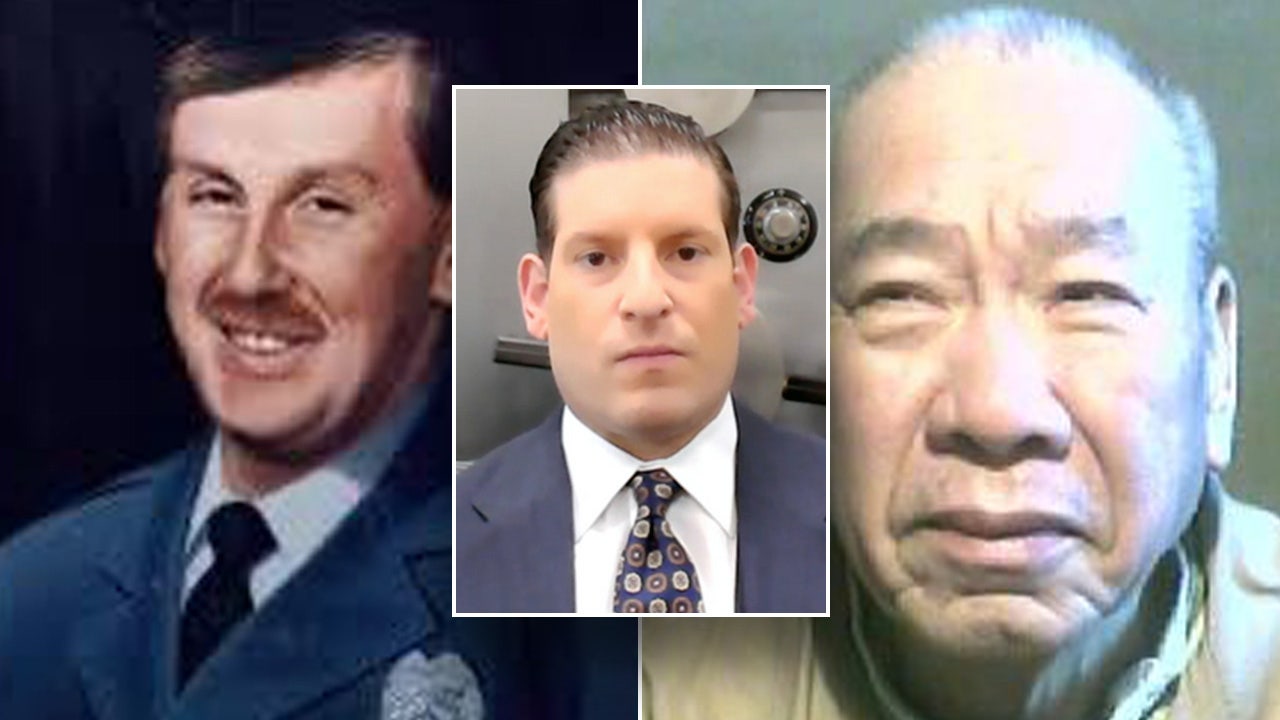
A New York City man who nearly 30 years ago admitted to fatally shooting a New Jersey police officer is set to be freed in a shocking turn of events that one expert called “disgusting.”
On June 26, Chung Ho, who is now 80, was granted parole for the Feb. 18, 1995, death of Lower Township Police Department Officer David Douglass.
David Gelman, a criminal defense attorney and a former deputy district attorney, told Fox News Digital that the news of Ho’s parole was a “slap in the face” to the officer’s memory.
“It’s really disgusting. This was the first time that he applied, and he was accepted,” Gelman said. “It’s a total slap in the face to Officer Douglass’ family, other officers in the department and, frankly, police in general in New Jersey.”
HOW US CAN BECOME ‘LAW ENFORCEMENT-MINDED COUNTRY’ AFTER DEFUND THE POLICE EFFECT: FORMER ICE OFFICIAL
Patrolman David Douglass was shot and killed while responding to a report of a burglary in February 1994. (Lower Township Police Department)
Gelman said that Ho being released on parole after pleading guilty in 1995 to the murder, aggravated arson and burglary charges sends a “terrible message” to the law enforcement community.
“If your life is taken away by a violent criminal and then the parole board sees it and says, you know what? It doesn’t matter that this happened over 30 years ago. It doesn’t matter that there is an individual whose life was taken for no reason whatsoever. But you know what? We think that the individual who committed this crime, they’ve changed enough,” he said. “We can let them free.”
“That is an absolutely terrible message and the family of Officer Douglass should 100% be upset and mad, which they are,” he said.
Chung Ho, who was sentenced to life in prison for the murder of Officer David Douglass, will be released on parole on Sept. 23, 2024. (New Jersey Department of Corrections)
Ho’s parole came after he came just shy of serving the minimum sentence for the murder of Officer Douglass.
Gelman shared that the decision was made after a group of 12 individuals reached a consensus before delivering Ho the news that he was granted parole.
“In New Jersey, you have parole boards, and parole boards consist of 12 individuals who are experts in their fields,” he said. “They have to interview the victim’s families, the dependents, doctors and individuals in the prison before they come to a conclusion.”
NYC MAYOR ERIC ADAMS HIT WITH FIRST SUBPOENA OVER 2021 CAMPAIGN FINANCES: REPORT
“I’d say it’s 50/50 whether individuals get parole,” he said. “When it comes to murders, parole is not often granted. In fact, I don’t think it has ever happened in the state of New Jersey that the officer’s killer has been granted parole at the first opportunity.”
“And frankly, there’s kind of an unwritten rule in New Jersey and probably a lot of other states as well, that officer killers usually don’t get parole, especially not the first time,” he said. “So this is going against the book on all levels.”
David Gelman, a criminal defense attorney, weighed in on Chung Ho’s upcoming release after he was granted parole on the first try. (Fox News Digital)
Gelman pointed to New Jersey’s justice system and the state’s “completely failed” bail reform.
“The New Jersey justice system has taken a dramatic turn over the last half decade or so. I’d say at least 90% are getting free and they’re not just petty crimes or drug crimes, these are individuals who commit violent offenses and are still getting out on the street in less than 24 hours.”
“So it’s par for the course, if you look at it, for a parole board to take that same attitude for those who committed extremely violent offenses.”
NJ MOM WISHES ‘NOTHING BUT THE WORST’ FOR DAD WHO KILLED SON, 6, BY FORCING HIM ON TREADMILL
Gelman said that New Jersey Gov. Phil Murphy has “exasperated the criminal justice system.”
“The criminal justice system here in our state is completely flawed, and a lot of it has to do with the politics in New Jersey,” he said. “Our governor, Governor Murphy, has really exasperated the criminal justice system and made it a lot easier for criminals to not only commit crimes, but to get very lenient sentences and to be get off pretty much scot-free.”
He said criminals know that New Jersey’s justice system is lenient, which has resulted in rising crime across the Garden State.
“Our crime in New Jersey has gone up substantially over the last half dozen years or so. And, you know, that is not a coincidence,” Gelman said.
A group of police officers honored Officer David Douglass at a memorial for the fallen officer in February 2024. (Lower Township Police Department)
On Feb. 18, 1994, Officer Douglass was called to the scene of a suspected burglary and engaged in a foot race against the suspect, Ho, who had just set a house on fire.
When the man turned and shot him. Douglass returned fire, striking the suspect in the hand. He was able to make it back to his patrol car to call for assistance but died shortly after.
Ho was sentenced to 30 years to life in 1995 after pleading guilty. Now, Ho, who is 80, is set to receive parole and will be released in September 2024.
On Feb. 18, 2024, the Lower Township Police Department remembered Officer David Douglass’ lifetime of service to the community. (Lower Township Police Department)
On Feb. 18, 2024, the Lower Township Police Department commemorated the 30th anniversary of the death of Officer Douglass.
CLICK TO GET THE FOX NEWS APP
“Let us not forget his efforts, let us not forget his name, and please let us not forget his family,” the department said.
A spokesperson for Gov. Phil Murphy did not respond to Fox News Digital.
Read the full article from Here

Boston, MA
After monthlong break, Boston Legacy FC battles back to earn a draw with Bay FC – The Boston Globe

After Bay took an early two-goal lead, the Legacy settled in and began to find their attack, and they got one back in first-half stoppage time. When they returned to the field after halftime, the Legacy looked confident on the ball and controlled the pace of play.
Trailing 2-0 in the second minute of first-half stoppage time, Nichelle Prince served a ball into the box, and Amanda Guttieres headed it into the back of the net for her third NWSL goal. It was the Brazilian striker’s first goal in the run of play after scoring on two penalty kicks earlier this season.
Boston entered the match with a league-leading 174 fouls committed and 27 cards (two red, 25 yellow), and the Legacy added to that total in the early minutes of the game, resulting an deficit.
Goalkeeper Casey Murphy received a yellow card in the fifth minute for a tackle on Alex Pfeiffer after a defensive error led to a loose ball in the box. Claire Hutton took the penalty kick and converted to give Bay a 1-0 lead.
Jorelyn Carabali also received a yellow card in the eighth minute.
Defender Lilly Reale made her first start for her hometown team since Boston acquired the Hingham native from Gotham FC on June 17.
The Legacy sent $350,000 in allocation money and $50,000 in intraleague transfer fee funds to Gotham FC for Reale, the 2025 NWSL Rookie of the Year. She joined the Legacy on a four-year deal that runs through December 2029.
Adding Reale to the lineup gives the Legacy a bit more flexibility on the left side, an area where they’ve suffered three injuries already this season. (Of those injured, only Brazilian defender Kaká remains out).
The defender has had two weeks of uninterrupted training with the Legacy to get used to her new team, but she still showed signs of growing pains on Sunday.
Known as a vocal communicator on the field, Reale was visibly frustrated at times when her teammates didn’t make the runs she expected them to, and Bay’s second goal was a direct result of Reale holding a Bay forward onside.
The visitors doubled their lead in the 17th minute on a ball in behind to Karlie Lema, who broke through Reale and Boston’s back line and had a 1-on-1 with Murphy. Lema slotted her first touch inside the near post to give Bay a 2-0 lead.
In their previous meeting, these teams played to a 1-1 draw on May 15 at PayPal Park despite Boston playing with 10 players for more than half the contest. Defender Bianca St-Georges was handed a red card and a three-game suspension for a tackle in the 42nd minute of that match, and Sunday’s game was the final game of her suspension.
Prior to Sunday, the Legacy hadn’t played since May 30, a 1-0 loss to Kansas City. Boston lost two straight entering Sunday’s contest, dating back to a 2-1 loss to Seattle on May 22 — the Legacy’s first game at Centreville Bank Stadium.
Boston will return to Pawtucket Friday at 8 p.m. to host Chicago.
Emma Healy can be reached at emma.healy@globe.com or on X @ByEmmaHealy.

WASHINGTON — The Pittsburgh Pirates could’ve lost a pitcher they valued, but they made sure they didn’t let him go elsewhere.
The Pirates announced that they selected the contract of right-handed pitcher Noah Murdock to the 40-man roster and optioned him to Triple-A Indianapolis on July 5.
Pittsburgh needed room on their 40-man roster and did this by designating infielder Davis Wendzel for assignment.
The Pirates can now recall Murdock to the 26-man roster with this move and also move him between the minor leagues and major leagues as needed.
Why The Pirates Added Murdock to 40-Man Roster
It’s an interesting move from the Pirates, not one that necessarily has massive ramifications on the team, but more so from a contract stand point.
Murdock had an assignment clause in the minor league contract he signed with the Pirates this past offseason.
This allows another MLB team to add Murdock to their 26-man roster and the Pirates had to either let him go to that MLB team or put him on their 40-man roster. The Pirates doing so signals that there was interest of another team doing exactly this.
It is somewhat different than when a player exercises an upward mobility clause, which would’ve required the Pirates to add Murdock to their 26-man roster or let him go to another team, which they did with left-handed pitcher Joe La Sorsa, who they traded to the Boston Red Sox on June 4.
The Pirates decided that it was worth it to add him to their 40-man roster and let Wendzel go, who had played for them this season.
Pittsburgh selected Wendzel’s contract on June 7 and then after two games, optioned him back to Indianapolis on June 11.
Wendzel also went on the 7-day injured list on July 3, so the Pirates likely decided that they’d want a healthy minor leaguer on their 40-man roster rather than one who wasn’t.
What the Pirates Will Get From Murdock
There isn’t a guarantee that Murdock will play for the Pirates this season, but this move means that there’s always the possibility.
Murdock built back up this season, first pitching with Single-A Bradenton, then Double-A Altoona and with Indianapolis most recently.
He has posted a 2-2 record in 24 relief appearances with one start, with a 4.11 ERA over 30.2 innings pitched, 39 strikeouts to nine walks, a .223 batting average allowed (BAA) and a 1.11 WHIP.
Murdock has posted a 4.26 ERA over 11 relief appearances and 12.2 innings pitched with Indianapolis, with 21 strikeouts to four walks, a .245 BAA and a 1.26 WHIP.
Expect Murdock to throw one of three pitches in a cutter, sweeper or a sinker, but he does have a changeup and four-seam fastball in his arsenal as well.
Make sure to visit Pirates OnSI for the latest news, updates, interviews and insight on the Pittsburgh Pirates!
 Add us as a preferred source on Google
Follow

TORRINGTON, Conn. (WFSB) – Mayor Molly Spino declared a local state of emergency in Torrington on Sunday after severe storms swept through Connecticut overnight, leaving thousands without power and causing widespread damage across the state.
Neighborhoods across Connecticut are dealing with the aftermath of the storms, which brought golf ball-sized hail, downed trees, and downed wires.
Eversource and United Illuminating customers across the state remain without power.
Torrington among hardest hit
The damage on Domain Avenue is hard to miss — two trees came down on top of a home, nearly hiding the structure underneath. The family who lives there said six trees fell on their property overnight.
Overnight, about 2,000 customers were without power in Torrington neighborhoods including Winthrop, Newfield, Pine Ridge, Laurel Hill Road, Hillside, and New Harwinton Road.
By morning, that number had more than doubled to more than 4,700 outages across the city.
Eversource, emergency crews, and the street department are working in Torrington.
Police said they are working to clear roads, assess damage, and respond to service calls.
Roads remain blocked
Downed trees, power lines, and debris are making travel difficult in several areas of Torrington. Several road closures remain in effect.
Drivers are reminded that any traffic light that is out should be treated as a four-way stop.
Police are urging residents to stay home if possible, slow down, and use extra caution.
Residents are also encouraged to check on elderly neighbors who may need assistance.
State of emergency declared
Mayor Spino’s declaration took effect immediately and remains in effect until terminated in writing by the mayor or acting mayor.
All emergency services personnel, public works crews, and essential city staff have been activated, and additional resources have been requested through the state of Connecticut.
No further details were released.
Eyewitness News will provide more details as soon as they become available.
Copyright 2026 WFSB. All rights reserved.
-
 Lifestyle2 minutes ago
How young people feel about American identity, on the nation’s 250th birthday
-

 Technology12 minutes ago
Mr. Lif’s Emergency Rations EP is post-9/11 hip hop at its most daring
-

 World17 minutes ago
Australian healing with ‘beautiful messages’ after losing arm to shark attack
-

 Politics24 minutes ago
Michigan Democrat Mallory McMorrow drops out of Senate race weeks before primary
-

 Health27 minutes ago
‘Tanmaxxing’ trend could come at a dangerous cost, skin cancer experts warn
-

 Sports32 minutes ago
Belgium ‘considering all possible options’ after FIFA clears Team USA’s Folarin Balogun
-

 Technology39 minutes ago
Hi Mom text scam: How to spot fake emergency texts
-
 Business42 minutes ago
‘Minions & Monsters’ tops the box office, but with a lower-than-expected haul

