Northeast
Baltimore mass shooting leaves 1 person dead, 7 others wounded: Police

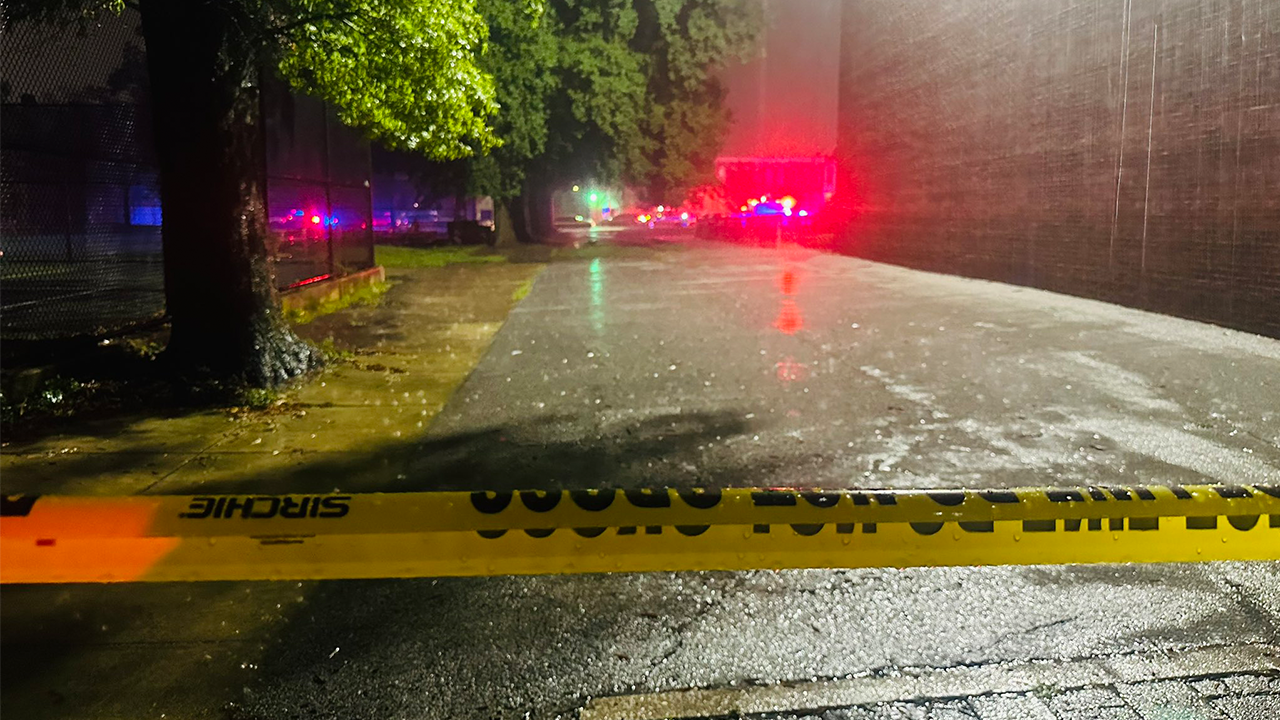
A mass shooting near a park in East Baltimore, Maryland, Sunday night left one victim dead and seven others wounded, according to police.
Baltimore Police said the incident happened at about 8 p.m. in the 1300 block of Spring St. near Caroline & Hoffman Park.
Police Commissioner Richard Worley said at a news conference that police believe there was a gathering on Spring St. when multiple people opened fire.
Officers responded to the scene and found multiple male victims and one female victim suffering from gunshot wounds, Worley said. Police also recovered several firearms at the scene.
WATCH: BODY CAMERA FOOTAGE OF MIGRANT ACCUSED IN MURDER, RAPE OF MARYLAND MOM RACHEL MORIN
Officers responded to a mass shooting incident involving multiple victims. (Baltimore Police)
Four victims were located at the scene while the other four transported themselves to hospitals. The surviving victims were all admitted to hospitals for medical treatment.
A 36-year-old man died in the shooting, Worley said.
The victims’ ages range from 22 to 45, Worley said. The surviving victims are listed in various conditions, from critical to stable.
Mayor Brandon Scott released a statement following the shooting in which he urged the community to report any information they may have on the suspects.
“Tonight, Baltimore is grappling with the impacts of another mass shooting event that has taken the life of one Baltimorean and irreparably changed several others,” the mayor said. “Investigators from the Baltimore Police Department will diligently work to find and hold those who are responsible accountable for this horrific act of violence. To those who know who was involved — even if they are your loved one — I implore you to do the right thing and urge them to take accountability.”
SECOND BODY FOUND IN MARYLAND HOUSE EXPLOSION, 12 FAMILIES DISPLACED IN AFTERMATH
One victim was killed and seven others were wounded in the shooting. (iStock)
Scott also attributed Sunday’s shooting to residents’ ability to access firearms.
“These tragic acts of violence — which are still too common in our city — are only possible because of the continued ease of access to guns on our streets,” he said. “We cannot acknowledge this tragedy without acknowledging the role that the proliferation of guns plays in endangering our communities.”
The mayor added: “Tonight, we are holding space in our hearts for the family of the Baltimorean we lost and those who have been injured — and we will continue our work to ensure no Baltimorean is lost to violence. To that end, we will activate a Coordinated Neighborhood Stabilization Response through [the Mayor’s Office of Neighborhood Safety and Engagement], and will offer this community every resource they need to begin the long process to heal from this tragedy.”
The incident remains under investigation.
Read the full article from Here


RUTLAND, Vt. (WCAX) – Vermont State Police are asking the public for help locating a 71-year-old Rutland man who has not been seen since Thursday evening.
Mark P. Herring was last seen between 6:30 and 7 p.m. on July 2. He was last connected to the area around Coolidge State Park Road in Plymouth but is believed to have returned to Rutland City.
Investigators said the circumstances do not appear suspicious, but they are concerned about Herring’s health.
Anyone who has seen Herring or knows his whereabouts is asked to contact the Vermont State Police Rutland Barracks.
Copyright 2026 WCAX. All rights reserved.
Boston, MA
After monthlong break, Boston Legacy FC battles back to earn a draw with Bay FC – The Boston Globe

After Bay took an early two-goal lead, the Legacy settled in and began to find their attack, and they got one back in first-half stoppage time. When they returned to the field after halftime, the Legacy looked confident on the ball and controlled the pace of play.
Trailing 2-0 in the second minute of first-half stoppage time, Nichelle Prince served a ball into the box, and Amanda Guttieres headed it into the back of the net for her third NWSL goal. It was the Brazilian striker’s first goal in the run of play after scoring on two penalty kicks earlier this season.
Boston entered the match with a league-leading 174 fouls committed and 27 cards (two red, 25 yellow), and the Legacy added to that total in the early minutes of the game, resulting an deficit.
Goalkeeper Casey Murphy received a yellow card in the fifth minute for a tackle on Alex Pfeiffer after a defensive error led to a loose ball in the box. Claire Hutton took the penalty kick and converted to give Bay a 1-0 lead.
Jorelyn Carabali also received a yellow card in the eighth minute.
Defender Lilly Reale made her first start for her hometown team since Boston acquired the Hingham native from Gotham FC on June 17.
The Legacy sent $350,000 in allocation money and $50,000 in intraleague transfer fee funds to Gotham FC for Reale, the 2025 NWSL Rookie of the Year. She joined the Legacy on a four-year deal that runs through December 2029.
Adding Reale to the lineup gives the Legacy a bit more flexibility on the left side, an area where they’ve suffered three injuries already this season. (Of those injured, only Brazilian defender Kaká remains out).
The defender has had two weeks of uninterrupted training with the Legacy to get used to her new team, but she still showed signs of growing pains on Sunday.
Known as a vocal communicator on the field, Reale was visibly frustrated at times when her teammates didn’t make the runs she expected them to, and Bay’s second goal was a direct result of Reale holding a Bay forward onside.
The visitors doubled their lead in the 17th minute on a ball in behind to Karlie Lema, who broke through Reale and Boston’s back line and had a 1-on-1 with Murphy. Lema slotted her first touch inside the near post to give Bay a 2-0 lead.
In their previous meeting, these teams played to a 1-1 draw on May 15 at PayPal Park despite Boston playing with 10 players for more than half the contest. Defender Bianca St-Georges was handed a red card and a three-game suspension for a tackle in the 42nd minute of that match, and Sunday’s game was the final game of her suspension.
Prior to Sunday, the Legacy hadn’t played since May 30, a 1-0 loss to Kansas City. Boston lost two straight entering Sunday’s contest, dating back to a 2-1 loss to Seattle on May 22 — the Legacy’s first game at Centreville Bank Stadium.
Boston will return to Pawtucket Friday at 8 p.m. to host Chicago.
Emma Healy can be reached at emma.healy@globe.com or on X @ByEmmaHealy.

WASHINGTON — The Pittsburgh Pirates could’ve lost a pitcher they valued, but they made sure they didn’t let him go elsewhere.
The Pirates announced that they selected the contract of right-handed pitcher Noah Murdock to the 40-man roster and optioned him to Triple-A Indianapolis on July 5.
Pittsburgh needed room on their 40-man roster and did this by designating infielder Davis Wendzel for assignment.
The Pirates can now recall Murdock to the 26-man roster with this move and also move him between the minor leagues and major leagues as needed.
Why The Pirates Added Murdock to 40-Man Roster
It’s an interesting move from the Pirates, not one that necessarily has massive ramifications on the team, but more so from a contract stand point.
Murdock had an assignment clause in the minor league contract he signed with the Pirates this past offseason.
This allows another MLB team to add Murdock to their 26-man roster and the Pirates had to either let him go to that MLB team or put him on their 40-man roster. The Pirates doing so signals that there was interest of another team doing exactly this.
It is somewhat different than when a player exercises an upward mobility clause, which would’ve required the Pirates to add Murdock to their 26-man roster or let him go to another team, which they did with left-handed pitcher Joe La Sorsa, who they traded to the Boston Red Sox on June 4.
The Pirates decided that it was worth it to add him to their 40-man roster and let Wendzel go, who had played for them this season.
Pittsburgh selected Wendzel’s contract on June 7 and then after two games, optioned him back to Indianapolis on June 11.
Wendzel also went on the 7-day injured list on July 3, so the Pirates likely decided that they’d want a healthy minor leaguer on their 40-man roster rather than one who wasn’t.
What the Pirates Will Get From Murdock
There isn’t a guarantee that Murdock will play for the Pirates this season, but this move means that there’s always the possibility.
Murdock built back up this season, first pitching with Single-A Bradenton, then Double-A Altoona and with Indianapolis most recently.
He has posted a 2-2 record in 24 relief appearances with one start, with a 4.11 ERA over 30.2 innings pitched, 39 strikeouts to nine walks, a .223 batting average allowed (BAA) and a 1.11 WHIP.
Murdock has posted a 4.26 ERA over 11 relief appearances and 12.2 innings pitched with Indianapolis, with 21 strikeouts to four walks, a .245 BAA and a 1.26 WHIP.
Expect Murdock to throw one of three pitches in a cutter, sweeper or a sinker, but he does have a changeup and four-seam fastball in his arsenal as well.
Make sure to visit Pirates OnSI for the latest news, updates, interviews and insight on the Pittsburgh Pirates!
 Add us as a preferred source on Google
Follow
-

 South Dakota2 minutes ago
One child dead following Hughes County fatal crash
-

 Tennessee14 minutes ago
Wild ride for temperatures: A look at Middle Tennessee’s first major heat wave of 2026
-

 Texas17 minutes ago
Riley Greene homers and triples for 4 RBIs as Tigers top Texas Rangers 6-3
-
 Utah22 minutes ago
Utah’s Venezuelan community gathers to honor victims, aid survivors after deadly earthquakes
-

 Vermont29 minutes ago
Vermont State Police seek missing Rutland man
-

 Virginia32 minutes ago
Way-Too-Early 2026 Virginia Tech Football Preview and Prediction: Week 12, @ Miami
-

 Washington38 minutes ago
Weather Alert: Storms move into DMV area
-

 Wisconsin44 minutes ago
3 fires in southeastern Wisconsin tied to improper fireworks disposal

