Connect with us

News

When the customer is not always right

Published

on

When the customer is not always right

Stay informed with free updates

One of the world’s best known luxury brands recently conducted a survey of its global store network, sending local platoons of secret shoppers to assess the level of customer service. Despite their stellar reputation, the outlets in Japan fared dismally.

“The problem was not the service. It was the shoppers,” relates the senior director in charge. “In reality, we knew the service in our Japan stores was by far the best anywhere in the world, but the Japanese customers that we sent found faults that nobody else on earth would see.”

Many will see an enviable virtuous circle in this tale — a parable of what happens when a service culture seems genuinely enthusiastic about and responsive to the idea that the customer is always right. High service standards have begotten high expectations, and who would see downside in this?

Advertisement

The trouble is that, in Japan as elsewhere in the world, the “customer is always right” mantra is having a bit of a wobble. Perhaps existentially so.  

The concept has always come with pretty serious caveats; fuller versions of the (variously attributed) original quote qualify it with clauses like “in matters of taste” that shift the meaning. But in a tetchier, shorter-fused world the caveats are multiplying.

Japan’s current experience deserves attention. After many decades at the extreme end of deifying the customer (Japanese companies across all industries routinely refer to clients as kamisama, or “god”), there is now an emerging vocabulary for expressing a healthy measure of atheism. 

The term “customer harassment” has, over the past few years, entered the Japanese public sphere to describe the sort of entitled verbal abuse, threats, tantrums, aggression and physical violence inflicted by customers on workers in retail, restaurants, transport, hotels and other parts of the customer-facing service economy. One recurrent complaint has been customers demanding that staff kneel on the floor to atone for a given infraction.

However tame these incidents may appear in relative terms — comparing them with often violent equivalents in other countries — the perception of a sharp increase in frequency means the phenomenon is being treated as a scourge. The Japanese government is now planning a landmark revision of labour law to require companies to protect their staff from customer rage.

Advertisement

The real breakthrough, though, lies in legislating the idea that customers can be wrong — a concept that could prove more broadly liberating.

Luxury goods and virtuous circles aside, customer infallibility has not necessarily been the optimal guiding principle for Japan, and is arguably even less so now that demographics are squeezing the ability to deliver the same levels of service as before. Excessive deference to customers came, during the country’s long battle with deflation, to border on outright fear that the slightest mis-step risked losing them forever.

So much deference was paid to the customer that companies were reluctant to raise prices even as they themselves bore the cost of maintaining high standards of service. Japan, during its deflationary phase, became one of the great pioneers of product shrinkflation: a phenomenon that, from some angles, made deference to customers look a lot like contempt for their powers of observation.

Perhaps the biggest dent left by Japan’s superior standards of service, though, has been the chronic misallocation of resources. The fabulous but labour-intensive service that nobody here wants to see evaporating has come at a steadily rising cost to other industries in terms of hogging precious workers. That has become more evident as the working-age population begins to shrink and other parts of the economy make more urgent or attractive demands. As with any large-scale reordering, the process will be painful.

Worldwide, though, the sternest challenge to the customer is always right mantra arises from its implication of imbalance. Even if the phrase is not used literally, it creates a subservience that seems ever more anachronistic. In a research paper published last month, Melissa Baker and Kawon Kim linked a general rise in customer incivility and workplace mental health issues to the customer is right mindset. “This phrase leads to inequity between employees and customers as employees must simply deal with misbehaving customers who feel they can do anything, even if it is rude, uncivil and causes increased vulnerability,” they wrote.

Advertisement

Japan may yet be some way from letting service standards slip very far. It may be very close, though, to deciding that customers can have rights, without being right.

leo.lewis@ft.com

News

Bill Clinton to testify before House committee investigating Epstein links

Published

on

Bill Clinton to testify before House committee investigating Epstein links

Former president Bill Clinton is scheduled to give deposition Friday to a congressional committee investigating his links to Jeffrey Epstein, one day after Hillary Clinton testified before the committee and called the proceedings “partisan political theatre” and “an insult to the American people”.

During remarks before the House oversight committee, Hillary Clinton, the former secretary of state, insisted on Thursday that she had never met Epstein.

The former Democratic president, however, flew on Epstein’s private jet several times in the early 2000s but said he never visited his island.

Clinton, who engaged in an extramarital affair while president and has been accused of sexual misconduct by three women, also appears in a photo from the recently released files, in a hot tub with Epstein and a woman whose identity is redacted.

Clinton has denied the sexual misconduct claims and was not charged with any crimes. He also has not been accused of any wrongdoing connected to Epstein.

Advertisement

Epstein visited the White House at least 17 times during the early years of Clinton’s presidency, according to White House visitor records cited in news reports. Clinton said he cut ties with him around 2005, before the disgraced financier, who died from suicide in 2019, pleaded guilty to solicitation of a minor in Florida.

The House committee subpoenaed the Clintons in August. They initially refused to testify but agreed after Republicans threatened to hold them in contempt.

The Clintons asked for their depositions to be held publicly, with the former president stating that to do so behind closed doors would amount to a “kangaroo court”.

“Let’s stop the games + do this the right way: in a public hearing,” Clinton said on X earlier this month.

The committee’s chair, James Comer, did not grant their request, and the proceedings will be conducted behind closed doors with video to be released later.

Advertisement

On Thursday, Hillary Clinton’s proceedings were briefly halted after representative Lauren Boebert leaked an image of Clinton testifying.

During the full day deposition, Clinton said she had no information about Epstein and did not recall ever meeting him.

Before the deposition, Comer said it would be a long interview and that one with Bill Clinton would be “even longer”.

Continue Reading

News

Read Judge Schiltz’s Order

Published

on

Read Judge Schiltz’s Order

CASE 0:26-cv-00107-PJS-DLM

Doc. 12-1 Filed 02/26/26

Page 5 of 17

and to file a status update by 11:00 am on January 20. ECF No. 5. Respondents never provided a bond hearing and did not release Petitioner until January 21, ECF Nos. 10, 12, after failing to file an update, ECF No. 9. Further, Respondents released Petitioner subject to conditions despite the Court’s release order not providing for conditions. ECF Nos. 5, 12–13.

Abdi W. v. Trump, et al., Case No. 26-CV-00208 (KMM/SGE)

On January 21, 2026, the Court ordered Respondents, within 3 days, to either (a) complete Petitioner’s inspection and examination and file a notice confirming completion, or (b) release Petitioner immediately in Minnesota and confirm the date, time, and location of release. ECF No. 7. No notice was ever filed. The Court emailed counsel on January 27, 2026, at 10:39 am. No response was provided.

Adriana M.Y.M. v. David Easterwood, et al., Case No. 26-CV-213 (JWB/JFD)

On January 24, 2026, the Court ordered immediate release in Minnesota and ordered Respondents to confirm the time, date, and location of release, or anticipated release, within 48 hours. ECF No. 12. Respondent was not released until January 30, and Respondents never disclosed the time of release, instead describing it as “early this morning.” ECF No. 16.

Estefany J.S. v. Bondi, Case No. 26-CV-216 (JWB/SGE)

On January 13, 2026, at 10:59 am, the Court ordered Respondents to file a letter by 4:00 pm confirming Petitioner’s current location. ECF No. 8. After receiving no response, the Court ordered Respondents, at 5:11 pm, to immediately confirm Petitioner’s location and, by noon on January 14, file a memorandum explaining their failure to comply with the initial order. ECF No. 9. Respondents did not file the memorandum, requiring the Court to issue another order. ECF No. 12. On January 15, the Court ordered immediate release in Minnesota and required Respondents to confirm the time, date, and location of release within 48 hours. ECF No. 18. On January 20, having received no confirmation, the Court ordered Respondents to comply immediately. ECF No. 21. Respondents informed the Court that Petitioner was released in Minnesota on January 17, but did not specify the time. ECF No. 22.

5

Continue Reading

News

Chicagoans pay respects to Jesse Jackson as cross-country memorial services begin

Published

on

Chicagoans pay respects to Jesse Jackson as cross-country memorial services begin

James Hickman holds a photo montage of the late Rev. Jesse Jackson before a public visitation at Rainbow/PUSH Coalition in Chicago on Thursday.

Nam Y. Huh/AP


hide caption

toggle caption

Advertisement

Nam Y. Huh/AP

CHICAGO — A line of mourners streamed through a Chicago auditorium Thursday to pay final respects to the Rev. Jesse Jackson Sr. as cross-country memorial services began in the city the late civil rights leader called home.

The protege of the Rev. Martin Luther King Jr. and two-time presidential candidate will lie in repose for two days at the headquarters of the Rainbow PUSH Coalition before events in Washington, D.C., and South Carolina, where he was born.

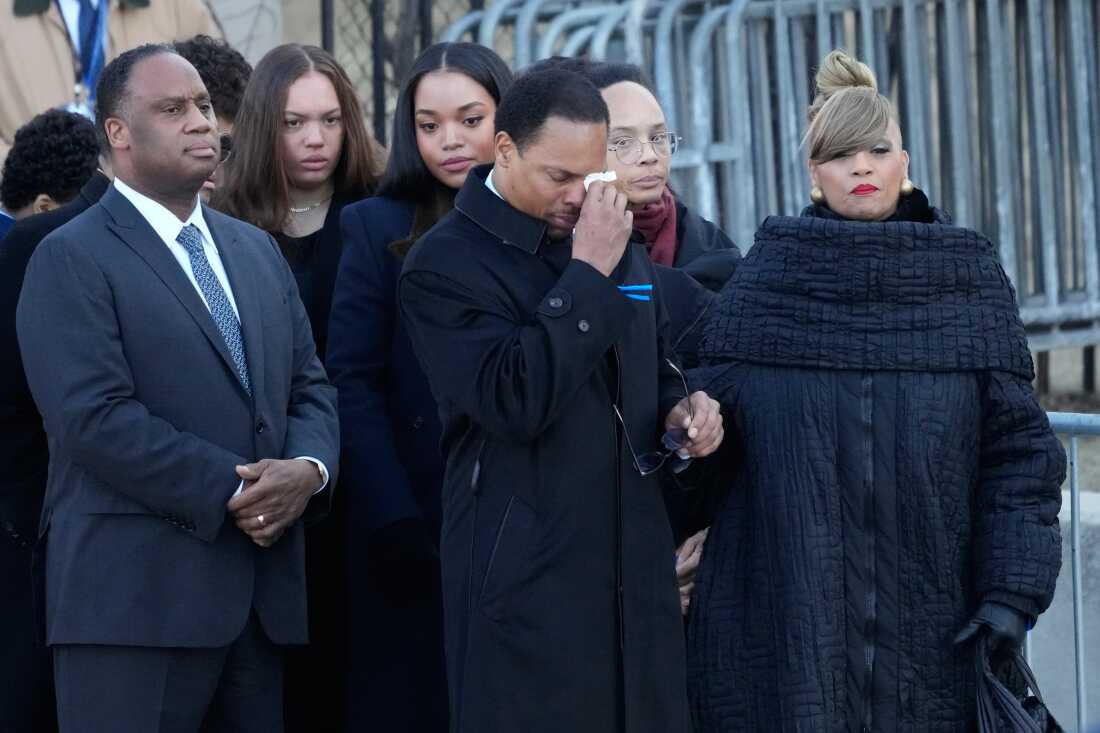
Family members wiped away tears as the casket was brought into the stately brick building. Flowers lined the sidewalks where people waiting to enter watched a large screen playing video excerpts of Jackson’s notable speeches. Some raised their fists in solidarity.

Advertisement
The casket with the Rev. Jesse Jackson arrives before a public visitation at Rainbow/PUSH Coalition in Chicago on Thursday.

The casket with the Rev. Jesse Jackson arrives before a public visitation at Rainbow/PUSH Coalition in Chicago on Thursday.

Nam Y. Huh/AP


hide caption

toggle caption

Nam Y. Huh/AP

Advertisement

Inside, Jackson’s children, Chicago Mayor Brandon Johnson and the Rev. Al Sharpton were among those who stood by the open casket to shake hands and hug those coming to view the body of Jackson, dressed in a suit and blue shirt and tie.

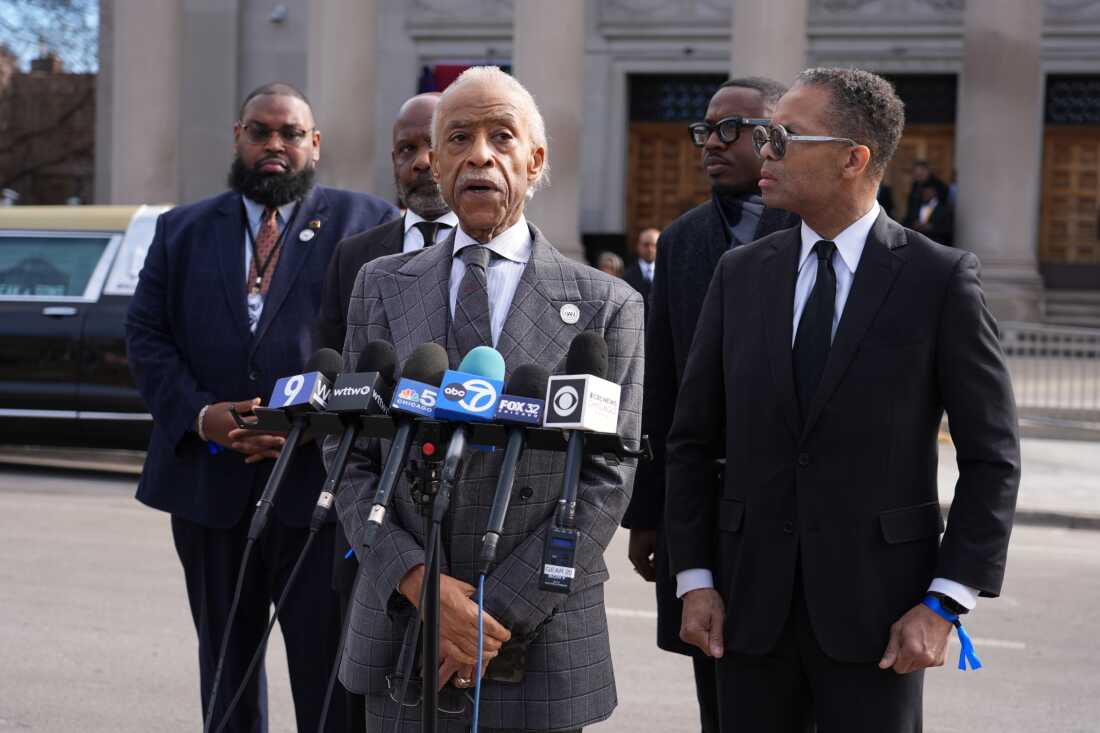
“The challenge for us is that we’ve got to make sure that all he lived for was not in vain,” Sharpton told reporters. “Dr. King’s dream and Jesse Jackson’s mission now falls on our shoulders. We’ve got to stand up and keep it going.”

The Rev. Al Sharpton speaks as Jesse Jackson Jr. listens after the public visitation for the Rev. Jesse Jackson at Rainbow/PUSH Coalition in Chicago on Thursday.

The Rev. Al Sharpton speaks as Jesse Jackson Jr. listens after the public visitation for the Rev. Jesse Jackson at Rainbow/PUSH Coalition in Chicago on Thursday.

Nam Y. Huh/AP


hide caption

Advertisement

toggle caption

Nam Y. Huh/AP

Jackson died last week at age 84 after battling a rare neurological disorder that affected his mobility and ability to speak in his later years.

Advertisement

Remembrances have already poured in from around the globe, and several U.S. states, including Minnesota, Iowa and North Carolina, are flying flags at half-staff in his honor.

But perhaps nowhere has his death been felt as strongly as in the nation’s third-largest city, where Jackson lived for decades and raised his six children, including a son who is a congressman.

Bouquets have been left outside the family’s Tudor-style home on the city’s South Side for days. Public schools have offered condolences, and city trains have used digital screens to display Jackson’s portrait and his well-known mantra, “I am Somebody!”

People wait to enter the security checkpoint for the public visitation for the Rev. Jesse Jackson at Rainbow/PUSH Coalition in Chicago on Thursday.

People wait to enter the security checkpoint for the public visitation for the Rev. Jesse Jackson at Rainbow/PUSH Coalition in Chicago on Thursday.

Nam Y. Huh/AP


hide caption

Advertisement

toggle caption

Nam Y. Huh/AP

His causes, both in the United States and abroad, were countless: Advocating for the poor and underrepresented on issues including voting rights, job opportunities, education and health care. He scored diplomatic victories with world leaders, and through his Rainbow PUSH Coalition, he channeled cries for Black pride and self-determination into corporate boardrooms, pressuring executives to make America a more open and equitable society.

Advertisement

“We honor him, and his hard-earned legacy as a freedom fighter, philosopher, and faithful shepherd of his family and community here in Chicago,” the mayor said in a statement.

Next week, Jackson will lie in honor at the South Carolina Statehouse, followed by public services. According to Rainbow PUSH’s agenda, Gov. Henry McMaster is expected to deliver remarks; however, the governor’s office said Thursday that his participation wasn’t yet confirmed. Jackson spent his childhood and started his activism in South Carolina.

Details on services in Washington have not yet been made public. However, he will not lie in honor at the United States Capitol rotunda after a request for the commemoration was denied by the House Speaker Mike Johnson’s office.

The two weeks of events will wrap up next week with a large celebration of life gathering at a Chicago megachurch and finally, homegoing services at the headquarters of the Rainbow PUSH Coalition.

Family members said the services will be open to all.

Advertisement

“Our family is overwhelmed and overjoyed by the amazing amount of support being offered by common, ordinary people who our father’s life has come into contact with,” his eldest son, Jesse Jackson Jr., said before the services began. “This is a unique opportunity to lay down some of the political rhetoric and to lay down some of the division that deeply divides our country and to reflect upon a man who brought people together.”

The family of the Rev. Jesse Jackson arrives as Yusep Jackson wipes his eyes before public visitation at Rainbow/PUSH Coalition in Chicago on Thursday.

The family of the Rev. Jesse Jackson arrives as Yusep Jackson wipes his eyes before public visitation at Rainbow/PUSH Coalition in Chicago on Thursday.

Nam Y. Huh/AP


hide caption

toggle caption

Advertisement

Nam Y. Huh/AP

The services included prayers from some of the city’s most well-known religious leaders, including Chicago Cardinal Blase Cupich. Mourners of all ages — from toddlers in strollers to elderly people in wheelchairs — came to pay respects.

Video clips of his appearances at news conferences, the campaign trail and even “Sesame Street” also played inside the auditorium.

Claudette Redic, a retiree who lives in Chicago, said her family has respected Jackson, from backing his presidential ambitions to her son getting a scholarship from a program Jackson championed.

Advertisement

“We have generations of support,” she said. “I’m hoping we continue.”

Continue Reading

Trending