News
When a Trump rally t-shirt is more than just a shirt


A vendor sells 2024 Donald Trump campaign souvenirs at the Turning Point Action USA conference in West Palm Beach, Florida, on July 15, 2023.
Giorgio Viera/AFP via Getty Images
hide caption
toggle caption
Giorgio Viera/AFP via Getty Images
Trump rallies involve a lot of merch – vendors will sometimes set up overnight before a rally, preparing for the huge crowds. There are hats, socks, flags, buttons and, especially, t-shirts.
I go to a lot of these rallies. In the middle of it all, I’ve gotten a little obsessed with this one particular shirt.
Miranda Barbee bought one in the hours before a Trump rally on the beach in Wildwood, New Jersey, and held it up, reading aloud.
“I just bought this shirt for $20. It says ‘Biden sucks, Kamala –’ what does that even — ‘swallows’? I didn’t even see the front! That is so funny.” She flipped it around. “And the back says, ‘F**k Joe and the Hoe.’”
She and the friend she came with laughed.
“I honestly didn’t know the front said that,” Barbee added. “But I think that’s hilarious.”
These shirts have been sold prominently at recent rallies – vendors who specialize in these particular shirts often stand right outside the entrances and exits, catching the eyes of the streams of Trump fans.
They’re not official campaign apparel. When asked for comment, a campaign spokesperson didn’t address the shirts directly, instead pointing to a Biden official campaign shirt (slogan: “Free on Wednesdays”) that pokes fun at Donald Trump’s legal troubles.
Still, I wanted to know: why? Why do these shirts exist, and who’s buying them? Sooner or later, I had spent so much time thinking about it, I wanted to know if there was anything to be learned here.
The infamous Hillary Clinton nutcracker

“The Hillary Nutcracker & Corkscrew Bill”, a boxed set of a nutcracker and bottle corkscrew were available for sale during the 2009 holiday season.
Paul J. Richards/AFP via Getty Images
hide caption
toggle caption
Paul J. Richards/AFP via Getty Images
Sexism isn’t exactly new in politics.
Consider America’s decades of Hillary-Clinton hatred. One t-shirt slogan around the time of her 2008 presidential campaign read “I wish Hillary had married O.J.,” referring to O.J. Simpson who famously faced trial for his wife’s murder. He was acquitted.
And then there was the Hillary Clinton nutcracker…described gleefully by MSNBC’s Willie Geist in 2007 as “a Hillary doll with serrated stainless steel thighs that, well, crack nuts.” To this, Tucker Carlson — then also of MSNBC — responded, “When she comes on television, I involuntarily cross my legs” and declared that he would be buying one.
Over the years, Michelle Obama, Nancy Pelosi and Sarah Palin would also be the targets of demeaning, often obscene merchandise.
But still, the open lewdness of the Trump t-shirts. That’s new, right? I asked Tim Miller, a Republican strategist who worked for Jon Huntsman and Jeb Bush’s presidential campaigns.
“It’s not like you couldn’t find a guy standing outside the RNC in 2012 selling some misogynistic Hillary stuff. It was there, but just the intensity of it,” he said, “just how crass it is, it’s definitely a category difference.”
That crassness has been around from the beginning at Trump rallies. As my colleague Don Gonyea reported in 2016, vendors then were selling shirts reading, “Hillary sucks, but not the way Monica does.”
The difference between parties
“What’s different about Donald Trump is that his campaign is not particularly worried about this type of misogyny being attached to his campaign, because at least to date, it hasn’t hurt him that much,” explained Kelly Dittmar, director of research for the Center for American Women and Politics at Rutgers University.

A vendor sells t-shirts at a May 1, 2024, Trump rally in Freeland, Michigan.
Danielle Kurtzleben/NPR
hide caption
toggle caption
Danielle Kurtzleben/NPR
One example: Even after a jury found him civilly liable for sexual abuse last year, polls didn’t budge.
Part of what’s going on is partisan, Dittmar adds — a reflection of an existing gender gap.
“I think there’s more kind of internal policing among Democrats about the fact that ‘this is contrary to our brand and it hurts us, by the way, with the constituency that is our most reliable one, which is women.’”
Furthermore, she says, this kind of language is often particularly directed at women of color, like Kamala Harris. The word “ho’” on the shirt undeniably makes this about race as well as sex.
Meanwhile, Dittmar says, the Republican base is majority-men.
“And of course,” she said, “of the women who do support [Republicans], they are more likely to say that this is just, you know, a joke.”
That was true of voter Christena Kincaid, who talked to me just after she had bought one of these shirts at a rally in Freeland, Michigan.
“It’s just a slang. That’s all it is,” she said. “It’s a goofy – it is a little over the top. I get it. But they’re just words.”
That idea, that they’re just words, fits with Trump’s brand as an anti-PC crusader who “tells it like it is,” which has involved loudly insulting women, from Clinton to Megyn Kelly to Minnesota Rep. Ilhan Omar.
But also, the idea that words don’t matter that much – that echoes the response to the infamous Access Hollywood tape, which Trump’s defenders shrugged off as “locker room talk.”
Trickle-down incivility
Rina Shah is a political strategist and a former Republican congressional aide, and a Republican who opposes Trump. She told me she thinks the shirts very much matter.
“If we’re allowing our kids to see this visually, even if it’s contained at a rally, the person who wears that shirt at that rally isn’t just going to wear that one day,” she said. “This flavor of incivility is permeating our nation’s social fabric.”
I did ask Bob Berger, who I met at that Freeland, Mich., rally, about wearing the shirt outside of a rally.
“Are you worried about offending anyone when you wear it?” I asked.
“No.”
“Do you think you’ll be careful where you wear it? Like around, I don’t know, grandkids?” I continued.
“Oh, maybe around the grandkids. I probably would be,” he replied.
What Rina Shah said about Trump’s incivility trickling down to his supporters seems true, whether it’s via clothing or simply their willingness to get nasty in talking about Biden and Harris.
“As much as I hope Joe Biden gets arrested, whatever, is not in office anymore. I’m like, we’re still stuck with the bitch. I don’t want her either,” said Barbee, the voter I met at that New Jersey rally, referring to Harris.
I asked her: Does that language feel demeaning to you as a young woman – using words like bitch?
“I mean, she is a bitch,” she responded.
On top of that, you can also see all this — the t-shirt slogans, the cuss words, Trump’s vulgarity — as a marker of a gap in American politics: A yawning partisan gap in attitudes about gender.
“Those differences in gender beliefs are going to make it more permissible or not to put forth these types of messages without some sort of a backlash or pushing down,” Dittmar of Rutgers University said.
Studies have found that Trump voters — including women — in 2016 were particularly likely to have beliefs that political scientists term “hostile sexism.” Furthermore, some found that these beliefs were prominent in a way they weren’t in 2012. Those “hostile sexist” beliefs include, for example, the idea that women are too easily offended.
Barbee, at that New Jersey rally, the voter who talked to me the longest about her shirt, echoed some of those beliefs.
“I feel like feminism is becoming like a huge thing these days, but I also feel like it’s – people are overly sensitive, like they’re reacting to things they shouldn’t be reacting to. “
It’s an attitude that’s been around for a long time. But her new t-shirt? That represented something new.







The U.S. and Israel have been conducting strikes against targets in Iran since Saturday morning, with the aim of toppling Tehran’s clerical regime. Iran has fired back, with retaliatory assaults featuring missiles and drones targeting several Gulf countries and American bases in the Middle East.
“All six aircrew ejected safely, have been safely recovered, and are in stable condition. Kuwait has acknowledged this incident, and we are grateful for the efforts of the Kuwaiti defense forces and their support in this ongoing operation,” Central Command said.
“The cause of the incident is under investigation. Additional information will be released as it becomes available,” it added.
In a separate statement later Monday, Central Command said that American forces had been killed during combat since the strikes began.
“As of 7:30 am ET, March 2, four U.S. service members have been killed in action. The fourth service member, who was seriously wounded during Iran’s initial attacks, eventually succumbed to their injuries,” it said.
Major combat operations continue and our response effort is ongoing. The identities of the fallen are being withheld until 24 hours after next of kin notification,” Central Command added.
This story has been updated.

Smoke rises over Konarak naval base in southern Iran on Sunday. The base was one of hundreds of targets of U.S. and Israeli forces throughout the country.
Planet Labs PBC
hide caption
toggle caption
Planet Labs PBC
Commercial satellite images are providing a unique look at the extent of damage being done to Iran’s military facilities across the country.
The U.S. and Israeli military campaign opened with a daytime attack that struck Iranian leadership in central Tehran. Smoke was still visible rising from Ayatollah Ali Khamenei’s compound following the attack that killed the supreme leader.

An image by the company Airbus taken on Saturday shows the aftermath of an Israeli strike on Iran’s Leadership House in central Tehran. Iran’s Supreme Leader Ayatollah Ali Khamenei was killed in the opening wave of attacks.
Pléiades Neo (c) Airbus DS 2026
hide caption
toggle caption
Pléiades Neo (c) Airbus DS 2026
Israel and the U.S. have gone on to strike targets across the country. Reports on social media indicate that there have been numerous military bases and compounds attacked all over Iran, and Iran has responded with attacks throughout the Middle East.
U.S. forces have also been striking at Iran’s navy. In a post on his social media platform, President Trump said that he had been briefed that U.S. forces had sunk nine Iranian naval vessels. U.S. Central Command did not immediately confirm that number but it did say it had struck an Iranian warship in port.

An image captured on Saturday shows a ship burning at Iran’s naval base at Konarak.
Satellite image ©2026 Vantor
hide caption
toggle caption
Satellite image ©2026 Vantor
Numerous satellite images show burning vessels at Konarak naval base in southern Iran. Images also show damage to a nearby airbase where hardened hangers were struck by precision munitions.

Hardened aircraft shelters at Konarak airbase were struck with precision munitions.
Satellite image ©2026 Vantor
hide caption
toggle caption
Satellite image ©2026 Vantor
And there was extensive damage at a drone base in the same area. Iran has launched numerous drones and missiles toward Israel and U.S. military installations in Bahrain, Kuwait and Qatar. Many drones have been intercepted but videos on social media show that some have evaded air defenses and caused damage in nearby Gulf countries. In Dubai, debris from an Iranian drone damaged the iconic Burj Al Arab, according to a statement from Dubai’s government.

Buildings at an Iranian drone base at Konarak were destroyed in the strikes.
Satellite image ©2026 Vantor
hide caption
toggle caption
Satellite image ©2026 Vantor
Iran’s most powerful weapons are its long-range missiles. The Iranian Revolutionary Guards have hidden the missiles deep inside mountain tunnels. Images taken Sunday in the mountains of northern Iran indicate that some of those tunnels were hit in a wave of strikes.
Following Khamenei’s death, Iran declared 40 days of mourning. Satellite images showed mourners gathering in Tehran’s Enghelab square on Sunday.
Iranian Foreign Ministry Spokesperson Esmail Baghaei told NPR on Sunday that Iran will continue to fight “foreign aggression, foreign domination.”
A White House official told NPR that Trump plans to talk to Iran’s interim leadership “eventually,” but that for now, U.S. operations continue in the region “unabated.”

A large crowd of mourners fill Enghelab Square in Tehran on Sunday, following the death of Iran’s Supreme Leader Ayatollah Ali Khamenei, who was killed in an Israeli airstrike.
Satellite image ©2026 Vantor
hide caption
toggle caption
Satellite image ©2026 Vantor

new video loaded: What the Texas Primary Battle Means for the Midterms
By J. David Goodman, Alexandra Ostasiewicz, June Kim and Luke Piotrowski
March 1, 2026

Prep talk: Birmingham’s Slava Shahbazyan celebrates winning state wrestling title

Pakistan calls troops, orders 3-day curfew as 24 killed in pro-Iran rallies

US says Kuwait accidentally shot down 3 American jets

Utah mom in upscale ski community killed husband to fund romance and lavish lifestyle, DA says

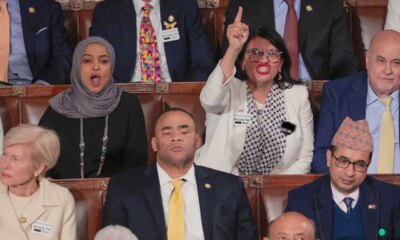
Ilhan Omar doesn’t have any regrets for her ‘unavoidable’ outburst at State of the Union

Florida High School Football Rankings: Top 25 teams – Oct. 21

Cleary's 21 help Le Moyne down Central Connecticut State 69-64 in OT

How old is Bo Nix? What to know about Oregon quarterback ahead of 2024 NFL Draft

99th annual Pony Swim held in Virginia

Indiana Members Credit Union announced as new anchor tenant at Bottleworks District
Pakistan calls troops, orders 3-day curfew as 24 killed in pro-Iran rallies
US says Kuwait accidentally shot down 3 American jets

House Republicans push Johnson to go to war with Senate over SAVE Act

Israel FM says Europe too divided, slams Spanish PM
Satellite images provide view inside Iran at war
-

 World4 days ago
Exclusive: DeepSeek withholds latest AI model from US chipmakers including Nvidia, sources say
-

 Massachusetts5 days ago
Mother and daughter injured in Taunton house explosion
-

 Denver, CO5 days ago
10 acres charred, 5 injured in Thornton grass fire, evacuation orders lifted
-

 Louisiana1 week ago
Wildfire near Gum Swamp Road in Livingston Parish now under control; more than 200 acres burned
-

 Technology1 week ago
YouTube TV billing scam emails are hitting inboxes
-

 Politics1 week ago
OpenAI didn’t contact police despite employees flagging mass shooter’s concerning chatbot interactions: REPORT
-

 Technology1 week ago
Stellantis is in a crisis of its own making
-

 News1 week ago
World reacts as US top court limits Trump’s tariff powers