Clockwise from top left: Monica Bicking, via Storyful; Status Coup News, via Storyful; Brendan Gutenschwager, via Storyful; and Level Up with Gene and Jay, via Facebook.
Advertisement
Federal immigration agents have broken windows and dragged occupants out of their vehicles. They have forcefully tackled people to the ground. They have pushed and shoved protesters, and deployed pepper spray directly in their faces.
For weeks, residents have documented the scenes unfolding as federal agents pursue President Trump’s immigration crackdown in Minnesota. The videos have circulated widely and intensified outrage and fear among many Minnesotans.
Marty Kurcias, 76, who was protesting at the airport on Friday, said the aggressive treatment he has seen of Minnesotans was jarring. “It can’t go on like this,” he said, adding, “We don’t abide by cruelty or violence.”
Advertisement
Trump administration officials have defended the tactics as necessary in the face of widespread protests. But the heavy-handed use of force has drawn mounting scrutiny.
The New York Times reviewed dozens of videos taken in recent weeks and identified multiple aggressive tactics that U.S. Immigration and Customs Enforcement and other federal agents used during immigration arrests and in encounters with protesters.
Advertisement
Officers forcibly entered homes without a judge’s warrant.
On Sunday, federal agents were seen dragging a man from his home in St. Paul. The man was later identified as ChongLy Scott Thao, a Hmong immigrant and naturalized U.S. citizen with no criminal record, according to his family. Mr. Thao and his family said that the armed agents did not present a warrant or allow him to show identification at the time of arrest.
The Department of Homeland Security said in a statement that Mr. Thao refused to be fingerprinted or facially identified and that he had matched the description of two sex offenders they were seeking.
Advertisement
An internal memo, leaked by a whistle-blower group, showed that ICE officials had drafted guidance saying that their officers could enter homes without a judicial warrant and that they could rely instead on administrative warrants that are issued by a government agency and do not go through the federal court system.
Tricia McLaughlin, a spokeswoman for the department, acknowledged that officers had relied on administrative warrants to enter homes to conduct arrests.
Advertisement
John Sandweg, who served as an acting director of ICE under President Barack Obama, said the practice of entering homes without a judicial warrant would be a significant departure from decades-old ICE policies and procedures.
They interrogated people because of their ethnicity or accents.
Administration officials have repeatedly said that the operations in Minnesota have targeted violent criminals and people who pose a serious threat to the community. But immigration agents have confronted and interrogated people because of what they assumed their race or ethnicity to be.
Advertisement
A video posted on social media and additional footage provided to The New York Times show one man, Ramon Menera, questioned by immigration agents who told him they were asking for documentation because of his accent.
Mr. Menera told The Times that he is a U.S. citizen and that the agents released him after he provided them with his passport card.
Advertisement
In July, a federal judge prohibited immigration agents in the Los Angeles area from targeting people based on assumptions about their race or ethnicity, but the Supreme Court lifted the order in September.
They broke windows and dragged occupants from their cars.
Immigration agents are taking sharp measures to detain and arrest people. That includes people who do not appear to be a danger to the community and in some cases people who are not the targets of immigration enforcement operations at all.
Advertisement
A widely shared video taken in Minneapolis shows immigration agents dragging a woman, later identified as Aliya Rahman, from her car, after one agent shattered the window on the passenger side.
Advertisement
Brendan Gutenschwager, via Storyful
The Homeland Security department later said that the woman was an “agitator” who ignored multiple commands to move her vehicle away from the scene. Ms. Rahman told CNN that she was not there to protest, and that she had received conflicting commands.
Advertisement
Another video shows one agent breaking the window of a car after a man inside refuses to open the door. Multiple agents then tackle the man, later identified as Orbin Mauricio Henriquez Serrano, to the ground.
Advertisement
Status Coup News/Jon Farina, via Storyful
Shattering a window and pulling someone out of their car can escalate an encounter significantly, said Geoffrey P. Alpert, a professor of criminology and criminal justice at the University of South Carolina. It would be suitable only in a situation in which the federal agents had probable cause to suspect that the target had committed a violent crime like murder, rape or robbery, he said.
It was not immediately clear whether the man fit that description. The Homeland Security Department said only that he was an undocumented immigrant from Honduras who failed to obey officers’ orders.
Advertisement
They used force on people who were already restrained.
The Times found multiple instances of several agents tackling someone to the ground and proceeding to handle that person aggressively, in one instance placing a knee on the person’s neck.
Advertisement
In another case, video shows five immigration agents holding a man to the ground as one agent repeatedly strikes the man in the face with his knee.
Advertisement
Monica Bicking, via Storyful
A strike to the head is generally considered deadly force, justified only to defend against imminent threat of death or serious bodily injury to the officer or another person, said Christy Lopez, a professor at Georgetown Law. “There was nothing in that video that indicated that was the situation,” she said.
The available video does not show what led up to the encounter. Ms. McLaughlin said in a statement to The Times that the man had violently resisted arrest. She added that officers are trained to use the minimum necessary amount of force.
Advertisement
They met protesters with force.
Immigration agents have increasingly clashed with protesters in recent weeks after a federal officer shot and killed a woman, Renee Good, on Jan. 7. Protesters have gathered in small groups and in large crowds, honking car horns, blowing whistles and yelling at and filming ICE agents. Immigration agents have been filmed exchanging insults and jeers with the protesters.
Advertisement
Videos showed multiple cases when agents were quick to use physical force with protesters, shoving or tackling them. In one instance, an agent gets out of a car, walks up to a protester who is standing in front of the agent’s car and shoves him into the middle of the street.
Advertisement
Level Up with Gene and Jay, via Facebook
Ms. Lopez said that the First Amendment gives people the broad right to protest, record and yell things, even profanity, at officers.
In a statement to The Times, Ms. McLaughlin characterized the protesters as “rioters and terrorists,” and said that they had assaulted law enforcement and vandalized federal vehicles.
Advertisement
They deployed chemical irritants at close range.
Videos also documented multiple occasions when, in confrontations with protesters, immigration agents deployed chemical irritants with little to no warning — firing directly in people’s faces.
Advertisement
A federal judge in Minneapolis cited several episodes of “gratuitous deployment of pepper spray” in a ruling last week that ordered agents not to retaliate against peaceful protesters. A federal appeals court temporarily lifted those restrictions on Wednesday.
In a video of a protest taken on Jan. 7 near where Ms. Good was killed, federal agents can be seen on multiple occasions hitting protesters in the face with pepper spray and other irritants at close range. Earlier in the video, one of the protesters throws a snow ball at one of the agents, and some protesters are blocking an agent’s vehicle.
Advertisement
Status Coup News, via Storyful
They continued to operate with anonymity.
Advertisement
In many of the videos The Times reviewed, immigration agents drove in unmarked cars, and wore ski masks, neck gaiters or other face coverings. Many also wore a cap and shades, further obscuring their identities, a practice that has been common in immigration operations across the country.
Federal officials have said that face coverings protect the agents and their families from retaliation, such as having their home address or contact information shared online.
Advertisement
But the practice runs counter to protocols for most other law enforcement personnel, like police officers whose uniforms include badge numbers. And critics have suggested that the agents have been emboldened to act with impunity, knowing that their identities are hidden and that it would be difficult to hold them accountable.
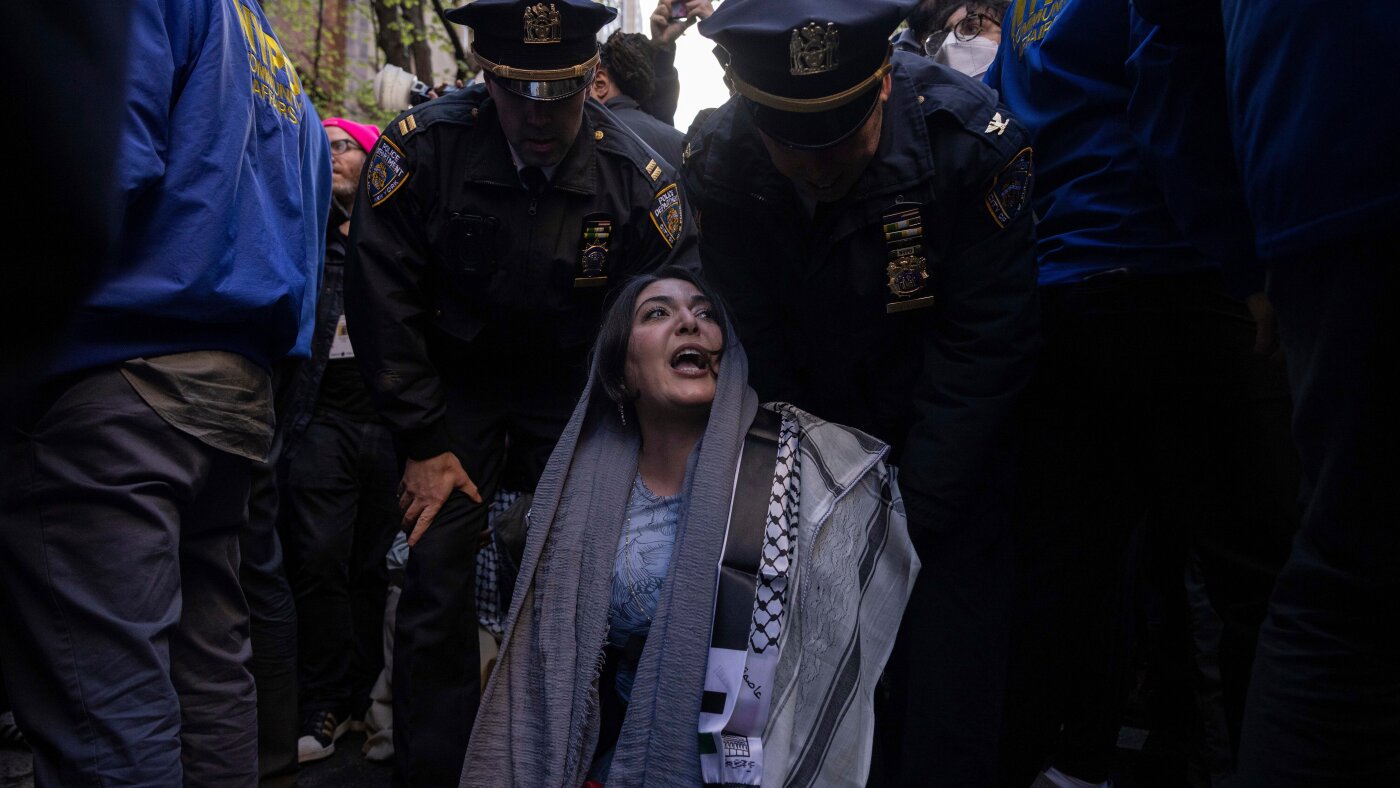
Police detain Nerdeen Kiswani, an organizer of pro-Palestinian demonstration group “Within Our Lifetime” during a protest on Friday, April 12, 2024, in New York.
Yuki Iwamura/AP
hide caption
toggle caption
Advertisement
Yuki Iwamura/AP
NEW YORK — A man accused of planning to firebomb the home of a prominent Palestinian activist has been arrested following a weekslong undercover operation led by the New York City Police Department, officials said Friday.
The target of the plot was Nerdeen Kiswani, who frequently leads protests in New York against Israel and the war in Gaza through the organization Within Our Lifetime.
Kiswani, 31, said law enforcement officials informed her late Thursday that they had disrupted “a threat on my life that was about to take place.”
Advertisement
Federal authorities said they arrested Alexander Heifler on Thursday at his home in Hoboken, New Jersey, as he was assembling Molotov cocktails that he planned to throw at Kiswani’s home. For weeks, he had discussed the plot with an undercover NYPD detective who had infiltrated a group chat used by Heifler, according to a police department spokesperson.
An official who was briefed on the investigation said Heifler, 26, identified as a member of the JDL 613 Brotherhood, a New Jersey-based group founded in 2024 that describes its membership as “Jewish warriors” fighting back against rising antisemitism.
A website for the group says they are inspired by the original Jewish Defense League, a group linked to numerous bombings and attempted assassinations of Arab American political activists in the 1970s and 1980s.
Heifler planned to flee to Israel following the attack, according to the official, who requested anonymity because they were not authorized to discuss the details of an ongoing investigation.
An email inquiry sent to the JDL 613 was not returned.
Advertisement
Kiswani, who lives in Brooklyn with her infant son and husband, said the plot would not deter her continued activism.
“I feel very blessed that they were able to thwart this, but it’s something that is a constant possibility for people who speak up on behalf of Palestine,” she said.
Heifler was charged in a criminal complaint with separate counts of making and possessing destructive devices, which each carry a maximum penalty of 10 years in prison. A message left with his attorney was not returned. He made an initial appearance in New Jersey federal court on Friday afternoon.
“Let me be clear: We will not tolerate violent extremism in our city,” New York City Mayor Zohran Mamdani said in a statement. “No one should face violence for their political beliefs or their advocacy. I am relieved that Nerdeen is safe.”
According to a court filing written by an FBI agent, Heifler spoke on a video call in February with a group that included an undercover detective about his interest in training for “self-defense” and wanting space where he could throw Molotov cocktails.
Advertisement
The next day, he met with the undercover detective in person and discussed his plan to use them against Kiswani and flee the country, according to the complaint. “We have (Kiswani’s) address,” Heifler allegedly told the undercover. “So it’s like that, that would be easier if you’d be more comfortable with that.”
Heifler and the undercover detective drove to Kiswani’s residence on March 4 to “conduct surveillance” and discussed making a dozen Molotov cocktails to throw at her home and two cars parked outside, complaint said.
On Thursday, the undercover detective and Heifler met at Heifler’s Hoboken residence, where he had assembled components to make the Molotov cocktails, including a large bottle of Everclear, a highly flammable alcohol, the complaint said. Law enforcement officers then executed a search warrant at the residence and recovered the eight Molotov cocktails, the complaint said.
Kiswani co-founded the group Within Our Lifetime, which frequently organizes protests against Israel that draw hundreds of participants and often end in arrests. The group’s calls to “abolish Zionism” and support for “all forms of struggle,” including violence, has drawn fierce criticism. Kiswani denies that her criticism of Israel amounts to antisemitism.
Kiswani has been a frequent target of online vitriol. Earlier this year, U.S. Rep. Randy Fine, a Florida Republican, sparked backlash after writing in a social media post that “the choice between dogs and Muslims is not a difficult one.” The post was a response to a message Kiswani shared about dog owners, which she said was a light joke.
Advertisement
“That hate against Palestinians has been bolstered by public officials, by Zionist organizations, who are never held accountable,” she said. “This is the inevitable result of that.”
The operation was carried out by the Racially and Ethnically Motivated Extremism unit within the NYPD’s counterterrorism bureau, a police spokesperson said.
“This is exactly how our intelligence and counterterrorism operation is designed to work — a sophisticated apparatus built to detect danger early and prevent violence before it reaches our streets,” Police Commissioner Jessica Tisch said.
Hackers connected to the Iranian government accessed FBI Director Kash Patel’s personal email and posted materials — including photos and documents — taken from his account, a person familiar with the breach confirmed to CNN.
The hackers have published a series of photos of Patel from before he became FBI director that they claim were stolen from his personal email account. A source familiar with the incident confirmed the images’ authenticity.
The stolen emails appear to date from around 2011 to 2022 and appear to include personal, business and travel correspondence that Patel had with various contacts, according to a preliminary CNN review of the files with the help of an independent cybersecurity researcher.
What the hacking group is calling a breach of “impenetrable” FBI systems is in reality something much more mundane — a breach of things like family photos and details on Patel’s previous search for an apartment, said the researcher, Ron Fabela.
“This isn’t an FBI compromise — it’s someone’s personal junk drawer,” he said.
Advertisement
Reuters first reported the breach of Patel’s email on Friday.
The FBI has confirmed the breach and said no government information was obtained. The FBI is offering a $10 million reward for information that leads to the identification for the “Handala Hack Team,” a group the FBI says has frequently targeted US governement officials.
“The FBI is aware of malicious actors targeting Director Patel’s personal email information, and we have taken all necessary steps to mitigate potential risks associated with this activity,” a statement from the FBI said in part. “Consistent with President Trump’s Cyber Strategy for America, the FBI will continue to pursue the actors responsible, support victims, and share actionable intelligence in defense of networks.”
US intelligence officials have repeatedly warned about the possibility of Tehran-linked hackers retaliating for the US and Israeli bombing of Iran that began last month. It is also not the first time Iranian-backed hackers have accessed Patel’s private information.
In late 2024, Patel, just weeks away from being appointed to lead the FBI, was informed by officials that he had been targeted as part of an Iranian hack and some of his personal communications had been accessed.
Advertisement
The 2024 hack was part of a broader effort by foreign hackers — from China and Iran — to access accounts for incoming Trump officials including now Deputy Attorney General Todd Blanche, former interim US Attorney for the Eastern District of Virginia Lindsey Halligan and Donald Trump Jr.
The Iran-linked hacking group that claimed responsibility for accessing Patel’s emails in this most recent breach was also behind a cyberattack earlier this month that disrupted business operations at a major US medical device maker.
The hackers said then that they were retaliating for a missile strike on an elementary school in Iran, which Iranian state media has claimed killed at least 168 children. The Pentagon has said it is investigating that incident.
The Justice Department has accused the hackers of working for Iran’s Ministry of Intelligence and Security. The department responded to the hack of the medical device company by seizing websites used by the Iran-linked hackers to disrupt their operations. But the Iranian cyber operatives have continued to claim victims and spread propaganda.