News
Video: The Counties Where Trump Made Gains


We look at “triple-trending counties,” where either the Republicans or the Democrats gained vote share in all of the last three presidential elections. Shane Goldmacher, a national political correspondent for The New York Times, shows that President Trump has gained ground as the country’s political geography has realigned.



The US is planning to board and seize Iran-linked oil tankers and commercial ships in the coming days, according to a Saturday report by The Wall Street Journal.
The report noted that these actions would take place in international waters, potentially outside of the Middle East.
The US “will actively pursue any Iranian-flagged vessel or any vessel attempting to provide material support to Iran,” US Chairman of the Joint Chiefs of Staff Gen. Dan Caine said. “This includes dark fleet vessels carrying Iranian oil.”
“As most of you know, dark fleet vessels are those illicit or illegal ships evading international regulations, sanctions, or insurance requirements,” Caine continued.
Caine was further quoted as saying that the new campaign, which would be operated in part by the US Indo-Pacific Command, would be part of a broader US President Donald Trump-led campaign against Iran, known as “Economic Fury.”
White House spokeswoman Anna Kelly told the WSJ that Trump was “optimistic” that the new measures would lead to a peace deal.
The potential US military action comes as Iran tightens its grip on the Strait of Hormuz, including attacking several ships earlier on Saturday, the WSJ reported.
The report cited CENTCOM as saying that the US has already turned back 23 ships trying to leave Iranian ports since the start of its blockade on the Strait.
The expansion of naval action beyond the Middle East will provide the US with further leverage against Iran by allowing it to take control of a greater number of ships loaded with oil or weapons bound for Iran, the report noted.
“It’s a maximalist approach,” said associate professor of law at Emory University Law School Mark Nevitt. “If you want to put the screws down on Iran, you want to use every single legal authority you have to do that.”
Iran claimed earlier on Saturday that it had regained military control over the Strait, intending to hold it until the US guarantees full freedom of movement for ships traveling to and from Iran.
“As long as the United States does not ensure full freedom of navigation for vessels traveling to and from Iran, the situation in the Strait of Hormuz will remain tightly controlled,” the Iranian military stated.
In addition, Iranian Supreme Leader Mojtaba Khamenei declared on Saturday in an apparent message on his Telegram channel that the Iranian navy is prepared to inflict “new bitter defeats” on its enemies.

new video loaded: The Origins of the Supreme Court’s Shadow Docket

By Jodi Kantor, Alexandra Ostasiewicz, June Kim and Luke Piotrowski
April 18, 2026

A Pakistani Ranger walks past a billboard for the U.S.-Iran peace talks in Islamabad on April 12, 2026. The talks, led by Vice President JD Vance, produced no concrete movement toward a peace deal.
Farooq Naeem/AFP via Getty Images
hide caption
toggle caption
Farooq Naeem/AFP via Getty Images
Despite stalled talks with Iran and a fragile ceasefire nearing its end, President Trump expressed optimism this week that a permanent deal is within reach — one that may include Iran relinquishing its enriched uranium. However, experts who spent months negotiating a nuclear agreement during the Obama administration say mutual mistrust, starkly different negotiating styles make a quick truce unlikely.

Referring to Vice President Vance’s whirlwind negotiations in Islamabad last week that appear to have produced little beyond dashed expectations, Wendy Sherman, the lead U.S. negotiator on the Joint Comprehensive Plan of Action (JCPOA) nuclear deal finalized in 2015, says the administration’s approach was all wrong.
“You cannot do a negotiation with Iran in one day,” she told NPR’s Here & Now earlier this week. “You can’t even do it in a week.” To get agreement on the JCPOA, she said, it took “a good 18 months.”
The talks leading to that deal highlighted Iran’s meticulous style of negotiation, says Rob Malley, who was also part of the JCPOA negotiating team and later served as a special envoy to Iran under President Joe Biden.
Summing up the two sides’ differing styles, Malley said: “Trump is impulsive and temperamental; Iran’s leadership [is] stubborn and tenacious.”
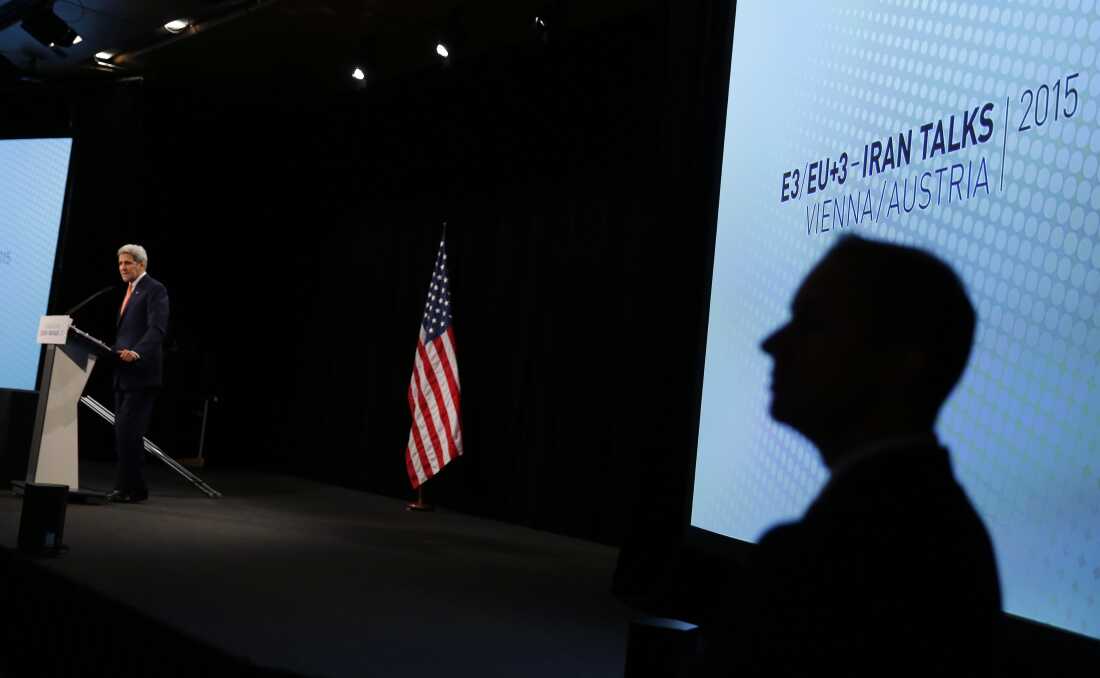
U.S. Secretary of State John Kerry speaks during a news conference on the Iran nuclear talks deal at the Austria International Centre in Vienna, Austria on July 14, 2015.
Pool/AFP via Getty Images
hide caption
toggle caption
Pool/AFP via Getty Images
In 2015, patience led to a deal
The talks in 2015, led by Secretary of State John Kerry and Iran’s Foreign Minister Mohammad Javad Zarif, culminated with a marathon 19-day session in Vienna to finish the deal, says Jon Finer, a former U.S. deputy national security adviser in the Biden administration. Finer was involved in the negotiations as Kerry’s chief of staff. He said his boss’s patience “was a huge asset” in getting the deal to the finish line, he said.

Mohammad Javad Zarif, Iran’s foreign minister during the negotiations for the Obama-era nuclear deal, speaks on April 22, 2016 in New York.
AFP/via Getty Images
hide caption
toggle caption
AFP/via Getty Images
“He would endure lectures … ‘let me tell you about 5,000 years of Iranian civilization’… and just keep plowing ahead,” Finer said, adding that a tactic of Iranian negotiators seemed to be “to say no to everything and see what actually matters” to the U.S.
“They’re just maddeningly difficult,” he said. “You need to go back at the same issue 10 or 12 times over weeks or months to make any progress.”
Even so, Finer called the Iranian negotiators “extremely capable” — noting that, unlike the U.S., they often lacked expert advisers “just outside the room,” yet still mastered the details of nuclear weapons, nuclear materials and U.S. sanctions.
“They were also negotiating not in their first language,” Finer added. “The documents were all negotiated in English, and they were hundreds of pages long with detailed annexes.”
Vance’s trip to Islamabad suggests that the U.S. doesn’t have the patience for a negotiation to end the conflict that could be at least as complex and time-consuming. “The Trump administration came in with maximalist demands and actually just wanted Iran to capitulate,” Sherman, who served as deputy secretary of state during the Biden administration, told Here & Now. “No nation – even one as odious as the Iran regime – is going to capitulate.”
Distrust but verify
Iran was attacked twice in the past year. First in June of last year, as nuclear negotiations were ongoing, Israel and the U.S. struck the country’s nuclear facilities. Months later, at the end of February, Iran was attacked again at the start of the latest conflict. This time around, “the level of trust is probably almost at an all-time low,” Malley said.
“It’s hard for them to take at their word what they’re hearing from U.S. officials,” Malley said. The Iranians, he said, have to be wondering how long any commitment will last and “will be very hesitant to give up something that’s tangible” – such as their enriched uranium – in exchange for anything that isn’t ironclad or subject to suddenly be discarded by Trump or some future president.
“Once they give up their stockpile … they can’t recapture it the next day,” Malley said.
Even during the 2013-2015 nuclear deal talks, the decades of mistrust between Tehran and Washington were impossible to ignore, Finer said. “Our theory was not trust but verify — it was distrust but verify,” he said, adding: “I think that was their theory too.”
Malley cautions about relying on the JCPOA as a guide to how peace talks to end the current war might go. The leadership in Tehran that agreed to the deal is now gone — killed in Israeli airstrikes, he says. The regime’s military capabilities are also greatly diminished and “whatever lessons were learned in the past … have to be viewed with a lot of caution, because so much has changed,” he said.
Negotiations have a leveling effect
Mark Freeman, executive director of the Institute for Integrated Transitions, a peace and security think tank based in Spain that advises on conflict negotiations, says several factors shape the U.S.-Iran relationship. Going into talks, one side always has the upper hand, he says, but negotiations have a leveling effect. “The weaker party gains just by virtue of entering into a negotiation process,” he said.
Each side is looking for leverage, he adds.
In Iran’s case, it has used its closure of the Strait of Hormuz to exert such leverage, while the White House has shown an eagerness to resolve the conflict quickly. “If one side perceives the other needs an agreement more … that shapes the entire negotiation,” he said.
-

 North Carolina4 minutes ago
Memorial service held for former Miss North Carolina Carrie Everett
-
North Dakota10 minutes ago
Richard D. Langowski Obituary April 16, 2026 – Tollefson Funeral Home
-

 Ohio16 minutes ago
Three Buckeyes Who Proved They Belong at Ohio State Spring Game
-

 Oklahoma22 minutes ago
Oklahoma’s Jahsiear Rogers ‘Knew It Was Time to Showcase’ His Talents In Spring Game
-

 Oregon28 minutes ago
Oregon Tight End Jamari Johnson Speaks Openly About New Role
-

 Pennsylvania34 minutes ago
Pennsylvania State Police investigating incident in Salisbury Township
-

 Rhode Island40 minutes ago
2 dead, 1 seriously hurt after crash on I-95 South in Warwick
-

 South-Carolina46 minutes ago
Missouri beats South Carolina in game two

