News
Under Trump, Green Card Seekers Face New Scrutiny for Views on Israel


For decades, immigrants who have followed the rules and have not broken the law have had hopes of earning a green card, a document that allows them to live legally in the United States and gain a path to citizenship.
But under new guidance issued by the Trump administration, immigrants can now be denied a green card for expressing political opinions, such as participating in pro-Palestinian campus protests, posting criticism of Israel on social media and desecrating the American flag, according to internal Department of Homeland Security training materials reviewed by The New York Times.
The documents, which have not been previously reported, show how expansively the Trump administration is carrying out a directive from last August to vet green card applicants for “anti-American” and “antisemitic” views.
The administration includes criticism of Israel as a potentially disqualifying factor, with the training materials citing as an example of questionable speech a social media post that declares, “Stop Israeli Terror in Palestine” and shows the Israeli flag crossed out.
The materials were distributed last month to immigration officers at U.S. Citizenship and Immigration Services, which is part of the Department of Homeland Security and handles applications for green cards and other forms of legal status.
They reflect how U.S.C.I.S. — long considered the gateway agency for legal migration — has rapidly transformed under President Trump into another cog in his administration’s deportation machine. The agency has worked to strip naturalized Americans of their citizenship and has hired armed federal agents to investigate immigration crimes.
The administration is also granting permanent legal residency to far fewer applicants. Green card approvals have fallen by more than half in recent months, according to a Times analysis of agency data.
“There is no room in America for aliens who espouse anti-American ideologies or support terrorist organizations,” Joseph Edlow, the agency’s director, told Congress in February.
Critics of Mr. Trump’s approach say the administration is seeking to restrict legitimate political speech, and has conflated opposition to Israeli government policies with antisemitism.
Basing green card decisions on “ideological screenings is fundamentally un-American and should have no place in a country built on the promise of free expression,” said Amanda Baran, a senior agency official under President Joseph R. Biden Jr.
Administration officials said they were defending American values.
“If you hate America, you have no business demanding to live in America,” said Zach Kahler, a spokesman for U.S.C.I.S.
Abigail Jackson, a White House spokeswoman, said the administration’s policies had “nothing to do with free speech” and were meant to protect “American institutions, the safety of citizens, national security and the freedoms of the United States.”
The administration has moved aggressively against immigrants for expressing political views that officials have deemed anti-American, making ideology a central part of its immigration vetting process. Secretary of State Marco Rubio has revoked the visas of pro-Palestinian student activists, including one who wrote a column criticizing her university’s response to pro-Palestinian demands.
The Department of Homeland Security has proposed reviewing the social media histories of tourists seeking to visit the United States.
Immigration officers have significant discretion in deciding whether to grant foreigners long-term permanent residence. They have long considered a variety of factors, including criminal records, national security threats, family ties to the United States and employment histories.
Ideology has also traditionally been one of those factors. In some cases, U.S. law forbids officers from granting green cards to people who have belonged to a Communist or other “totalitarian” political party, have promoted anarchy or have called for the overthrow of the U.S. government by “force or violence or other unconstitutional means.”
But in the past, immigration officers have focused on statements that could incite or encourage violence, given concerns about infringing on constitutionally protected speech, former U.S.C.I.S. officials said.
The new training materials reviewed by The Times guide immigration officers through the factors they should consider when ruling on green card applications. They discourage officers from granting green cards to people with a history of “endorsing, promoting or supporting anti-American views” or “antisemitic terrorism, ideologies or groups.”
Immigration officers have been told to weigh those factors as “overwhelmingly negative.”
The documents list support for “subversive” ideologies as among other factors that could lead to an application being rejected. As an example, the materials point to someone “holding a sign advocating overthrow of the U.S. government.”
In addition, the guidance describes the desecration of the American flag as a negative factor, citing Mr. Trump’s executive order last year directing the Justice Department to prosecute protesters who burn the flag. The Supreme Court has ruled that flag burning is a form of political expression protected by the First Amendment.
Immigration officers have also been told to scrutinize applicants who encourage antisemitism “through rhetorical or physical actions.” They were instructed to “focus particularly on aliens who engaged in on-campus anti-American and antisemitic activities” after the Hamas attacks against Israel in 2023, the documents show.
Further examples in the documents of conduct characterized as antisemitic include a social media post showing a map of Israel with the nation’s name crossed out and replaced with the word “Palestine.” Another illustrative post suggests that Israelis should “taste what people in Gaza are tasting.”
Immigration officers must elevate all cases involving “potential anti-American and/or antisemitic conduct or ideology” to their managers and to the agency’s general counsel’s office for review, according to the documents.
In recent months, the agency has also changed the way it refers to the employees who adjudicate green card applications, long known as “immigration services officers.” In job postings, it now calls them “homeland defenders.”
“Protect your homeland and defend your culture,” one posting says.
Steven Rich contributed reporting.



EPISODE 2: In the summer of 2020, protests are happening all across the country. But Seattle is different. A confrontation between protestors and police outside a precinct leads to the birth of CHOP. A thousand miles away, Antonio Mays Jr. hears about what’s happening in Seattle. He was shot and killed there three weeks later.
Listen to Embedded wherever you get your podcasts, including NPR App, Apple Podcasts, Pocket Casts, Spotify, and RSS.
Support journalism like this by signing up for NPR+ at plus.npr.org
Additional reporting by David Gutman. Produced by Dan Girma, with Adelina Lancianese and Abby Wendle. Edited by Luis Trelles, Laura Greanias and Katie Simon. Fact checking and research by Dania Suleman and Miyoko Wolf. Mastering by Jimmy Keeley.

new video loaded: Trump Says He ‘Loves the Inflation’ Amid War With Iran
transcript
transcript
Trump Says He ‘Loves the Inflation’ Amid War With Iran
President Trump dismissed the newest inflation report on Wednesday, marking the third-straight month of high prices for consumers. The war in Iran has snarled the world’s energy supply, resulting in high oil and gas prices.
-
Reporter: “Are you concerned, Mr. President, about the latest inflation number which came out this morning? Could that be a —” “No, I love it. The numbers were great. You know what I really love. I love the inflation.” “Inflation to come down between now and —” “When the war is over?” “Yes.” “It’s coming down.” “I know you can’t —” “It’s going to come down like a rock.”
By Jorge Mitssunaga
June 10, 2026

Iran has again claimed attacks on United States military bases in Bahrain, Kuwait and Jordan, and targeted two vessels in the Strait of Hormuz in retaliation for renewed waves of US attacks on the country.
The Islamic Revolutionary Guard Corps (IRGC) said it launched drone strikes on Bahrain’s Sheikh Isa airbase and Kuwait’s Ali Al Salem and Ahmad Al-Jaber airbases early on Thursday.
list of 4 itemsend of listRecommended Stories
The Al-Azraq airbase in Jordan was also targeted with 12 ballistic missiles, it said, while two oil tankers that attempted “to illegally pass through” the Strait of Hormuz were also hit.
Bahrain activated air raid sirens twice, while Kuwait said its air defence systems were “intercepting hostile aerial targets”.
The IRGC said the strikes were in response to the US’s “repeated violations” of an April ceasefire and declared the Strait of Hormuz “closed until further notice”.
All traffic in the waterway, including oil tankers and commercial vessels, would be shot at, it said.
The attacks came after the US’s Central Command announced renewed strikes on “multiple targets” inside Iran. The military said the strikes were at President Donald Trump’s “direction” and “in response to Iran’s unwarranted and continued aggression”.
Tit-for-tat exchanges
Al Jazeera’s Mohamed Vall, reporting from Tehran, said about a dozen places were hit in three waves of attacks by the US, including in the city of Karaj, west of the Iranian capital, and in the central Abyek county.
Iranian state media reported multiple explosions on the islands of Qeshm and Kish and in the cities of Bandar Abbas and Sirik along the Strait of Hormuz.
Blasts also hit the southern city of Kargan, wounding at least two people.
The US Central Command, which announced an end to the strikes four hours after they began at 22:15 GMT on Wednesday, said it hit “military surveillance capabilities, communication systems, and air defense sites across Iran”.
The latest exchange came a day after the two sides traded tit-for-tat strikes, triggered by the downing of a US Apache helicopter in the Strait of Hormuz. Washington blamed Tehran for the incident and said the two pilots were rescued uninjured.
Iran said it targeted the US Fifth Fleet in Bahrain, the Ali Al Salem airbase in Kuwait, as well as an airbase in Azraq, Jordan, on Wednesday. The US, meanwhile, bombed Qeshm Island as well as the ports of Sirik, Jask and Bandar Abbas.
Tehran said the US attacks destroyed two water reservoirs and damaged a telecommunications tower.
Al Jazeera’s Vall said many of the locations hit on Thursday “were similar to those hit during the previous night”. He said that “the Americans are betting on force as the only means for them to force the Iranians to sign a deal, but the Iranians are saying that the result will be the contrary”.
Trump threatens Iran
At the White House on Wednesday, Trump accused Iran of stalling negotiations for a peace deal and threatened to hit the country “very hard”.
“We’ll see what happens with the deal. We were really close to a deal. But they keep tapping us along. They keep playing us for suckers,” he told reporters.
Earlier in the day, the US president wrote on his Truth Social platform that Iran had taken too long to negotiate a peace deal and “now they will have to pay the price”.
In a subsequent interview with Fox News, he also threatened to strike power plants and bridges in Iran if it was unwilling to sign an agreement.
Iran’s President Masoud Pezeshkian hit back in a post on X.
“Critical infrastructures are the lifeblood of the people. Threats to target them – from transportation networks to the electricity and water industries – are not a show of strength but a sign of desperation in the face of a nation’s will,” he wrote.
“Iran, relying on the knowledge and capabilities of its specialists, national unity, and solidarity, will stand firm against any pressure or threat,” he added.
The US-Iran escalation comes days after Israel and Iran traded fire in their most serious clash since the April ceasefire, which ended weeks of devastating US-Israeli strikes on Iran and Iranian retaliatory attacks across the Gulf.
Traffic through the Strait of Hormuz has remained severely limited ever since, driving up oil and food prices worldwide.
Progress towards a peace deal also remains slow.
The two sides are engaged in indirect talks aimed at securing an interim agreement that would halt hostilities, while deferring Iran’s nuclear programme to future negotiations.
But sticking points remain, with Iran demanding the release of frozen assets and relief from sanctions. Complicating matters further is Israel’s intensifying campaign in Lebanon against the Iranian-backed Hezbollah.
-

 Sports7 minutes ago
Seven-time NBA champion Robert Horry advises Caitlin Clark to protect herself on the court
-

 Technology10 minutes ago
12 biggest Apple WWDC 2026 takeaways you need to know
-
 Business15 minutes ago
Commentary: The right-wing attack on science reaches a nadir, but it could get worse
-
 Entertainment22 minutes ago
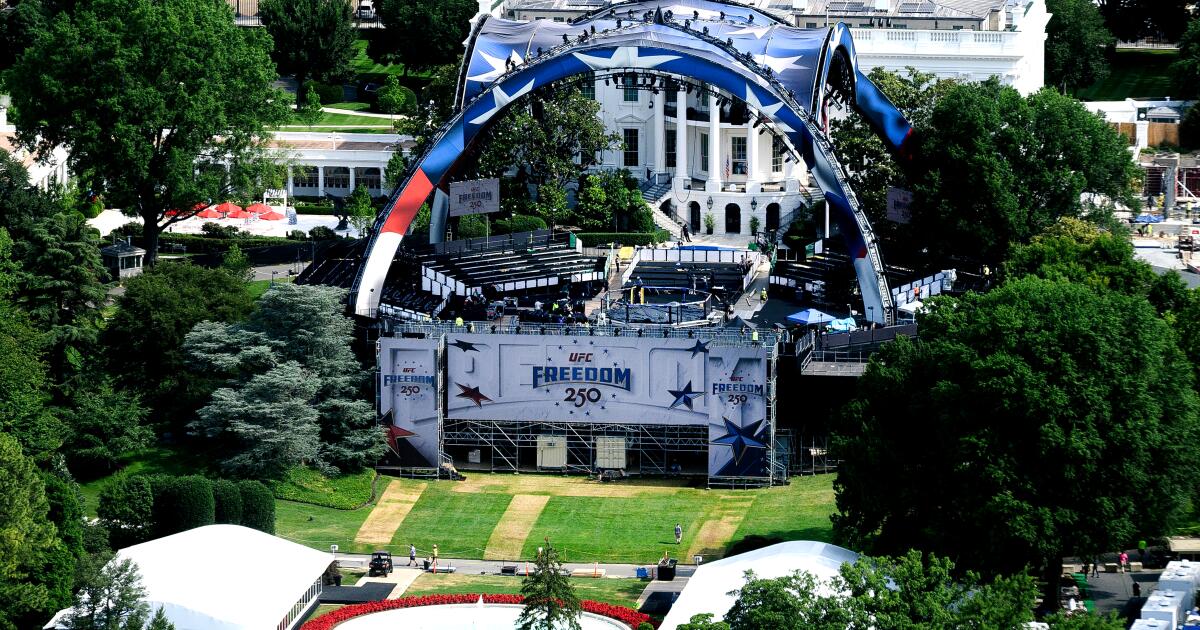
UFC Freedom 250: What to know about the White House bout, Paramount and the lawsuit
-
 Lifestyle24 minutes ago
Skip $300 parking. How to get to the World Cup at SoFi Stadium on $1.75 Metro shuttles
-
 Politics30 minutes ago
Who will be the new ’60 Minutes’ correspondents?
-
 Sports40 minutes ago
LA Card Show! Everything you need to know to make the best of the event this weekend
-

 World52 minutes ago
Trump says US will ‘be taking’ Kharg Island in latest Iran war threat

