News
Trump’s ‘Liberation Day’ Tariffs Are Coming, but at a Cost to U.S. Alliances


The incoming German chancellor, more convinced than ever that the defense and trade relationship with Washington is crumbling, has made plans to execute on his goal of “independence from the U.S.A.”
He’s not the only one.
The new Canadian prime minister said last week that “the old relationship we had with the United States” — the tightest of military and economic partnerships — is now “over.” Poland’s president is musing publicly about getting nuclear weapons. And the new leader of Greenland, host to American air bases since World War II, reacted to the uninvited visit of a high-level American delegation with indignation.
“President Trump says that the United States ‘will get Greenland,’” Prime Minister Jens-Frederik Nielsen said on social media. “Let me be clear: The United States will not get it. We do not belong to anyone else. We decide our own future.”
These are the results so far of President Trump’s threats to abandon NATO allies whose contributions he judges insufficient, his declaration that the European Union was designed “to screw” the United States and his efforts to expand the United States’ land mass. The main reaction is resistance all around. Now, into this maelstrom of threats, alienation and recriminations, President Trump is expected to announce his “Liberation Day” tariffs on Wednesday.
The details of the tariffs are still unclear, which is one reason the markets are so on edge. Political leaders are on edge as well, because Mr. Trump has made clear that the tariffs will fall on adversaries like China as well as nations that, until recently, were considered America’s closest defense and intelligence allies.
Trump administration officials do not dwell on the price that will be paid by consumers, nor on the effects that the inevitable retaliation will have on American farmers. But just as curiously, the administration has not described any cost-benefit analysis of the president’s actions, such as whether the revenue gained is worth the damage done to America’s central alliances.
Gone are the days when Mr. Trump merely threatened to pull troops out of nations like South Korea and Japan that run a trade surplus with the United States. Now, he wants them to pay up — for some kind of ill-defined mix of subsidies to their own industries, taxes on American goods, free-riding on American security and refusal of his expansionist demands.
Mr. Trump is already showing signs of concern that his targets may team up against him.
A few days ago, he posted a middle-of-the-night warning on social media to his closest allies that “if the European Union works with Canada in order to do economic harm to the USA, large scale Tariffs, far larger than currently planned, will be placed on them both.”
On Sunday China declared that its trade minister had agreed with Japan and South Korea — Washington’s two most powerful treaty allies in the Pacific — on a common response to Mr. Trump’s actions. In Seoul, the statement was described as an “exaggerated” version of a discussion about new supply chains. But Beijing clearly wanted to leave the impression that it can work with America’s allies if Washington will not.
Viewed one way, Mr. Trump’s “Liberation Day” is the logical extension of the goal he announced in his inaugural address. “Instead of taxing our citizens to enrich other countries,” he said, “we will tariff and tax foreign countries to enrich our citizens.” That suggests he does not intend the tariffs to be a negotiating tool. Instead, they are expected to be a permanent source of revenue and — if you believe officials like Commerce Secretary Howard Lutnick — “they are going to reduce the deficit and balance the budget.” He added: “Let the people who live off our economy pay, and we will pay less.”
Viewed less optimistically, the imposition of the tariffs may well kick out the last of the three pillars of the trans-Atlantic, trans-Pacific and Canadian alliances. The defense relationships, the trade interdependencies and the bond nurtured over 80 years in those regions have all been intertwined.
Those three strands were deliberately designed to be reinforcing. To Mr. Trump and his allies, though, they have been twisted to take advantage of the United States, a view made clear in the exchanges in the now-famous Signal chat made public last week. It drove home the fact that while President Trump is taking on all of America’s allies, he harbors a particular animus for Europe.
As they debated the timing and wisdom of a strike on the Houthis for their attacks on shipping, Vice President JD Vance wondered whether “we are making a mistake” since it is Europe and Egypt that are most dependent on moving ships through the Suez Canal. (In fact, China is among the biggest beneficiaries, but it was never mentioned.)
“I just hate bailing out Europe again,” he wrote, leading the defense secretary, Pete Hegseth, to respond, “I fully share your loathing of European free-loading. It’s PATHETIC.” They went on to discuss that, somehow, Europe would be made to pay for the cost of the operation — even though the European allies appear to have been kept in the dark about the planned attack.
“There needs to be some further economic gain extracted in return,” Stephen Miller, the deputy chief of staff in the White House, noted in the chat.
Ivo Daalder, a former U.S. ambassador to NATO, wrote recently that the clear conclusion other countries can reach from the chat is “apparently, the U.S. military is for hire, even if there has been no request for its services.”
“And if you want us — you have to pay,” he continued.
Somewhat remarkably, Mr. Trump’s national security officials are acting as if all is normal, as if their boss is not upending the system. On Thursday, a day after Mr. Trump is expected to announce the tariffs, Secretary of State Marco Rubio will represent the United States at a long-scheduled NATO meeting that will be heavily focused on the war in Ukraine.
He will have to navigate the resentments of fellow foreign ministers, most of whom argue, largely in private, that the United States is making a fundamental error by seeking to normalize relations with Russia — rather than contain it and punish it for invading Ukraine — and that it is seeking to hobble their economies. (Occasionally these leak out: Justin Trudeau, before he left office as prime minister of Canada, told a Canadian audience that Mr. Trump was attempting “a total collapse of the Canadian economy because that will make it easier to annex us”.)
The result is that the NATO nations are meeting regularly to discuss whether it is possible to design a peacekeeping or observer force to go into Ukraine, in the event that a cease-fire takes hold, without the United States. They are discussing whether Britain and France’s nuclear umbrella could extend over the other NATO allies, because the United States may no longer be relied upon. It is an erosion of trust that, just two-and-and-half months ago, seemed almost unthinkable.
Such discussions are prompting a long-overdue recognition by European nations that they will have to spend significantly more on defense, though it would probably take a decade or longer to replicate the capabilities the United States brings to the alliance. The downside is that should there be a world crisis in coming years, the United States may have to enter it without its greatest force-multiplier: its allies.
“In the 1950s the U.S. thought NATO was going to be one of many alliances,” Kori Schake, the director of foreign and defense Policy Studies at the American Enterprise Institute, said on Monday.
“The reason that NATO survived and prospered was because the common values and the trade relationship supported the security commitments,” Ms. Schake, a defense official in President George W. Bush’s first administration who writes extensively on the history of alliances, added.
“Who does President Trump think will help us when we need allied forces for operations critical to the security of the United States?” she asked. “And who is going to sympathize with Americans if there is another 9/11, given the behavior of the government of the United States?”



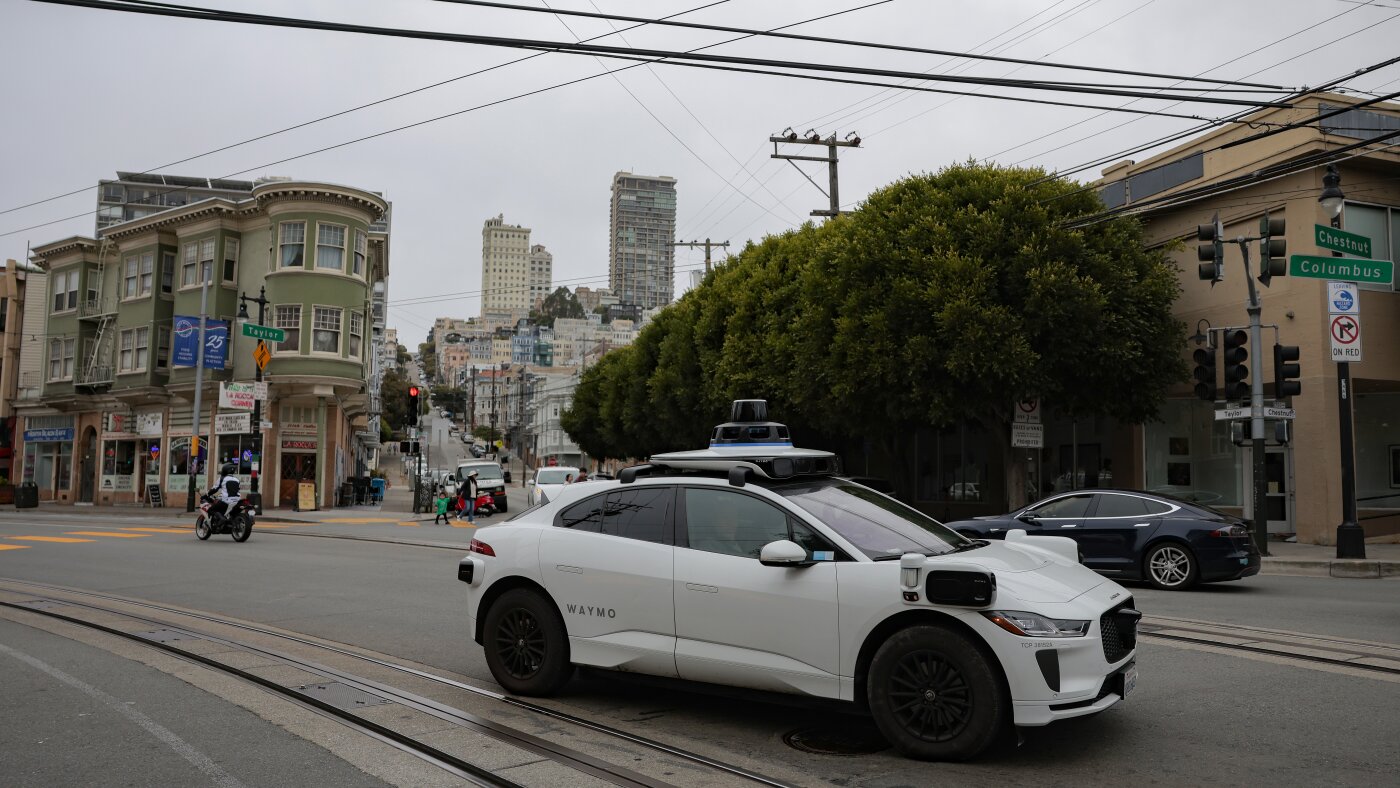
A Waymo robotaxi drives in San Francisco’s North Beach neighborhood this week.
Heather Diehl/Getty Images
hide caption
toggle caption
Heather Diehl/Getty Images
Police in San Mateo, Calif., posted Monday on social media that they had apprehended a pair of teenagers from a Waymo driverless robotaxi after the company alerted authorities to suspected criminal activity. It’s the latest incident involving video surveillance of passengers and others by autonomous vehicles — raising questions about the limits of privacy in such vehicles.

The Facebook post by the San Mateo County Police said: “Parents do you know where your teens are? @waymo does!”
The 15-year-olds were allegedly drinking alcohol and shooting toy guns from the car, according to the police. They said Waymo’s systems detected behavior that then triggered a safety response, after which the company disabled the vehicle and contacted police.
Waymo’s cars, equipped with an array of cameras, microphones and other sensors to monitor passengers and other nearby vehicles, are becoming more common in cities across the United States. Experts say the detention of the two teens in San Mateo highlights a potential — but not inevitable — trade-off between privacy and convenience. It also questions the extent to which companies similar to Waymo are required to hand over private data, including audio and video of passengers, in situations where a crime is suspected.
NPR reached out to Waymo, which is owned by Alphabet, the parent company of Google, for comment on the details of the San Mateo incident and how the company responded, but did not hear back. But on its website, the company says that as many as 29 cameras in its autonomous cars provide an all-around view and “are designed with high dynamic range and thermal stability, to see in both daylight and low-light conditions, and tackle more complex environments.”
“There already exist laws that govern duty to report or even duty to protect” for carriers such as Waymo, according to Alessandro Acquisti, a professor of information technology at the MIT Sloan School of Management. “The privacy problems arise when and if driverless carrier companies used such laws or ethical obligations as a pretext for blanket, indiscriminate accumulation of identifiable data for unspecified future purposes.”
That includes not just monitoring people inside the cars, but outside too. Take, for example, a hit-and-run investigation last year in Los Angeles. Media reported that the police inquiry was aided by video captured by a Waymo taxi that had a clear view of the crime. Critics suggested at the time that authorities were using the company’s vehicles as a mobile surveillance platform. And during 2025 protests in Los Angeles against Immigration and Customs Enforcement crackdowns, demonstrators vandalized Waymos, apparently angry that video recorded by the vehicles could be used by police, although there is no evidence that happened.
In a transparency report, Google says it received nearly 290,000 requests from governments worldwide in the first six months of 2025 for disclosure of user information across all its platforms, including Waymo. The company says that in more than 80% of the requests in those six months, some information was disclosed. “Google carefully reviews each request to make sure it satisfies applicable laws. If a request asks for too much information, we try to narrow it, and in some cases we object to producing any information at all,” the company says.
In an email to NPR, San Mateo Police Department spokesperson Jeanine Luna said that detaining the teens in the Waymo on Monday was “wholly appropriate” under the circumstances. “We received the call of a ‘firearm’ being shot from a moving vehicle,” she said. “Furthermore, the occupants were described as being possibly ‘intoxicated.’” she said.
“Being that the vehicle was disabled (the occupants had every right to exit the vehicle before police arrival, but they did not), a high-risk traffic stop was conducted to ensure the safety of all involved,” Luna added. “They were not arrested and were released to their parents, however, potential charges are still pending dependent on what the video from inside the vehicle shows.”
Autonomous taxis represent an ethical gray area
Robotaxis began to roll out across the U.S. in December 2018, when Waymo launched in Phoenix. These services have been used for less than a decade — so the norms surrounding them aren’t settled, experts agree.
The Facebook post may make Waymo passengers wonder what triggers a police intervention, says Irina Raicu, director of the Internet Ethics program at Santa Clara University. She has used Waymo’s driverless taxis and says ethically, the privacy issues surrounding them sit in a gray area. “There’s something about being in a car without another person that makes you think it’s private.”
“With all these recording devices, we don’t see them, [and] they’re not these obvious things being stuck in our faces,” Raicu adds.
That brings up a key issue: informed consent, Acquisti says.
“It is not clear the extent to which passengers … are reminded that when they step into the car, that they are being monitored, and most likely they are not told in its entirety how the data will be used,” he says.
Bruce Schneier, a cybersecurity and privacy expert and professor at the Munk School at the University of Toronto, believes that Waymo does have a compelling interest in protecting its vehicles. He compares monitoring a robotaxi via cameras to a human taxi driver keeping an eye on passengers in the rearview mirror.
“Maybe the driverless car comes back … and it has all of its cushions slashed, and it’s like, ‘Who the hell did that? Let’s go and look at the tape,’” Schneier suggests. “You can’t have sex in the back of a taxi, right? Someone would say, ‘Stop it.’”
He concludes that some supervision makes sense. In an Uber rideshare, he notes, “most of the time there’s a camera recording the back seat.” (Uber says on its website that it allows drivers to install such cameras for the purpose of “fulfilling transportation services.”)
Waymo robotaxis, while a fairly common sight in the San Francisco Bay Area, are still a novelty in much of the country. And many people are hesitant to ride in one, according to a Pew Research Center poll published this month. The survey found that only 5% of Americans had ever ridden in a driverless car. Meanwhile, 71% of those polled said they would feel uncomfortable in one, with only 7% saying they would be “extremely or very comfortable” riding in one.
For that reason, experts who spoke with NPR said they were optimistic that it’s not too late to shift gears on privacy norms and policies surrounding these vehicles.
Acquisti doesn’t see why privacy measures can’t be built into driverless vehicles.
“I would immediately challenge the notion that people have to be monitored,” he says, noting that privacy-preserving technologies exist and can be installed.
“Driverless cars are coming, but they don’t have to come in this particular incarnation,” Raicu says. “They’re still being designed and redesigned. It’s early days.”

Donald Trump has terminated the remaining members of the independent, federal commission that assists election administration officials nationwide just a few months before the midterm elections, multiple outlets reported Thursday.
The remaining three commissioners of the four-member bipartisan commission were forced out on Thursday in different ways. The one Republican appointee resigned and the other two, Democratic appointees were notified of their terminations via email from the White House presidential personnel office.
“On behalf of President Donald J Trump, I am writing to inform you that your position as Commissioner of the Election Assistance Commission is terminated, effective immediately. Thank you for your service,” the email, seen by Reuters, said.
The White House did not immediately respond to a request for comment.
The Election Assistance Commission serves as a “national clearinghouse of information on election administration”, accredits testing laboratories and certifies voting systems, and maintains the national mail-voter registration form developed by the National Voter Registration Act of 1993, according to the commission’s website. The terminations follow Trump and top administration officials’ advocacy to change vote-by-mail requirements and investigations into the 2020 election outcome, which Trump lost to Democrat Joe Biden.
“It is irresponsible and dangerous that this Administration remains dead set on causing chaos for our election officials across this country,” Arizona secretary of state Adrian Fontes said in a Thursday statement. “This move undermines the integrity of nonpartisan election administration.”
The 2002 law that established the commission, the Help America Vote Act, states the president can appoint replacements to the commission.
It is unclear how Trump will move ahead with the commission.
Reuters contributed reporting
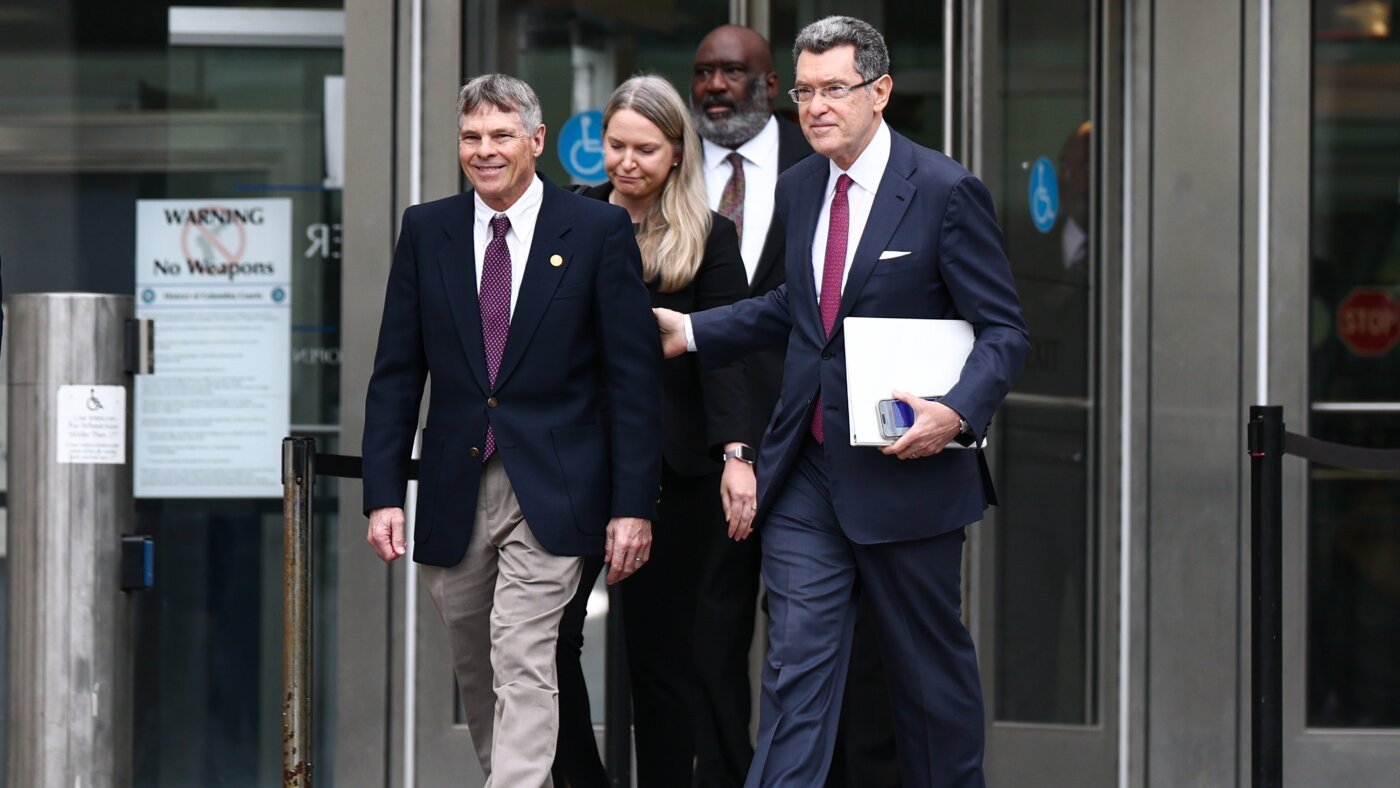
Former U.S. Olympian David Hearn (left) walks with his attorney Norman Eisen to speak to reporters and protesters gathered after his arraignment at the Superior Court of the District of Columbia in Washington, D.C. on Thursday.
Finn Gomez/Getty Images
hide caption
toggle caption
Finn Gomez/Getty Images
Former U.S. Olympic canoeist David Hearn pleaded not guilty to damaging the Lincoln Memorial Reflecting Pool in D.C. Superior Court Thursday morning.
Federal prosecutors charged Hearn with a single count of destruction of property causing more than $1,000 in damage to the pool.

Hearn has previously claimed, which his attorneys repeated during a short press conference outside the court, that he simply touched the water in the pool out of curiosity.
The Trump administration had just completed a $14 million renovation of the pool.
But shortly after the work finished, peeling paint and algae gathered in the water. The remodel has been largely criticized as a massive failure and waste of taxpayer dollars.

Superior Court Judge Carmen McLean released Hearn on his own recognizance. His next hearing is scheduled for Aug. 5.
Norm Eisen, one of Hearn’s attorneys, spoke to reporters outside of court following the hearing. He said the administration is using Hearn as a “scapegoat … for their own failures.”
“It is not a crime to touch the reflecting pool, to touch water in the United States of America,” he said.
Prosecutors say there is a host of evidence against Hearn.
This is a developing story.
-

 West Virginia1 minute ago
Helicopter crashes in Pocahontas County
-

 Wyoming4 minutes ago
Wyoming officials say Meta’s 715,000-square-foot data center is responsible for contaminating its water system with a rare bacterium | Fortune
-

 Crypto9 minutes ago
What Are KOLs Discussing About the Cryptocurrency Market Today?
-

 Finance16 minutes ago
From Love Island to Precious Metals, Prediction Markets Are Changing Finance | PYMNTS.com
-

 Fitness19 minutes ago
80-year-old fitness icon Joan MacDonald reveals her simple exercise for a stronger, more stable core
-

 Movie Reviews31 minutes ago
‘Gail Daughtry and the Celebrity Sex Pass’ Review: We’re Off to Hump the Wizard
-

 World39 minutes ago
Backlash on ethanol-blend fuel intensifies in India, puts carmakers in the dock
-
Politics49 minutes ago
Crews Drape Tarp Over White House in Latest Trump Restoration

