Connect with us

News

Top BlackRock executive Mark Wiedman to depart

Published

on

Top BlackRock executive Mark Wiedman to depart

Unlock the Editor’s Digest for free

Top BlackRock executive Mark Wiedman is departing, in a move that disrupts the asset manager’s planning for the eventual departure of founder Larry Fink, according to four people close to the company.

Wiedman had been widely discussed as a potential successor to Fink for more than a decade and had recently been one of the $11.5tn asset manager’s most prominent public faces as the head of its client business.

BlackRock’s board described him in as a regulatory filing last year as one of three “senior leaders who we believe will play critical roles in BlackRock’s future” as it granted him a special retention package.

Advertisement

However, Wiedman, who led the integration and rapid growth of BlackRock’s flagship index and exchange traded fund business, has opted not to wait around. His departure is expected to be announced very shortly, the people said. He is forfeiting $8mn in stock options, according to the proxy.

Wiedman’s departure comes after the world’s largest asset manager embarked on a $28bn acquisition spree last year to bulk up its footprint in the fast-growing and lucrative alternative assets sector. The strategic moves not only put pressure on Fink, 72, to personally oversee their success, but also brought in a clutch of high-powered and high-paid executives who need to be carefully managed.

Fink, who has led BlackRock since its 1988 founding, is very popular with investors and is among the most influential figures in finance. But analysts and some within the firm have begun expressing concerns whether the slow pace of succession planning will drive the next generation of top talent to start going elsewhere. BlackRock president Rob Kapito, 67, is also a founder of the firm.

BlackRock declined to comment.

Wiedman is leaving almost exactly a year after Salim Ramji, another executive who was also once touted as a potential leader. Ramji became chief executive of Vanguard, BlackRock’s chief rival in the US and the world’s second-largest asset manager. Several other lower-ranking executives have also left in the past few years to take leadership jobs at smaller firms, including Daniel Gamba to Northern Trust and Zach Buchwald to Russell Investments.

Advertisement

After Ramji left, the group touted its strong stable of current leaders, including Wiedman and two other executives who also received special option grants: chief operating officer Robert Goldstein and chief financial officer Martin Small.

“BlackRock is proud to have a record of our firm’s alumni going on to lead multiple investment management companies and financial institutions,” it has previously said.

A senior Wall Street figure with knowledge of the situation said “Larry [Fink] and Rob [Kapito] are not going anywhere. They just made a major acquisition and you have to see that through, [but] Wiedman is at an age where if he doesn’t make a move, he ages out of being a CEO.”

A lawyer by training, Wiedman joined BlackRock in 2004 after stints at the US Treasury and McKinsey. He started BlackRock’s financial markets advisory consulting arm, which helped central banks and government agencies dig through the rubble of the 2008 financial crisis.

Wiedman negotiated the 2009 purchase and integration of Barclays Global Investors, the deal widely seen as the most important in BlackRock’s history. He then headed up the resulting iShares business from 2011 to 2019 as it developed into a juggernaut in index and ETFs.

Advertisement

Keenly interested in talent development, Wiedman recruited or promoted many of BlackRock’s top executives, including Small and Rachel Lord, who heads the international business.

News

Waymo called the cops on teen riders, raising privacy concerns

Published

on

Waymo called the cops on teen riders, raising privacy concerns

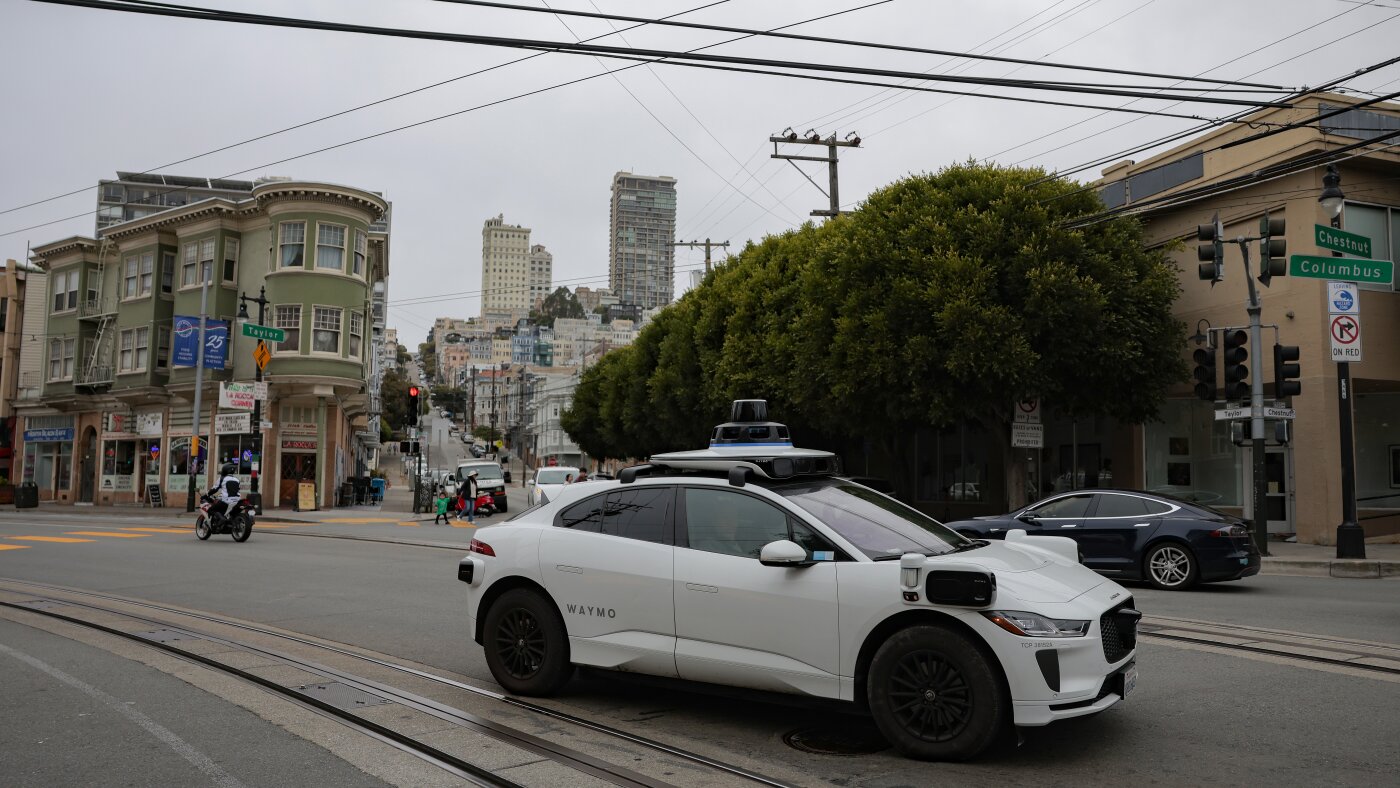
A Waymo robotaxi drives in San Francisco’s North Beach neighborhood this week.

Heather Diehl/Getty Images


hide caption


toggle caption

Advertisement

Heather Diehl/Getty Images

Police in San Mateo, Calif., posted Monday on social media that they had apprehended a pair of teenagers from a Waymo driverless robotaxi after the company alerted authorities to suspected criminal activity. It’s the latest incident involving video surveillance of passengers and others by autonomous vehicles — raising questions about the limits of privacy in such vehicles.

The Facebook post by the San Mateo County Police said: “Parents do you know where your teens are? @waymo does!”

The 15-year-olds were allegedly drinking alcohol and shooting toy guns from the car, according to the police. They said Waymo’s systems detected behavior that then triggered a safety response, after which the company disabled the vehicle and contacted police.

Advertisement

Waymo’s cars, equipped with an array of cameras, microphones and other sensors to monitor passengers and other nearby vehicles, are becoming more common in cities across the United States. Experts say the detention of the two teens in San Mateo highlights a potential — but not inevitable — trade-off between privacy and convenience. It also questions the extent to which companies similar to Waymo are required to hand over private data, including audio and video of passengers, in situations where a crime is suspected.

NPR reached out to Waymo, which is owned by Alphabet, the parent company of Google, for comment on the details of the San Mateo incident and how the company responded, but did not hear back. But on its website, the company says that as many as 29 cameras in its autonomous cars provide an all-around view and “are designed with high dynamic range and thermal stability, to see in both daylight and low-light conditions, and tackle more complex environments.”

“There already exist laws that govern duty to report or even duty to protect” for carriers such as Waymo, according to Alessandro Acquisti, a professor of information technology at the MIT Sloan School of Management. “The privacy problems arise when and if driverless carrier companies used such laws or ethical obligations as a pretext for blanket, indiscriminate accumulation of identifiable data for unspecified future purposes.”

That includes not just monitoring people inside the cars, but outside too. Take, for example, a hit-and-run investigation last year in Los Angeles. Media reported that the police inquiry was aided by video captured by a Waymo taxi that had a clear view of the crime. Critics suggested at the time that authorities were using the company’s vehicles as a mobile surveillance platform. And during 2025 protests in Los Angeles against Immigration and Customs Enforcement crackdowns, demonstrators vandalized Waymos, apparently angry that video recorded by the vehicles could be used by police, although there is no evidence that happened.

Continue Reading

News

Trump fires last members of election commission, inciting fears of midterm ‘chaos’

Published

on

Trump fires last members of election commission, inciting fears of midterm ‘chaos’

Donald Trump has terminated the remaining members of the independent, federal commission that assists election administration officials nationwide just a few months before the midterm elections, multiple outlets reported Thursday.

The remaining three commissioners of the four-member bipartisan commission ⁠were forced out on Thursday in different ways. The one Republican appointee resigned and the other ⁠two, Democratic appointees were notified of their terminations via email from ​the White House presidential personnel office.

“On ‌behalf of President ‌Donald J Trump, I am writing to inform you that your position ‌as Commissioner of the Election Assistance Commission is terminated, effective immediately. Thank you for your service,” the email, seen by Reuters, said.

The White House did not immediately respond to a request for comment.

The Election Assistance Commission serves as a “national clearinghouse of information on election ‌administration”, accredits testing laboratories and certifies voting systems, and maintains the national mail-voter registration form developed by the National ​Voter Registration Act of 1993, according to the commission’s website. The terminations follow Trump and top administration officials’ advocacy to change vote-by-mail requirements and investigations into the 2020 election outcome, which Trump lost to Democrat Joe Biden.

Advertisement

“It is ⁠irresponsible and dangerous that this Administration remains dead set on ​causing chaos for ​our election officials across this ​country,” Arizona secretary of state Adrian Fontes said in a ​Thursday statement. “This ‌move undermines the integrity ​of nonpartisan ​election administration.”

The 2002 law that established the commission, the Help America Vote Act, states the president can appoint replacements to the commission.

It is unclear how Trump will move ahead with the commission.

Reuters contributed reporting

Advertisement
Continue Reading

News

Former Olympian pleads not guilty in reflecting pool vandalism charges

Published

on

Former Olympian pleads not guilty in reflecting pool vandalism charges

Former U.S. Olympian David Hearn (left) walks with his attorney Norman Eisen to speak to reporters and protesters gathered after his arraignment at the Superior Court of the District of Columbia in Washington, D.C. on Thursday.

Finn Gomez/Getty Images


hide caption


toggle caption

Advertisement

Finn Gomez/Getty Images

Former U.S. Olympic canoeist David Hearn pleaded not guilty to damaging the Lincoln Memorial Reflecting Pool in D.C. Superior Court Thursday morning.

Federal prosecutors charged Hearn with a single count of destruction of property causing more than $1,000 in damage to the pool.

Hearn has previously claimed, which his attorneys repeated during a short press conference outside the court, that he simply touched the water in the pool out of curiosity.

Advertisement

The Trump administration had just completed a $14 million renovation of the pool.

But shortly after the work finished, peeling paint and algae gathered in the water. The remodel has been largely criticized as a massive failure and waste of taxpayer dollars.

Superior Court Judge Carmen McLean released Hearn on his own recognizance. His next hearing is scheduled for Aug. 5.

Norm Eisen, one of Hearn’s attorneys, spoke to reporters outside of court following the hearing. He said the administration is using Hearn as a “scapegoat … for their own failures.”

“It is not a crime to touch the reflecting pool, to touch water in the United States of America,” he said.

Advertisement

Prosecutors say there is a host of evidence against Hearn.

This is a developing story.

Continue Reading
Advertisement

Trending