Connect with us

News

The realpolitik of Trump’s tariffs

Published

on

The realpolitik of Trump’s tariffs

Unlock the White House Watch newsletter for free

T-day — or Tariff Day — is coming this week. Or not. We simply won’t know until it’s here, given that President Donald Trump changes his mind about policy daily. But assuming reciprocal tariffs do go into effect, it’s worth thinking about them as Trump himself probably does. 

Economists might fret about their inflationary effects, but Trump isn’t motivated by classical economic theory. To the extent that he thinks about tariffs in purely economic terms at all, he would look at the evidence of the increased tariffs against China during his first term, between 2018 and 2019, and note that, even though these represented a material adjustment in rates, they had minimal inflationary effect.

As Stephen Miran, the chair of Trump’s Council of Economic Advisers, put it in his now infamous report “A User’s Guide to Restructuring the Global Trading System”, the result of these tariffs was that “the dollar rose by almost the same amount as the effective tariff rate, nullifying much of the macroeconomic impact but resulting in significant revenue. Because Chinese consumers’ purchasing power declined with their weakening currency, China effectively paid for the tariff revenue.” 

Advertisement

Readers who want to understand America’s current tariff strategy would do better to think less about orthodox economics, and more about the realpolitik that motivates Trump. There are three points to consider here.

Trump’s realpolitik rule number one is that burden sharing between America and the rest of the world must shift. We already know about this in terms of the US push for more European defence spending. But when it comes to tariffs, there are only three numbers that matter to Trump: the average US tariff rate on other countries is 3 per cent; Europe’s is 5 per cent; and China’s is 10 per cent. To him, and to many Americans, those figures seem fundamentally unfair. If the president can move those averages closer together within four years without any major inflationary impact or a market crash, that will represent success to him, and to many voters.

Realpolitik rule two is that China is the most critical geostrategic threat to the US and must be countered by any means necessary. Trade deficits between the two countries matter to Trump, but so does security. This is the reason that he is pursuing decoupling in areas such as ships, technology, critical minerals and energy, creating separate nodes of production and consumption globally for security reasons. It is all about being able to project power and strength, which are the things — aside from wealth — that motivate him.

There are certainly exceptions to this. For example, it doesn’t make a whole lot of sense to allow American financiers to pay for the rebuilding of the Nord Stream 2 pipeline to carry Russian gas into Europe (not that many Europeans would trust Vladimir Putin with their energy security anyway), given the tight relationship between Russia and China. It’s much smarter to use cheap US natural resources as a bargaining chip in trade negotiations with Europeans. These are the sorts of head-scratching Trumpian decisions that bolster the idea that his only real north star is commerce and short-term transactionalism.

Still, supply-chain independence from China is a stated goal for the administration, not only for reasons of trade but for security. If you don’t have independent supply chains to produce crucial goods, you don’t have national security. Or, as Trump has said, “if you don’t have steel, you don’t have a country.” The US doesn’t even want to count unequivocally on allies that have significant trade relationships with China, as Europe does (China is the EU’s largest import partner, and trade dependency between the two regions has increased in recent years), because the administration doesn’t believe it will be able to trust them given their economic dependence on Beijing.

Advertisement

Finally, realpolitik rule three is that the Trump administration views the dollar as both an exorbitant privilege, as then French finance minister Valéry Giscard d’Estaing put it in the 1960s, and an exorbitant burden. The emphasis right now is on the latter.

The possibility of a “Mar-a-Lago” accord to weaken the dollar is roughly based on Ronald Reagan’s 1985 Plaza Accord, which did the same thing relative to European and Japanese currencies. In both cases, the goal was to make US exports more competitive. 

While many people believe Trump would never do anything to destabilise the dollar and thus potentially endanger the US stock market, it’s worth bearing in mind that his re-election is no longer on the table. Share prices undoubtedly matter to him, but legacy probably matters more. Being the president who ended the Bretton Woods era would be quite the legacy.

Consider too that the dollar must weaken to support re-industrialisation, which is crucial to realpolitik rule number two. This is also an echo of the Reagan era, another period in which realpolitik mattered as much as economics.

Reagan was a free trader, but also a defence hawk. He worried about US exports and supply chain security; indeed, his deputy US trade representative Robert Lighthizer, who was later Trump’s USTR, put pressure on the Japanese to limit exports of steel, cars and other goods in part for this reason.

Advertisement

Realpolitik is practical, not moral or ideological. If Trump thinks tariffs will help him, he won’t care who they’ll hurt.

rana.foroohar@ft.com
    

News

Bill Clinton to testify before House committee investigating Epstein links

Published

on

Bill Clinton to testify before House committee investigating Epstein links

Former president Bill Clinton is scheduled to give deposition Friday to a congressional committee investigating his links to Jeffrey Epstein, one day after Hillary Clinton testified before the committee and called the proceedings “partisan political theatre” and “an insult to the American people”.

During remarks before the House oversight committee, Hillary Clinton, the former secretary of state, insisted on Thursday that she had never met Epstein.

The former Democratic president, however, flew on Epstein’s private jet several times in the early 2000s but said he never visited his island.

Clinton, who engaged in an extramarital affair while president and has been accused of sexual misconduct by three women, also appears in a photo from the recently released files, in a hot tub with Epstein and a woman whose identity is redacted.

Clinton has denied the sexual misconduct claims and was not charged with any crimes. He also has not been accused of any wrongdoing connected to Epstein.

Advertisement

Epstein visited the White House at least 17 times during the early years of Clinton’s presidency, according to White House visitor records cited in news reports. Clinton said he cut ties with him around 2005, before the disgraced financier, who died from suicide in 2019, pleaded guilty to solicitation of a minor in Florida.

The House committee subpoenaed the Clintons in August. They initially refused to testify but agreed after Republicans threatened to hold them in contempt.

The Clintons asked for their depositions to be held publicly, with the former president stating that to do so behind closed doors would amount to a “kangaroo court”.

“Let’s stop the games + do this the right way: in a public hearing,” Clinton said on X earlier this month.

The committee’s chair, James Comer, did not grant their request, and the proceedings will be conducted behind closed doors with video to be released later.

Advertisement

On Thursday, Hillary Clinton’s proceedings were briefly halted after representative Lauren Boebert leaked an image of Clinton testifying.

During the full day deposition, Clinton said she had no information about Epstein and did not recall ever meeting him.

Before the deposition, Comer said it would be a long interview and that one with Bill Clinton would be “even longer”.

Continue Reading

News

Read Judge Schiltz’s Order

Published

on

Read Judge Schiltz’s Order

CASE 0:26-cv-00107-PJS-DLM

Doc. 12-1 Filed 02/26/26

Page 5 of 17

and to file a status update by 11:00 am on January 20. ECF No. 5. Respondents never provided a bond hearing and did not release Petitioner until January 21, ECF Nos. 10, 12, after failing to file an update, ECF No. 9. Further, Respondents released Petitioner subject to conditions despite the Court’s release order not providing for conditions. ECF Nos. 5, 12–13.

Abdi W. v. Trump, et al., Case No. 26-CV-00208 (KMM/SGE)

On January 21, 2026, the Court ordered Respondents, within 3 days, to either (a) complete Petitioner’s inspection and examination and file a notice confirming completion, or (b) release Petitioner immediately in Minnesota and confirm the date, time, and location of release. ECF No. 7. No notice was ever filed. The Court emailed counsel on January 27, 2026, at 10:39 am. No response was provided.

Adriana M.Y.M. v. David Easterwood, et al., Case No. 26-CV-213 (JWB/JFD)

On January 24, 2026, the Court ordered immediate release in Minnesota and ordered Respondents to confirm the time, date, and location of release, or anticipated release, within 48 hours. ECF No. 12. Respondent was not released until January 30, and Respondents never disclosed the time of release, instead describing it as “early this morning.” ECF No. 16.

Estefany J.S. v. Bondi, Case No. 26-CV-216 (JWB/SGE)

On January 13, 2026, at 10:59 am, the Court ordered Respondents to file a letter by 4:00 pm confirming Petitioner’s current location. ECF No. 8. After receiving no response, the Court ordered Respondents, at 5:11 pm, to immediately confirm Petitioner’s location and, by noon on January 14, file a memorandum explaining their failure to comply with the initial order. ECF No. 9. Respondents did not file the memorandum, requiring the Court to issue another order. ECF No. 12. On January 15, the Court ordered immediate release in Minnesota and required Respondents to confirm the time, date, and location of release within 48 hours. ECF No. 18. On January 20, having received no confirmation, the Court ordered Respondents to comply immediately. ECF No. 21. Respondents informed the Court that Petitioner was released in Minnesota on January 17, but did not specify the time. ECF No. 22.

5

Continue Reading

News

Chicagoans pay respects to Jesse Jackson as cross-country memorial services begin

Published

on

Chicagoans pay respects to Jesse Jackson as cross-country memorial services begin

James Hickman holds a photo montage of the late Rev. Jesse Jackson before a public visitation at Rainbow/PUSH Coalition in Chicago on Thursday.

Nam Y. Huh/AP


hide caption

toggle caption

Advertisement

Nam Y. Huh/AP

CHICAGO — A line of mourners streamed through a Chicago auditorium Thursday to pay final respects to the Rev. Jesse Jackson Sr. as cross-country memorial services began in the city the late civil rights leader called home.

The protege of the Rev. Martin Luther King Jr. and two-time presidential candidate will lie in repose for two days at the headquarters of the Rainbow PUSH Coalition before events in Washington, D.C., and South Carolina, where he was born.

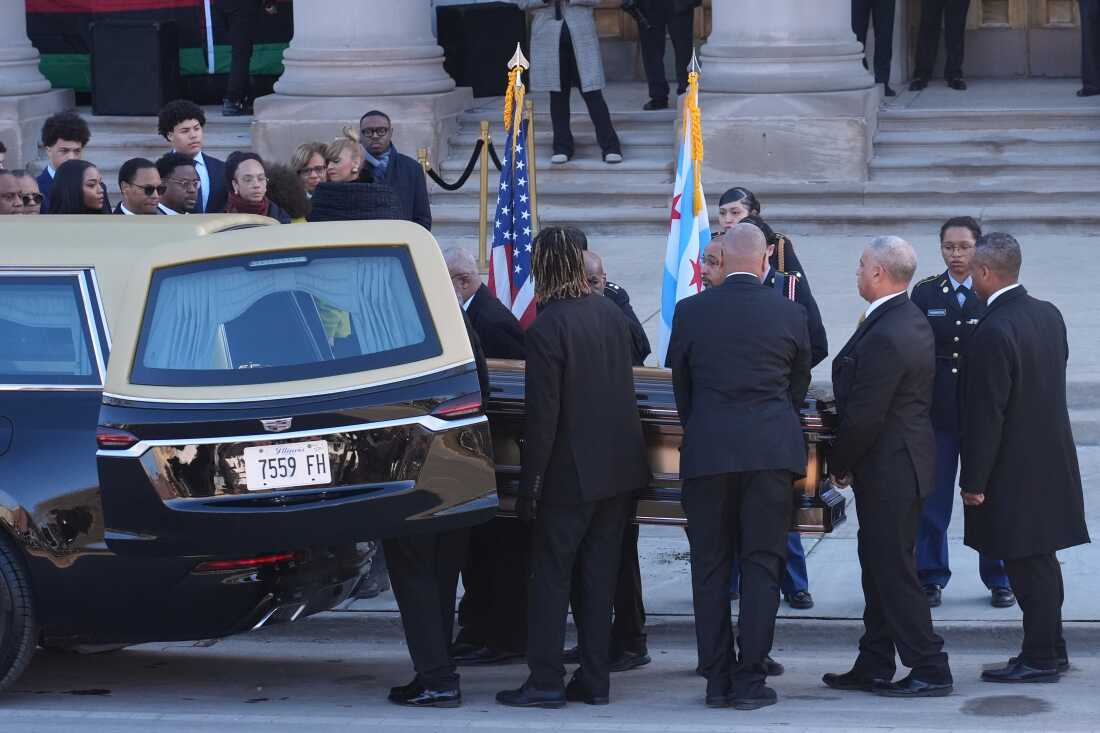
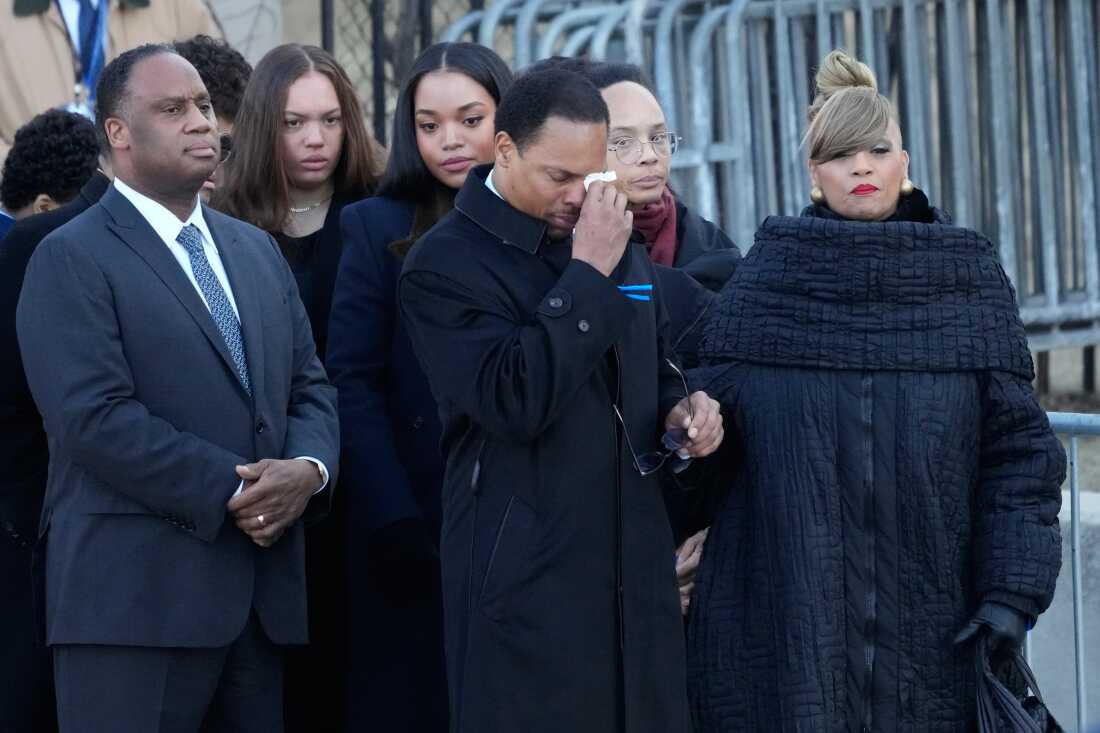
Family members wiped away tears as the casket was brought into the stately brick building. Flowers lined the sidewalks where people waiting to enter watched a large screen playing video excerpts of Jackson’s notable speeches. Some raised their fists in solidarity.

Advertisement
The casket with the Rev. Jesse Jackson arrives before a public visitation at Rainbow/PUSH Coalition in Chicago on Thursday.

The casket with the Rev. Jesse Jackson arrives before a public visitation at Rainbow/PUSH Coalition in Chicago on Thursday.

Nam Y. Huh/AP


hide caption

toggle caption

Nam Y. Huh/AP

Advertisement

Inside, Jackson’s children, Chicago Mayor Brandon Johnson and the Rev. Al Sharpton were among those who stood by the open casket to shake hands and hug those coming to view the body of Jackson, dressed in a suit and blue shirt and tie.

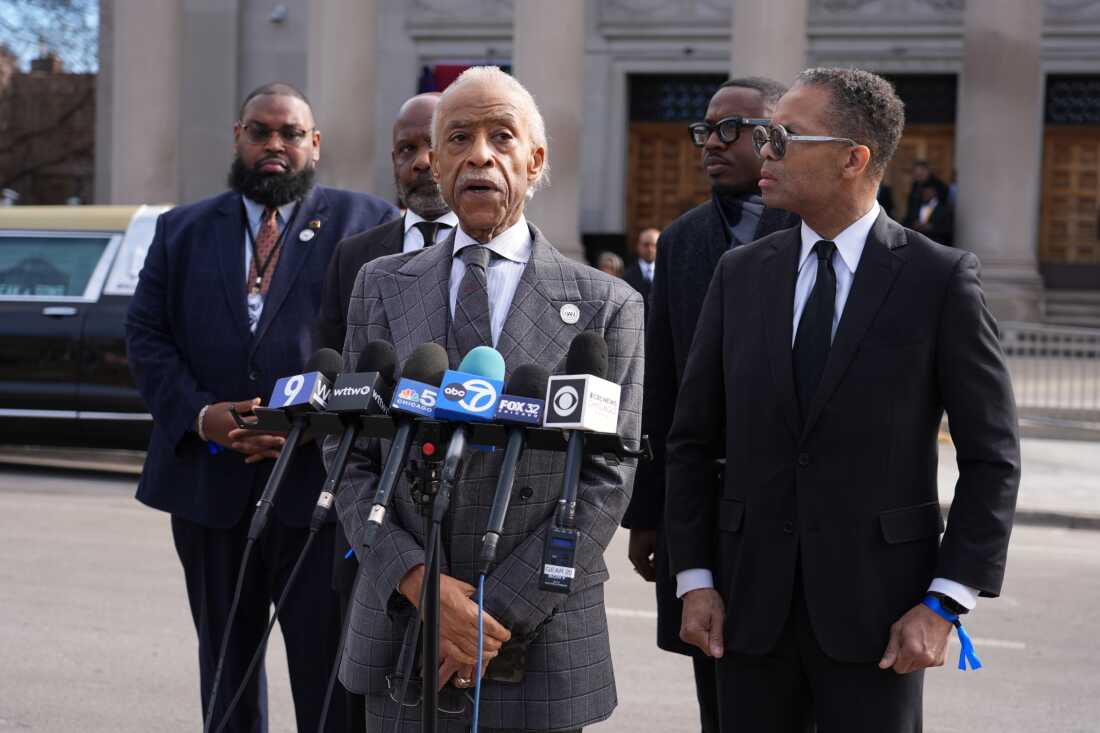
“The challenge for us is that we’ve got to make sure that all he lived for was not in vain,” Sharpton told reporters. “Dr. King’s dream and Jesse Jackson’s mission now falls on our shoulders. We’ve got to stand up and keep it going.”

The Rev. Al Sharpton speaks as Jesse Jackson Jr. listens after the public visitation for the Rev. Jesse Jackson at Rainbow/PUSH Coalition in Chicago on Thursday.

The Rev. Al Sharpton speaks as Jesse Jackson Jr. listens after the public visitation for the Rev. Jesse Jackson at Rainbow/PUSH Coalition in Chicago on Thursday.

Nam Y. Huh/AP


hide caption

Advertisement

toggle caption

Nam Y. Huh/AP

Jackson died last week at age 84 after battling a rare neurological disorder that affected his mobility and ability to speak in his later years.

Advertisement

Remembrances have already poured in from around the globe, and several U.S. states, including Minnesota, Iowa and North Carolina, are flying flags at half-staff in his honor.

But perhaps nowhere has his death been felt as strongly as in the nation’s third-largest city, where Jackson lived for decades and raised his six children, including a son who is a congressman.

Bouquets have been left outside the family’s Tudor-style home on the city’s South Side for days. Public schools have offered condolences, and city trains have used digital screens to display Jackson’s portrait and his well-known mantra, “I am Somebody!”

People wait to enter the security checkpoint for the public visitation for the Rev. Jesse Jackson at Rainbow/PUSH Coalition in Chicago on Thursday.

People wait to enter the security checkpoint for the public visitation for the Rev. Jesse Jackson at Rainbow/PUSH Coalition in Chicago on Thursday.

Nam Y. Huh/AP


hide caption

Advertisement

toggle caption

Nam Y. Huh/AP

His causes, both in the United States and abroad, were countless: Advocating for the poor and underrepresented on issues including voting rights, job opportunities, education and health care. He scored diplomatic victories with world leaders, and through his Rainbow PUSH Coalition, he channeled cries for Black pride and self-determination into corporate boardrooms, pressuring executives to make America a more open and equitable society.

Advertisement

“We honor him, and his hard-earned legacy as a freedom fighter, philosopher, and faithful shepherd of his family and community here in Chicago,” the mayor said in a statement.

Next week, Jackson will lie in honor at the South Carolina Statehouse, followed by public services. According to Rainbow PUSH’s agenda, Gov. Henry McMaster is expected to deliver remarks; however, the governor’s office said Thursday that his participation wasn’t yet confirmed. Jackson spent his childhood and started his activism in South Carolina.

Details on services in Washington have not yet been made public. However, he will not lie in honor at the United States Capitol rotunda after a request for the commemoration was denied by the House Speaker Mike Johnson’s office.

The two weeks of events will wrap up next week with a large celebration of life gathering at a Chicago megachurch and finally, homegoing services at the headquarters of the Rainbow PUSH Coalition.

Family members said the services will be open to all.

Advertisement

“Our family is overwhelmed and overjoyed by the amazing amount of support being offered by common, ordinary people who our father’s life has come into contact with,” his eldest son, Jesse Jackson Jr., said before the services began. “This is a unique opportunity to lay down some of the political rhetoric and to lay down some of the division that deeply divides our country and to reflect upon a man who brought people together.”

The family of the Rev. Jesse Jackson arrives as Yusep Jackson wipes his eyes before public visitation at Rainbow/PUSH Coalition in Chicago on Thursday.

The family of the Rev. Jesse Jackson arrives as Yusep Jackson wipes his eyes before public visitation at Rainbow/PUSH Coalition in Chicago on Thursday.

Nam Y. Huh/AP


hide caption

toggle caption

Advertisement

Nam Y. Huh/AP

The services included prayers from some of the city’s most well-known religious leaders, including Chicago Cardinal Blase Cupich. Mourners of all ages — from toddlers in strollers to elderly people in wheelchairs — came to pay respects.

Video clips of his appearances at news conferences, the campaign trail and even “Sesame Street” also played inside the auditorium.

Claudette Redic, a retiree who lives in Chicago, said her family has respected Jackson, from backing his presidential ambitions to her son getting a scholarship from a program Jackson championed.

Advertisement

“We have generations of support,” she said. “I’m hoping we continue.”

Continue Reading

Trending