News
'Something needs to change.' Woman denied abortion in South Carolina challenges ban


Over two dozen abortion-rights supporters attend a rally outside the South Carolina State House in Columbia, S.C., on Aug. 23, 2023. The South Carolina Supreme Court ruled to uphold a law banning most abortions except those in the earliest weeks of pregnancy.
James Pollard/AP
hide caption
toggle caption
James Pollard/AP

Over two dozen abortion-rights supporters attend a rally outside the South Carolina State House in Columbia, S.C., on Aug. 23, 2023. The South Carolina Supreme Court ruled to uphold a law banning most abortions except those in the earliest weeks of pregnancy.
James Pollard/AP
Taylor Shelton said she isn’t ready to be a mother. She’d been using birth control for years — an intrauterine device (IUD), which is said to be more than 99% effective.
She’d just gotten the device checked by a doctor when she missed her period in September.
“When I found out I was pregnant, I was shocked to say the least,” Shelton told NPR.
Shelton and her boyfriend decided together that she would get an abortion. But South Carolina’s fetal heartbeat ban had just taken effect.
“I thought, ‘Luckily, I’m under six weeks. This shouldn’t be hard,’” said Shelton. “And then it turned out to be unbelievably hard.”
Shelton ultimately had to travel out of state to get an abortion.
“It was unnecessary, and it was traumatizing,” said Shelton. She’s now suing the state, alongside Planned Parenthood, arguing the ban’s parameters are vague and make it nearly impossible to get an abortion.
“The government want[s] us to be responsible. Well, I’m telling you right now — I had birth control. I tracked my period. I took the pregnancy test as soon as possible,” said Shelton. “And even then, I could not figure out how to get this procedure done.”
Abortion-rights advocates held a news conference last May before debate of a bill that would restrict abortions after six weeks.
Logan Cyrus/AFP via Getty Images
hide caption
toggle caption
Logan Cyrus/AFP via Getty Images
Abortion-rights advocates held a news conference last May before debate of a bill that would restrict abortions after six weeks.
Logan Cyrus/AFP via Getty Images
Questions persist on when during pregnancy the ban applies
Since the U.S. Supreme Court overturned Roe v. Wade in 2022, most Republican-controlled states have enacted abortion bans of some kind.
In South Carolina, the Republican-dominated General Assembly passed an abortion ban after a “fetal heartbeat” is present.
Republican lawmakers at the time argued that South Carolina was becoming “an abortion destination state,” as women facing strict bans across the South sought abortions.
The ban defines a “fetal heartbeat” as “cardiac activity, or the steady and repetitive rhythmic contraction of the fetal heart, within the gestational sac.”
That has been interpreted as around six weeks of pregnancy, before most women know they are pregnant.
But physicians who specialize in reproductive health have called the “fetal heartbeat” language misleading.
Vicki Ringer, the director of public affairs for Planned Parenthood South Atlantic, said the definition describes two different points in pregnancy: an electrical impulse that appears at roughly six weeks and an actual heart, which Ringer said does not begin to form until at least nine weeks.
“This is what happens when you have legislators that try to practice medicine,” said Ringer.
It’s not the first time the ban’s language has been called into question. Even as the South Carolina Supreme Court upheld the law six months ago, its chief justice noted that the “fetal heartbeat” definition is ambiguous, writing, “We leave for another day … the meaning of ‘fetal heartbeat.’”
Planned Parenthood and Shelton are asking the state court to clarify the ban and allow abortions up to at least nine weeks.
“Nine weeks will allow about 50% of the patients that come to see us [to get an abortion],” said Ringer, adding that Planned Parenthood in South Carolina currently provides abortions to only 10% of those seeking one.
After the lawsuit was filed, the state attorney general said his office has defended the law in the past and will continue to do so.
Ringer said the ambiguity of the ban, coupled with the threat of criminal charges for abortion providers, has led to a chilling effect in the state and has left patients like Shelton vulnerable.
“My blood is boiling about it”
Shelton said she filed the lawsuit so other women wouldn’t have to go through a similar experience.
After learning she was pregnant, she immediately called her gynecologist and asked the receptionist how to get an abortion.
“‘Do you know where I can get help?’” Taylor remembers asking. “‘Do you have any resources for me?’ And each answer was, ‘no, no, no.’”
Next, Shelton called Planned Parenthood, which has two clinics that provide abortion in the state. But the ban had left those clinics overwhelmed. They could not see Shelton before six weeks.
Shelton then started to search online and found a pregnancy center in North Carolina, which has a 12-week ban requiring two appointments: one for counseling where an ultrasound is performed and another for the abortion itself.
Shelton said the center told her it could see her quickly and perform the ultrasound.
“My mom came with me. We drove four hours to Charlotte,” she said. “The moment I stepped foot in that place, I felt uncomfortable.”
She said it felt like a bait-and-switch.
“It was anything that could prevent me from the idea of an abortion, that abortion is bad,” said Shelton.
When Shelton insisted she wanted an abortion, she said the center would no longer give her an ultrasound.
“It turns out this place was a fake abortion clinic, an anti-abortion clinic,” said Shelton.
Ringer said crisis pregnancy centers are popping up across the southeast, appearing on searches for abortion services but then offering only anti-abortion information when women arrive.
But Shelton was also experiencing pain. She let the counselor know, explaining her IUD was still in place.
“And immediately it was, ‘Oh my goodness, you need to go to the hospital. Your baby could be in danger,’” said Shelton. “Not me, but the baby could be in danger.”
Shelton left the pregnancy center in tears and immediately called her gynecologist. The doctor removed the IUD, which was bent, and said that this was what was likely causing Shelton’s pain.
Shelton finally connected with Planned Parenthood in North Carolina. After two more trips, she got an abortion at six weeks, four days pregnant.
“It’s so surreal. I could have never seen this happening to me. And now that it has, I mean, my blood is boiling about it,” Shelton said, adding she can’t imagine what would have happened if she did not have the support of her family, the means to travel and money for all the appointments.
“I think that my story shows the six-week ban is not enough time to be fair and that something needs to change.”


A woman suffered several injuries but survived falling 1,500 feet down California’s Mount Shasta on Sunday, officials said.
The climber, 31, was attempting to ascend the mountain, which is technically a stratovolcano with the second-highest peak in the Cascades, according to the U.S. Forest Service. She was climbing in a group of three novices at an elevation of around 13,000 feet when she fell.
She suffered a suspected ankle fracture and “additional injuries consistent with the significant fall,” although she was found alert and “in good spirits,” the forest service said. Officials haven’t identified the climber.
Efforts to locate and rescue the woman got underway at around noon on Sunday and involved three climbing rangers from the forest service as well as members of the California Highway Patrol. An initial helicopter search was limited because of cloud cover on the mountain, the forest service said, prompting one ranger to ascend a portion of the mountain on foot to reach her. One member of the woman’s climbing party helped carry rescue equipment, as did a fourth climber who stopped to assist.
California Highway Patrol safely removed the woman from the mountain at around 5:30 p.m., and she was eventually taken to Mercy Medical Center Mount Shasta for medical care, according to the forest service.
The agency said the woman’s fall “serves as an important reminder that Mount Shasta is a high-altitude mountaineering environment, not a hike,” and “experienced climbers can encounter rapidly ranging weather, steep snow and ice, rockfall, and hazardous fall conditions.”
It also encouraged prospective climbers to “be honest about your experience and physical conditioning” before attempting to summit the mountain.
The woman and her climbing party were ascending Mount Shasta along a route called Avalanche Gulch, which “is steep and rigorous requiring crampons, a mountain axe, helmet, and basic snow travel skills,” according to the Mount Shasta Avalanche Center. It takes climbers up a 7,000-foot vertical ascent that features “steep snow and ice, rock fall, and weather extremes,” the center said.

It’s a tiny restaurant in the Little Morocco neighborhood of Queens. But throughout this World Cup, it has swelled with pride, song and beating drums as the Moroccan national team has pushed its way deep into soccer’s biggest international tournament.
It’s a scene that has been echoed across the United States — in a multitude of languages and colors, as soccer fans from all over the world, many now making their homes in America, have packed bars, restaurants, living rooms and concert venues.
No matter where they came from or where they gathered, they all sought the same experience: a chance to watch their nations compete while surrounded by others who share passion and pride for the country they or their ancestors once called home.
Together, these fans have brought places throughout the United States to life.
Bosnia vs Qatar
Bosnians Rejoice in St. Louis, Mo.
Thousands of Bosnians settled in the St. Louis area during the 1990s, as war and genocide ripped their communities apart. The city is now home to more than 60,000 Bosnians, scores of whom gathered at Bevo Caffe Lounge on June 24 to watch Bosnia and Herzegovina play.
This is only the second time the team has qualified for the World Cup — and the first time it has reached the knockout round. Its reward: Meeting one of the hosts, the United States, on Wednesday in Santa Clara, Calif.
Haiti vs Brazil
In Miami, Little Haiti Comes to Life
More than 100,000 residents of Miami-Dade County, Fla., are of Haitian descent, and the Little Haiti neighborhood of Miami has long been their central hub.
During the World Cup, fans of Haiti’s team have flocked to the neighborhood, packing restaurants, bars and even parking lots to watch the action. Many have come wearing jerseys, while others simply dressed in the red and blue of the Haitian flag.
Haiti ended up in a tough group, losing all of its matches, including a 3-0 defeat to Brazil on June 19. But for some fans, the fact that the team had qualified at all was its one victory. Before this year, Haiti had played in only one other World Cup, in 1974.
Morocco
Moroccan Joy in Queens, N.Y.
Touria Lamtahaf worked as a chef four years ago at a restaurant in Astoria, Queens, in the heart of an enclave on Steinway Avenue known as Little Morocco.
After the Moroccan team upset Portugal in a World Cup quarterfinal, Ms. Lamtahaf remembers hundreds of Morocco fans surging onto Steinway Avenue, setting off flares and red smoke bombs to celebrate.
“It was a good memory for all of us,” she said. “We were very proud. You just needed something to be happy. After Covid, this was amazing.”
The neighborhood has long been a hub for immigrant communities from North African countries, including Egypt, and is also home to a large Greek community.
Many settled in Astoria decades ago, drawn by low rents and a neighborhood that could feel calm compared with other bustling parts of New York. Ms. Lamtahaf, who moved to the United States in 2007, said that she originally lived in Ridgewood neighborhood of Queens, but word of mouth led her to Astoria, where she now runs her own restaurant.
The restaurant, Dar Lbahja, is just a few blocks from where she used to work. Ms. Lamtahaf said that when she opened it just over a year ago, she wanted to create a space where people could not just eat, but also gather to watch soccer, like she did growing up with her father in Morocco.
“It was only one TV, and we had to watch with him,” Ms. Lamtahaf said. “So we grew up with the soccer.”
During this tournament, Morocco fans have packed into Dar Lbahja on game days, with many in Morocco’s red jersey, and others in the team’s white kit. They were rewarded with a berth in the knockout stages, and then again on Monday when their team won a tense matchup with the Netherlands in a penalty shootout.
Fans took to the streets in jubilant celebration, just as they did in 2022.
Kacem Ettahali, 19, of Houston, is spending the summer in New York for an internship and watched the first Morocco game of the tournament on June 13 at the restaurant.
After the team scored, Mr. Ettahali received a flurry of texts from his friends. “When they think of Morocco, they think of me,” he said.
He wasn’t the only Texan in the joint. Jori and Ahmed Lamghari traveled from the Dallas area because Ms. Lamghari, 43, wanted her husband to experience the city during the tournament. “I wanted him to get the New York World Cup vibe,” she said.
Mr. Lamghari, 33, said that “Moroccans make their own ambience,” adding, “We want to live it.”
France vs Norway
In Chicago, Hope for Another French Title
The French love a good outdoor drinking venue. For the country’s June 26 match against the rowing Norwegians, fans gathered on the outdoor patio of Soccer House in Chicago, a city whose deep French roots stretch back to the colonial days.
France is widely considered a tournament favorite, potentially giving its fans several more opportunities to celebrate.
Argentina vs Austria
In Provo, Utah, Messi Mania Is a Family Affair
Sporting the colors is intergenerational in Provo, Utah. Luis and Lidia Peve moved there 25 years ago, following a son who emigrated first, and decorated their home with small Argentina flags ahead of the team’s match against Austria on June 22.
As game time approached, about a dozen members of the family painted their faces with the sky blue and white of Argentina’s flag. Together, they sat around the TV with their eyes trained particularly on Lionel Messi, the team’s star, who is likely playing in his last World Cup.
He finished the game with three goals — a hat trick — and a new generation of fans in the Peve household.
D.R. Congo vs Colombia
In Silver Spring, Md., a Happy Return to the World Cup
Congolese fans in Silver Spring, Md., belted out their national anthem in a veterans hall, hands over their hearts, ahead of the country’s match against Colombia on June 23.
Refugee aid programs have resettled many Congolese families in the suburbs north of the nation’s capital, as their nation has been rived by war, unrest and now an Ebola outbreak.
The Congolese side lost its match to Colombia on that day. But the team managed to advance out of the group stage for the first time in its history. Before this World Cup, the country had been to the tournament only once, in 1974, when it lost all of its matches.
Portugal
A Block Party of Red and Green in Rhode Island
The go-to drink special last weekend in East Providence, R.I., was a vodka cocktail called the CR7. And you’d be hard-pressed to find a resident of the region who didn’t know it was in honor of Cristiano Ronaldo, the 41-year-old Portuguese striker who is playing in his sixth — and likely last — World Cup, wearing his famous No. 7.
The drink was served at the Portuguese restaurant O Dinis, a neighborhood staple. A large number of Portuguese immigrants settled in this corner of Rhode Island and nearby Massachusetts during the Industrial Revolution, finding work in the textile, whaling and manufacturing industries.
“Life is beautiful in Portugal,” said Natalia Paiva-Neves, who moved to the United States when she was 16 and now runs O Dinis, which was founded by her father. “But at the time, there was a lot of poverty, because there were no jobs, and there was no tourism. There was none of that stuff going on, so you had to find a means to provide for your family.”
After pre-gaming over CR7s, along with beer, wine, meats and shrimp, some fans walked from O Dinis to a watch party that stretched for two blocks, from a screen in the parking lot of nearby Cafe Alma to Campino’s, another Portuguese restaurant.
“It’s just a great feeling,” said Kevin Matos, the cafe’s owner. “Everybody’s enjoying themselves. It doesn’t matter the result on the screen.”
Some fans might not have agreed, though a scoreless draw sent both teams through to the knockout stage.
The block party, with hundreds of fans lining the streets, was in part the brainchild of East Providence’s mayor, Roberto DaSilva. “We had no idea that it’d be this many people showing up,” he said. “We thought we got a good crowd, but this is much more than than I ever expected.”
Some had to stand on their tiptoes see the screens. Others packed into shops to sit down and watch the game, while others pulled out their phones as they stood in line to buy beer and snacks from food trucks and vendors.
Mexico vs South Korea
A Backyard Party in a Texas Border Town
Roughly four out of five residents in the Texas border town of Weslaco are of Mexican descent, making the country’s June 18 match in Guadalajara feel like a home game.
For a youth soccer team, it was a chance to watch their heroes take another step toward the knockout rounds.
Under the night sky, they watched anxiously, breaking into dance after Mexico won.
Uruguay vs Spain
Elimination Brings Anguish to Uruguay Fans in Miami
Uruguay needed this one. The nation that hosted the first World Cup in 1930, winning the tournament that year and again in 1950, was on the brink of elimination last week against Spain — considered one of the strongest teams in the tournament.
Fans at Doña Paulina, a Uruguayan restaurant in Miami, anxiously watched their team fight for a chance to stay in the competition.
It wasn’t to be. Spain emerged victorious, 1-0.
Japan vs Tunisia
In San Diego, Fans Cheer the Samurai Blue
Their team is called the Samurai Blue, and the many Japanese fans living in Southern California — a diaspora that first settled there in the late 19th century as farmers and fishermen, and endured harsh incarceration during World War II — made their blue kits prominent as the team played its way through a so-called group of death.
They eventually earned a second-place finish to reach the round of 32. The result was a Monday matchup with Brazil, in which Japan fell 2-1.
Iran
In Los Angeles, Mixed Feelings About the Iranian Team
For Americans from Iran, supporting the Iranian national team has been a thorny issue.
Some have refused to even watch the matches. To them, the team feels like an extension of the government, whose persecution drove many to flee the country. It’s especially difficult as their new home, the United States, and their old home are at war.
“That’s a little conflict for me,” said Roozbeh Farahanipour, who helped lead an Iranian student uprising in 1999 and fled the country the following year, seeking political asylum in America. “I am a little different from other fans, because no way I can cheer or stand for either Islamic Republic of Iran’s national anthem, nor for the flags.”
He added, “I am American now. My flag is the U.S. flag.”
Others of Iranian descent have eagerly backed the national team and bristled at its travails, especially in Southern California, which was host to the team’s first match and is home to the largest diaspora of Iranians outside Iran. Many live, shop and eat in the Westwood area of Los Angeles, where an enclave has become known as Tehrangeles, after the Iranian capital.
Still, compared with those of other diasporas, gatherings to back the Iranian team have seemed smaller and more muted. Only a handful of fans gathered at Attari Sandwich Shop, a Persian eatery in the heart of Tehrangeles, during Iran’s June 21 match against Belgium at SoFi Stadium in nearby Inglewood, Calif.
Inside the restaurant, some fans anxiously watched the game over kebab plates and pastries. Others outside proudly waved their flags on the neighborhood thoroughfare, Westwood Boulevard.
Bijan Bahmani, who lives in Los Angeles, took his 2-year-old son to Iran’s match against New Zealand on June 15 in Inglewood with his father-in-law. While he opposes the Iranian regime and hopes for democracy one day, Mr. Bahmani said he still wanted to cheer to the national team.
“It’s complicated, because we have feelings a lot of different ways, with the complicated politics,” said Mr. Bahmani, 41, who moved to the United States in 2001. “I am definitely rooting for Iran because they represent Iran, not the government.”
Even as he took in the game with this family, Mr. Bahmani said the war was on his mind.
“I hope this peace lasts,” he said, referring to the current fragile cease-fire. “Every day, we’re worried.”
Cape Verde vs Saudi Arabia
Celebrating the Small but Mighty in New Bedford, Mass.
Every tournament has a surprise underdog. This year, it’s Cape Verde, a small island nation off the western coast of Africa. Its team had an opportunity on Friday to become the smallest country by population ever to advance to a World Cup knockout round.
The pivotal match drew people of Cape Verdean descent to a veterans hall in New Bedford, Mass., about an hour drive south of Boston. Like Portugal and Brazil, whaling and related industries brought a sizable population of immigrants from Cape Verde to southeastern New England.
A scoreless tie with Saudi Arabia was all it took for tears and roars to erupt in the veterans hall. Their team would keep playing, for at least one more game.
Brazil vs Haiti
A Brazilian Dance Party Near Boston
Massachusetts has a long history of Portuguese-speaking settlers, making Brazilians feel welcome in the Boston area. That’s especially the case in the southwest suburb of Framingham, Mass., where the Brazilian-born population rivals that of Boston.
They packed into Tropical Cafe, a Brazilian restaurant in Framingham, gathering around hightop tables as their team played Haiti on June 19. After Brazil secured a 3-0 win, fans made the restaurant an impromptu dance club to celebrate.
Germany vs Curaçao
In Texas, German Fans Root, and Eat, to Honor a Neighbor
Bratwurst and steins of beer accompanied the match at Bavarian Grill in Plano, Texas, a Dallas suburb, as Germany played Curaçao in Houston on June 14. But perhaps the city’s most important fan of the German team was not there.
Jürgen Mahneke, who was born in Braunschweig, Germany, immigrated to the United States in 1984, and worked in hotels across the country before settling in Plano.
He opened the restaurant in 1993, and died at age 67 on June 10, a day before the World Cup began.
His restaurant went on with the planned festivities. One of the managers said Mr. Mahneke would have wanted them to. His team won its opener, 7-1, but went home on Monday, falling to Paraguay in a heartbreaking penalty shootout — the opposite of Morocco’s elating win hours later.
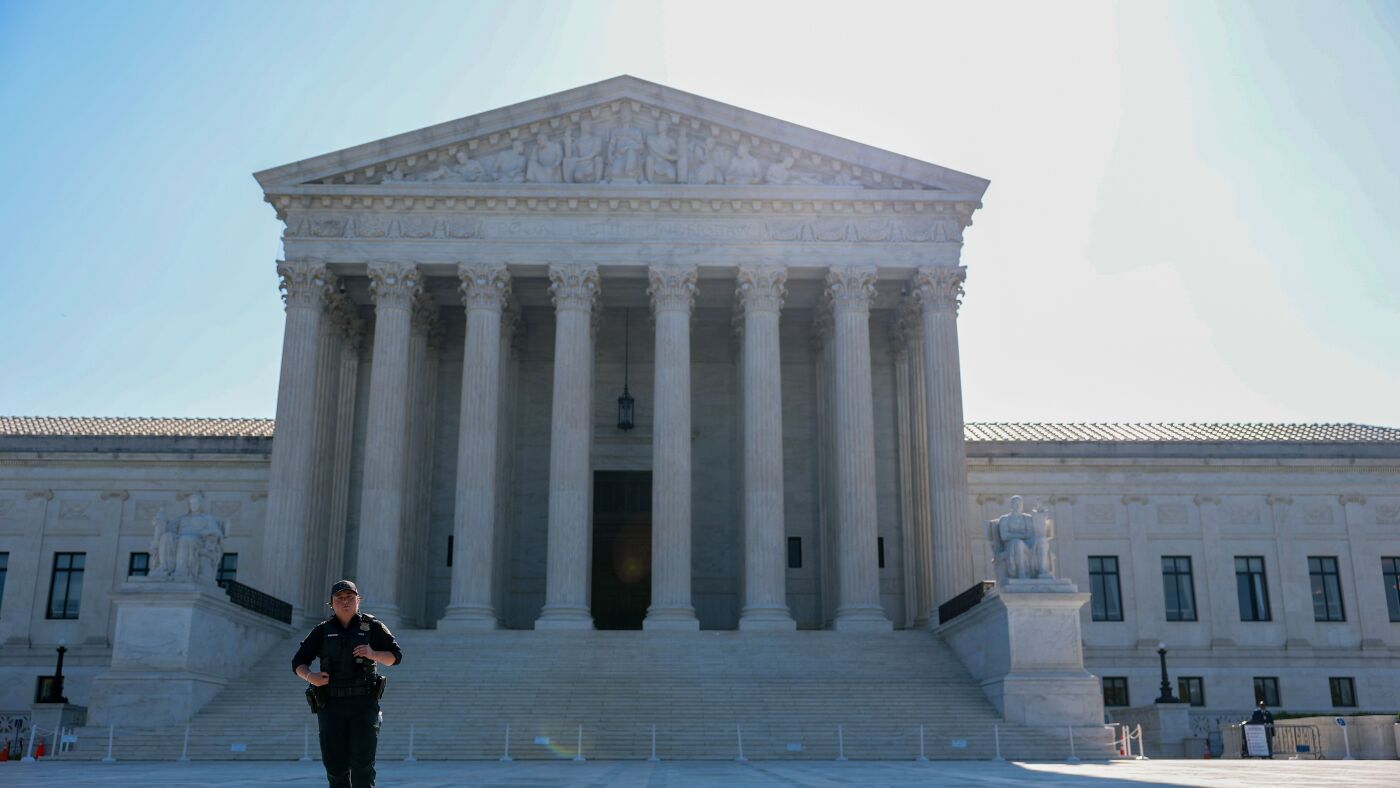
The U.S. Supreme Court
Tasos Katopodis/Getty Images
hide caption
toggle caption
Tasos Katopodis/Getty Images
The Supreme Court Tuesday upheld the long-established right of children born on U.S. soil to automatic American citizenship, regardless of their parents’ immigration status. In so doing, the court rejected President Trump’s most aggressive attempt to limit immigration in the United States.
Writing for the court majority, Chief Justice John Roberts traced birthright citizenship back to the founding of the nation. Just as the colonists demanded “the rights of Englishmen” more than 250 years ago, he said, Congress, after the Civil War, amended the Constitution to specify automatic citizenship for any child born on U.S. soil.
“Citizenship then and now was the right to have rights”—and the framers of the 14th amendment extended that promise to every free born person in this land. He concluded: “We keep that promise today.”
The vote was 6-to-3, depending on how you count it. Altogether, five justices signed on to the Roberts’ majority opinion. A sixth, Justice Brett Kavanaugh, agreed only that federal legislation enacted in the 1950s grants automatic citizenship for children born in the U.S.
Justice Clarence Thomas wrote the lead dissent, a 91-page opus that agreed with Trump’s assertion that the 14th amendment only applied to former slaves and their descendants. The Thomas dissent added ominously that he “was not sure that “today’s opinion will stand the test of time.” The dissent was joined by Justice Neil Gorsuch, with Justice Samuel Alito writing a separate dissent.
Justice Ketanji Brown Jackson, who, like Thomas is African American, responded to some of the themes in the Thomas dissent.
“Despite his longstanding endorsement of a colorblind society,” she wrote, “Justice Thomas now surprisingly suggests that the citizenship clause was a race-conscious remedial measure relating only to freed slaves.”
Cecillia Wang, legal director of the ACLU, who successfully argued the case at the Supreme Court, said President’s Trump failed attempt to limit birthright citizenship was transparent.
“A majority of the court saw through what the president was trying to do in spinning birthright citizenship as something that can flex and retract and expand depending on what the administration in power thinks about immigration policy,” she said.
Wang sees birthright citizenship as “much more fundamental than that.”
“It is part of how our country rejected caste distinctions and championed freedom and equality,” she said.
Yale law professor Akhil Amar called the court’s opinion a classic example of the court sticking to the original meaning of the Constitution. The text of the 14th Amendment, he said, “is about the child. It doesn’t say anything about parents.”
University of Virginia law professor Amanda Frost, however, was surprised and saddened that the court was so closely divided.
“The very length of the opinion,” she told NPR, plus “the fact that you had four justices say the Constitution does not require near universal birthright citizenship, which had been the understanding, that suggests that this is a fringe argument that the Trump administration has succeeded in moving into the mainstream, even though it has not succeeded in the end of the result.”
The issues in the birthright case focused in large part on the longstanding, and as of Tuesday, still standing, meaning of the 14th Amendment, which was enacted after the Civil War. It guarantees birthright citizenship to almost all persons born or naturalized in the United States. Chief Justice Roberts pointedly said the only exceptions written into the amendment were for certain Indian tribes, which were not subject to the laws of the United States at the time, and the children of foreign diplomats. That understanding was so well accepted that even in World War II, when Japanese citizens were confined to internment camps, their children, born in those camps, were automatically deemed to be American Citizens.
The Supreme Court’s decision Tuesday was the second time the justices have upheld birthright citizenship. The court’s previous decision came in 1898 in the case of Wong Kim Ark, born in the U.S. to Chinese parents. His great grandson, Norman Wong, issued a statement today saying, “My great grandfather, Wong Kim Ark, never set out to become a symbol. He was one man, only a cook, and yet he stood up for what was right, and I believe that it has made a difference. As a result, he stood up for the rights of all of us Americans – it just so happens that I am related to him. Today’s ruling shows that his victory remains as important now as it was in 1898.”
The high court also issued opinions in two other cases on Tuesday. In a 6-to-3, ideologically divided vote, the court upheld state laws that prevent transgender athletes from playing on women’s sports teams. Writing for the conservative majority, Justice Brett Kavanaugh said that the laws violate neither federal statutes nor the 14th Amendment. States, he said, have a legitimate interest in protecting the safety of sports, which he suggested could be compromised if transgender girls or women are allowed to play on female teams. Similarly, he said transgender athletes could also compromise fairness in athletic competition.
Sitting in the court chambers Tuesday when Kavanaugh summarized his opinion were not only his wife and mother, but his two daughters, whose athletic teams their father has long coached.
Justice Sonia Sotomayor, joined by her liberal colleagues, issued a partial dissent. She agreed with the majority that the benefits of sports are “immense,” but she wrote that these laws unconstitutionally deny transgender athletes the opportunity to play with their peers.
In a third ideologically divided case Tuesday, the Court struck down decades-long limits on the amount of money political parties can spend on candidates. The limits were challenged by the Republican National Committee. The decision may well increase by millions of dollars the amount of money that will pour into campaigns.
-

 Illinois2 minutes ago
Illinois Product Farmers Market Highlights Local Flavors and Family Traditions
-

 Indiana9 minutes ago
2 Indiana men plead guilty in Montana oxycodone conspiracy case
-

 Iowa12 minutes ago
Iowa’s governor and her family on weeklong tour of Iowa tourist sites – Radio Iowa
-

 Kansas17 minutes ago
New mural to be unveiled Thursday afternoon in North Topeka
-

 Kentucky24 minutes ago
Former Northern Kentucky school bus driver sentenced in child pornography case
-

 Louisiana27 minutes ago
Audit finds barriers hinder Louisiana WIC enrollment – American Press
-

 Maine32 minutes ago
How to safely enjoy the water in Maine as temperatures rise
-

 Maryland39 minutes ago
Rep. Glenn Ivey, Community Members Discuss Gun Violence Solutions

