News
Some progress made in recovering U.S. Army soldiers submerged in Lithuanian swamp


Military personnel work at the site of a rescue operation for missing U.S. soldiers at Pabradė training ground, in Lithuania, on Friday.
Petras Malukas/AFP via Getty Images
hide caption
toggle caption
Petras Malukas/AFP via Getty Images
Scores of soldiers and rescue workers are heading to Lithuania to assist in the recovery efforts of four U.S. Army soldiers whose vehicle has been submerged in a swamp for more than five days.
The soldiers, all part of the 1st Brigade, 3rd Infantry Division, based at Fort Stewart in Georgia, went missing in the early hours of March 25 while on a training mission to recover another Army vehicle.
The incident happened in a training area near Pabradė, a city in eastern Lithuania close to the Belarus border. The vehicle carrying the four soldiers was discovered the next day, buried under a thick layer of mud and water.
Recovery efforts have been complicated by the muddy swampland and massive 70-ton weight of the missing soldiers’ M88 Hercules armored vehicle.
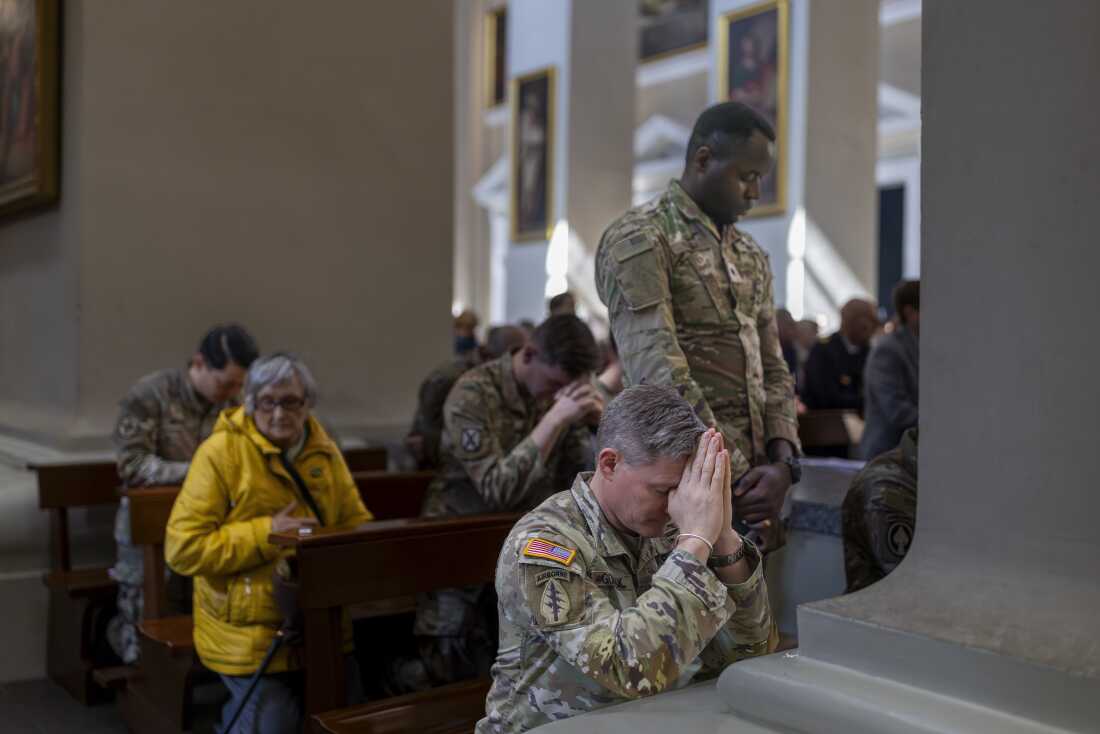
U.S. soldiers attend a Holy Mass at the Cathedral Basilica in Vilnius, Lithuania, on Sunday, for the four U.S. soldiers who went missing.
Mindaugas Kulbis/AP
hide caption
toggle caption
Mindaugas Kulbis/AP
In an update, the Army said the vehicle continued to sink into the bog and was about 13 feet below the water’s surface and stuck in more than 6 feet of mud, which U.S. officials have described as clay-like.
“It is highly complex trying to get to the vehicle itself with the terrain out here and where the M88 is sitting in a bog swamp-like area, below the waterline,” Brig. Gen. John Lloyd, commander of the U.S. Army Corps of Engineers North Atlantic Division, said in a statement Sunday.
He added: “So not only are we dealing with the terrain, a lot of mud that is over top of the vehicle, but also the fact that it’s 70 tons that we’re trying to recover out of a swamp or bog.”
A specialized U.S. Navy dive team, who arrived on site and made an initial dive on Saturday, also had a difficult time navigating the swamp. “Last night, divers were in the water trying to get to the vehicle. We were unable to because of the amount of mud,” Lloyd said.
But on Sunday, the U.S. military said the dive team managed to successfully attach a line to one hoist point on the submerged vehicle. The goal is to hook up a series of hoists in order to pull the vehicle out of the mud.
“This is the first big step towards successfully recovering the vehicle and bringing our Soldiers home,” the U.S. Army Europe and Africa said in a statement. “We expect that process to take some time, as the amount of pressure and suction from the mud will take significant power to overcome.”

Military personnel work at the site of a rescue operation for missing U.S. soldiers at Pabradė training ground, in Lithuania, on Friday.
Petras Malukas/AFP via Getty Images
hide caption
toggle caption
Petras Malukas/AFP via Getty Images
Over the past week, rescue crews have been working to remove water and mud from the site using various draining, digging and dredging techniques. The Army said the process has been slow and challenging due to “ground water seepage.” The terrain has been unable to support the heavy equipment required to extract the vehicle.
More than 200 personnel have been involved in the recovery effort, including American and Lithuanian soldiers, Lithuanian authorities, and 55 engineers from the Polish Armed Forces, according to the U.S. military.
The families of the four missing soldiers have been notified and the U.S. military said it is continuing to update the families on the status of search efforts.
“This tragic situation weighs heavily on all of us,” U.S. Army Maj. Gen. Curtis Taylor, the commanding general of 1st Armored Division, said last week in a statement. “We want everyone to know, we will not stop until our Soldiers are found.”
Lithuanian defense officials prayed for the recovery efforts at a Holy Mass on Sunday, according to the country’s defense ministry.
“Shoulder to shoulder, we stand together until we find missing soldiers,” Lithuanian Defense Minister Dovilė Šakalienė said on social media on Sunday.



The Supreme Court
Win McNamee/Getty Images
hide caption
toggle caption
Win McNamee/Getty Images
The Supreme Court on Monday intervened in New York’s redistricting process, blocking a lower court decision that would likely have flipped a Republican congressional district into a Democratic district.
At issue is the midterm redrawing of New York’s 11th congressional district, including Staten Island and a small part of Brooklyn. The district is currently held by a Republican, but on Jan. 21, a state Supreme Court judge ruled that the current district dilutes the power of Black and Latino voters in violation of the state constitution.
GOP Rep. Nicole Malliotakis, who represents the district, and the Republican co-chair of the state Board of Elections promptly appealed to the U.S. Supreme Court, asking the justices to block the redrawing as an unconstitutional “racial gerrymander.” New York’s congressional election cycle was set to officially begin Feb. 24, the opening day for candidates to seek placement on the ballot.
As in this year’s prior mid-decade redistricting fights — in Texas and California — the Trump administration backed the Republicans.
Voters and the State of New York contended it’s too soon for the Supreme Court to wade into this dispute. New York’s highest state court has not issued a final judgment, so the voters asserted that if the Supreme Court grants relief now “future stay applicants will see little purpose in waiting for state court rulings before coming to this Court” and “be rewarded for such gamesmanship.” The state argues this is an issue for “New York courts, not federal courts” to resolve, and there is sufficient time for the dispute to be resolved on the merits.
The court majority explained the decision to intervene in 101 words, which the three dissenting liberal justices summarized as “Rules for thee, but not for me.”
The unsigned majority order does not explain the Court’s rationale. It says only how long the stay will last, until the case moves through the New York State appeals courts. If, however, the losing party petitions and the court agrees to hear the challenge, the stay extends until the final opinion is announced.
Dissenting from the decision were Justices Sonia Sotomayor, Elena Kagan, and Ketanji Brown Jackson. Writing for the three, Sotomayor said that if nonfinal decisions of a state trial court can be brought to highest court, “then every decision from any court is now fair game.” More immediately, she noted, “By granting these applications, the Court thrusts itself into the middle of every election-law dispute around the country, even as many States redraw their congressional maps ahead of the 2026 election.”
Monday’s Supreme Court action deviates from the court’s hands-off pattern in these mid-term redistricting fights this year. In two previous cases — from Texas and California — the court refused to intervene, allowing newly drawn maps to stay in effect.
Requests for Supreme Court intervention on redistricting issues has been a recurring theme this term, a trend that is likely to grow. Earlier last month the high court allowed California to use a voter-approved, Democratic-friendly map. California’s redistricting came in response to a GOP-friendly redistricting plan in Texas that the Supreme Court also permitted to move forward. These redistricting efforts are expected to offset one another.
But the high court itself has yet to rule on a challenge to Louisiana’s voting map, which was drawn by the state legislature after the decennial census in order to create a second majority-Black district. Since the drawing of that second majority-black district, the state has backed away from that map, hoping to return to a plan that provides for only one majority-minority district.
The Supreme Court’s consideration of the Louisiana case has stretched across two terms. The justices failed to resolve the case last term and chose to order a second round of arguments this term adding a new question: Does the state’s intentional creation of a second majority-minority district violate the constitution’s Fourteenth and Fifteenth Amendments’ guarantee of the right to vote and the authority of Congress to enforce that mandate?
Following the addition of the new question, the state of Louisiana flipped positions to oppose the map it had just drawn and defended in court. Whether the Supreme Court follows suit remains to be seen. But the tone of the October argument suggested that the court’s conservative supermajority is likely to continue undercutting the 1965 Voting Rights Act.

Note: Map shows the area with a shake intensity of 3 or greater, which U.S.G.S. defines as “weak,” though the earthquake may be felt outside the areas shown. The New York Times
A minor earthquake with a preliminary magnitude of 3.5 struck in Central California on Monday, according to the United States Geological Survey.
The temblor happened at 7:17 a.m. Pacific time about 6 miles northwest of Pinnacles, Calif., data from the agency shows.
As seismologists review available data, they may revise the earthquake’s reported magnitude. Additional information collected about the earthquake may also prompt U.S.G.S. scientists to update the shake-severity map.
Source: United States Geological Survey | Notes: Shaking categories are based on the Modified Mercalli Intensity scale. When aftershock data is available, the corresponding maps and charts include earthquakes within 100 miles and seven days of the initial quake. All times above are Pacific time. Shake data is as of Monday, March 2 at 10:20 a.m. Eastern. Aftershocks data is as of Monday, March 2 at 11:18 a.m. Eastern.

The U.S. and Israel have been conducting strikes against targets in Iran since Saturday morning, with the aim of toppling Tehran’s clerical regime. Iran has fired back, with retaliatory assaults featuring missiles and drones targeting several Gulf countries and American bases in the Middle East.
“All six aircrew ejected safely, have been safely recovered, and are in stable condition. Kuwait has acknowledged this incident, and we are grateful for the efforts of the Kuwaiti defense forces and their support in this ongoing operation,” Central Command said.
“The cause of the incident is under investigation. Additional information will be released as it becomes available,” it added.
In a separate statement later Monday, Central Command said that American forces had been killed during combat since the strikes began.
“As of 7:30 am ET, March 2, four U.S. service members have been killed in action. The fourth service member, who was seriously wounded during Iran’s initial attacks, eventually succumbed to their injuries,” it said.
Major combat operations continue and our response effort is ongoing. The identities of the fallen are being withheld until 24 hours after next of kin notification,” Central Command added.
This story has been updated.

Husband, 19, fatally shot wife, 24, himself at Alabama hospital moments after welcoming their first child

Alaska’s voter roll transfer: Republicans bash hearing questioning if lieutenant governor broke the law

No. 2 Arizona tops Iowa State to win outright Big 12 title

Arkansas Library Board approves funding for public libraries after initially declining to do so | Arkansas Democrat Gazette

Supreme Court blocks California law limiting schools from telling parents about trans students

Florida High School Football Rankings: Top 25 teams – Oct. 21

Cleary's 21 help Le Moyne down Central Connecticut State 69-64 in OT

How old is Bo Nix? What to know about Oregon quarterback ahead of 2024 NFL Draft

99th annual Pony Swim held in Virginia

Indiana Members Credit Union announced as new anchor tenant at Bottleworks District

Trump sends official notification to Congress on strikes against Iran

Unexpected birth brings hope to near-extinct Amazon tribe
Supreme Court blocks redrawing of New York congressional map, dealing a win for GOP

Map: Earthquake Shakes Central California

Gas prices could jump as Middle East tensions threaten global oil supply
-

 World5 days ago
Exclusive: DeepSeek withholds latest AI model from US chipmakers including Nvidia, sources say
-

 Massachusetts6 days ago
Mother and daughter injured in Taunton house explosion
-

 Denver, CO5 days ago
10 acres charred, 5 injured in Thornton grass fire, evacuation orders lifted
-

 Louisiana1 week ago
Wildfire near Gum Swamp Road in Livingston Parish now under control; more than 200 acres burned
-

 Technology1 week ago
YouTube TV billing scam emails are hitting inboxes
-

 Politics1 week ago
OpenAI didn’t contact police despite employees flagging mass shooter’s concerning chatbot interactions: REPORT
-

 Technology1 week ago
Stellantis is in a crisis of its own making
-

 Oregon4 days ago
2026 OSAA Oregon Wrestling State Championship Results And Brackets – FloWrestling