News
Saturday is the winter solstice. Make the most of the shortest day of the year


People soak up the sun on deck chairs in the Allgäu region of southern Germany in 2020. Saturday is the winter solstice, the shortest day of the year in the Northern Hemisphere.
Benjamin Liss/dpa/AFP via Getty Images
hide caption
toggle caption
Benjamin Liss/dpa/AFP via Getty Images
Saturday is the winter solstice in the Northern Hemisphere. It’s not only the shortest day of the year, but the official arrival of astronomical winter.
“At 4:20 a.m. EST, the solstice marks the beginning of winter in the Northern Hemisphere and summer in the Southern Hemisphere,” NASA says on its website.

That means from now until the end of June, each day will get a little bit longer — and brighter (no matter what any famous animal prognosticators may predict).
In the meantime, there’s plenty to cherish during the cold season, and we’re not just talking about the December holidays.
Here are some ideas for how to celebrate the solstice and welcome winter:
Try out traditions from around the world
The winter solstice has long symbolized a time of renewal and ritual for people all over the world, as NPR has reported.

In Iran and many Central Asian countries, people gather to eat (especially red fruits like pomegranates and watermelons), drink and read poetry through the night. Some Japanese traditions include taking a hot bath with the citrus fruit yuzu and eating foods that contain the “n” sound (like udon) for good luck.
To learn more about winter solstice celebrations from both hemispheres, click here.
Stream the sunrise at Stonehenge
Each December and June, visitors flock to the ancient monument in England to celebrate the solstice.
The rock formation was built to align with the sun on those days, making for a dramatic view. On the winter solstice, the sun sets to the southwest of the stone circle (as opposed to the summer solstice, when the sun’s first rays shine into the heart of the monument).

The site allows entry — free of charge — for several hours on Saturday morning. If you can’t make the trip in person, you can catch a free livestream of the sunrise on the English Heritage YouTube and Facebook pages. It’s best suited for night owls or early birds, since it starts around 2:30 a.m. ET.
Enjoy the best of the Paul Winter Consort’s solstice concerts
Fittingly named saxophone player Paul Winter has been ushering in the winter solstice with a special concert for decades.
Since 1980, the Grammy winner and a slew of special guests have gathered in New York’s Cathedral of St. John the Divine to mark the occasion with music and dance. The event has found new homes since the COVID-19 pandemic, this year touring 10 acoustic venues throughout New England.

The sun rises over a snow-covered landscape in Denderhoutem, Belgium.
Hans Vandendriessche/BELGA/AFP via Getty Images
hide caption
toggle caption
Hans Vandendriessche/BELGA/AFP via Getty Images
NPR’s broadcast of Winter’s concerts has become a beloved seasonal tradition in itself. Last year, Winter combed through the archives and picked out his favorite moments from four decades of solstice celebrations. You can listen to them here.
Read The Shortest Day and hear an interview with its award-winning author
Susan Cooper’s children’s book The Shortest Day, released in 2019, is a celebration of light returning after the winter solstice.
The text of the book is actually a poem she wrote in the 1970s for The Christmas Revels (an annual celebration of the solstice), and it has been read at such events for more than four decades. Cooper, herself a Newbery Medal winner, partnered with Caldecott-honor illustrator Carson Ellis to bring its colorful imagery and wintry atmospherics to life.
Read or listen to NPR’s story on the beautiful book, and hear snippets of Cooper reading it out loud.
Prepare to do some “wintering”
Several recent works offer sage advice on how to “winter” — which essentially means embracing the season, not just weathering it.
This year, health psychologist Kari Leibowitz published How to Winter: Harness Your Mindset to Thrive on Cold, Dark, or Difficult Days. It examines how people in places with extreme winters — from Scandinavia to northern Japan — have positive attitudes about the season, and the book offers practical tips for those who want a warmer outlook.

As Leibowitz told NPR, those tips include bundling up to reclaim a summer activity in the winter (like a beach barbecue or park picnic), making a list of winter things you look forward to and trading your home’s “big light” for cozier candles and lamps.
Another helpful manual is Katherine May’s 2020 book, Wintering. The English author acknowledges that winter can be a painful and isolating time — but also one of transformation. Her book, which involved traveling to far-flung, freezing destinations, explores how to confront the season head-on.
“Every time we winter, we develop a new knowledge about how to go back into the world,” May told Morning Edition that year. “We learn about our tastes and preferences. We learn about what makes us happy.”

The sun shines between snow-covered branches at the Hareskoven forested area near Copenhagen, Denmark.
Liselotte Sabroe/Ritzau Scanpix/AFP via Getty Images
hide caption
toggle caption
Liselotte Sabroe/Ritzau Scanpix/AFP via Getty Images
Cozy up with the year’s best books, shows and films
With winter weather closing in, it’s a great time to pick out your next entertainment obsession, from a TV series to binge with your family to an album you can play on loop while defrosting in the car.
NPR has you covered with recommendations in every category, thanks to staff members who consumed culture in every possible form all year long. They’ve put together a complete guide to the best of 2024.

NPR’s annual book recommendations engine is back with over 350 new titles (plus all of those from years past, going back over a decade). Critics compiled their favorite shows and movies of the year — searchable by both genre and where to watch it.
NPR Music has pulled together a few lists of its own, including the 124 best songs and 50 best albums of the year. Plus, check out NPR’s favorite games of the year, sortable by platform and genre.
Take care of yourself
Maybe darker days are making you crave better sleep or have you feeling stuck in a rut. Perhaps you’re looking for tips on protecting your home from winter weather, your car from icy roads and your family from COVID-19. You could be curious about the benefits of cold plunging or how to dress for a winter workout.

Enter NPR’s Life Kit, with expert advice for all sorts of physical and mental health topics. Whether you’re looking to get a head start on your New Year’s resolutions or just taking winter day by day, here are some resources that can help:
A version of this story originally published in 2021.



A series of tornadoes hit parts of Texas, Illinois, and Indiana late Tuesday and overnight, as forecasters warn that the threat of severe weather, including flooding, will continue on Wednesday for tens of millions of people from Texas to Michigan.
At least four tornado touchdowns were reported in eastern Illinois, the National Weather Service (NWS) said, leaving a trail of damage stretching into Indiana, where at least two people were killed.
Video of a separate tornado in Taylor county, central Texas, on Tuesday was posted to weather.com. Officials there reported 60mph wind gusts and “baseball-sized” hail.
A search continued on Wednesday for possible victims of a supercell of storms that followed a path from Kankakee county, Illinois, into Indiana late on Tuesday. Rob Churchill, chief of the Lake Township fire department in Indiana, said in a video on Facebook that the small town of Lake Village had taken “a direct hit”.
“We have multiple homes destroyed, please stay away from the area,” he said.
Fire department officials said at an early morning Wednesday press conference that there were two fatalities, WTHR News, an NBC affiliate, reported. Details were not immediately available.
Shannon Cothran, sheriff of Newton county in Indiana, said in a separate Facebook video that the immediate threat of dangerous weather had passed, but first responders were faced with challenging circumstances as they dealt with the storm’s aftermath.
“[There’s] a lot of damage. Please do not come here. Do not try to help right now. We’ve got a lot of first responders out here doing their job, just give us some room,” he said.
The tornadoes in parts of Illinois and Indiana downed trees and power lines in an area south of Chicago, and overwhelmed 911 operators, officials said. The Kankakee county sheriff’s office said one tornado touched down near the Kankakee fairgrounds before moving north-east into Aroma park, where it caused extensive damage.
JB Pritzker, the Democratic Illinois governor, said in a post on X early Wednesday that he was briefed on the storm and tornado damage and that the state’s emergency management agency was in contact with local officials.
“Keeping in our thoughts all Illinoisans impacted by the severe weather – we’ll be here to help them recover,” he said.
Severe storms dumping rain and hail in parts of the midwest were threatening to bring intense tornadoes, damaging winds and very large hail from the southern plains to the southern Great Lakes, according to the NWS. States from Oklahoma to Michigan were under tornado watches.
Andrew Lyons, a meteorologist with the weather service’s storm prediction center, told the Associated Press that the exact number of tornado touchdowns would not be known until after officials conducted damage assessments.
He described it as a fairly typical early spring strong storm system that was expected to continue to move east and northeast towards the Atlantic coast on Wednesday, likely bringing more severe weather, he said.
Brandon Buckingham, an AccuWeather meteorologist, said at least 10 tornadoes were spotted in Illinois, Indiana and Texas.
“There were nearly 200 filtered reports of severe weather spanning more than 2,500 miles from Texas to Michigan,” he said in a post on the weather service’s website.
The forecaster said the chain of storms would peak midweek and “could become the most widespread and impactful severe weather outbreak so far this year”.
The severe weather could reach Washington DC by Wednesday afternoon, CBS News reported, bringing new threats of damaging winds and tornadoes. A line of storms was forecast to sweep east and move into Ohio and Tennessee, including the cities of Cincinnati, Memphis and Nashville, it said.

American Steve Emt competes in Sunday’s mixed doubles match against Italy, which the U.S. won.
Maja Hitij/Getty Images
hide caption
toggle caption
Maja Hitij/Getty Images
Anyone watching the Winter Paralympics has probably taken note of Steve Emt, who — along with Laura Dwyer — is representing Team USA in the Games’ first-ever mixed doubles event.
Their performance is one thing: The pair notched three dramatic, back-to-back wins in the round-robin tournament to reach the semifinals, marking the first time the U.S. has qualified for a medal round in wheelchair curling since the 2010 Paralympics.

After losing to Korea in the semifinals, Emt and Dwyer will face Latvia in the bronze medal match on Tuesday, in the hopes of winning the U.S. its first Paralympic medal in wheelchair curling.
But it’s their teamwork and attitude on ice that really set them apart. Emt, in particular, has charmed the internet, with his booming baritone delivering a steady stream of encouragement to his doubles partner and demands to the granite stones they’re sliding (“curl!” “sit!”).
“I have three older siblings. I was always on the basketball court getting beat up by them, so I had to assert myself on the court, around the kitchen table, everything,” he said when asked about his deep voice this week.

Steve Emt and Laura Dwyer have made sure to celebrate their wins, of which there have been many throughout this wheelchair curling mixed doubles round-robin tournament.
Maja Hitij/Getty Images
hide caption
toggle caption
Maja Hitij/Getty Images
While Emt, 56, is competing in a new event, he’s no stranger to the sport: The 10-time national champion and three-time Paralympian is the most decorated Paralympic curler in U.S. history.
But he didn’t know what curling was until he got recruited off the street just over a decade ago.
Emt, who is 6 feet, 5 inches tall, was enjoying a day in Cape Cod, Mass., in 2013 when a stranger with slicked-back hair approached and asked if he was local. Emt replied that he lived in Connecticut and suspiciously asked why.
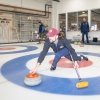
“He said, ‘Well, I train with the Paralympic rowing team here in the Cape. I saw you pushing up the hill back there. With your build, I could make you an Olympian in a year,’” Emt recalled, referring to his wheelchair. “And I heard ‘Olympics,’ I’m like: Let’s go. What the hell is curling?”
After their conversation, Emt drove home and did some research, confirming that curling was not related to weightlifting, as he originally suspected.
“I went back two weeks later and I threw my first stone, and it just bit me,” he said.
Before long, Emt was making the two-and-a-half-hour drive to Massachusetts to spend the weekend training with that stranger-turned-coach, Tony Colacchio. He made the U.S. wheelchair curling team in 2014 and competed at his first world championship in 2015. Emt made his Paralympic debut in Pyeongchang in 2018, five years after that fateful encounter.
Emt, speaking to reporters in October, said the sport of curling has changed him as a person, mellowing him out. But the existence of the sport as a competitive outlet for athletes with disabilities changed his life.

Emt had been an all-star high school athlete, an Army West Point cadet and a UConn basketball walk-on before a drunk driving incident paralyzed him from the waist down at 25 years old.
“I’m a jock … I need to compete, and I didn’t have anything going on in my life,” Emt said. “Seventeen years after my crash, I had a hole, and then [Colacchio] came along and stalked me into the sport.”
By that point, Emt had spent years working as a middle school math teacher, a high school basketball coach and a motivational speaker. The latter has been his full-time job for almost a decade, taking him to over 100 schools across the country each year. He tells those teenagers about the chance Colacchio took on him, encouraging them to “be a Tony.”
“Go sit with that kid at lunch that’s sitting alone … smile [at] somebody in a hallway, get your heads out of your phones, get your heads out of the sand,” he continued. “We’re all going through something … and a simple ‘hello’ or ‘good morning,’ it could change their day. It could change somebody’s life.”
Why Emt now shares his story

This is the third Paralympics for Emt, who is already eyeing Salt Lake City 2034.
Mattia Ozbot/Getty Images
hide caption
toggle caption
Mattia Ozbot/Getty Images
Emt wasn’t always so willing to open up. For the first half a year after his 1995 crash, he told everyone a deer had run in front of his car rather than admit he had gotten behind the wheel drunk.
“I was lying to myself, I was lying to everybody around me,” he said. “I didn’t want kids to look at me in my hometown, in the state, and everyone around the country, as a drunk driver. I wanted them to look at me as a stud athlete and a great person.”
Emt had been a “stud athlete”: His talents in high school basketball, soccer and baseball made him a star in his hometown of Hebron, Conn., and earned him a spot on the basketball team at West Point.
But he dropped out two years later, after his father’s sudden death from a heart attack. He went home to Connecticut and eventually enrolled at UConn, where he walked on to its storied basketball team, joining future NBA greats like Donyell Marshall. Emt says, with a chuckle, that he had 38.7 seconds of playing time in his two years.
Emt was wearing his Big East championship jacket the night of his 1995 accident, which he says left him for dead on the side of the highway. When he woke up from a coma a few days later, he learned he would never walk again.
And he didn’t want to tell people why, until a newspaper reporter approached him six months later wanting to tell his story — and encouraged him to be honest. He said the opportunity to “come clean” helped him accept what he’d done and forgive himself.
“That’s my label: Yeah I’m a curler, yeah I’m a speaker, yeah I’m a drunk driver,” he said. “I’m in a wheelchair because of a drunk driving crash, and I want you to know it and I want you to learn from me.”
Emt first got into motivational speaking about eight months after his accident, and has been doing it ever since. He calls it his therapy.

He says that and curling — which is about shaking hands with competitors instead of smack-talking them — has helped him slow down and appreciate the little things. Relocating to Wisconsin and the chiller pace of Midwest life has also helped. And he says he cherishes the platform that curling has given him.
“I want people to know: ‘Hey, when you’re ready to talk, I’m here for you.’ This is what I do, from my speaking to my curling, whatever it is, there are so many opportunities to be successful again,” he said. “When you wake up and you’re told you’re never going to walk again, it’s like, what do I do now? … And I just want people to know that there are so many avenues out there, so many things to do.”
Emt, the oldest Paralympian on Team USA, originally aimed to make it to three Games. But he’s now eyeing even more, as he’d like to compete on home turf in Salt Lake City in 2034 (two Games away).
“I’m going to be like 90 years old competing at the Paralympics,” he laughed.

Note: Map shows the area with a shake intensity of 3 or greater, which U.S.G.S. defines as “weak,” though the earthquake may be felt outside the areas shown. The New York Times
A minor, 2.3-magnitude earthquake struck about 12 miles north of New York City on Tuesday, according to the United States Geological Survey.
The temblor happened at 10:17 a.m. Eastern in Sleepy Hollow, N.Y., data from the agency shows.
The Westchester County emergency services department said in a statement that it had not received any reports of damage.
As seismologists review available data, they may revise the earthquake’s reported magnitude. Additional information collected about the earthquake may also prompt U.S.G.S. scientists to update the shake-severity map.
Source: United States Geological Survey | Notes: Shaking categories are based on the Modified Mercalli Intensity scale. When aftershock data is available, the corresponding maps and charts include earthquakes within 100 miles and seven days of the initial quake. All times above are Eastern. Shake data is as of Tuesday, March 10 at 10:30 a.m. Eastern. Aftershocks data is as of Tuesday, March 10 at 2:18 p.m. Eastern.

Videos show standing water inside Detroit elementary school, as source reports sewage smell

SF mayor assures there’s ‘no imminent threat’ after FBI report warns Iran aspires to attack CA

A look at Dallas Cowboys’ 2026 NFL draft picks after Osa Odighizuwa, Solomon Thomas trades

Dolphins focus on secondary, special teams with addition of three players

Kraft Group reaches deal with Foxborough on security funding for World Cup games at Gillette Stadium – The Boston Globe

Florida High School Football Rankings: Top 25 teams – Oct. 21

Cleary's 21 help Le Moyne down Central Connecticut State 69-64 in OT

How old is Bo Nix? What to know about Oregon quarterback ahead of 2024 NFL Draft

99th annual Pony Swim held in Virginia

Indiana Members Credit Union announced as new anchor tenant at Bottleworks District

Reporter’s Notebook: Trump’s SAVE Act ultimatum runs into Senate reality

Not ‘a litre of oil’ to pass Strait of Hormuz, expect $200 price tag: Iran

Tornadoes hit Illinois, Indiana and Texas as severe storms sweep US

EXCLUSIVE: ICE says El Paso detention facility will stay open under new contractor after $1.2B deal scrapped

Von der Leyen ‘acting outside of competence,’ Araud tells Euronews
-

 Wisconsin1 week ago
Setting sail on iceboats across a frozen lake in Wisconsin
-

 Massachusetts1 week ago
Massachusetts man awaits word from family in Iran after attacks
-

 Detroit, MI6 days ago
U.S. Postal Service could run out of money within a year
-

 Pennsylvania6 days ago
Pa. man found guilty of raping teen girl who he took to Mexico
-

 Miami, FL1 week ago
City of Miami celebrates reopening of Flagler Street as part of beautification project
-

 Sports7 days ago
Keith Olbermann under fire for calling Lou Holtz a ‘scumbag’ after legendary coach’s death
-

 Michigan2 days ago
Operation BBQ Relief helping with Southwest Michigan tornado recovery
-

 Virginia1 week ago
Giants will hold 2026 training camp in West Virginia