News
Ohio deputy who fatally shot Black man entering his grandmother’s house is convicted of reckless homicide


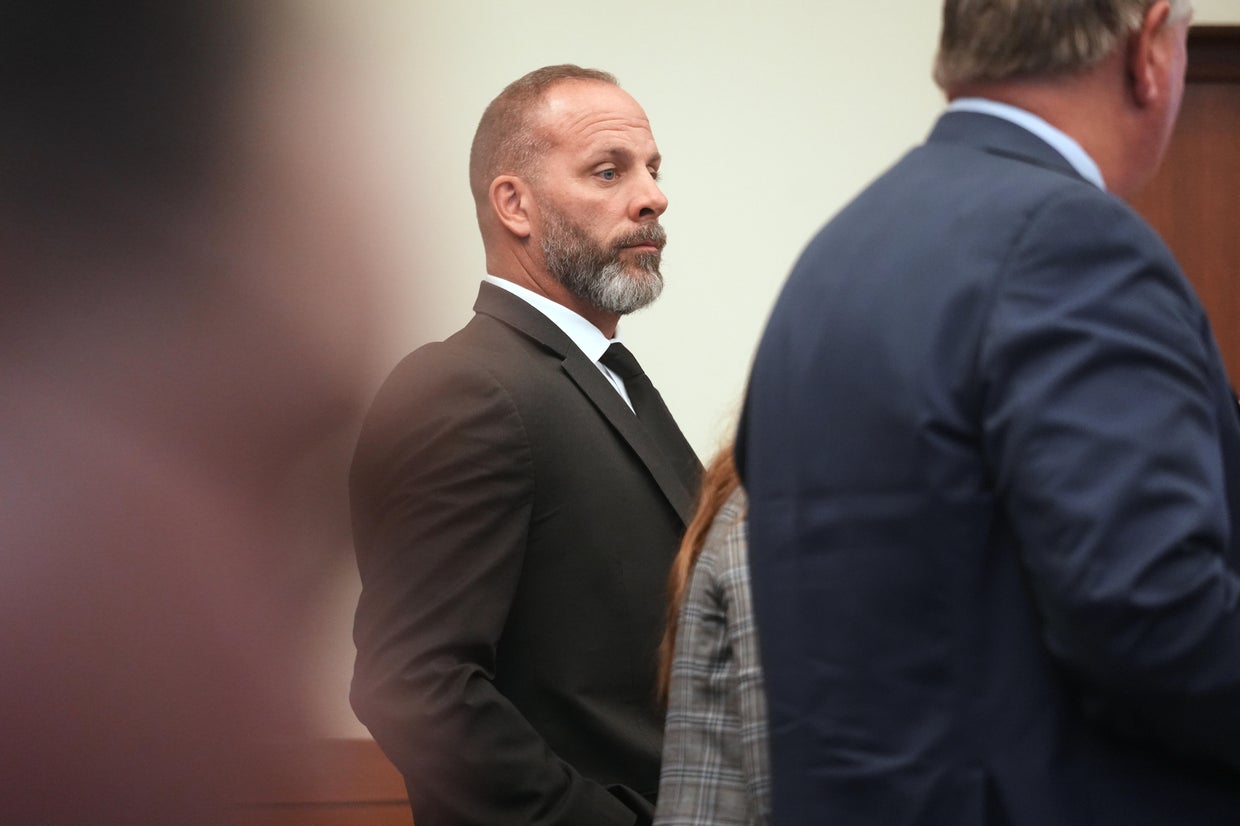
A former sheriff’s deputy was found guilty of reckless homicide at trial Thursday for shooting a Black man who was bringing sandwiches to his grandmother’s house.
The killing of Casey Goodson Jr. by Jason Meade in December 2020 had provoked outrage in Ohio.
Trial jurors said they couldn’t agree on the more serious charge of murder, prompting the judge to declare a mistrial on that count.
Meade, who is White, said his shooting of Goodson — five times in the back and once in the side — was justified because he saw the 23-year-old holding a gun and turning toward him in the doorway of the house in Columbus. But no one else testified they saw Goodson holding the gun he was licensed to carry, and no cameras recorded the shooting.
This was Meade’s second murder trial after the first one ended in a mistrial two years ago. He is now the second White law enforcement officer to be convicted in the killing of a Black man in the state since the 2020 killing of George Floyd in Minnesota sparked national protests.
Tamala Payne, Goodson’s mother, said the guilty verdict gives her family closure and peace. She previously told CBS News that she believed her son had been “murdered in cold blood.”
“I’m happy, I’m sad and I’m everywhere,” Payne told CBS affiliate WBNS. She said that to have Meade “convicted of something is still a great feeling.”
Meade had testified in the first trial that he pursued Goodson after the man waved a gun at him as they passed each other in their vehicles. According to his family and prosecutors, Goodson was holding a bag of Subway sandwiches in one hand and his keys in the other, and was listening to music through earbuds when he was killed.
Meade did not take the stand at his second trial.
Prosecutors also said the evidence suggests the gun wasn’t in his hands, but in a flimsy holder under his belt. They added it was found under his body, its safety mechanism still engaged, as Goodson laid mortally wounded on the kitchen floor of his grandmother’s house.
Meade, now 47, retired from the Franklin County Sheriff’s Department in 2021. He’s also a Baptist pastor. His attorney cited Meade’s oral and written accounts of what happened, and said the shooting was justified.
Ohio law defines murder as the purposeful causing of a death, while the lesser charge of reckless murder means the defendant acted recklessly in causing a death. The former is punishable by up to life in prison, while the latter carries a maximum prison sentence of five years.
Judge David Young set sentencing for July 16.
Prosecutors said they were pleased with the guilty verdict on the reckless homicide charge and haven’t decided yet whether to pursue a third trial on the murder charge — something Payne said she would like to see happen.
“Knowing that in the first trial, nine jurors wanted to convict him of murder, and (in) this trial, 10 jurors wanted to convict him of murder, there’s an overwhelming number of folks who hear this case and they understand that this was murder,” Sean Walton, the attorney for the Payne family, told WBNS.
Defense attorneys Mark Collins and Kaitlyn Stephens did not address the media afterward.
Following the verdict, Brian Steel, president and chief executive of the Fraternal Order of Police Capital City Lodge #9, said he respects the jury but was “disappointed” with the decision. He said he hopes the prosecutor’s office does not seek a retrial on the murder charge.
“This was long six years drawn out. This is the second trial. I hope they’re for the sake of not only the Meade family, the Goodson family and the community, I hope we don’t try to do a third trial on this murder charge,” Steel said.

Christopher Corne was driving nearby that day and testified for the prosecution at both trials. He said Goodson seemed to be dancing and singing in his truck shortly before the shooting. He also testified during the first trial that he did not see a gun in Goodson’s hand.
Columbus police Officer Samuel Rippey testified at the second trial that while he was administering emergency treatment to Goodson, he saw the gun, with an extended magazine, lying on the floor.
Goodson’s death provoked public outrage in Ohio as the killings of Black people by White officers increased demands for police reform following the killing of Floyd by a White police officer in Minneapolis.
Banners were hung from highway overpasses in Columbus, carrying messages such as “Justice for Casey Goodson Jr.” and “Convict Murderer Meade.” The judge ordered the banners taken down during the trial.
Previous Ohio prosecutions in such cases led to only one conviction — that of Columbus police officer Adam Coy, who was indicted on charges including murder in the 2020 killing of Andre Hill.



News
A day after Alito’s testy response to Sotomayor’s dissent, court says it was a ‘misunderstanding’

The justices of the U.S. Supreme Court, with Justice Sonia Sotomayor (seated left) and Justice Samuel Alito (seated second from right).
Alex Wong/Getty Images
hide caption
toggle caption
Alex Wong/Getty Images
As the Supreme Court heads into the announcement of its final and hugely important opinions next week, there are reverberations from this week’s announcements, and Justice Samuel Alito’s public rebuke of his colleague Justice Sonia Sotomayor.
On Thursday, Justice Alito summarized from the bench three very big opinions he authored for the court’s six justice conservative majority. Alito, unlike most of his colleagues, doesn’t spend much time on these summaries. And it is rare that a justice has three big opinions to announce, but it is almost the end of the term, and there are a lot of big cases still outstanding.
The first case he announced came and went. Alito then moved on to a second case, this one tests whether migrants may apply for asylum in the U.S. by going to one of several ports of entry along the U.S.-Mexican border, and presenting themselves for admission. This entails presenting documents that persuade an asylum officer that applicants’ fear of persecution in their home country is credible enough to allow them to enter the U.S. while their asylum application is processed. Alito’s opinion ruled in favor of the Trump administration’s policy of refusing all such applicants by blocking them at the border. It was a policy also followed at one time by the Obama administration until it was blocked by the lower courts.
After Alito finished his summary of the opinion, he paused, at which point Justice Sotomayor read a summary of her contrary views in dissent. When she finished, however, Justice Alito did not move on to the announcement of his third opinion. Instead, he did something that nobody in the press corps ever remembers happening before. Looking much as if he had just bitten into a lemon, Alito said, “There is much that I would have added to my bench statement had I known there would be a dissent read.” And he then went on to a short extemporaneous rebuttal.
What caused the hissy fit? Did Sotomayor really fail to tell him she would have an oral dissent? That really would have been a breach of the court’s practices. A justice typically notifies the chief justice and the author of the majority opinion in writing if there is to be an oral dissent.
In response Friday to an inquiry from NPR came this terse statement from the court’s public information office.
“Justice Alito was notified in advance by Justice Sotomayor’s chambers that she would be reading a dissent from the bench. It was a misunderstanding on Justice Alito’s part.”
News
“It’s blood money”: Family of exonerated man in Texas yogurt shop murders speaks out after settlement

The widow and the daughter of Maurice Pierce, one of the four men wrongfully accused in the 1991 Texas yogurt shop murders, have confirmed they signed a multimillion-dollar settlement with the city of Austin.
Kimberli and Marisa Pierce spoke with correspondent Erin Moriarty in a new episode of the podcast “48 Hours: Case by Case.” Moriarty has reported on the yogurt shop murders for over 30 years.
Maurice Pierce’s widow Kimberli made clear that their priority has never been financial compensation. “It’s blood money for us. He died for this money,” Kimberli Pierce said. “It’s about the reform and the changes that need to happen, not only in Austin, but apparently across the country.”
They also went into great detail about what they believe happened when Maurice Pierce was shot and killed by police in 2010.
Maurice Pierce was one of four men, along with Michael Scott, Robert Springsteen and Forrest Welborn, who were wrongfully accused in the murders of four teenage girls in Austin on Dec. 6, 1991. Eliza Thomas, Amy Ayers, and sisters Jennifer and Sarah Harbison were tied up, shot and left inside the yogurt shop as it was set ablaze.
The four men were exonerated in February after investigators linked another man, Robert Eugene Brashers, to the killings. The city of Austin subsequently offered a $35 million settlement. Because Maurice Pierce died in 2010, his share of $10 million will go to Kimberli and Marisa Pierce.
Eight days after the killings, 16-year-old Maurice Pierce was arrested at a mall, carrying a .22, the same caliber handgun connected to the crime. Kimberli Pierce said police told Maurice Pierce that his gun was the murder weapon. He responded by mentioning his friend Forrest Welborn. Maurice Pierce was then wired up and sent to speak with Welborn, but investigators ultimately determined that Welborn and the others knew nothing about the murders, and no charges were filed at that time.
Marisa Pierce has said there was no evidence when her father was questioned, “only a detective and a narrative, a narrative so completely false. It feels evil.”
Nearly eight years later, in 1999, all four men were arrested after Scott and Springsteen confessed to the murders. They later recanted, saying they had been coerced. Springsteen and Scott were tried and convicted, but later those convictions were overturned on constitutional grounds. A subsequent DNA test excluded all four men. Maurice Pierce was never convicted but spent three years in jail before his release in 2003.
Kimberli Pierce said her husband came home a hardened man. She believes police continued to harass Maurice and their family after his release. In 2010, Maurice Pierce was stopped for a routine traffic stop, fled on foot, and was shot and killed by an Austin police officer who said Pierce had stabbed him with a knife.
Marisa and Kimberli Pierce told “48 Hours” that they intend to review the circumstances surrounding the night of Maurice Pierce’s death. Marisa Pierce revealed in new, emotional detail that she was on the phone with her father at the time. She believes he panicked and was only trying to get away, not to hurt anyone. She described her father’s last breaths: “And in those last moments, he had just said I’m sorry, I don’t think you’re gonna see me again, and I love you.”
“48 Hours” reached out to the Austin Police Department about the Pierces’ allegations of harassment and their questions about Maurice Pierce’s death in 2010. The police department said they had no additional comment.
For the Pierce family, the settlement is a starting point, not an end point. They have put forward seven proposed reforms they hope the city of Austin will approve, including appointing a child advocate whenever a minor is questioned, prohibiting deceptive interrogation tactics, educating juveniles about their rights and establishing accountability measures to address tunnel vision in police investigations.
In a statement shared with “48 Hours,” the Pierces wrote: “Real justice is not only about acknowledging harm after the fact but about creating safeguards that prevent future families from enduring the same pain.”
This year, Maine nearly became the first state to pass a statewide moratorium on new data centers. But before the law could take effect, supporters of an A.I. data center project in the small town of Jay rallied to fight the ban — and won. So why do residents there want one? We traveled to Jay to find out.
-

 Idaho3 minutes ago
The reactor race has begun
-

 Illinois10 minutes ago
New Illinois bill aims to overhaul public defense system | The Chicago Report
-

 Indiana13 minutes ago
Driver airlifted after NW Indiana police chase ends with crash into tree
-

 Iowa18 minutes ago
Vote: Class 1A Iowa High School Softball Midseason Player Of The Year
-

 Kansas25 minutes ago
Salina Stars Unite for Final High School Stage at Kansas Shrine Bowl
-

 Kentucky28 minutes ago
Beechwood’s Tyler Fryman commits to the Kentucky Wildcats
-

 Louisiana33 minutes ago
Southern football’s Marshall Faulk visits Central Louisiana
-

 Maine40 minutes ago
Gov. Mills to decide on Maine school choice tax credit program

