News
New Jersey’s special Democratic primary too early to call

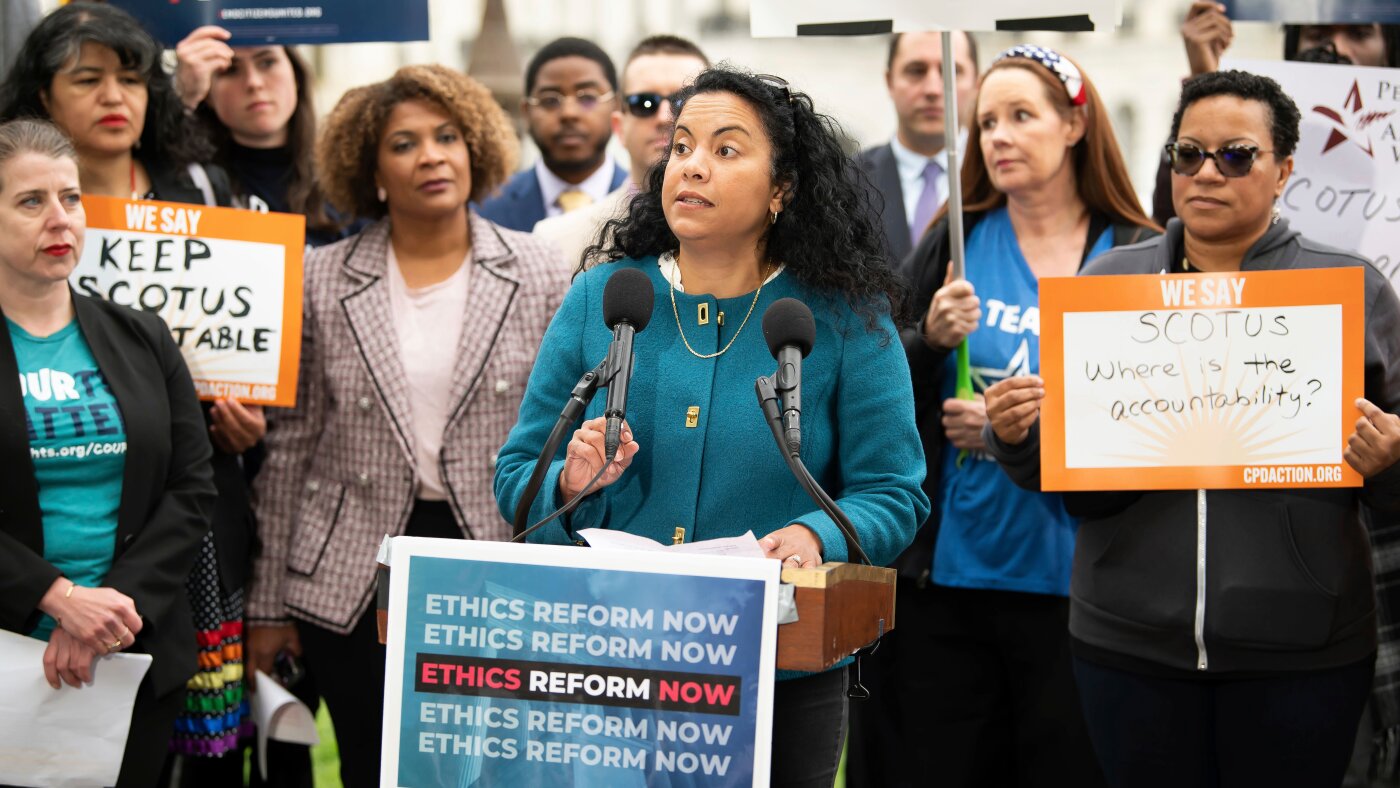
FILE – Analilia Mejia, center, speaks during a rally calling for SCOTUS ethics reform, May 2, 2023, in Washington.
Joy Asico/AP
hide caption
toggle caption
Joy Asico/AP
TRENTON, N.J. — The race in New Jersey between a onetime political director for Sen. Bernie Sanders and a former congressman was too early to call Thursday, in a special House Democratic primary for a seat that was vacated after Mikie Sherill was elected governor.
Former U.S. Rep. Tom Malinowski started election night with a significant lead over Analilia Mejia, based largely on early results from mail-in ballots. The margin narrowed as results from votes cast that day were tallied.
With more than 61,000 votes counted, Mejia led Malinowski by 486, or less than 1 percentage point.
All three counties in the district report some mail-in ballots yet to be processed. Also, mail-in ballots postmarked by election day can arrive as late as Wednesday and still be counted.
Malinowski did better than Mejia among the mail-in ballots already counted in all three counties, leaving the outcome of the race uncertain.
The Democratic winner will face Randolph Mayor Joe Hathaway, who was unopposed in the Republican primary, on April 16.
Malinowski served two terms in the House before losing a bid for reelection in a different district in 2022. He had the endorsement of New Jersey Democratic Sen. Andy Kim, who has built support among progressive groups.

FILE – Democratic Congressman Tom Malinowski speaks during his election night party in Garwood, N.J., Nov. 8, 2022.
Andres Kudacki/AP
hide caption
toggle caption
Andres Kudacki/AP
Mejia, a former head of the Working Families Alliance in the state and political director for Sanders during his 2020 presidential run, had the Vermont independent senator’s endorsement as well as that of U.S. Rep. Alexandria Ocasio Cortez of New York. She also worked in President Joe Biden’s Labor Department as deputy director of the women’s bureau.
Both Malinowski and Mejia were well ahead of the next-closest candidates: Brendan Gill, an elected commissioner in Essex County who has close ties to former Gov. Phil Murphy; and Tahesha Way, who served as lieutenant governor and secretary of state for two terms under Murphy until last month.
The other candidates were John Bartlett, Zach Beecher, J-L Cauvin, Marc Chaaban, Cammie Croft, Dean Dafis, Jeff Grayzel, Justin Strickland and Anna Lee Williams.
The district covers parts of Essex, Morris and Passaic counties in northern New Jersey, including some of New York City’s wealthier suburbs.
The special primary and April general election will determine who serves the remainder of Sherrill’s term, which ends next January. There will be a regular primary in June and general election in November for the next two-year term.
Sherrill, also a Democrat, represented the district for four terms after her election in 2018. She won despite the region’s historical loyalty to the GOP, a dynamic that began to shift during President Donald Trump’s first term.



Julie T. Le, a former government lawyer, described in stark terms how overstretched the legal system had become during the administration’s immigration crackdown in Minnesota. Now, she said, she hopes to fix the “system’s failures” by running for Congress.

A sign in front of the entrance of the Security Administration’s main campus on March 19, 2025 in Woodlawn, Maryland. Congress and the SSA’s Inspector General are investigating whistleblower claims about whether Department of Government Efficiency staff may have misused Social Security data.
Kayla Bartkowski/Getty Images
hide caption
toggle caption
Kayla Bartkowski/Getty Images
An internal government watchdog and members of Congress are separately investigating new allegations that a Department of Government Efficiency staffer potentially misused sensitive Social Security data.
The Social Security Administration’s inspector general notified the leaders of several House and Senate committees on Mar. 6 that it is reviewing an anonymous complaint “on matters relating to the potential misuse of SSA data by a former DOGE employee, among other allegations,” according to a copy of the letter obtained by NPR.
This week, Congressional Democrats investigating DOGE’s access to Social Security data also announced an expanded probe after receiving whistleblower information alleging a former DOGE software engineer at SSA claimed to have retained copies of sensitive databases filled with personal information about almost every living American. The whistleblower’s allegations were first reported by the Washington Post on Tuesday.
According to the Post‘s reporting, the former DOGE employee claimed at least one database was held on a personal thumb drive, and claimed to have retained “God-level” access to SSA systems, the whistleblower alleged. The former staffer also allegedly told colleagues they wanted to share the data with their private-sector employer, the Post reported. NPR has not reviewed the whistleblower complaint.

Rep. Robert Garcia of California, the House Oversight committee’s top Democrat, called the allegations “deeply disturbing” and said they show the Trump administration’s “callous disregard for the safety and security of Americans’ most sensitive information.”
“Not only has an ex-DOGE bro been accused of running around with the Social Security information of every American on a flash drive, he also may have the ability to edit and manipulate data at the Social Security Administration at will,” Garcia wrote in a statement.
The Office of the Inspector General for the Social Security Administration declined to comment, saying it doesn’t confirm or deny the existence of law enforcement investigations.
The inspector general’s office told lawmakers in its Mar. 6 letter that it was not sharing further information about the anonymous complaint because that “risks jeopardizing any investigation and potentially chills future complainants from submitting anonymous allegations of fraud, waste, and abuse.”
An unnamed spokesperson for SSA disputed the whistleblower’s claims in an email to NPR.
“The allegations by a singular anonymous source have been strongly refuted by all named parties – SSA, the former employee, and the company. Even the Washington Post admitted they could not verify the information – because it is not true,” the spokesperson said. (The Post story did not name the former DOGE employee or the company they work for.)
“SSA is focused on continuing our digital-first transformation to deliver better, faster service for every American,” the spokesperson continued, and went on to disparage the Washington Post.
Democrats in Congress call for more investigations
The whistleblower alleged the former DOGE staffer claimed to have retained copies of two databases, NUMIDENT and the Death Master File, according to the Post‘s report.
The NUMIDENT database contains sensitive records for almost every American alive today, including Social Security numbers, dates of birth, place of birth and parents’ names. The Death Master File includes records for individuals who have been reported as deceased.

An aerial of The Social Security Administration’s main campus in Woodlawn, Maryland. The agency is investigating claims that DOGE employees misused sensitive personal data for millions of Americans.
Kayla Bartkowski/Getty Images
hide caption
toggle caption
Kayla Bartkowski/Getty Images
As part of the House Oversight Committee Democrats’ ongoing investigation into DOGE, Garcia is now asking the Social Security Administration to answer questions about DOGE’s data access and wants former DOGE staffers affiliated with SSA to contact the committee to “clarify the facts surrounding DOGE use of Americans’ sensitive data.”
Other Democratic lawmakers who received the letter from the SSA inspector general also called for investigations into the whistleblower’s allegations.
“These allegations describe one of the largest known data breaches in American history, perpetrated by Trump appointees for the explicit purpose of weaponizing Americans’ sensitive personal data for political gain,” Sen. Ron Wyden (D-Ore.), the ranking member of the Senate Finance Committee, said in a statement. “There must be a full public accounting of this breach at Social Security, including justice for anyone who committed or enabled criminal theft of Americans’ data.”
Rep. John B. Larson (D-Conn.) and Richard E. Neal (D-Mass.), who sit on the House Ways and Means Committee, said in a statement: “These continued revelations demand a full investigation with accountability if wrongdoing is confirmed.”
A growing pattern of DOGE data access concerns
The OIG investigation and the whistleblower complaint come after the Social Security Administration disclosed in January that DOGE employees secretly and improperly shared sensitive personal data in 2025 and that the agency could not verify the extent of the violations.
The January disclosure was made in an ongoing court fight over whether DOGE improperly gained access to SSA data and abused that access. The disclosure also said two unnamed DOGE employees were referred to a federal watchdog for potentially violating the Hatch Act, which bars government employees from using their job for political activity.

The court filing also said SSA found that the employees communicated with a political advocacy group about matching Social Security data with state voter rolls.
DOGE team members also circumvented the agency’s IT rules and improperly shared data on outside servers, sent private records to other DOGE staffers outside the agency and had access to some data even after a judge temporarily blocked access.
Charles Borges, the former chief data officer at SSA, filed his own whistleblower disclosure last year alleging DOGE staffers improperly copied a dataset of more than 300 million Americans’ information into a virtual database without following security protocols.

Borges’ complaint said that last summer, a former DOGE employee at the SSA requested that the agency make a copy of its NUMIDENT database to a private cloud server that would effectively give DOGE officials unfettered access to the data.
On Wednesday, Borges told NPR the allegations made in the new whistleblower complaint would have “generational consequences” if true.
“This is exactly the scenario that kept me up at night. An irrecoverable loss of the entirety of our personal data. Once that data has ‘left the building’, you cannot close Pandora’s Box again,” Borges said.
“The loss of this data would not be ‘just another data breach,’ but could represent a structural failure of our identity system,” he said. “It could require significant federal action, counterintelligence planning and response, and the consideration of a complete redesign of how identity works in the United States.”
Have a tip to share with NPR? Reach out through encrypted communications on Signal to Stephen Fowler at stphnfwlr.25, Jude Joffe-Block at JudeJB.10 and Shannon Bond at shannonbond.01. Please use a nonwork device.

A series of tornadoes hit parts of Texas, Illinois, and Indiana late Tuesday and overnight, as forecasters warn that the threat of severe weather, including flooding, will continue on Wednesday for tens of millions of people from Texas to Michigan.
At least four tornado touchdowns were reported in eastern Illinois, the National Weather Service (NWS) said, leaving a trail of damage stretching into Indiana, where at least two people were killed.
Video of a separate tornado in Taylor county, central Texas, on Tuesday was posted to weather.com. Officials there reported 60mph wind gusts and “baseball-sized” hail.
A search continued on Wednesday for possible victims of a supercell of storms that followed a path from Kankakee county, Illinois, into Indiana late on Tuesday. Rob Churchill, chief of the Lake Township fire department in Indiana, said in a video on Facebook that the small town of Lake Village had taken “a direct hit”.
“We have multiple homes destroyed, please stay away from the area,” he said.
Fire department officials said at an early morning Wednesday press conference that there were two fatalities, WTHR News, an NBC affiliate, reported. Details were not immediately available.
Shannon Cothran, sheriff of Newton county in Indiana, said in a separate Facebook video that the immediate threat of dangerous weather had passed, but first responders were faced with challenging circumstances as they dealt with the storm’s aftermath.
“[There’s] a lot of damage. Please do not come here. Do not try to help right now. We’ve got a lot of first responders out here doing their job, just give us some room,” he said.
The tornadoes in parts of Illinois and Indiana downed trees and power lines in an area south of Chicago, and overwhelmed 911 operators, officials said. The Kankakee county sheriff’s office said one tornado touched down near the Kankakee fairgrounds before moving north-east into Aroma park, where it caused extensive damage.
JB Pritzker, the Democratic Illinois governor, said in a post on X early Wednesday that he was briefed on the storm and tornado damage and that the state’s emergency management agency was in contact with local officials.
“Keeping in our thoughts all Illinoisans impacted by the severe weather – we’ll be here to help them recover,” he said.
Severe storms dumping rain and hail in parts of the midwest were threatening to bring intense tornadoes, damaging winds and very large hail from the southern plains to the southern Great Lakes, according to the NWS. States from Oklahoma to Michigan were under tornado watches.
Andrew Lyons, a meteorologist with the weather service’s storm prediction center, told the Associated Press that the exact number of tornado touchdowns would not be known until after officials conducted damage assessments.
He described it as a fairly typical early spring strong storm system that was expected to continue to move east and northeast towards the Atlantic coast on Wednesday, likely bringing more severe weather, he said.
Brandon Buckingham, an AccuWeather meteorologist, said at least 10 tornadoes were spotted in Illinois, Indiana and Texas.
“There were nearly 200 filtered reports of severe weather spanning more than 2,500 miles from Texas to Michigan,” he said in a post on the weather service’s website.
The forecaster said the chain of storms would peak midweek and “could become the most widespread and impactful severe weather outbreak so far this year”.
The severe weather could reach Washington DC by Wednesday afternoon, CBS News reported, bringing new threats of damaging winds and tornadoes. A line of storms was forecast to sweep east and move into Ohio and Tennessee, including the cities of Cincinnati, Memphis and Nashville, it said.

Metro Detroit’s whirlwind weather this week continues with sun on Thursday, snow chances Friday

The Navy Jet Generations of San Francisco Kids Played on | KQED

Dallas Police Shooting: Armed man killed after barricading himself at Children’s Health hospital

Miami Springs police crack down on those illegally parking in disabled spots

Boston firefighter, National Guard member reportedly injured in strike that killed 6 US soldiers – The Boston Globe

Florida High School Football Rankings: Top 25 teams – Oct. 21

Cleary's 21 help Le Moyne down Central Connecticut State 69-64 in OT

How old is Bo Nix? What to know about Oregon quarterback ahead of 2024 NFL Draft

99th annual Pony Swim held in Virginia

Indiana Members Credit Union announced as new anchor tenant at Bottleworks District
ICE Lawyer Who Told Judge She Was Overwhelmed Is Running for Congress

Dr Oz helps older woman who collapsed during Trump’s speech at Kentucky event

The Ring: Is the EU a spectator or player as war grips Middle East?
The government is investigating new claims that DOGE misused Social Security data

Reporter’s Notebook: Trump’s SAVE Act ultimatum runs into Senate reality
-

 Massachusetts1 week ago
Massachusetts man awaits word from family in Iran after attacks
-

 Detroit, MI6 days ago
U.S. Postal Service could run out of money within a year
-

 Miami, FL1 week ago
City of Miami celebrates reopening of Flagler Street as part of beautification project
-

 Pennsylvania7 days ago
Pa. man found guilty of raping teen girl who he took to Mexico
-

 Sports1 week ago
Keith Olbermann under fire for calling Lou Holtz a ‘scumbag’ after legendary coach’s death
-

 Michigan3 days ago
Operation BBQ Relief helping with Southwest Michigan tornado recovery
-

 Culture1 week ago
Try This Quiz on the Real Locations in These Magical and Mysterious Novels
-

 Virginia1 week ago
Giants will hold 2026 training camp in West Virginia