News
Justice Department won't pursue contempt charges against Garland

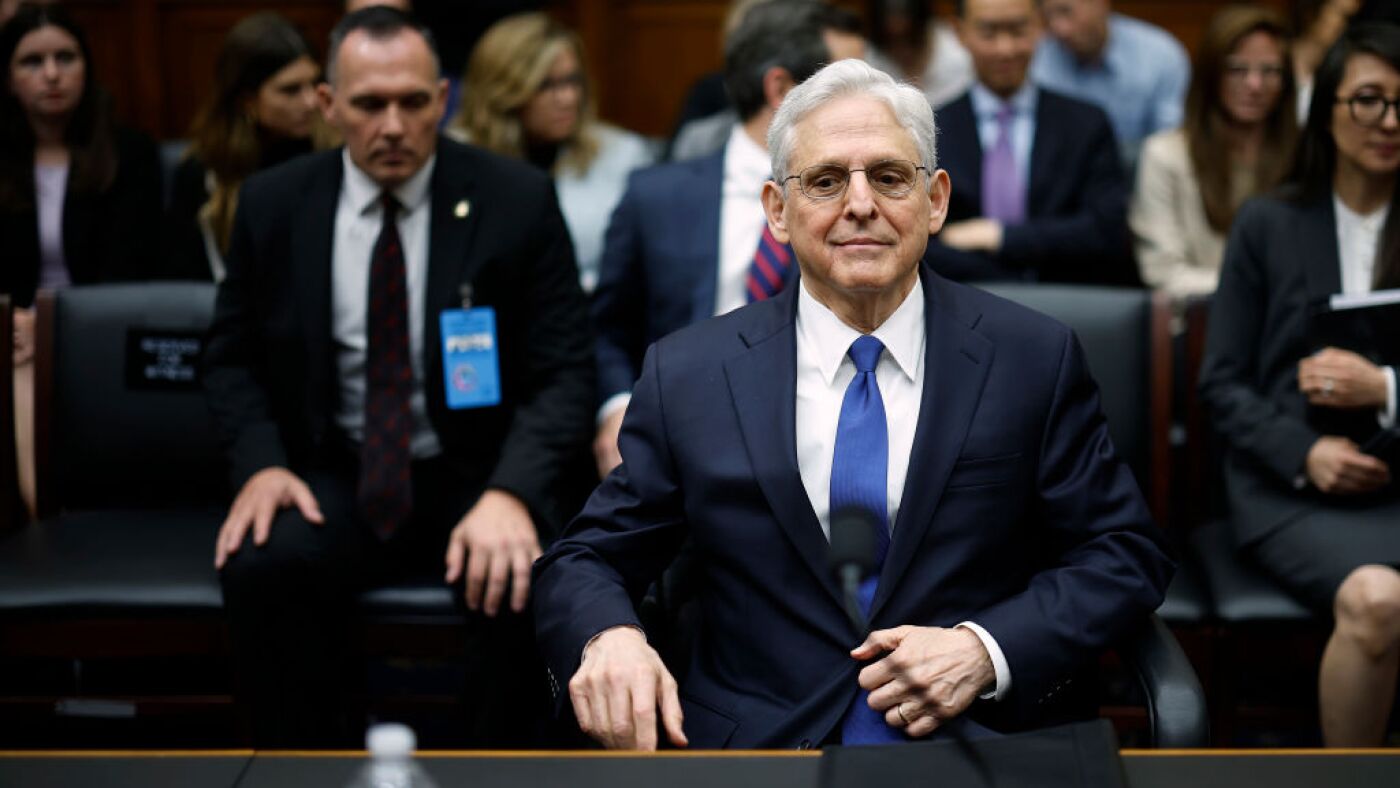
The Justice Department said it will not pursue a criminal cases against U.S. Attorney General Merrick Garland.
Chip Somodevilla/Getty Images
hide caption
toggle caption
Chip Somodevilla/Getty Images
The Justice Department has declined to pursue a criminal case against Attorney General Merrick Garland, just days after House Republicans voted to hold him in contempt for defying a congressional subpoena for audiotapes of President Biden.
Prosecutors said Garland enjoys a legal shield from prosecution because Biden asserted executive privilege over the tapes last month. The decision means the case is now closed.
That’s in line with how the Justice Department handled two previous episodes where congressional majorities advanced contempt resolutions against Garland’s predecessors, Attorneys General Eric Holder and Bill Barr.
“Consistent with this longstanding position and uniform practice, the Department has determined that the responses by Attorney General Garland to the subpoenas issued by the Committees did not constitute a crime, and accordingly the Department will not bring the congressional contempt citation before a grand jury or take any other action to prosecute the Attorney General,” Carlos Uriarte, the assistant attorney general, said in a letter to Speaker Mike Johnson.

Garland voiced disappointment over the June 12 vote, largely along party lines, writing that the House of Representatives “turned a serious congressional authority into a partisan weapon.”
“Today’s vote disregards the constitutional separation of powers, the Justice Department’s need to protect its investigations, and the substantial amount of information we have provided to the Committees,” Garland added.
The recordings feature hours of interviews between Biden and a special counsel investigating how classified information came to be found at Biden’s home and academic office. That prosecutor, Robert Hur, ended the probe with no charges, reasoning that jurors could view Biden as a “sympathetic, well-meaning elderly man with a poor memory.”
The Republican-led House Judiciary and Oversight Committees demanded the audiotapes of the Biden interviews. The Justice Department handed over written transcripts and correspondence with Biden’s lawyers. And Hur testified before lawmakers for about five hours. But DOJ refused to give up the recordings.
Garland told reporters the releasing the tapes could impede cooperation with sensitive investigations of the White House in the future and said there was no “legitimate” legislative reason for Congress to request them. Lawyers in the Justice Department’s Office of Legal Counsel agreed.
But House Speaker Mike Johnson, R-La., said “it is up to Congress—not the executive branch—to determine what materials it needs to conduct its own investigations and there are consequences for refusing to comply with lawful congressional subpoenas.”
The conservative-leaning Heritage Foundation and several media organizations have filed a separate lawsuit to gain access to the Biden audiotapes. But it’s not clear whether that case will reach resolution before the presidential election in November.



Note: Map shows the area with a shake intensity of 3 or greater, which U.S.G.S. defines as “weak,” though the earthquake may be felt outside the areas shown. The New York Times
A minor earthquake with a preliminary magnitude of 3.5 struck in Central California on Monday, according to the United States Geological Survey.
The temblor happened at 7:17 a.m. Pacific time about 6 miles northwest of Pinnacles, Calif., data from the agency shows.
As seismologists review available data, they may revise the earthquake’s reported magnitude. Additional information collected about the earthquake may also prompt U.S.G.S. scientists to update the shake-severity map.
Source: United States Geological Survey | Notes: Shaking categories are based on the Modified Mercalli Intensity scale. When aftershock data is available, the corresponding maps and charts include earthquakes within 100 miles and seven days of the initial quake. All times above are Pacific time. Shake data is as of Monday, March 2 at 10:20 a.m. Eastern. Aftershocks data is as of Monday, March 2 at 11:18 a.m. Eastern.

The U.S. and Israel have been conducting strikes against targets in Iran since Saturday morning, with the aim of toppling Tehran’s clerical regime. Iran has fired back, with retaliatory assaults featuring missiles and drones targeting several Gulf countries and American bases in the Middle East.
“All six aircrew ejected safely, have been safely recovered, and are in stable condition. Kuwait has acknowledged this incident, and we are grateful for the efforts of the Kuwaiti defense forces and their support in this ongoing operation,” Central Command said.
“The cause of the incident is under investigation. Additional information will be released as it becomes available,” it added.
In a separate statement later Monday, Central Command said that American forces had been killed during combat since the strikes began.
“As of 7:30 am ET, March 2, four U.S. service members have been killed in action. The fourth service member, who was seriously wounded during Iran’s initial attacks, eventually succumbed to their injuries,” it said.
Major combat operations continue and our response effort is ongoing. The identities of the fallen are being withheld until 24 hours after next of kin notification,” Central Command added.
This story has been updated.

Smoke rises over Konarak naval base in southern Iran on Sunday. The base was one of hundreds of targets of U.S. and Israeli forces throughout the country.
Planet Labs PBC
hide caption
toggle caption
Planet Labs PBC
Commercial satellite images are providing a unique look at the extent of damage being done to Iran’s military facilities across the country.
The U.S. and Israeli military campaign opened with a daytime attack that struck Iranian leadership in central Tehran. Smoke was still visible rising from Ayatollah Ali Khamenei’s compound following the attack that killed the supreme leader.

An image by the company Airbus taken on Saturday shows the aftermath of an Israeli strike on Iran’s Leadership House in central Tehran. Iran’s Supreme Leader Ayatollah Ali Khamenei was killed in the opening wave of attacks.
Pléiades Neo (c) Airbus DS 2026
hide caption
toggle caption
Pléiades Neo (c) Airbus DS 2026
Israel and the U.S. have gone on to strike targets across the country. Reports on social media indicate that there have been numerous military bases and compounds attacked all over Iran, and Iran has responded with attacks throughout the Middle East.
U.S. forces have also been striking at Iran’s navy. In a post on his social media platform, President Trump said that he had been briefed that U.S. forces had sunk nine Iranian naval vessels. U.S. Central Command did not immediately confirm that number but it did say it had struck an Iranian warship in port.

An image captured on Saturday shows a ship burning at Iran’s naval base at Konarak.
Satellite image ©2026 Vantor
hide caption
toggle caption
Satellite image ©2026 Vantor
Numerous satellite images show burning vessels at Konarak naval base in southern Iran. Images also show damage to a nearby airbase where hardened hangers were struck by precision munitions.

Hardened aircraft shelters at Konarak airbase were struck with precision munitions.
Satellite image ©2026 Vantor
hide caption
toggle caption
Satellite image ©2026 Vantor
And there was extensive damage at a drone base in the same area. Iran has launched numerous drones and missiles toward Israel and U.S. military installations in Bahrain, Kuwait and Qatar. Many drones have been intercepted but videos on social media show that some have evaded air defenses and caused damage in nearby Gulf countries. In Dubai, debris from an Iranian drone damaged the iconic Burj Al Arab, according to a statement from Dubai’s government.

Buildings at an Iranian drone base at Konarak were destroyed in the strikes.
Satellite image ©2026 Vantor
hide caption
toggle caption
Satellite image ©2026 Vantor
Iran’s most powerful weapons are its long-range missiles. The Iranian Revolutionary Guards have hidden the missiles deep inside mountain tunnels. Images taken Sunday in the mountains of northern Iran indicate that some of those tunnels were hit in a wave of strikes.
Following Khamenei’s death, Iran declared 40 days of mourning. Satellite images showed mourners gathering in Tehran’s Enghelab square on Sunday.
Iranian Foreign Ministry Spokesperson Esmail Baghaei told NPR on Sunday that Iran will continue to fight “foreign aggression, foreign domination.”
A White House official told NPR that Trump plans to talk to Iran’s interim leadership “eventually,” but that for now, U.S. operations continue in the region “unabated.”

A large crowd of mourners fill Enghelab Square in Tehran on Sunday, following the death of Iran’s Supreme Leader Ayatollah Ali Khamenei, who was killed in an Israeli airstrike.
Satellite image ©2026 Vantor
hide caption
toggle caption
Satellite image ©2026 Vantor

Arkansas Division of Higher Education on continuing your education after high school

Rep. Kevin Kiley announces run in California’s redrawn 6th Congressional District

How the Colorado Rockies Are Actually Building Its Opening Day Roster

Lawmakers again push to restore Shore Line East service to 2019 levels

Delaware Supreme Court upholds reforms to curb ‘DExit’ concerns

Florida High School Football Rankings: Top 25 teams – Oct. 21

Cleary's 21 help Le Moyne down Central Connecticut State 69-64 in OT

How old is Bo Nix? What to know about Oregon quarterback ahead of 2024 NFL Draft

99th annual Pony Swim held in Virginia

Indiana Members Credit Union announced as new anchor tenant at Bottleworks District

Map: Earthquake Shakes Central California

Gas prices could jump as Middle East tensions threaten global oil supply

Pakistan calls troops, orders 3-day curfew as 24 killed in pro-Iran rallies

US says Kuwait accidentally shot down 3 American jets

House Republicans push Johnson to go to war with Senate over SAVE Act
-

 World5 days ago
Exclusive: DeepSeek withholds latest AI model from US chipmakers including Nvidia, sources say
-

 Massachusetts5 days ago
Mother and daughter injured in Taunton house explosion
-

 Denver, CO5 days ago
10 acres charred, 5 injured in Thornton grass fire, evacuation orders lifted
-

 Louisiana1 week ago
Wildfire near Gum Swamp Road in Livingston Parish now under control; more than 200 acres burned
-

 Technology1 week ago
YouTube TV billing scam emails are hitting inboxes
-

 Politics1 week ago
OpenAI didn’t contact police despite employees flagging mass shooter’s concerning chatbot interactions: REPORT
-

 Technology1 week ago
Stellantis is in a crisis of its own making
-

 News1 week ago
World reacts as US top court limits Trump’s tariff powers