News
Judge says Education Dept. partisan out-of-office emails violated First Amendment

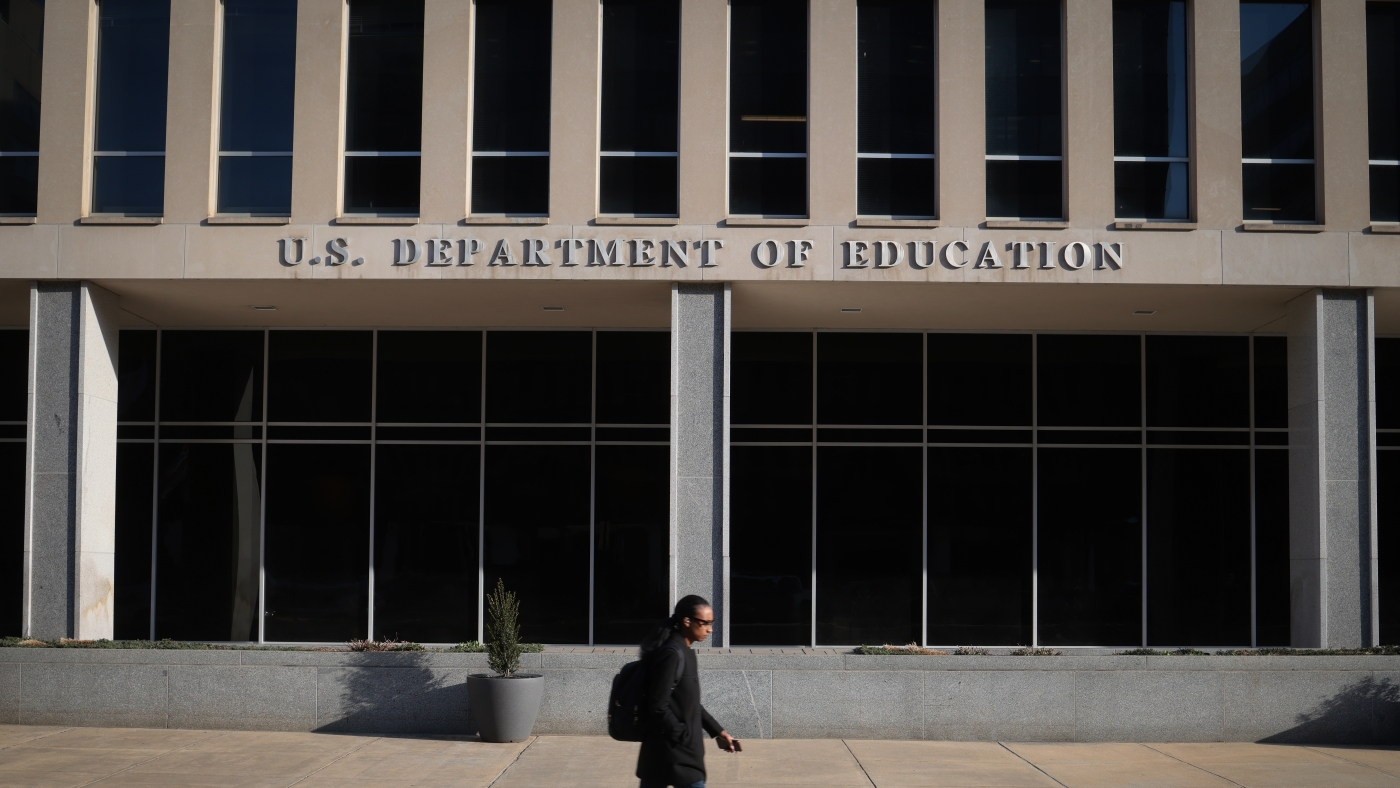
The Washington headquarters of the Department of Education on March 12. A federal judge ruled that the Trump administration violated the First Amendment rights of Education Department employees when it replaced their personalized out-of-office notifications with partisan language.
Win McNamee/Getty Images
hide caption
toggle caption
Win McNamee/Getty Images
A federal judge ruled that the Trump administration violated the First Amendment rights of Education Department employees when it replaced their personalized out-of-office e-mail notifications with partisan language blaming Democrats for the government shutdown.

“When government employees enter public service, they do not sign away their First Amendment rights,” U.S. District Judge Christopher Cooper wrote in his decision on Friday, “and they certainly do not sign up to be a billboard for any given administration’s partisan views.”
The lawsuit was brought by the American Federation of Government Employees (AFGE).
“This ridiculous ploy by the Trump administration was a clear violation of the First Amendment rights of the workers at the Education Department,” said Rachel Gittleman, the president of AFGE Local 252, which represents many Education Department workers, in a statement. She added it is “one of the many ways the Department’s leadership has threatened, harassed and demoralized these hardworking public servants in the last 10 months.”
Cooper ordered the department to restore union members’ personalized out-of-office email notices immediately. If that could not be done, he warned, then the department would be required to remove the partisan language from all employees’ accounts, union member or not.

According to court records, in the run-up to the government shutdown, Education Department employees were told to create an out-of-office message for their government email accounts to be used while workers were furloughed. The department even gave employees boilerplate language they could adapt that simply said:
“We are unable to respond to your request due to a lapse in appropriations for the Department of Education. We will respond to your request when appropriations are enacted. Thank you.”
But, on the shutdown’s first day, the department’s deputy chief of staff for operations overrode staffers’ personal messages and replaced them with this partisan autoreply:
“Thank you for contacting me. On September 19, 2025, the House of Representatives passed H.R. 5371, a clean continuing resolution. Unfortunately, Democrat Senators are blocking passage of H.R. 5371 in the Senate which has led to a lapse in appropriations. Due to the lapse in appropriations I am currently in furlough status. I will respond to emails once government functions resume.”
While the message was written in the first person, multiple employees told NPR they did not write it and were not told it would replace the out-of-office messages they had written.

At the time, Madi Biedermann, deputy assistant secretary for communications, said in a statement to NPR: “The email reminds those who reach out to Department of Education employees that we cannot respond because Senate Democrats are refusing to vote for a clean CR and fund the government. Where’s the lie?”
In his decision, Cooper lambasted the department for “turning its own workforce into political spokespeople through their official email accounts. The Department may have added insult to injury, but it also overplayed its hand.”
The department did not respond to an NPR request to comment on the ruling.
“Nonpartisanship is the foundation of the federal civil-service system,” Cooper wrote, a principle that Congress enshrined in the Hatch Act.
That law, passed in 1939, was intended to protect public employees from political pressure and, according to the U.S. Office of Special Counsel, “to ensure that federal programs are administered in a nonpartisan fashion.”



Smoke rises over Konarak naval base in southern Iran on Sunday. The base was one of hundreds of targets of U.S. and Israeli forces throughout the country.
Planet Labs PBC
hide caption
toggle caption
Planet Labs PBC
Commercial satellite images are providing a unique look at the extent of damage being done to Iran’s military facilities across the country.
The U.S. and Israeli military campaign opened with a daytime attack that struck Iranian leadership in central Tehran. Smoke was still visible rising from Ayatollah Ali Khamenei’s compound following the attack that killed the supreme leader.

An image by the company Airbus taken on Saturday shows the aftermath of an Israeli strike on Iran’s Leadership House in central Tehran. Iran’s Supreme Leader Ayatollah Ali Khamenei was killed in the opening wave of attacks.
Pléiades Neo (c) Airbus DS 2026
hide caption
toggle caption
Pléiades Neo (c) Airbus DS 2026
Israel and the U.S. have gone on to strike targets across the country. Reports on social media indicate that there have been numerous military bases and compounds attacked all over Iran, and Iran has responded with attacks throughout the Middle East.
U.S. forces have also been striking at Iran’s navy. In a post on his social media platform, President Trump said that he had been briefed that U.S. forces had sunk nine Iranian naval vessels. U.S. Central Command did not immediately confirm that number but it did say it had struck an Iranian warship in port.

An image captured on Saturday shows a ship burning at Iran’s naval base at Konarak.
Satellite image ©2026 Vantor
hide caption
toggle caption
Satellite image ©2026 Vantor
Numerous satellite images show burning vessels at Konarak naval base in southern Iran. Images also show damage to a nearby airbase where hardened hangers were struck by precision munitions.

Hardened aircraft shelters at Konarak airbase were struck with precision munitions.
Satellite image ©2026 Vantor
hide caption
toggle caption
Satellite image ©2026 Vantor
And there was extensive damage at a drone base in the same area. Iran has launched numerous drones and missiles toward Israel and U.S. military installations in Bahrain, Kuwait and Qatar. Many drones have been intercepted but videos on social media show that some have evaded air defenses and caused damage in nearby Gulf countries. In Dubai, debris from an Iranian drone damaged the iconic Burj Al Arab, according to a statement from Dubai’s government.

Buildings at an Iranian drone base at Konarak were destroyed in the strikes.
Satellite image ©2026 Vantor
hide caption
toggle caption
Satellite image ©2026 Vantor
Iran’s most powerful weapons are its long-range missiles. The Iranian Revolutionary Guards have hidden the missiles deep inside mountain tunnels. Images taken Sunday in the mountains of northern Iran indicate that some of those tunnels were hit in a wave of strikes.
Following Khamenei’s death, Iran declared 40 days of mourning. Satellite images showed mourners gathering in Tehran’s Enghelab square on Sunday.
Iranian Foreign Ministry Spokesperson Esmail Baghaei told NPR on Sunday that Iran will continue to fight “foreign aggression, foreign domination.”
A White House official told NPR that Trump plans to talk to Iran’s interim leadership “eventually,” but that for now, U.S. operations continue in the region “unabated.”

A large crowd of mourners fill Enghelab Square in Tehran on Sunday, following the death of Iran’s Supreme Leader Ayatollah Ali Khamenei, who was killed in an Israeli airstrike.
Satellite image ©2026 Vantor
hide caption
toggle caption
Satellite image ©2026 Vantor

new video loaded: What the Texas Primary Battle Means for the Midterms
By J. David Goodman, Alexandra Ostasiewicz, June Kim and Luke Piotrowski
March 1, 2026

Gunfire rang out at a bar in Austin, Texas, early Sunday and at least three people were killed, the city’s police chief said.
Austin Police Chief Lisa Davis told reporters the shooter was killed by officers at the scene.
Fourteen others were hospitalized and three were in critical condition, Austin-Travis County EMS Chief Robert Luckritz said.
“We received a call at 1:39 a.m. and within 57 seconds, the first paramedics and officers were on scene actively treating the patients,” Luckritz said.
There was no initial word on the shooter’s identity or motive.
Davis noted how fortunate it was that there was a heavy police presence in Austin’s entertainment district at the time, enabling officers to respond quickly as bars were closing.
“Officers immediately transitioned … and were faced with the individual with a gun,” Davis said. “Three of our officers returned fire, killing the suspect.”
She called the shooting a “tragic, tragic” incident.

Austin Mayor Kirk Watson said his heart goes out to the victims, and he praised the swift response of first responders.
“They definitely saved lives,” he said.
Davis said federal law enforcement is aiding the investigation.

Canton High School students find success in personal finance

The Workout Habit That Can Become Harm

Film reviews: ‘How to Make a Killing,’ ‘Pillion,’ and ‘Midwinter Break’

Investors brace for a bigger backlash from Middle East war

‘Wait Wait’ for February 28. 2026: Live in Bloomington with Lilly King!

Florida High School Football Rankings: Top 25 teams – Oct. 21

Cleary's 21 help Le Moyne down Central Connecticut State 69-64 in OT

How old is Bo Nix? What to know about Oregon quarterback ahead of 2024 NFL Draft

99th annual Pony Swim held in Virginia

Indiana Members Credit Union announced as new anchor tenant at Bottleworks District

House Republicans push Johnson to go to war with Senate over SAVE Act

Israel FM says Europe too divided, slams Spanish PM
Satellite images provide view inside Iran at war

Video: What the Texas Primary Battle Means for the Midterms

Dems’ potential 2028 hopefuls come out against US strikes on Iran
-

 World4 days ago
Exclusive: DeepSeek withholds latest AI model from US chipmakers including Nvidia, sources say
-

 Massachusetts4 days ago
Mother and daughter injured in Taunton house explosion
-

 Montana1 week ago
2026 MHSA Montana Wrestling State Championship Brackets And Results – FloWrestling
-

 Denver, CO4 days ago
10 acres charred, 5 injured in Thornton grass fire, evacuation orders lifted
-

 Louisiana7 days ago
Wildfire near Gum Swamp Road in Livingston Parish now under control; more than 200 acres burned
-

 Technology1 week ago
YouTube TV billing scam emails are hitting inboxes
-

 Politics1 week ago
OpenAI didn’t contact police despite employees flagging mass shooter’s concerning chatbot interactions: REPORT
-

 Technology1 week ago
Stellantis is in a crisis of its own making