
Connect with us

News

How Trump’s Second Term Is Already Different From His First

Published

on

How Trump’s Second Term Is Already Different From His First

During his Inaugural Address on Monday, President Trump made a point of telling the country that he had learned “a lot” over the past eight years.

The four and a half days since have revealed what he meant.

Gone are the Washington outsiders who took the reins of government in 2017 and struggled to get its wheels turning. Instead, we’ve seen a hailstorm of action that reflects how Trump’s advisers have become masters of the government bureaucracy they have promised to upend.

My colleague Charlie Savage has covered law, government and the way presidents use their power for more than two decades. He reported extensively on the first Trump administration as well as on Trump’s plans for his second, and I asked him to talk us through just how much is different this time around — and what that could mean for the presidency to come.

Our conversation was condensed and edited for clarity.

Advertisement

JB: You covered the first Trump administration, and now you’ve covered the first week of the second one. What was different in the opening days of Trump II, compared with Trump I?

CS: The opening of the first Trump administration was chaotic and dysfunctional. Trump had little support from the Republican establishment during the 2016 campaign. He and many of the officials he gathered around him when he took office simply did not know what they were doing at first — and it showed. Trump issued only four executive orders in his first five days in office in 2017. Even when the pace later picked up, many of his early directives were effectively press releases that did not do much of substance, or were so poorly developed that it was a no-brainer for courts to block them.

By contrast, the second Trump administration has begun with a blizzard of consequential executive orders. A few are vague nothing-burgers — like ordering the government to think about ways to reduce prices — but most are very substantive. Many of his policy changes will strike many people as extreme. Some, as I wrote this week, pushed at the limits of legitimate executive power and may not survive court challenges. One about ending birthright citizenship has already been blocked for now. But inarguably, Trump is moving much more quickly to achieve his goals.

This is partly because he and his advisers learned a lot about how government works over the course of his first term. And partly because, over the past eight years, Trumpism has become the conservative establishment, and policy think tanks in Washington are now aligned with and helping him — like Project 2025.

To be sure, things are still bumpy, but Trump’s advisers have been carefully planning out this takeover.

Advertisement

What, specifically, does it seem like Trump — or the people around him — have learned since 2017? Have they figured out how to be bureaucrats?

Here’s one example of how they are operating more shrewdly. One of the executive orders that got less attention this week was about foreign visitors to the United States. It has a section that requires the government to take two months to study vetting and screening procedures in countries around the world, and then to deliver a report identifying which are so deficient as to supposedly warrant banning entry to the United States by any citizens of those countries.

It appears that the administration is planting a seed to later revive Trump’s controversial ban on travel by people from several predominantly Muslim countries. Last time, he abruptly imposed that policy days after taking office without careful planning, and the courts immediately blocked it. Making a show of having studied the issue first may make it easier to defend a new travel ban in court.

Who has been most responsible for putting these changes into practice?

One person who seems to have learned a lot is Stephen Miller, a top domestic policy adviser to Trump who has long been an architect of his immigration crackdown policies. He was a Senate aide before 2017, and learned over the course of Trump’s first term how to avoid pitfalls and get things done within the executive branch bureaucracy. He spent the four years out of office cultivating donors and relationships, both on Capitol Hill and with lawyers and others now going into the administration. He also helped get specific allies into key positions around the new administration, positioning them to keep the gears of bureaucracy turning the way he wants them to.

Advertisement

Trump clearly wanted to put a stamp on the first week of the presidency. But, in a way, is it actually Miller’s imprint that we are seeing, given how much preparation and nuts-and-bolts strategizing he has put into this opening salvo?

No president personally performs the nuts-and-bolts work of drafting the executive orders and proclamations that he signs. That said, I have no doubt that Miller played a major role in developing the cluster of immigration actions we saw this week. He had previewed a lot of those very steps back in the fall of 2023, when I and my colleagues Jonathan Swan and Maggie Haberman were working on a series about the policy stakes of a potential return to power by Trump.

Plenty of other people were heavily involved, too. For example, Russell Vought, who was Trump’s head of the Office of Management and Budget in his first term and is set to reprise that role, has been very interested in other policy themes we have seen reflected in these early orders, such as efforts to impose tighter political control over the federal bureaucracy. At Project 2025, Vought was in charge of drafting executive orders that Trump could consider issuing early on if he got back into power. Of course, during the campaign Trump tried to distance himself from Project 2025; we don’t know yet whether or which of these early orders trace back to that effort.

Taken together, what does Trump’s first week in office tell us about how he now views power, and about his hold on the levers of government? What might it tell us about how he’ll approach the next four years?

Trump has tightened his grip on the Republican Party, and that party controls Congress, so he has no fear of impeachment. He cannot run for president again, so he has no fear of rejection by voters. He appointed a large number of federal judges during his first term, which means he now faces a federal judiciary that is much more tilted in his favor than when he first took office. He managed to wriggle free from two federal indictments and even survived an assassination attempt. The decision last summer by the six Republican-appointed Supreme Court justices to declare a constitutional doctrine of broad immunity for presidents can only be giving him additional confidence.

Advertisement

Against the backdrop of all that, I think the scope and aggression of his early executive orders and his decision to grant clemency to even those Jan. 6 rioters who violently assaulted police officers are clear signals that he is feeling little constraint.

By now, you’ve seen the gesture made by the world’s richest man during President Trump’s inaugural festivities. You may also have seen his prominent defenders. But my colleague Katrin Bennhold, a former Berlin bureau chief, writes that there was little debate in Germany over the meaning of Musk’s outstretched arm.

In Germany, gestures like the one Musk made are illegal, along with other symbols and slogans from the Nazi era. So for the German establishment, the situation was very clear.

“A Hitler salute is a Hitler salute is a Hitler salute,” the prominent weekly Die Zeit wrote in an editorial.

“There is no need to make this unnecessarily complicated,” the editorial said. “Anyone on a political stage giving a political speech in front of a partly right-wing extremist audience” — present at the inauguration were several far-right politicians from Germany, Italy, France and Britain — “anyone who raises their right arm in a swinging manner and at an angle several times is doing the Hitler salute.”

Advertisement

Read more here.

As President Trump traveled to North Carolina and California on Friday, to view damage from Hurricane Helene, in Asheville, N.C., and from the continuing wildfires in Los Angeles, he seemed to demonstrate a tendency I wrote about just a couple of weeks ago: mixing politics into the once politically neutral territory of disasters.

As a candidate, Trump made a series of false claims about the Helene disaster response as he sought to depict the Biden administration’s efforts as hapless. On Friday in Asheville, he said that former President Biden had done a “bad job” and that he was mulling shuttering FEMA altogether. He has previously threatened to withhold disaster aid to California, and he said today that he wanted to secure new voter ID laws and new water management policies while he was there.

California officials are already worried about how he might treat their state.

“He’s infected much of the Republican Party in Washington to view us not as the United States of America but as red states and blue states,” Senator Adam Schiff, the California Democrat, told my colleague Annie Karni. “We’re going to have to deal with that.”

Advertisement

News

Video: How Trump Is Prioritizing White People as Refugees

Published

on

Video: How Trump Is Prioritizing White People as Refugees

new video loaded: How Trump Is Prioritizing White People as Refugees

President Trump has upended the U.S. refugee program to prioritize mainly white Afrikaners. Our White House correspondent Zolan Kanno-Youngs reports he is now is now considering doubling the amount he allows into the country.

By Zolan Kanno-Youngs, Gilad Thaler, Stephanie Swart, Jon Miller and Whitney Shefte

May 8, 2026

Continue Reading

News

UFO files spanning decades are released by Defense Department

Published

on

UFO files spanning decades are released by Defense Department

An image recorded on the Moon during the Apollo 12 mission in 1969 shows the shadows of astronauts, along with a highlighted area above the horizon showing “unidentified phenomena,” according to the Defense Department.

NASA/via Defense Department


hide caption

toggle caption

Advertisement

NASA/via Defense Department

Cold War reports of mysterious rotating saucers; recent sightings of metallic elliptical objects floating in mid-air. Those and other reports of unidentified anomalous phenomena or UAPs — the military’s term for UFOs — are described in a trove of documents released by the Department of Defense on Friday.

In all, the Pentagon released more than 160 records, citing President Trump’s call for unprecedented transparency in giving the public access to federal and military records related to unexplained encounters with strange phenomena.

President Trump said via Truth Social that with the documents and other records available to the public, “the people can decide for themselves, ‘WHAT THE HELL IS GOING ON?’ Have Fun and Enjoy!”

Advertisement

The records are posted to a specialized web portal, war.gov/info, which will house additional files as they’re released on a rolling basis.

“These files, hidden behind classifications, have long fueled justified speculation — and it’s time the American people see it for themselves,” Defense Secretary Pete Hegseth said in a Defense Department posting on Facebook as it made the files public.

Friday’s action “is the first in what will be an ongoing joint declassification and release effort,” Director of National Intelligence Tulsi Gabbard said.

One document cites unusual phenomena arising during the debriefing of the Apollo 11 technical crew in July of 1969, attributing three observations to astronaut Buzz Aldrin, from that lunar mission: “one, an object on the way out to the Moon; two, flashes of light inside the cabin; and three, a sighting on the return trip of a bright light tentatively assumed by the crew to be a laser.”

One of the oldest files dates from November 1948. The report from the U.S. Air Force Directorate of Intelligence is marked Top Secret, and it notes recurring instances of unidentified objects spotted in the skies over Europe.

Advertisement

“They have been reported by so many sources and from such a variety of places that we are convinced that they cannot be disregarded,” the report states, “and must be explained on some basis which is perhaps slightly beyond the scope of our present intelligence thinking.”

The report goes on to say that U.S. officers consulted their peers in Sweden’s intelligence service about the objects, and they were told, “these phenomena are obviously the result of a high technical skill which cannot be credited to any presently known culture on earth.”

That document is seemingly free of redactions. But many details in a more recent entry are obscured, as it relays the account of a woman with deep experience with U.S. military aircraft and drones who reported an inexplicable sighting in September of 2023, in an area where airspace had been closed for testing purposes.

Materials related to that incident include a composite sketch of an ovaloid metallic object floating above a treeline, with a bright light at one end of the object.

“They watched the object for five to ten seconds and then the object just disappeared,” the report states.

Advertisement

Several people in at least two cars corroborated the sighting, according to the report. It states that the unidentified woman who spoke to the FBI ” would not have reported the object if she had seen it by herself.”

And hinting at the stigma that is seen as a prevalent challenge to collecting and discussing such eyewitness accounts, the report states, “Several of her co-workers subsequently made fun of her due to her report.”

Some records include venerable witnesses — such as a well-known case in 1955, when a group led by then-Sen. Richard Russell, who chaired the Senate Armed Services Committee at the time, reported that they saw two strange objects from the window of a train in the former Soviet Union. The group, which included U.S. Army Lt. Col. E. U. Hathaway, reported seeing what looked to be “flying disc aircraft.”

The U.S. Air Attache who prepared the report describes the witnesses as “excellent sources.”

That 1955 sighting was described in records previously released by the CIA. But that report, based on a cable received from the U.S. Air Force, seems to have been partially redacted.

Advertisement

The report of the unidentified object isn’t the only bit of intelligence that the American visitors brought back: the folder also includes descriptions and a diagram of a jet bomber, and accounts of a railroad switching system designed to resolve the differing widths of Russian and Czech train tracks.

Continue Reading

News

Democratic Candidates and Voters Challenge Tennessee’s New Map

Published

on

Democratic Candidates and Voters Challenge Tennessee’s New Map

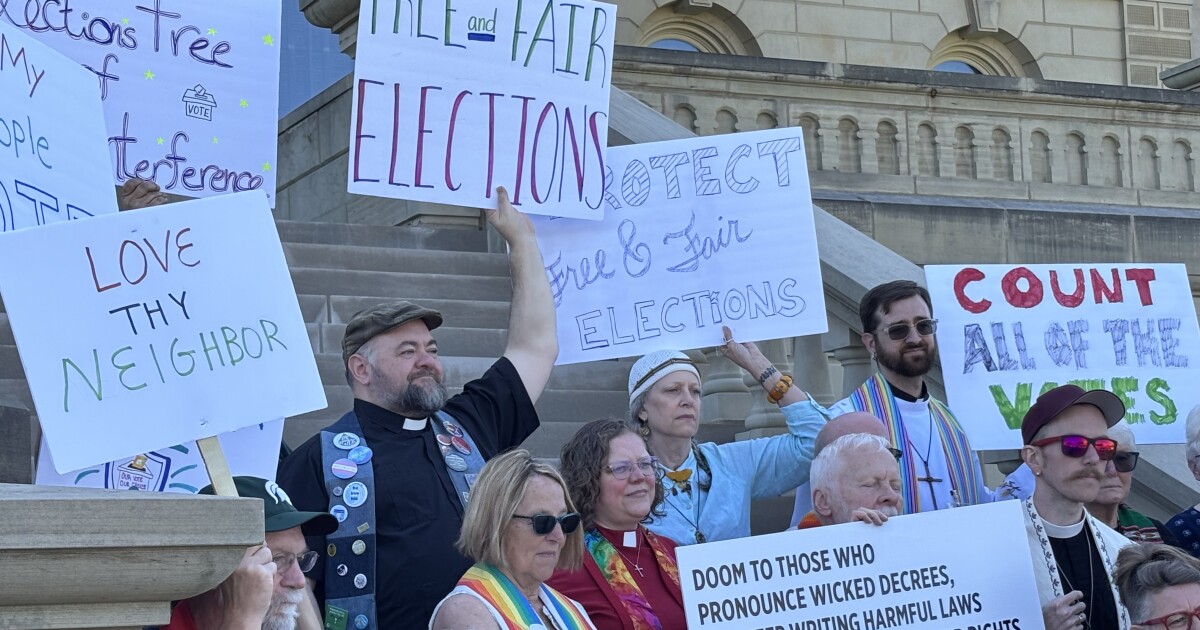
A coalition of voters and Democratic candidates sued Tennessee officials in federal court late Thursday over its new congressional map, arguing that it was unconstitutional to implement new district lines this close to the state’s August primary.

It was the latest twist in the aftermath of a Supreme Court ruling last week on the Voting Rights Act that declared congressional districts in Louisiana to be an unconstitutional racial gerrymander. The ruling set off a frenetic scramble in Tennessee and several other Republican-led states to redraw their districts for partisan advantage on the assumption that they are no longer required to preserve Black majority districts.

The Republican supermajority in the Tennessee General Assembly muscled through a new congressional map on Thursday that carves up the majority-Black city of Memphis, home to the state’s lone Democratic-held seat.

The lawsuit and its outcome took on heightened stakes after the Virginia Supreme Court on Friday struck down a voter-approved map that created four Democratic-leaning districts in the state. If Tennessee’s map holds — and if other Southern states approve new maps that dilute majority-Black seats held by Democrats — Republicans will have established a structural advantage across multiple districts ahead of the 2026 midterm elections.

“Changing the rules midstream will create chaos for voters and throw communities into upheaval,” Rachel Campbell, the chairwoman of the Tennessee Democratic Party, which is also part of the lawsuit, said in a statement. “We will fight these racially gerrymandered maps tooth and nail because the future of democracy in Tennessee, across the South, and throughout this nation depends on it.”

Advertisement

The lawsuit centers on the constitutional right to vote under the First and Fourteenth Amendments, and it argues that both the voters’ and candidates’ constitutional rights were harmed by changes to the congressional map that undermined months of campaigning and voter education based on the old map.

The lawsuit also references a legal doctrine known as the Purcell principle. That principle, stemming from a contested 2006 Supreme Court ruling in Purcell v. Gonzalez, discourages changes to voting rules and procedures close to elections.

The lawsuit was filed overnight by a cluster of voters, as well as four Democratic candidates: Representative Steve Cohen of Memphis, whose district was divided up among three new Republican-leaning districts; State Representative Justin J. Pearson, who had challenged Mr. Cohen for the Memphis seat; Mayor Chaz Molder of Columbia, a lead challenger to Representative Andy Ogles in what was once a solely Middle Tennessee seat; and Chaney Mosely, a candidate for a Nashville-area seat.

A second lawsuit is already underway in state court, filed Thursday afternoon by the NAACP Tennessee State Conference.

Spokeswomen for Gov. Bill Lee, a Republican, and Attorney General Jonathan Skrmetti did not immediately respond to requests for comment. The lawsuit also names Tre Hargett, the secretary of state, and Mark Goins, the Tennessee coordinator of elections, in their official positions. A spokeswoman for the secretary of state’s office declined to comment, citing the ongoing litigation.

Advertisement

In their brief filed before the district court for the Middle District of Tennessee, the candidates and voters argue that the sudden shift of the congressional districts just months before the primary “will wreak chaos on the electorate, will cause significant voter confusion” and will affect election officials’ ability to administer the election. They asked the court to stop the implementation of the map before the 2026 election.

Tennessee was the first state to draft and approve a map after the Supreme Court’s ruling raised the bar for challenging district lines under the Voting Rights Act. Within a week, Mr. Lee summoned lawmakers to Nashville for a special session, and Republican leaders had drawn and approved a new map that gives the party an advantage toward electing an entirely Republican congressional delegation.

The map carved up the Ninth Congressional District, where two-thirds of the voting-age population is Black, into thirds, most likely eliminating the state’s lone Democrat-leaning district. It also moved district lines around the Nashville area in an apparent bid to shore up Mr. Ogles.

Candidates now have until noon on May 15 to file papers with the secretary of state’s office. Those who already qualified may remain in the new district with the same number. At least one Republican, State Senator Brent Taylor, has already announced his candidacy for the new Ninth Congressional District.

All four congressional candidates on the suit warned that they would have to “to expend more resources identifying, associating with, and campaigning to voters who live in the newly-enacted district.”

Advertisement

They also pointed to litigation filed in February 2022 after a new map of State House and State Senate districts that year was challenged, prompting a push to delay the qualifying date from April to May. At the time, Tennessee officials argued against moving the qualifying date. The State Supreme Court agreed.

Seamus Hughes and Katherine Chui contributed research.

Continue Reading
Advertisement

Trending