News
Here Are Cases of Trump Rivals Who Were Subject to Investigation


Former President Donald J. Trump and his allies have suggested that his constant threats to prosecute rivals and perceived enemies if he is elected again should not be taken literally. “His vengeance is going to be by winning and making America great again, not going after his political opponents,” Senator Marco Rubio, Republican of Florida, told CNN.
But as president, Mr. Trump tried repeatedly to use the powers of the federal government to investigate or penalize those he considered foes. While a few of them had engaged in conduct that made them legitimate targets of inquiry, there was no legal basis for the investigation of many. None were ultimately put behind bars, but they had to fend off criminal investigations, civil suits brought by the Justice Department and other forms of government pressure.
The decisions to pursue Mr. Trump’s rivals cannot always be traced back to a direct, formal order from him, but they are consistent with public or private pressure he exerted. Here are some of the more prominent examples from his time in office:
James B. Comey
Former F.B.I. director
Subjected to Justice Department investigation and I.R.S. audit
What Comey did that Trump did not like
He declined to prosecute Hillary Clinton, opened an investigation into the Trump campaign’s ties to Russia, refused a loyalty pledge to Mr. Trump and bucked pressure to drop an investigation into Mr. Trump’s national security adviser. He kept and later had contemporaneous memos disclosed about his private meetings with Mr. Trump that raised questions about whether he had obstructed justice, leading to the appointment of a special counsel, Robert S. Mueller III.
Donald J. Trump @realDonaldTrump
James Comey is a proven LEAKER & LIAR. Virtually everyone in Washington thought he should be fired for the terrible job he did-until he was, in fact, fired. He leaked CLASSIFIED information, for which he should be prosecuted. He lied to Congress under OATH. He is a weak and…..
8:01 AM · Apr 13, 2018
What Trump wanted done
Mr. Trump publicly called Mr. Comey a traitor and pressed for him to be investigated and prosecuted for disclosing classified information and mishandling the Clinton and Russia investigations. Privately, Mr. Trump pressured the Justice Department and the attorney general to investigate and prosecute Mr. Comey, saying he would prosecute Mr. Comey himself if the attorney general refused. Mr. Trump told his White House chief of staff that he wanted to “get the I.R.S. on” Mr. Comey.
What happened
The Justice Department conducted a criminal investigation into whether Mr. Comey had leaked classified information. Federal prosecutors and a special counsel appointed by Mr. Trump’s attorney general examined whether he had mishandled the Clinton and Russia investigations. The I.R.S. conducted a highly unusual and invasive audit into Mr. Comey’s finances.
Consequences
Mr. Comey was never charged criminally, and the I.R.S. audit found he had overpaid his taxes. Mr. Comey paid tens of thousands of dollars in legal and accounting fees to deal with the investigations and audit. The I.R.S. inspector general investigated how the audit had come about but did not find evidence of political meddling.
Andrew G. McCabe
Deputy F.B.I. director
Investigated by the Justice Department, fired and subjected to I.R.S. audit
What McCabe did that Trump did not like
While Mr. McCabe was serving as Mr. Comey’s deputy at the F.B.I., his wife ran as a Democrat for a state assembly seat in Virginia and took money from a Clinton ally. After Mr. Trump fired Mr. Comey, Mr. McCabe opened a two-pronged investigation into whether Mr. Trump was a counterintelligence threat and was obstructing justice. Mr. McCabe made statements to internal Justice Department and F.B.I. investigators that raised questions about whether Mr. McCabe had lied to them.
What Trump wanted done
Mr. Trump called Mr. McCabe a traitor and asked for him to be investigated and prosecuted for a range of matters, including whether he had lied to the internal F.B.I. and Justice Department investigators. Mr. Trump said he wanted to “get the I.R.S.” on Mr. McCabe and for him to be fired.
What happened
The Justice Department conducted a criminal investigation into whether Mr. McCabe had lied to the F.B.I. and Justice Department, and Mr. McCabe was investigated over whether he had leaked material to journalists. Federal prosecutors and a special counsel appointed by Mr. Trump’s attorney general examined his handling of the Clinton and Russia investigations. The I.R.S. conducted the same highly unusual and invasive audit on him that it did on Mr. Comey.
Consequences
Prosecutors went to a grand jury to seek Mr. McCabe’s indictment, but in a highly unusual move, the grand jury declined to charge him. Amid public and private pressure from Mr. Trump, his beleaguered attorney general, Jeff Sessions, fired Mr. McCabe just days before his retirement, depriving him of his pension and benefits. The Biden Justice Department essentially rescinded the firing and restored his benefits. Mr. McCabe spent over a million dollars in legal fees defending himself in the criminal investigation and tens of thousands of dollars in accounting fees for the audit. As in Mr. Comey’s case, the I.R.S. inspector general found no evidence that the audit — of a type that only a tiny sliver of Americans are selected for — had come about through political interference.
Peter Strzok
Lead F.B.I. agent on Clinton and Russia investigations
Investigated by the Justice Department and fired
What Strzok did that Trump did not like
While serving as lead agent on the Clinton and Russia investigations, Mr. Strzok exchanged text messages with another F.B.I. official that were highly critical of Mr. Trump. He interviewed Mr. Trump’s national security adviser, Michael T. Flynn, at the White House in the early days of the Trump presidency. Mr. Flynn lied about his contacts with Russian officials, leading to Mr. Flynn’s dismissal and ultimate prosecution. Working with Mr. McCabe, Mr. Strzok opened the two-pronged investigation into whether Mr. Trump was a counterintelligence threat and was obstructing justice.
What Trump wanted done
Mr. Trump called Mr. Strzok a traitor and said he should be criminally investigated for his handling of the Russia investigation. Publicly and privately, Mr. Trump pushed to have him fired and told top aides that he wanted the I.R.S. to investigate him.
What happened
The F.B.I. fired Mr. Strzok. Federal prosecutors and a special counsel investigated his handling of the Clinton and Russia investigations. Prosecutors also examined his interview of Mr. Flynn, which ultimately led to the charges against Mr. Flynn being thrown out.
Consequences
Because of his dismissal, Mr. Strzok lost benefits and his pension. He racked up over a million dollars in legal fees dealing with a range of investigations and filed a lawsuit against the Justice Department and the F.B.I., seeking to have his job reinstated and to regain his benefits and pension.
John F. Kerry
Obama’s secretary of state
Investigated by the Justice Department
What Kerry did that Trump did not like
Mr. Kerry helped negotiate the nuclear deal with Iran while serving under President Barack Obama. After leaving office, he publicly criticized Mr. Trump for wanting to pull out of the deal, and he maintained some contacts with Iranian diplomats.
What Trump wanted done
Mr. Trump publicly and privately raised questions about whether Mr. Kerry was breaking the law by continuing to remain in contact with Iranian officials after leaving office. Mr. Trump told top aides and the attorney general that Mr. Kerry should be prosecuted.
What happened
Immediately after Mr. Trump started raising questions publicly about Mr. Kerry, Justice Department officials in Washington told prosecutors for the U.S. attorney’s office in Manhattan that they were referring to them an investigation related to Mr. Kerry’s contacts with Iran.
A year later, after Mr. Trump again publicly attacked Mr. Kerry and raised new questions about whether he was breaking the law, a top Justice Department official in Washington called the U.S. attorney’s office in New York to find out why the office was delaying taking an investigative step to look at Mr. Kerry’s personal communications.
Consequences
The U.S. attorney’s office in Manhattan declined to prosecute Mr. Kerry. But the Trump Justice Department did not give up on trying to bring charges. Attorney General William P. Barr took the case to the U.S. attorney’s office in Maryland, where the top prosecutor there came to the same conclusion as the federal prosecutors in New York and declined to charge Mr. Kerry.
Hillary Clinton
2016 Presidential Campaign
Investigated by the Justice Department
What Clinton did that Trump did not like
Mr. Trump had sought to portray Mrs. Clinton as corrupt throughout the 2016 campaign. Among other issues, he focused on donations to the Clinton Foundation, her use of a private email server and her deletion of messages from it. As his own legal issues intensified after taking office, he sought to redirect attention to what he cast as her criminality.

Donald J. Trump @realDonaldTrump
So why aren’t the Committees and investigators, and of course our beleaguered A.G., looking into Crooked Hillarys crimes & Russia relations?
18:49 AM · Jul 24, 2017
What Trump wanted done
Mr. Trump publicly called for Mrs. Clinton and her campaign to be criminally prosecuted on a range of issues. Privately, he pressured Mr. Sessions to investigate and prosecute Mrs. Clinton and told the White House’s top lawyer that if Mr. Sessions refused to prosecute Mrs. Clinton he would do it himself.
What happened
Federal prosecutors and a special counsel examined nearly all the issues and conspiracy theories Mr. Trump raised about Mrs. Clinton, her campaign and the Clinton Foundation, including the Clinton campaign’s role in gathering information during the 2016 campaign about ties between Mr. Trump’s associates and Russia and providing it to the F.B.I.
Consequences
A lawyer for the Clinton campaign was indicted on a charge of making false statements to the F.B.I. about Mr. Trump’s ties to Russia. The lawyer was acquitted. Mrs. Clinton sat for questioning with the special counsel John Durham, answering a litany of questions about the issues and conspiracies Mr. Trump had pushed about her. She was never charged with anything.
Michael D. Cohen
Trump’s former lawyer and fixer
Pleaded guilty to federal charges in hush money case, served prison sentence, faced retaliatory effort to stop him from publishing anti-Trump book
What Cohen did that Trump did not like
Mr. Cohen turned against Mr. Trump in a federal investigation, admitting the president had directed him to make hush money payments to a porn actress in the final days of the 2016 campaign.
Donald J. Trump @realDonaldTrump
Remember, Michael Cohen only became a “Rat” after the FBI did something which was absolutely unthinkable & unheard of until the Witch Hunt was illegally started. They BROKE INTO AN ATTORNEY’S OFFICE! Why didn’t they break into the DNC to get the Server, or Crooked’s office?
9:39 AM · Dec 16, 2018
What Trump wanted
After Mr. Cohen pleaded guilty to federal charges connected to the hush money payments and was sentenced to prison, Mr. Trump privately discussed with aides ways of trying to stop publication of a book Mr. Cohen was writing.
What happened
During the pandemic, Mr. Cohen, like many inmates, was allowed to serve his sentence at home. While there, he was told by Bureau of Prisons officials that in order to remain out of prison he had to sign an agreement saying that he would not publish a book while still serving his sentence.
Consequences
Mr. Cohen refused to sign the agreement and was thrown back in prison. Days later, a federal judge freed him, ruling that the decision to put him back behind bars amounted to retaliation. “It’s retaliatory because of his desire to exercise his First Amendment rights to publish a book and to discuss anything about the book or anything else he wants on social media and with others,” the judge said, adding that he had never seen the federal government try to reach such an agreement with a convict.
What news organizations did that Trump did not like
Journalists from all three organizations covered the Trump presidency and the Russia investigation aggressively and used material that Mr. Trump felt had been leaked to hurt him.
Donald J. Trump @realDonaldTrump
The Fake News Media has NEVER been more Dishonest or Corrupt than it is right now. There has never been a time like this in American History. Very exciting but also, very sad! Fake News is the absolute Enemy of the People and our Country itself!
8:24 AM · Mar 19, 2019
What Trump wanted
Mr. Trump publicly called the media the enemy of the people and repeatedly pushed aides to use the Justice Department to go after reporters who were writing damaging and embarrassing stories about him. He told the White House’s top lawyer to tell the attorney general to “arrest reporters, force them to serve time in jail, and then demand they disclose their sources,” according to a book by John R. Bolton, who served as Mr. Trump’s national security adviser. The book said that the White House counsel agreed to relay Mr. Trump’s request to the attorney general.
What happened
As part of leak investigations, the Justice Department obtained phone and email records for reporters for CNN, The Washington Post and The New York Times.
Consequences
Lawyers for the media companies were forced to secretly fight the Justice Department to stop them from obtaining the records. The Biden administration subsequently banned the use of subpoenas, warrants or court orders to seize reporters’ communications records or demand their notes or testimony in an effort to uncover confidential sources in leak investigations.
John R. Bolton
Trump’s national security adviser
Faced criminal investigation and civil suit by the Justice Department seeking to block publication of book critical of Trump
What Bolton did that Trump did not like
Mr. Bolton wrote a highly unflattering book about Mr. Trump that was published during the 2020 election.
Donald J. Trump @realDonaldTrump
Washed up Creepster John Bolton is a lowlife who should be in jail, money seized, for disseminating, for profit, highly Classified information. Remember what they did to the young submarine sailor, but did nothing to Crooked Hillary. I ended up pardoning him – It wasn’t fair!
6:28 AM · Jun 23, 2020
What Trump wanted
Mr. Trump sought to stop publication of the book.
What happened
The Justice Department filed suit, asking a federal judge to take the extraordinary step of halting the publication on the grounds that Mr. Bolton had failed to complete a prepublication review of the book for classified material. The department sought to use the suit to recoup Mr. Bolton’s profits. The department also opened a criminal investigation into whether Mr. Bolton had unlawfully disclosed classified information in the book, subpoenaing Mr. Bolton’s publisher.
A career government official who reviewed the book for classified information accused White House lawyers of pressuring her to ensure that contents of the book did not come out during Mr. Trump’s first impeachment and said the lawyers retaliated against her when she refused.
Consequences
A federal judge refused to halt the publication. Mr. Bolton was never charged with mishandling classified information. The Biden Justice Department dropped the suit to recoup the book’s profits. The matter cost Mr. Bolton and his publisher hundreds of thousands of dollars in legal fees.
Omarosa Manigault Newman
Trump’s White House aide
Faced civil suit by the Justice Department that led to a $61,000 fine
What she did that Trump did not like
A former contestant on “The Apprentice” who then worked in the White House communications office in 2017, Ms. Manigault Newman wrote a negative tell-all memoir about Mr. Trump while he was president. After her book came out, Mr. Trump called her “that dog” and a “crazed, crying lowlife.”
Donald J. Trump @realDonaldTrump
…Yes, I am currently suing various people for violating their confidentiality agreements. Disgusting and foul mouthed Omarosa is one. I gave her every break, despite the fact that she was despised by everyone, and she went for some cheap money from a book. Numerous others also!
8:58 AM · Aug 31, 2019
What Trump wanted done
The president wanted to sue her for breaking what he considered a confidentiality agreement.
What happened
A day after her publisher announced the book, the White House asked the Justice Department to open an investigation into a seemingly unrelated paperwork dispute involving her. Ten months after the book was published, the Justice Department filed a lawsuit against her citing ethical breaches related to her failure to properly file financial disclosure forms.
Consequences
A judge ruled that she had violated ethics laws that required her to file a report disclosing certain financial and travel matters and fined her $61,585.
Stephanie Winston Wolkoff
Former adviser to Melania Trump, the first lady
Faced a Justice Department lawsuit seeking to recoup her profits from a book critical of Trump and his wife
What she did that Trump did not like
Ms. Wolkoff published an embarrassing book about Mr. Trump and his wife during the 2020 election.
What happened
A month after she published the book, the Justice Department sued her, trying to recoup her profits from it. The suit said she violated a nondisclosure agreement she had signed with the government when she worked as a volunteer to help Mrs. Trump in the early months of the presidency.
Consequences
The Biden Justice Department later dropped the suit.


At least two structural columns buckled and failed in a 37-story office tower in Midtown Manhattan on Tuesday, prompting evacuations of nearby streets and buildings. While city officials asserted that the tower was in no danger of collapsing completely, outside engineers said further failures in the structure could not be ruled out.
A pair of columns that failed completely were part of the tower’s existing structure. A New York Times review of images and videos from inside the building has found that several floors were added atop these columns.
City officials said in a news conference on Tuesday that the building was continuing to move, while they simultaneously assured the city that the building would not suffer “total collapse.” “The way this building is constructed, it’s a steel-frame building,” John Esposito, a chief in the Fire Department in New York, said at the afternoon news conference. “So, it would not be a total collapse. It would be more of a localized collapse.” Still, he said, “that remains our concern, that it’s moved.”
Engineers said that the movement itself was cause for concern. In a properly designed steel building, they said, loads should redistribute quickly to surviving structural supports if columns failed.
Joe DiPompeo, a former president of the Structural Engineering Institute at the American Society of Civil Engineers, said that if the structure had been overloaded, he would expect any movement “to happen very quickly,” rather than gradually.
“Generally when a column buckles, it’s a sudden failure,” Mr. DiPompeo said. He said that a full collapse remained unlikely given the redundancies built into the building codes.
Engineers often refer to the most dangerous possibility as a progressive collapse, a process in which structures near the initial failure become overstressed and also fail, potentially bringing down the building if the sequence continues. While unlikely, it cannot be ruled out, Mr. DiPompeo said.
Footage recorded from inside the building shows at least two structural columns appear to have failed completely, Mr. DiPompeo said. Other nonstructural, interior walls — or at least the metal “studs” that were in place to hold them up — also appear to have deformed.
“The only way that really happens is if the floor above them dropped. It looks like the floor above could have dropped a foot or two, which is obviously not a good situation,” Mr. DiPompeo said.
The 37-story building is in the process of being converted from office space into residential units. Four new floors and a large vertical portion were added onto the existing building in recent months. The vertical portion consists of a stack of over a dozen new floors cantilevered out over the existing building below.
Engineers said that there was nothing inherently wrong with adding residential floors or the cantilevered section above the columns that failed, as long as the original structure and the modifications had properly accounted for the added weight and wind loads.
“The cantilever alone doesn’t change anything,” Mr. DiPompeo said, but it does put additional load on the columns underneath — a factor that should have been reflected in the design.
Nathan Berman, managing principal and founder of MetroLoft, the developer overseeing the conversion, said on Tuesday that “this incident is nothing more than a typical construction mishap.”
He said two columns near the northwest corner of the tower had bent under the weight of additions to the building above, most likely because those columns had not been properly reinforced, though he said an investigation would determine the cause. The rest of the columns, he said, “picked up the weight.” He estimated the affected floors above the failed columns had sagged by a maximum of four inches.
Mr. Berman said that he expected the problems to be fixed and the project to be completed with, at most, a slight delay.
On Tuesday evening, installation of temporary shoring was set to begin shortly, in order to help stabilize the 20th and 21st floors of the building.

The Justice Department sent letters warning election officials in all 50 states and the District of Columbia that they could face criminal prosecution over noncitizen voting, a spokesperson for the Justice Department confirmed Tuesday.
The letters, signed by Assistant Attorney General Harmeet Dhillon, who heads up the department’s Civil Rights Division, give states five days to explain how they will comply with federal voter eligibility laws and how they will maintain “clean voter lists.”
“The Department sent these letters to all 50 states and the District of Columbia, asking for voluntary compliance in a timely manner with their obligations under federal law to ensure only citizens vote in federal elections,” a Justice Department spokesperson said in a statement.
Noncitizen voting in federal elections is extremely rare, but Trump and his administration have falsely portrayed it as a widespread issue.
Michigan Secretary of State Jocelyn Benson, Nevada Secretary of State Francisco Aguilar and Utah Lt. Gov. Deidre Henderson are among those who said they received the letters from the Justice Department.
The letters say state election officers “could be criminally prosecuted for aiding and abetting” noncitizen voting. They further specify that any election officer who knowingly retains noncitizens on a statewide voting registration list or who facilitates noncitizens’ receiving and casting ballots could be subject to criminal liability.
“An intentional act that is aimed at diluting the votes of citizens could also constitute a violation” of federal law, the letters said.
Henderson wrote on social media that the threats constitute “truly bizarre behavior.”
“Got another love letter this morning from the DOJ sprinkled throughout with threats of criminal prosecution,” she wrote. “I’m sure I’m not the only chief election officer of a state who is being targeted for following state and federal laws by resisting DOJ’s demands for private voter data that have thus far been ruled illegal by at least a dozen courts.”
The letters are the latest move in the Justice Department’s campaign to assert more federal control over state elections.
While some states have complied with the administration’s demands that they hand over voter roll data, the Justice Department has sued 30 states and Washington, D.C., for resisting. So far, 11 different federal courts have dismissed the Justice Department’s efforts to seize voter rolls.

Lionel Messi #10 of Argentina celebrates scoring his team’s second goal during their World Cup match against Egypt in Atlanta on Tuesday.
Elsa/Getty Images
hide caption
toggle caption
Elsa/Getty Images
They looked beaten. And out. Argentina, the defending World Cup champion and No. 1-ranked team, was down 2-0 late against Egypt.

Then, in a span of 13 remarkable minutes, Argentina scored not once, not twice, but three times, capping a comeback for the ages and leaving Egypt stunned and shellshocked.
For much of the game in Atlanta, Egypt was in control, hobbling Argentina early. The Egyptian attack began almost immediately with a stunning header goal delivered by Yasser Ibrahim in the 15th minute. After that, Egypt’s defense closed ranks, making it practically impossible for Argentina to equalize.
It was downhill from there for the Argentines: team captain Lionel Messi failed to convert a penalty kick, and in the 67th minute, Egypt got a second goal from Mostafa Ziko (after an earlier Egyptian goal had been disallowed after a video review). It looked like Argentina was finished. On the brink of elimination.
But no one told the Argentine players that.
In the 79th minute, Lionel Messi began doing his thing. He fired a cross near the Egyptian goal, and Cristian Romero headed it in. Messi was not done. Four minutes later, he powered a shot past the Egyptian keeper. It was his eighth goal of this tournament, the most of any player. The score was 2-2.
Then, in stoppage time, yet another Argentina header and another goal, this time from Enzo Fernandez.
“This is the World Cup for you,” said Messi after the game. “It wasn’t easy to come back from two goals down. But as I always say, this group never gives up. We always try to fight until the end.”
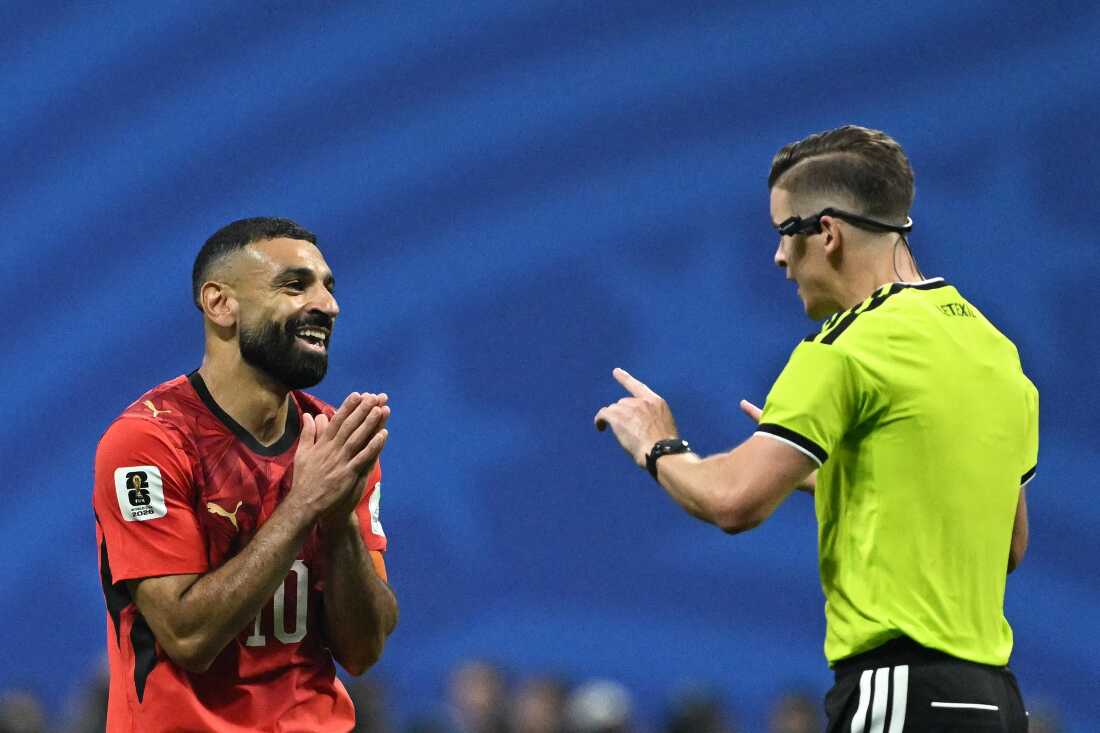
French referee François Letexier speaks with Egypt forward Mohamed Salah during the World Cup Round of 16 match between Argentina and Egypt in Atlanta.
Roberto Schmidt/AFP via Getty Images
hide caption
toggle caption
Roberto Schmidt/AFP via Getty Images
Afterward, Egypt coach Hossam Hassan complained about the French referee and the officiating. “I am not convinced. I am not convinced with this outcome. I’m not convinced with the way things unfolded during this match,” said Hassan in a post-match news conference. “We have been treated unfairly today. We have suffered injustice.”
“We would have deserved to earn this win, but we are leaving with honor, with pride, regardless of this defeat,” said Hossan.
African soccer teams have been the stars of this World Cup. Morocco has yet to lose a game. Cape Verde qualified for the first time in its history and stymied Spain, Uruguay and Saudi Arabia. Argentina barely beat them in a nail-biter of a match.
For Egypt, getting this far in the tournament is historic in itself: it’s the first time the team has made it this far. For Argentina, it was a terrifying yet relieving victory: several players, including Messi himself, cried after the game.
Next, they move to the quarterfinals and will play the winner of today’s Switzerland-Colombia match.
-

 Florida2 minutes ago
Video shows man attack Florida deputies in snake-and-gator-infested canal, sheriff says
-

 Georgia7 minutes ago
Georgia Supreme Court upholds convictions of men in deadly shooting during gas station carjacking
-

 Hawaii14 minutes ago
Chinese communist party member arrested in Hawaii on visa fraud charge | Honolulu Star-Advertiser
-

 Illinois22 minutes ago
Illinois girl, 8, dies after being struck by lightning
-

 Kansas27 minutes ago
Kansas City Royals news: MLB draft still coming into focus
-

 Indiana29 minutes ago
Northwest Indiana under air quality alert for July 8th
-

 Iowa31 minutes ago
Person drowns at Coralville pool
-

 Kentucky44 minutes ago
Kentuckians deserve honesty about McConnell’s health | Letters

