News
Has Trump kept his campaign promises to American workers? Here's what some say.


Good morning. You’re reading a special Labor Day edition of the Up First newsletter. Subscribe here to get the newsletter delivered to your inbox, and listen to the Up First podcast for all the news you need to start your day.
Checking in with the labor movement
by Andrea Hsu, NPR labor and workplace correspondent
At this time last year, President Trump was courting America’s workers, promising them a renaissance if they helped send him back to the White House. Now seven months into his second term, he says he’s on track to keep that promise.
“Every policy of the Trump administration is designed to lift up the American worker, promote great-paying blue-collar jobs and to rebuild the industrial bedrock of our nation,” Trump said at a meeting of his Cabinet last week.
Many labor leaders could not disagree more.
Protesters gather on the National Mall for the nationwide “Hands Off!” protest against President Donald Trump and his advisor, Tesla CEO Elon Musk, in Washington, D.C., on April 5, 2025.
Roberto Schmidt/AFP via Getty Images
hide caption
toggle caption
Roberto Schmidt/AFP via Getty Images
“By every measure, this has been the most hostile administration to workers in our lifetimes,” AFL-CIO President Liz Shuler told me in an interview ahead of Labor Day. “Working people are really not feeling secure in this economy.”
If you simply look at the numbers, workers appear to be in pretty decent shape. As of July, average wages were up 3.9% over the last year, outpacing inflation. Unemployment remains low, at just over 4%. Most people in America who want a job are working.
But behind these numbers, there’s a lot of uncertainty and tension.
On the campaign trail, Trump often warned American workers that immigrants were taking their jobs. The Trump administration is now not only cracking down on people who are in the U.S. illegally, it has also ended programs that provided hundreds of thousands of people relief from unsafe conditions in their home countries. People who were previously allowed to stay and work in the U.S., sometimes for decades, have suddenly had their legal status revoked.
These new immigration policies are affecting workers and employers, forcing people out of jobs on farms in rural America, in factories in the Midwest, and in the homes of elderly people who need help – places that have long welcomed immigrants. In agriculture and long-term health care, Americans are not exactly lining up for jobs. Workers who are left behind after immigrant colleagues leave say they’re now working longer hours or having to train inexperienced newcomers.
Unions representing blue-collar workers, including those Trump considers his base, have additional concerns. They fear that big infrastructure projects launched when Joe Biden was president will be deprived of federal funds or even stopped all together.
“It’s chaos, it’s uncertainty, it’s unpredictability,” Brent Booker, general president of the Laborers’ International Union of North America, told me.
Booker is especially riled up right now about the Trump administration’s stop-work order on Revolution Wind, a wind farm under construction off the coast of Rhode Island. The administration paused the project last month, citing national security concerns. Booker points out that the project was permitted long ago, and it is 80% done. But now, several hundred workers who were out over the water, working to get it up and running, have been idled.
Booker worries about what this signals to the entire renewable energy industry – and moreover, what it means for American workers who were counting on those jobs. “It runs contrary to everything that [Trump] promised to our members and to the American people,” he says.
There’s another topic I’ve spent a lot of time covering since January: the upheaval in the federal workforce. The Office of Personnel Management recently revealed that by year’s end, the government will have shed about 300,000 federal employees, most of them voluntary departures.
In an interview on CNBC, OPM director, Scott Kupor, described this as an opportunity — a chance to change the government to reward efficiency. This is something I’ve heard even Trump’s staunchest critics say is needed. But others warn that the mass exodus of federal employees, including several senior leaders at the CDC just last week, is leaving agencies ill-positioned to deliver the services Americans need. We have the next three-plus years to see who’s right.
Labor Day reads and listens

When you’re stuck at the airport, you need the right soundtrack.
Alex Wong/Getty Images
hide caption
toggle caption
Alex Wong/Getty Images

When you’re stuck at the airport, you need the right soundtrack.
Alex Wong/Getty Images
If you took advantage of the holiday weekend to travel, I hope your return trip goes off without a hitch. But if you find yourself dealing with a flight delay, don’t fret — Pop Culture Happy Hour has three songs to help you through those stressful travel moments.
Missouri workers are campaigning to reinstate mandated sick leave after state lawmakers repealed part of a voter-approved law. Proposition A, the voter-approved measure, was set to increase the minimum wage and allow workers to earn sick days. Since it was a statutory change, lawmakers were able to overturn the paid sick leave portion, with many citing the cost it would add to businesses. This time around, voters want it back as a constitutional amendment lawmakers can’t repeal. (via KCUR)
Visitation at all of Utah’s national parks has decreased this summer after a couple of record-setting years. The slump reflects a broader travel trend. International tourism has taken a dip due to economic uncertainty, fluctuating tariffs, and political rhetoric, which has led some foreign travelers to reconsider plans to visit the U.S. This shift could have big implications for local economies that rely heavily on tourism. (via KUER)
Movie-goers will get a chance to revisit a classic with fresh eyes when Jaws returns to theaters for its 50th anniversary this year. The movie takes place on Amity Island. To prepare for the event, NPR network station WBUR produced a three-part series called Jaws Island. The podcast brings the listeners to the real-life “Amity Island” at Martha’s Vineyard and explores the legacy of the blockbuster movie. Check out all three episodes here and photos of the “finatics” who ventured to the island for the anniversary.
U.S.-made sunscreens have not been updated for decades, which is a reason why Korean and European sunscreens are hyped for their superior protection against UV radiation. But are U.S.-made sunscreens really subpar? Chemist and science communicator Michelle Wong joins Short Wave to discuss the research on UVA and UVB rays and provide advice on how to maximize your sun protection, regardless of which sunscreen you use.
This newsletter was edited by Suzanne Nuyen.


The nation’s capital may be the focal point of the 250th Independence Day celebration, but people all across America have plans to mark the occasion, from boisterous public parades to quiet personal reflections on history.
Julia Demaree Nikhinson/AP
hide caption
toggle caption
Julia Demaree Nikhinson/AP
As the United States turns 250 years old, Americans across the country are spending the holiday thinking about what the big birthday means to them, with reflections and celebrations as diverse as the nation itself.
NPR’s member station reporters fanned out to collect snapshots of the occasion from sea to shining sea.
In one ‘City of Presidents,’ Main Street is decorated for a party
At least two cities in the U.S.call themselves the “City of Presidents” and Cuba City, in Wisconsin, is one of them, largely due to its patriotic Main Street decorations. Every year from Memorial Day through Veteran’s Day, red, white, and blue shields, one for each U.S. president, are prominently displayed high up on the light poles lining Main Street.
It’s a tradition that began in 1976 to commemorate the country’s bicentennial, says Donna Rogers, who is president of the ongoing project but admitted that when it first started, she wasn’t particularly tuned-in to the display.
“I was raising three little boys and working at John Deere, so I didn’t really pay too much attention to community service at that time,” she said.
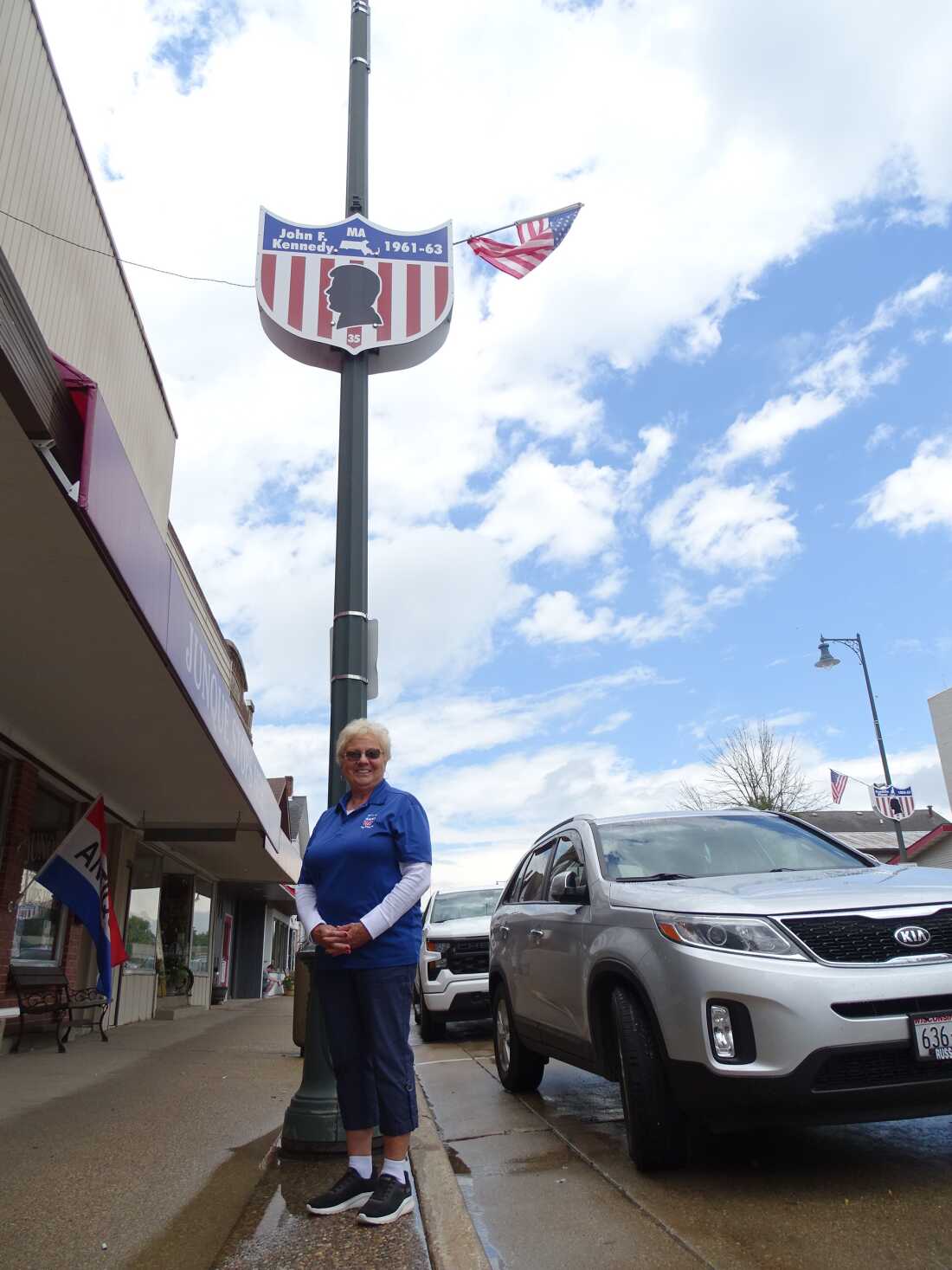
Donna Rogers shows off one of Cuba City’s presidential lampposts.
Susan Bence/WUWM
hide caption
toggle caption
Susan Bence/WUWM
A few years later, she was tapped to help keep the initiative alive.
When she thinks of the country’s history, she says the signing of the Declaration of Independence and abolition of slavery top her list, plus a current event–
“Of course, now, our nation’s 250th birthday. I think those three would be the three most important things in history to me,” she said, quickly adding “[the] right for women to vote, don’t forget that, right?”
Rogers and Cuba City are pulling out all the stops for the 250th, with a parade and a mac-and-cheese festival, because “that was some of our founding fathers favorite foods, along with turkey and cranberries and other items.”
She laughed and admitted she googled that. True or not, Rogers says they’ll go all-out to celebrate the 250th in her “City of Presidents”.
WUWM’s Susan Bence reported from Cuba City, Wisconsin.
In Georgia, a civics competition inspires hope for future generations
At the Georgia state finals of the National Civics Bee, middle school students were peppered with questions about the U.S. government.
Like this one: why is a single energetic executive desirable?
The answer: it promotes accountability and decisive leadership.

9th grader Ella Hummel got it right.
“I’ve always kind of had the idea of serving in politics,” she said after the competition. “And I really think that civics has opened my mind.”
Ella will advance to the civics bee finals later this fall, with her grandmother, Peggy Farmer, cheering her on. Farmer remembers the excitement around the bicentennial in 1976, but said she feels a different energy around this year’s anniversary.
“It’s a togetherness type of thing that’s really not around all the time now,” she mused. “I think it’s just the world’s changed a lot.”
But there is something Farmer will celebrate about America on this Independence Day: her grandkid, the Georgia Civics Bee Champion.
“Maybe she and the kids that was sitting up there, they can change [the country] a little bit. I mean, they seem to be having a ball with each other up there today, so that’s a good thing.”
GPB’s Sofi Gratas reported from Atlanta.
In Texas, appreciating the process of patriotism

Rodney Ellis, who has served 43 years in public office, is guardedly optimistic that America will stay on a path towards progress.
John Burnett
hide caption
toggle caption
John Burnett
Rodney Ellis will celebrate at picnics around his precinct in Houston with barbecue pork ribs and ice tea, and a heaping helping of worry about the nation’s future. The tall, garrulous 72-year-old county commissioner is guardedly patriotic.
“We should be celebrating that America is a process,” he said. “Patriotism is telling the truth, and doin’ the work to repair the harms that have come about over these 250 years.”
The son of a maid and a landscaper, Ellis has served 43 years in public office, first as a Houston city councilman, then state senator, and now as a Harris County commissioner.
Fifty years ago, during the bicentennial, Ellis was a public affairs graduate student at the University of Texas in Austin. In 1976, there were 18 Black representatives in Congress; today there are 67.
“We’ve made tremendous progress since then, tremendous gains,” he said. “And so when I compare what was happening then to what’s happening now, I look at how quickly a lot of those fundamental rights, those gains that we’ve taken for granted have rolled back so quickly.”
He ticked off areas where he believes America has lost ground: clean air and clean water, people of color in key positions in government, owning up to uncomfortable U.S. history, and selfless public service.
But, said the commissioner with a broad grin, that’s how it’s always been in America.
“Progress is made but along the way sometimes you take two steps forward and 10 steps back, but you don’t give up.”
John Burnett reported from Houston, TX.
In Milwaukee, Fourth of July tacos with a big helping of pride
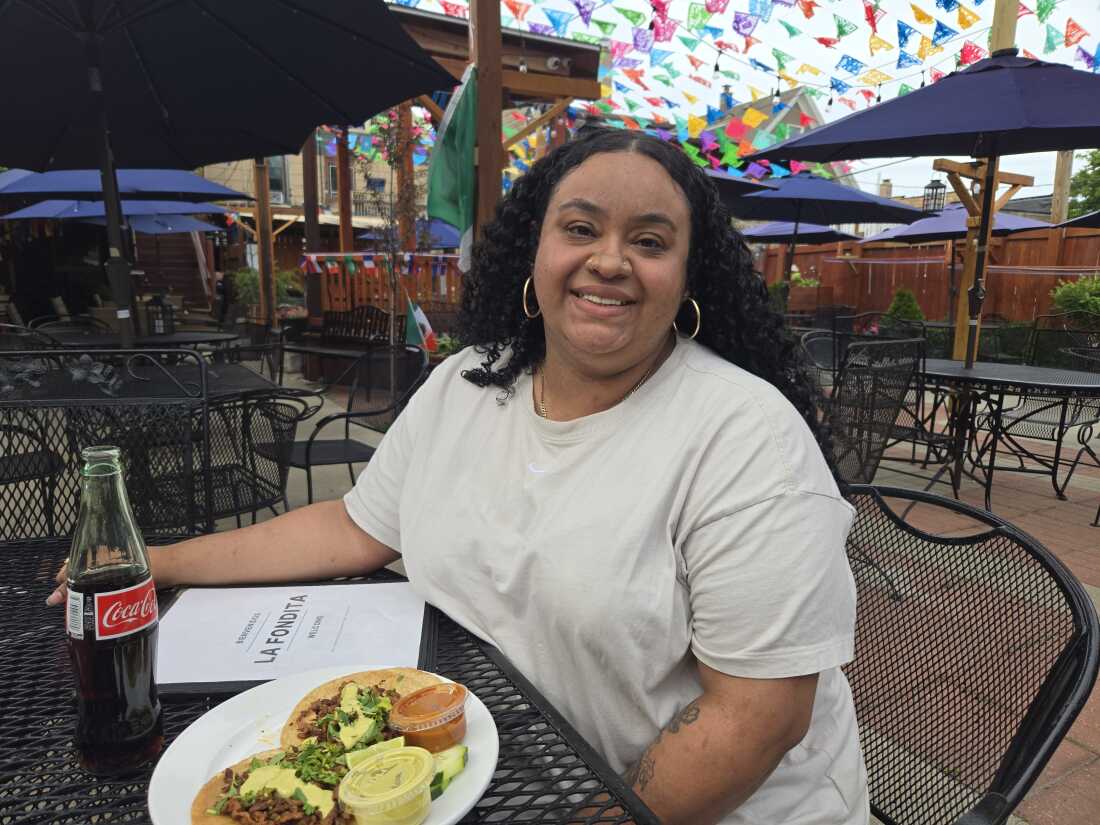
Gissell Vera is proud to be both American and Mexican. She plans to celebrate both of her cultures with a Fourth of July carne asada cookout.
Maayan Silver/WUWM
hide caption
toggle caption
Maayan Silver/WUWM
Gissell Vera ordered carne asada tacos on her favorite patio in Milwaukee, a vibrant spot punctuated with strings of international flags and a steady cumbia drumbeat.
“The music, the colors, the language, all of it is part of me and I am a proud American,” she said.
Vera is a U.S. citizen from a mixed status family; her parents emigrated from Veracruz, Mexico.
“My family has particularly always been grateful for this country and the opportunities that it’s provided us,” said the 25 year-old. “Although there is always the fear and uncertainty of what immigration reform could, how it could impact us, we choose to live every day without fear.”
Vera said there’s a phrase she’s heard many immigrants use to describe their relationship to the United States, “ni de aquí ni de allá,”, meaning ‘neither from here or there.’
“It’s almost like a limbo in which we existed,” she explained. “And I think that now I’m very proud to say that I am ‘de aquí’ and ‘de allá’. So I am proud to be from here and from there.”
She said she’ll join her family for a cookout to celebrate America’s 250th birthday, but instead of hot dogs, they’ll be grilling carne asada.
WUWM’s Maayan Silver reported from Milwaukee.
In the Mountain West, a closer look at a national myth
As America turned 250 this year, historian Megan Kate Nelson used the occasion to take a closer look at a foundational myth of the country’s history and ask, “what stories do we carry forward?”
Her new book ‘The Westerners’ profiled pioneers who, according to Nelson, don’t fit “the narrative of white Easterners moving westward in covered wagons with a nuclear family in tow, engaging with a series of challenges.”
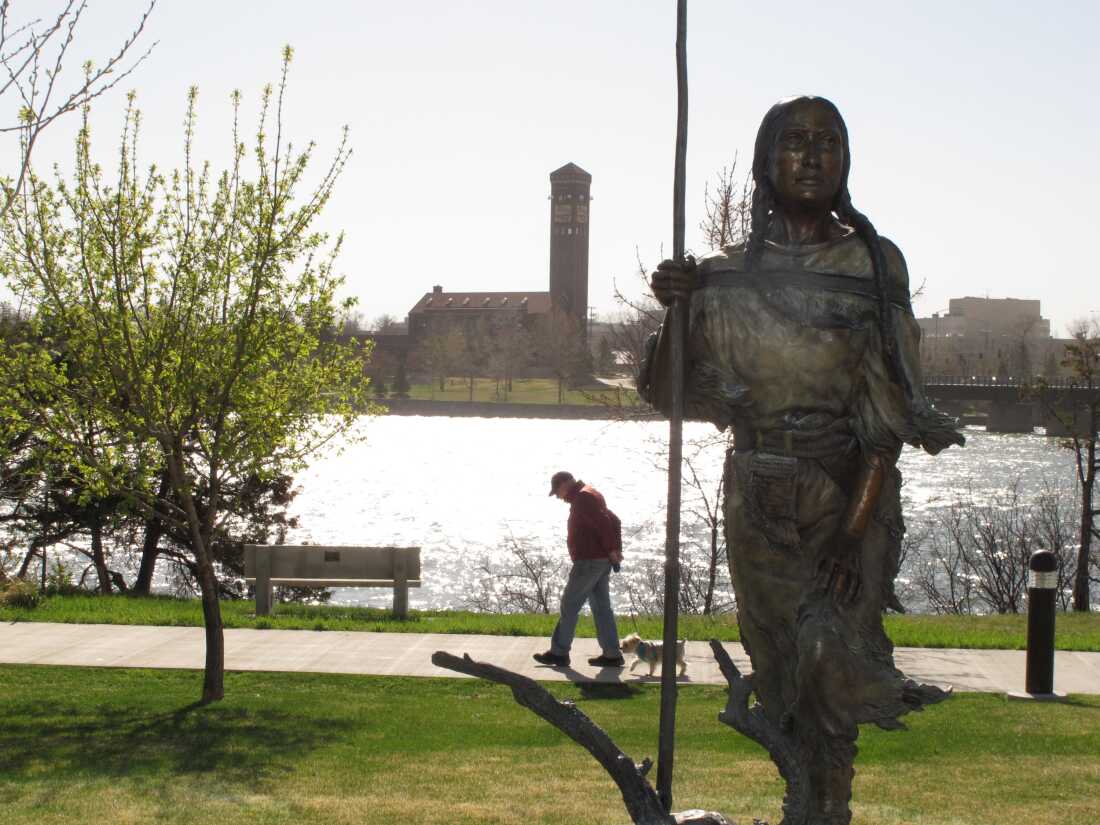
A statue of Sacagawea along the banks of the Missouri River in Great Falls, Mont. Sacajawea was a Lemhi Shoshone woman, who accompanied Lewis and Clark as an interpreter and guide. Her role in the expedition is reexamined in Megan Kate Nelson’s book.
Matt Volz/AP
hide caption
toggle caption
Matt Volz/AP
That includes historical figures like Polly Bemis, who was trafficked from China to the Idaho frontier, and María Gertrudis Barceló, a Santa Fe saloon owner and professional gambler.
Even the well-known figure, Sacagawea, gets another look.
“I read through the Lewis and Clark journals. They mention her more than 150 times, and she is always doing something or saying something,” said Nelson. “My favorite part: when they arrive on the western coast, they set up camp a couple miles away from the ocean, and she yells at William Clark. ‘You are going to take me to go see the ocean! I did not travel all this way not to see the ocean!’”
Nelson said it’s more important than ever to elevate a fuller picture of westward expansion, and to challenge the frontier myth that “there’s only one white pioneer; there’s only one kind of story of American greatness.”
Ryan Warner reported from Crested Butte, Colorado.
In Rhode Island, the parade is nearly as old as the nation itself

Every Independence Day, the yellow stripes dividing Hope Street get a patriotic makeover.
David Wright/Ocean State Media
hide caption
toggle caption
David Wright/Ocean State Media
The town of Bristol, Rhode Island, lays claim to the nation’s oldest Independence Day celebration. This year, they will celebrate America’s 250th with their 241st birthday bash for the country, an effort that brought together over 100 volunteers as part of the Fourth of July committee.
Plans include a parade with at least 34 floats, a golf tournament, a “Miss Fourth of July” beauty pageant, and a gala ball.
Even the double yellow line down Hope Street got its annual red, white and blue makeover for the parade.
For the past decade, Heidi Vermilyea has been in charge of the parade souvenirs, selling hats, t-shirts, and Christmas tree ornaments out of a blue trailer.
“I think I’ve missed the parade once when I was in Europe for the Fourth of July,” Vermilyea admits. “But otherwise, I have been either watching the parade or working the parade my whole life.”
Even when she’s not working the events, she’s decked out in stars-and-stripes, all the way down to her patriotic pedicure.

Heidi Vermilyea runs the souvenir truck for Bristol’s parade every July 4th. But her American flag outfits are year-round display of her patriotism.
David Wright/Ocean State Media
hide caption
toggle caption
David Wright/Ocean State Media
“Politics you can be left, right, moderate, whatever,” Vermilyea explains. “Patriotism is just loving your community. Helping out to make your community, your country a better place.”
The way she sees it, she’s flying the flag for Bristol, her family and friends.
This story was reported by Ocean State Media’s David Wright.
In Oregon, grappling with a complicated history
Some of Mitchell S. Jackson’s fondest childhood memories are of the Fourth of July.
“My mother would always buy me an outfit that had a red, white, and blue color scheme,” Jackson, who is now 50 years old, remembered. “And it was joyous, you know, to don those colors.”
But as the Pulitzer Prize-winning writer grew up, he learned more about America’s history of slavery and racism. Jackson said that made his relationship to his country more complicated, especially after he was convicted on drug and weapons charges as a 21-year-old and imprisoned for over a year.
“I lost my right to vote before I ever voted, before it ever dawned on me that my suffrage was important,” remembers Jackson. “And I would say that that is an American project, that a young Black boy loses his right to vote.”
Jackson said these inequalities, both historical and modern, call into question the very anniversary we’re celebrating.
“When I hear 250, I know that that’s a false number, right?”

Mitchell S. Jackson at the 60th anniversary of the March on Washington. For Jackson, the 250th is not a true celebration of American freedom, since so many people were enslaved at the time.
Erwin JT Trollinger
hide caption
toggle caption
Erwin JT Trollinger
Jackson said that to him, true freedom in America only goes back 160 years, to when the 14th amendment granted everyone equal protection under the law. Or even just 62 years to the Civil Rights Act, which outlawed segregation.
“If you love something, you’re also critical of it,” he pointed out. “You don’t just love it blindly, or I hope you don’t just love it blindly. So if you truly love America, then you gotta tell the truth about America.”
Jackson says there are ways for Black Americans to make the Fourth of July, and America itself, their own. But it’s a group project to understand who we are, and who we’ve been, and who we can become.
Deena Prichep reported from Portland, Oregon.
News
Family-owned company prepares to put on the largest fireworks display in history: “It is the biggest show that we’ve ever done”

Washington — There are fireworks, and then there’s what’s in store for Saturday in Washington, D.C.
When the sun goes down on Independence Day, the skies of Washington are expected to fill with a record-setting 850,000 individual fireworks for a 40-minute spectacle like no one has seen before.
A company called Pyrotecnico will attempt the biggest fireworks show in history, using five generations of family know-how and a background in Super Bowls and large musical acts to help America celebrate its 250th birthday with a bang.
“I mean, it is the biggest show that we’ve done,” Rocco Vitale, president of Pyrotecnico, told CBS News. “…My earliest memories of fireworks displays and doing the Fourth of July was here.”
Pyrotecnico has been planning this year’s show since January, using computers to simulate the display. But now it’s time for the real thing.
Vitale gave CBS News an exclusive look at his not-so-secret weapons: eight barges out on the Potomac River, each one ready to light up the night sky.
“Each firing location has a communication device, and its all set on GPS. And once the time of the show is put into the system, it goes at that time,” Vitale explained.
According to Freedom 250, the organizer of the “Salute to America 250 Celebration & Fireworks” on the National Mall, President Trump will deliver remarks at 9:45 p.m. Eastern Time, and the fireworks display will get underway at 10:45 p.m. The event is expected to draw hundreds of thousands of people.
Join CBS for “The Great American Block Party 250,” a primetime special on Saturday, July 4, hosted by CBS Evening News anchor Tony Dokoupil and Entertainment Tonight’s Nischelle Turner, featuring live musical performances, celebrations around the country, and the largest fireworks show in history in the skies over the nation’s capital. Tune in July 4 at 8 p.m. ET on CBS and stream it on Paramount+ and CBS News 24/7.

A national physician staffing firm tried to take over the contract held by Eugene Emergency Physicians to work in local hospitals. The local physicians used a new state law to oppose the move.
sorbetto/Digital Vision Vectors/Getty Images
hide caption
toggle caption
sorbetto/Digital Vision Vectors/Getty Images
For the latest stories on the science of healthy living, subscribe to NPR’s Health newsletter.
In between shifts in the emergency room, Dr. Dan McGee was in an Oregon courtroom. He was fighting for his practice — Eugene Emergency Physicians (EEP). The group of more than 40 doctors and physician assistants work at multiple emergency departments; it was being replaced by a national company.
“This was big time, David and Goliath stuff,” McGee said. “You see 14 of their lawyers sitting there and you see three of ours.”
Those lawyers argued that ApolloMD, the national company, violated Oregon’s corporate practice of medicine law. The 2025 law bans corporations from taking control of a medical practice’s operations and finances.
The case garnered national interest because Oregon’s new law targets the loopholes large staffing firms have been employing to circumvent state corporate medicine laws.

Money for control
Most states have laws requiring that doctors own medical practices, not corporations. These rules aim to put patient interests ahead of profit motives. Over the last several years, companies have used a model where a doctor technically owns the local practice, but as Erin Fuse Brown, a professor at Brown University, explains, those physician owners are often not involved in care and cede hiring, firing and other operational functions to the corporation.
Fuse Brown said these arrangements are attractive to hospitals because these companies often promise more revenue and take over the responsibilities that come with running an ER.
“There’s worry that these investors or these corporate management companies should not be totally controlling the operations and the clinical decisions of those who are trained to deliver patient care,” Fuse Brown said.
The connection to patient care concerned Dr. Jonas Pologe, who works for Eugene Emergency Physicians, in the Eugene, Ore., area. ApolloMD offered local doctors jobs, but Pologe worried that if he pushed back on decisions ApolloMD made, he could lose work hours.
“There’s certainly a chance that if you make enough of a stink, you think that something needs to change, they can just stop giving you shifts,” said Pologe.

ApolloMD’s CEO, Dr. Yogin Patel, said the group doesn’t infringe on the way its doctors practice. He says the company is being unfairly lumped in with broader concerns over physicians’ feelings of disempowerment at the hands of corporate medical takeovers.
A closely watched experiment
Fuse Brown, policy experts and independent physicians theorized that updating state corporate medicine laws could be a fix to limit the control management companies can exert over medical doctors.
Oregon’s the first state to try this, and the case brought by the Eugene doctors group is the first test of that law. McGee, who leads the Eugene physicians group, says colleagues at other hospitals around the state were literally tuning in to their case.
“You could hear it almost like background music on an elevator,” McGee says he was told. “At key moments, all of a sudden the nurses would break out in a cheer.”
Before any ruling, the hospital system dropped its plan to work with ApolloMD and struck a deal to stick with McGee’s local group of doctors.
“This is a big victory for independent physician groups over corporate medicine,” McGee said. “This is a game changer.”
The American Academy of Emergency Medicine (AAEM) supported the Eugene doctors as part of the organization’s strategy to protect independent practices. The AAEM president, Dr. Vicki Norton, said Oregon has the strongest law in the country.
“This signals that that law works and we need it replicated in other states to really strengthen their corporate practice laws,” said Norton.
California and Vermont have passed similar legislation to Oregon, and lawmakers in other states, including Rhode Island and New Mexico, are considering related bills.
In Virginia, an independent group of ER doctors who were replaced by a large staffing firm is meeting with state legislators to try to change their laws.
Impact on Oregon physicians
Back in Oregon, the open question is about how the law may impact the physician practice market.
A few of the largest companies, Envision Healthcare, TeamHealth and USACS, declined to answer NPR’s questions about whether this case or the new law changed their outlook on investing in Oregon practices.
Opponents of the legislation warned lawmakers that many physician groups depend on outside investment to survive.
-

 World4 minutes ago
Nabatieh recovery begins amid ongoing southern Lebanon tensions
-
News27 minutes ago
Reflections on America’s 250th birthday
-

 Los Angeles, Ca2 hours ago
Man hospitalized in critical condition from L.A. car fire
-

 Detroit, MI2 hours ago
Which Lions player has the most to prove in 2026?
-

 San Francisco, CA2 hours ago
Lettuce | SF Jazz | Music in San Francisco
-

 Dallas, TX2 hours ago
WATCH: Australia soccer fans take over Walmart near Dallas Stadium
-

 Miami, FL3 hours ago
MDSO: Man killed in hit-and-run in northwest Miami-Dade; driver sought
-

 Boston, MA3 hours ago
Where to watch Boston Red Sox vs Los Angeles Angels: TV channel, start time, streaming for July 4

