News
Four people on NASA’S Crew-12 arrive at the International Space Station


In this image from video provided by NASA, a SpaceX Dragon capsule carrying Americans Meir and Jack Hathaway, France’s Sophie Adenot and Russia’s Andrei Fedyaev, approaches the International Space Station for docking on Saturday, Feb. 14, 2026.
NASA/AP
hide caption
toggle caption
NASA/AP
The four members of NASA’S SpaceX Crew-12 mission docked at the International Space Station on Saturday afternoon.
The crew blasted off before dawn on Friday morning from Cape Canaveral in Florida.

The Crew-12 mission includes two NASA astronauts, Jessica Meir and Jack Hathaway, French astronaut Sophie Adenot, and Russian cosmonaut Andrey Fedyaev. During their eight-month mission, the crew will conduct scientific research to prepare for human exploration beyond earth’s orbit and enhance food production in space.
“With Crew-12 safely on orbit, America and our international partners once again demonstrated the professionalism, preparation, and teamwork required for human spaceflight,” NASA Administrator Jared Isaacman said in a statement.
The mission replaces the crew from NASA’s Crew-11 mission, which departed the ISS a month ahead of schedule in January due to a medical evacuation of one of the crew members. Since then, the space station has been operating with a reduced staff of three people — well below it’s typical seven-person staff.
Isaacman also said that NASA is simultaneously making preparations for the 10-day Artemis II mission, which would send a crew of four astronauts around the moon. It’s the first crewed mission to the moon since Apollo 17 in 1972 and is slated to take off as soon as March.



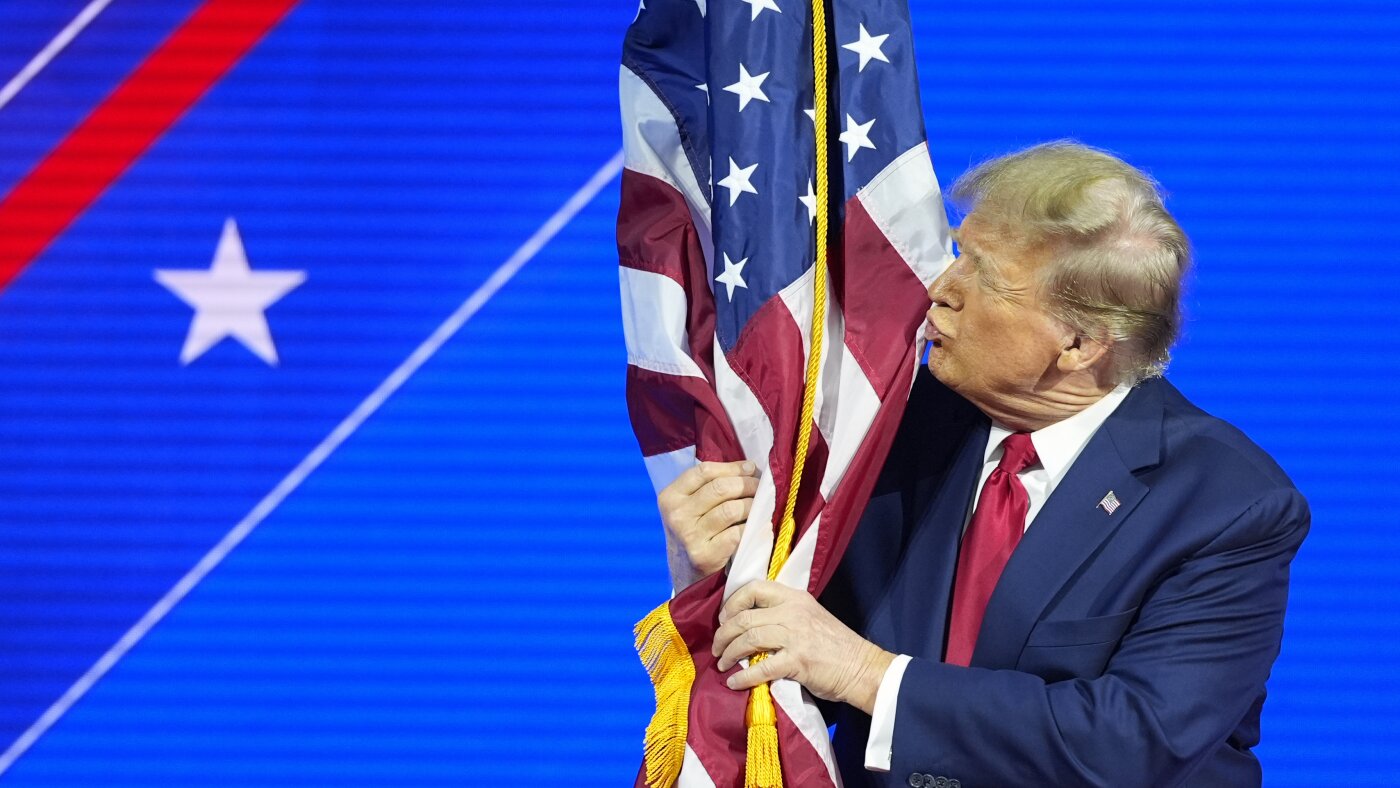
Before he was elected to a second term, former President Donald Trump hugged and kissed the U.S. flag as he spoke at the Conservative Political Action Conference at National Harbor, in Oxon Hill, Md., in 2024.
Alex Brandon/AP
hide caption
toggle caption
Alex Brandon/AP
Three major reports out this month say President Trump has done serious damage to American democracy at remarkable speed since his return to the White House.
An annual report from V-Dem, an institute at Sweden’s University of Gothenburg, concluded democracy had deteriorated so much in the U.S. that it lowered the country’s democracy ranking from 20th to 51st out of 179 countries.
The U.S. landed between Slovakia and Greece.

Meanwhile, Bright Line Watch, which surveys more than 500 U.S. scholars, concluded that the U.S. system now falls nearly midway between liberal democracy and dictatorship. The newest survey comes out next week. Bright Line Watch’s co-directors spoke to NPR exclusively ahead of publication.
Yet another report out Thursday from Freedom House, a Washington, D.C.-based democracy think-tank, said that among free countries, the U.S. joined Bulgaria and Italy in registering the largest declines in political rights and civil liberties last year.
“The developments in the United States are moving towards dictatorship, what the founders wanted to avoid,” said Staffan Lindberg, the V-Dem Institute’s founding director, who spent seven years in the U.S. “It’s the most rapid decline ever in the history of the United States and one of the most rapid in the world.”
V-Dem stands for Varieties of Democracy. More than 4,000 scholars contributed data to the report, which is the largest of its kind.
White House spokeswoman Olivia Wales dismissed V-Dem’s analysis as “a ridiculous claim made by an irrelevant, blatantly biased organization.”
She called Trump a champion for freedom and democracy and the most transparent and accessible president ever.
“His return to the White House saved the legacy media from going out of business,” Wales said.

Trump has rejected criticism that he tries to rule as an autocrat.
“A lot of people are saying maybe we like a dictator,” Trump said to reporters in the Oval Office last August. “I don’t like a dictator. I’m not a dictator.”
Lindberg said V-Dem downgraded America’s rating based on the Trump administration concentrating executive power, overstepping laws, circumventing the Republican-led Congress as well as attacks on the news media and freedom of speech. Lindberg, a political scientist, is struck by the speed with which Trump has acted.
“Under the Trump administration, democracy has been rolled back as much during just one year as it took Modi in India and Erdogan in Turkey 10 years to accomplish, and Orban in Hungary four years,” said Lindberg, referring to Indian Prime Minister Narendra Modi, Turkish President Recep Tayyip Erdogan and Hungarian Prime Minister Viktor Orbán.
All three of those leaders came to power through democratic elections, but scholars say they have since undermined checks and balances on executive power to try to ensure they remain in office.
Trump is a big fan of Orbán’s and has praised him as a “strongman” and a “tough person.” Orbán faces election next month — the first real challenge to his rule in a decade and a half.

President Trump is a big fan of Hungarian Prime Minister Viktor Orbán, pictured at the White House on Nov. 7, 2025. Political scientists view Orbán as an autocratic leader who has chipped away at this country’s system of checks and balances.
Roberto Schmidt/Getty Images
hide caption
toggle caption
Roberto Schmidt/Getty Images
Scholars are alarmed by Trump’s blitz on the U.S. system of governance, but John Carey, a co-director of Bright Line Watch, says the United States’ democracy rating might have slid even further in recent months if not for the courts pushing back.
Carey says autocrats try to co-opt or pressure government institutions that serve as referees but notes that didn’t work last month as the Supreme Court ruled against the president on tariffs.
“One of the things that the tariff decision suggested [is] he has not fully captured that set of referees,” said Carey, a professor of political science at Dartmouth, “and that’s the most important set.”
Brendan Nyhan, a fellow Dartmouth professor and Bright Line co-director, adds that just because Trump has undermined democracy, doesn’t mean the effects are permanent.
“There’s just no question that what we’re seeing is the authoritarian playbook,” said Nyhan, “but there’s no guarantee that Trump will be able to operate this way after the midterms, let alone a successor after 2028.”
Yana Gorokhovskaia, director for strategy and design for Freedom House, says some of Trump’s policies abroad also are undermining the country’s democratic standing overseas.
For instance, the State Department often used to call out election fraud in other countries, but under Trump, it has said it will only comment on foreign elections when the U.S. has a clear and compelling interest.
“What we’re losing is democratic solidarity globally,” Gorokhovskaia said. “We’re no longer emphasizing … a distinction between democracies and autocracies in the world.”
That doesn’t mean the U.S. doesn’t take sides in foreign elections. Just last month, Secretary of State Marco Rubio publicly endorsed Orbán, Hungary’s autocratic leader, for a fifth term.

Halle O’Brien writes during after-school cursive club, held by teacher Sherisse Kenerson, at Holmes Middle School in Alexandria, Va.
Anna Rose Layden for NPR
hide caption
toggle caption
Anna Rose Layden for NPR
Twelve-year-old Sandi Chandee wants to be a doctor when she grows up. But that’s not why she memorized one of the longest medical terms in the English language:
Pneumonoultramicroscopicsilicovolcanoconiosis.
In Sherisse Kenerson’s after-school classroom, Sandi takes out a piece of paper and fills up a whole line to spell the word that describes a type of lung disease. The word allows her to practice cursive — her new favorite method of writing.
When she becomes a doctor, Sandi, who signs her cursive autograph with a heart above the i, is determined to have a perfect signature.
Twelve-year-old Halle O’Brien, Sandi’s cursive partner-in-crime, agrees.
“I prefer writing in cursive,” Halle said.
The pair are proud members of the Holmes Middle School cursive club in Virginia. Cursive has been on the upswing for years now. More than two dozen states now require cursive instruction in schools after the 2010 Common Core standards omitted the skill.
Kenerson, a multilingual teacher at Holmes, started the middle school club when students couldn’t read her writing on the board. They just stared at her blankly, she said.

Conrad Thompson writes during cursive club.
Anna Rose Layden for NPR
hide caption
toggle caption
Anna Rose Layden for NPR
“I realized they didn’t know how to write or read in cursive,” Kenerson said. For an educator who firmly believes that quotes deserve to be written in cursive, and has a new one on her board each month, Kenerson wanted to give students a chance to understand the magic of the loopy writing.
The club exploded in popularity this past winter, with local news stations and the Washington Post crediting it for “keeping cursive alive.” Since then, Kenerson has been racking her brain trying to figure out why it has drawn so much attention.

She has received fan mail from retirees and teachers (written in cursive, of course). She has heard from people in Idaho, Pennsylvania and Florida. She has even had Zoom calls with educators in Oklahoma and Maryland to explain how she runs the club.
“I’m flabbergasted,” Kenerson said. “I’m just going along with the ride.”
She decided that cursive is a way to hold on to the past, and many people are not ready to let it go.

Teacher Sherisse Kenerson has received fan mail from retirees and teachers for starting the club.
Anna Rose Layden for NPR
hide caption
toggle caption
Anna Rose Layden for NPR
Kenerson’s after-school club is a local example of a nationwide trend — cursive handwriting is back in many classrooms across the country. Teachers and legislators credit the resurgence to nostalgia and some evidence of educational benefits. But surprisingly, the curves and swoops are contentious among experts, and some argue that cursive does not add any real value for students, especially in the age of artificial intelligence.
“I have seen no evidence that cursive brings any particular cognitive or learning benefit beyond that brought by hand printing,” wrote Mark Warschauer, a professor of education at the University of California, Irvine, in an email to NPR. He noted that the cognitive benefits of young students writing by hand in general are already well established.
Warschauer, who founded the UC Irvine Digital Learning Lab, opposes teaching cursive in schools because of the “waste of time and effort” when print handwriting, voice-to-text applications, and keyboards are easily accessible to students.
Much of the cursive debate centers around time in the classroom. Should educators spend precious minutes teaching another way to write on paper when technology is so prevalent?
Shawn Datchuk, a professor of special education at the University of Iowa, said the answer does not have to be one or the other. In his college classroom, he sees students increasingly using tablets and a stylus to take notes.
“What that means is that as a country, we likely need to help our students become multi-modal,” Datchuk said. They need to not only be able to handwrite using print, but also use cursive, type, and interact with technology, he said.

Top left: Kenerson demonstrates writing cursive letters on the whiteboard. Right: Kenerson helps a student with their worksheet. Bottom: Sandi Chandee (right) and Halle O’Brien practice their writing during cursive club.
Anna Rose Layden for NPR
hide caption
toggle caption
Anna Rose Layden for NPR
Technology is not a fix-all for students, though, he said.
“One of the dirty secrets behind spell checker and artificial intelligence is that you still need to be able to spell in order to use those well,” Datchuk said.
He and a team of researchers compiled the known studies on cursive teaching. Some studies used antiquated technology like ink wells and quill tips, so they were cut. A few of the others were missing details on how the instruction was implemented. With those caveats, Datchuk said, preliminary evidence shows cursive writing could improve spelling.
Datchuk said the “special sauce” for cursive is that students have to pay closer attention to how letters connect when they write.
Kenerson, the cursive club’s founder, said she’s seen anecdotal evidence that cursive helps students with dyslexia. Sharon Quirk-Silva, a California assemblymember who introduced the cursive bill in the state, said she’s also heard anecdotal evidence that cursive can be therapeutic for students with special needs.
Since Quirk-Silva’s 2023 cursive mandate, she said the reception from constituents has been overwhelmingly positive.
Datchuk, the University of Iowa professor, said he receives a constant stream of emails from people asking about cursive, but his reason for studying the technique was personal — his 8-year-old son, who is reading Harry Potter, still passes his grandmother’s birthday cards to his dad to read.
“That brings up the larger generational divide that’s probably happened not only with my sons, but with kids and young adults across the United States who just never received instruction in cursive,” Datchuk, a former elementary school teacher, said.
Antonio Benavides, an 11-year-old in Kenerson’s cursive club, is an example of that divide. His dad heard about the club and immediately sent Antonio.

Antonio Benavides says his penmanship has improved since joining cursive club.
Anna Rose Layden for NPR
hide caption
toggle caption
Anna Rose Layden for NPR
Now, he sticks his tongue out and stares intently at the loops in front of him. He enjoys practicing the curves, and he said his normally sprawling print penmanship has improved.
“I’m like, ‘Are you kidding me, cursive club, what do I need that for?’” Benavides remembered telling his dad. But now, “Yeah, I like it,” he said.
When there’s a moment of silence as the students practice their i’s and t’s, Antonio whispers, “I love that sound.”
“The sound of a pencil when it’s silent is just so nice,” he explained.
Steve Graham, the Regents Professor at Arizona State University’s College for Teaching and Learning Innovation, argues that despite the media attention, cursive never really went anywhere. Graham, who has authored numerous books about writing, said he has been hearing about the “death of handwriting or the death of cursive” for about 50 years. At one point, his responses to questions from reporters became “snarky,” he said.
“I’d say, ‘Well, damn, I didn’t hear it was buried,’” Graham said. “Can you tell me where? I’d like to visit the grave.”
Graham is ambivalent about whether cursive or print is a more effective tool for students. He said he thinks the fixation on cursive is an adult phenomenon.

Kenerson started the club after she realized students could not read her cursive handwriting on the board.
Anna Rose Layden for NPR
hide caption
toggle caption
Anna Rose Layden for NPR
“I’m often amazed at how much attention it gets,” Graham said. With more studies, Graham said he thinks the differences in benefits between the two types of handwriting will be insignificant. He said what’s more important is spending the time to teach kids to write.
Back in Kenerson’s cursive club, 11-year-old Conrad Thompson said she’s the only student in her history class who can read her teacher’s huge Declaration of Independence printout. It makes her proud.

Conrad Thompson is proud of her cursive skills.
Anna Rose Layden for NPR
hide caption
toggle caption
Anna Rose Layden for NPR
“Hopefully, one day, me and my family will get to go see it in person,” Conrad said.
As for Sandi and Halle, the pair have no doubts about their newfound skill.
“Will you be back next week?” Halle asked Sandi about the after-school club.
“Of course I will,” Sandi responded.

Washington — The Senate defeated a war powers resolution on Wednesday that aimed to block President Trump from ramping up the war with Iran, as the operation approaches a fourth week.
In a 53 to 47 vote, a Democrat-led effort to restrict Mr. Trump from taking military action in Iran fell short for a third time. Sen. John Fetterman of Pennsylvania was the sole Democrat to vote against advancing the resolution. GOP Sen. Rand Paul of Kentucky supported it.
The resolution, led by Democratic Sen. Cory Booker of New Jersey, would have directed the president to “remove the United States Armed Forces from hostilities within or against Iran, unless explicitly authorized by a declaration of war or a specific authorization for use of military force.” Congress has not authorized military force against Iran.
The vote came as Republicans are holding an unusual and lengthy debate on elections legislation amid pressure by Mr. Trump, who has threatened to withhold his signature from other bills that reach his desk until the measure passes. Democrats were able to force the war powers vote despite the floor takeover because the resolution is privileged.
The Senate had previously defeated an Iran war powers resolution introduced by Democratic Sen. Tim Kaine of Virginia on March 4. It was the second time in less than a year that the upper chamber had voted down an effort to rein in Mr. Trump’s ability to strike Iran, following a similar vote after last June’s U.S. airstrikes on Iranian nuclear sites.
But as the Iran war approaches the one-month mark, Mr. Trump has yet to make clear an exit strategy and has not ruled out sending ground forces into the country. The president has said he expects the war to end “soon,” but hasn’t specified a timeline.
After the early March defeat, a group of Democratic senators vowed to keep pressing the issue if Secretary of State Marco Rubio and Defense Secretary Pete Hegseth did not testify in public about the war. The Democratic senators behind the war powers push indicated in a letter to Senate Majority Leader John Thune, a South Dakota Republican, that they would abandon votes on a handful of resolutions if the Trump officials testified at public hearings.
“We’re going to use every lever that we have to stop business as usual and force the Senate [to do] what it should have done already,” Booker told reporters earlier this month.
Sen. Chris Murphy, a Connecticut Democrat, accused the Trump administration of dodging public hearings on Iran out of fear of losing any public support for the war.
“I don’t think they can defend this war,” Murphy told reporters earlier this month. “I think they’ll lose votes in the Senate if they actually have to go in front of the American public and explain why gas prices are so high, explain whether we’re engaged in regime change or whether we’re not, explain how they’re going to get the nuclear weapons and the nuclear material without the ground invasion.”
The Trump administration’s top intelligence officials testified Wednesday to the Senate Intelligence Committee in a hearing that was pegged to the release of the annual worldwide threats assessment, though questions largely focused on Iran. Director of National Intelligence Tulsi Gabbard deferred to Mr. Trump when pressed on the president’s claims that Iran posed an “imminent” threat to the United States.
The administration and most congressional Republicans have argued that Mr. Trump acted within his legal authority when ordering strikes on Iran. In a letter to Congress in early March, the president said the strikes were necessary to eliminate threats.
“Despite my Administration’s repeated efforts to achieve a diplomatic solution to Iran’s malign behavior, the threat to the United States and its allies and partners became untenable,” the president wrote. He acknowledged that “it is not possible at this time to know the full scope and duration of military operations that may be necessary.”
VT Lottery Gimme 5, Pick 3 results for March 19, 2026

Virginia vs. Arizona State – First Four NCAA tournament extended highlights

Devils Head to Nation’s Capital | PREVIEW | New Jersey Devils

Wisconsin Lottery Pick 3, Pick 4 results for March 19, 2026
West Virginia Lottery results: See winning numbers for Daily 3, Daily 4 on March 19, 2026

Florida High School Football Rankings: Top 25 teams – Oct. 21

How old is Bo Nix? What to know about Oregon quarterback ahead of 2024 NFL Draft

Cleary's 21 help Le Moyne down Central Connecticut State 69-64 in OT

99th annual Pony Swim held in Virginia

Indiana Members Credit Union announced as new anchor tenant at Bottleworks District

Meet the longtime biz partner of Ilhan Omar’s husband as questions swirl over her skyrocketing net worth

‘Nobody can blackmail us’: Leaders excoriate Orbán’s veto
Trump is dismantling democracy at ‘unprecedented’ speed, global report finds

4 House Dems vote against Women’s History Museum bill over biological women-only amendment, Republican claims

Iran attacks cut 17% of Qatar’s LNG capacity for up to 5 years: QatarEnergy
-

 Oklahoma5 days ago
Family rallies around Oklahoma father after head-on crash
-

 Detroit, MI1 day ago
Drummer Brian Pastoria, longtime Detroit music advocate, dies at 68
-

 Nebraska7 days ago
Wildfire forces immediate evacuation order for Farnam residents
-

 Georgia4 days ago
How ICE plans for a detention warehouse pushed a Georgia town to fight back | CNN Politics
-

 Massachusetts1 week ago
Massachusetts community colleges to launch apprenticeship degree programs – The Boston Globe
-

 Alaska5 days ago
Police looking for man considered ‘armed and dangerous’
-

 Colorado1 week ago
‘It’s Not a Penalty’: Bednar Rips Officials For MacKinnon Ejection | Colorado Hockey Now
-

 Southwest1 week ago
Talarico reportedly knew Colbert interview wouldn’t air on TV before he left to film it