News
Dominican officials cram thousands of inmates facing no charges into overcrowded prisons


Inmates stand inside a corridor during time they are allowed to be outside of their cells at Najayo jail in San Cristobal, west of Santo Domingo in 2007.
Ramon Espinosa/AP
hide caption
toggle caption
Ramon Espinosa/AP
SANTO DOMINGO, Dominican Republic — They’re known as “frog men,” inmates who are forced to sleep on prison floors across the Dominican Republic, often next to overflowing toilets or holes in the ground that serve as one.

Thousands of them are crammed into the country’s severely overcrowded prisons, some operating at seven times their capacity. A majority languish there without ever having been charged with a crime, and activists warn they face inhuman conditions and a lack of medical care.
Despite promises to improve the system, critics say the Dominican Republic continues to push for and allow pretrial detentions in nearly all criminal cases where no charges have been filed and has made few changes as problems within prisons keep mounting.
“Prisons have become no man’s land,” said Rodolfo Valentín Santos, director of the Dominican Republic’s National Public Defense Office.
Over 60% of the country’s roughly 26,000 inmates are being held under preventive detention, without any charges, according to the National Public Defense Office. Proponents argue the measure aims to protect society and allows authorities time to collect evidence in a case.
But some detainees have spent up to 20 years in prison without ever being found guilty of a crime, Valentín said.
He noted that the country’s Constitution and penal code dictate that preventive detention is an “exceptional” measure. There are six other measures that don’t involve prison time, including bail, but Valentín said they are rarely used.
‘We have a situation’
On a recent afternoon, Darwin Lugo and Yason Guzmán walked out of La Victoria National Penitentiary, in the northeast corner of the sprawling capital, Santo Domingo.

The prison was built for a maximum of 2,100 inmates but holds more than 7,000 of them, with more than 3,300 under pretrial detention, according to the National Public Defense Office.
It is the country’s oldest and most populated prison.
“You have to watch out for your life,” said Lugo, who with Guzmán visited several friends held there, some under pretrial detention.
“There are a lot of them who are not doing well,” Guzmán said of inmates there. “There’s extreme poverty.”
They said their friends, who have spent more than five years incarcerated there, are well-connected and only occasionally request money or ask that their cell phone’s SIM card be recharged.
Last year, at least 11 inmates died at La Victoria following a short circuit in a cell that sparked a fire and an explosion. It was one of the country’s deadliest prison fires since 2005, when at least 134 inmates were killed in the eastern town of Higüey after rival gangs set their bedding ablaze.
After last year’s fire at La Victoria, Dominican President Luis Abinader appointed former prisons director Roberto Santana as head of a commission tasked with overhauling and improving the country’s more than 40 prisons.
“We must admit, gentlemen, that we have a situation in all of the country’s prisons,” Abinader said when he announced the appointment last March. He also announced that money recovered from corruption cases would help fund construction of new prisons.
Santana has long called for the closure of La Victoria and the 15 de Azua prison, located in the country’s western region. The commission he leads is working on those and other monumental tasks, free from outside interference, he said.
“We don’t take orders from politicians or anyone else,” said Santana, who previously trained staff for the new prisons built in the early 2000s.
Santana, who once served as president of the Federation of Dominican Students in the 1970s, was arrested multiple times under President Joaquín Balaguer, known for having political opponents and dissidents jailed and sometimes killed.
Santana knows first-hand the conditions of La Victoria — he spent two years in solitary confinement there.
‘On the brink of collapse’
In the early 2000s, the Dominican Republic began building 21 new prisons to improve conditions. They were staffed by trained personnel, not police and soldiers, which oversee the country’s other 19 prisons.

But conditions in the new prisons have deteriorated, according to the Dominican Republic’s National Commission of Human Rights.
“The Dominican Republic’s prison system is on the brink of collapse,” the commission said in its 2023 report, the latest one available.
In prisons across the country, overcrowding is rampant. Cells lack bathrooms, natural light and ventilation, leading to worsening health conditions. Some 5,000 inmates are ill with conditions ranging from heart problems to cancer to HIV, but they receive only the most basic medication, if that, and some prisons have no medical staff, according to Valentín, whose office issues a yearly in-depth report on the conditions of all prisons.
In its 2023 report, the latest year available, his office called for the closure of prisons including one in the north coastal city of Nagua.
“The level of overcrowding…makes it impossible to achieve true rehabilitation for the inmates since they have been forgotten by the state,” the report read. “In the conditions they are in, it is obvious that they are treated as objects and not as human beings endowed with rights.”
Another prison was so overcrowded that the government held inmates outdoors in trucks with metal roofs that broiled under the sun, sparking lawsuits, Valentín said.
A spokesperson for Col. Roberto Hernández Basilio, director of prisons, did not respond to requests for an interview. Hernández has previously said his office is taking measures to improve conditions.
Meanwhile, Dominican Attorney General Miriam Germán Brito has repeatedly spoken out against pretrial detention but noted that the decision lies in the hands of judges. A spokesperson for Germán said she is not granting media interviews.
Both Santana and Valentín said they believe government corruption is one reason the country has dragged its feet in overhauling the system, accusing soldiers and police who run prisons of benefiting from illegal activities.
Public corruption also prompted authorities to halt construction of a much-touted prison in recent years that was expected to ease overcrowding.
Even as that half-built prison wastes away, Santana said he expects that 25 new prisons capable of holding more than 20,000 inmates will be built by 2028.
While those are expected to help ease overcrowding, concerns remain. Activists note that inmates are not freed even when a judge has legally released them.
The National Commission of Human Rights noted that roughly 2,700 inmates are still in prison because their paperwork is paralyzed in backlogged courts. Meanwhile, hundreds of others remain incarcerated despite being officially freed because they owe the government money and are unable to pay fines ordered by a judge.

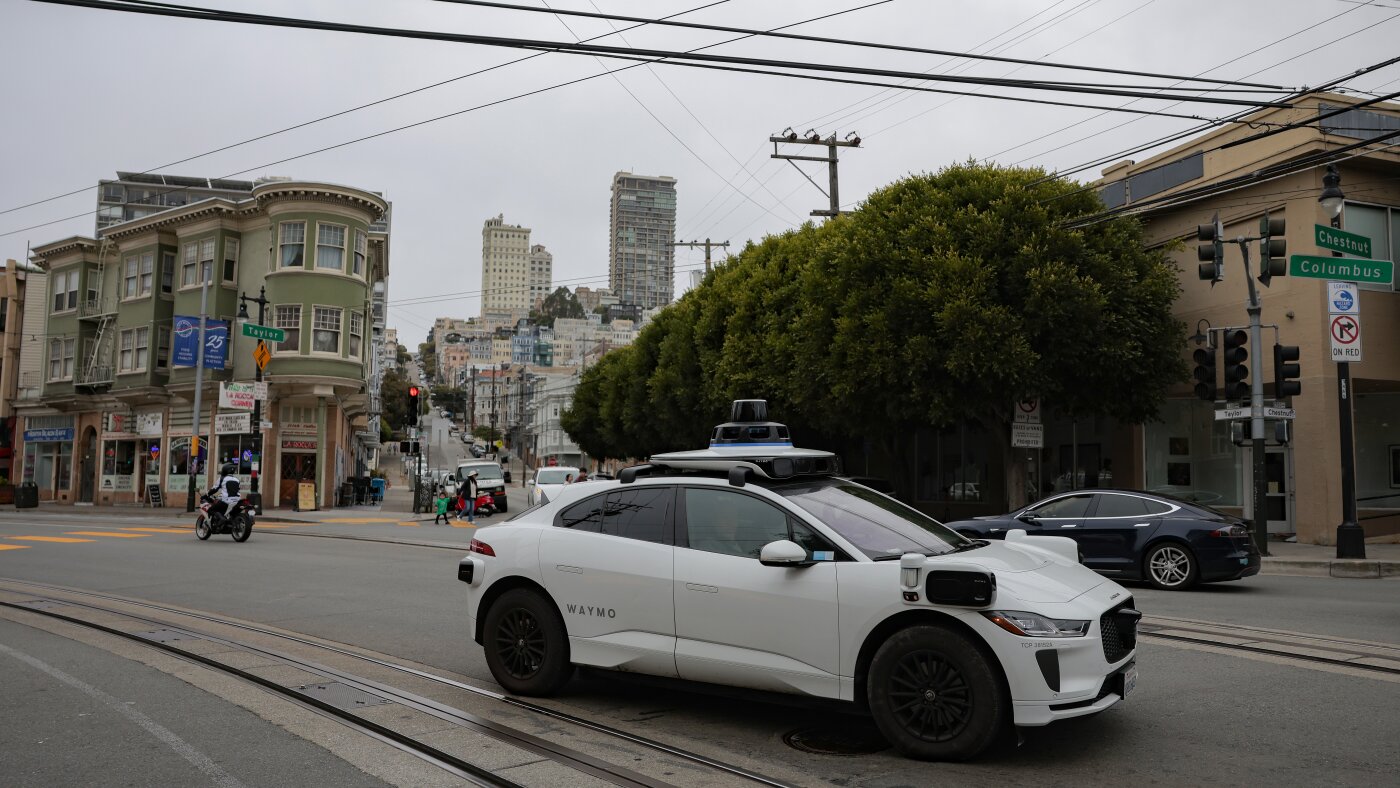
A Waymo robotaxi drives in San Francisco’s North Beach neighborhood this week.
Heather Diehl/Getty Images
hide caption
toggle caption
Heather Diehl/Getty Images
Police in San Mateo, Calif., posted Monday on social media that they had apprehended a pair of teenagers from a Waymo driverless robotaxi after the company alerted authorities to suspected criminal activity. It’s the latest incident involving video surveillance of passengers and others by autonomous vehicles — raising questions about the limits of privacy in such vehicles.

The Facebook post by the San Mateo County Police said: “Parents do you know where your teens are? @waymo does!”
The 15-year-olds were allegedly drinking alcohol and shooting toy guns from the car, according to the police. They said Waymo’s systems detected behavior that then triggered a safety response, after which the company disabled the vehicle and contacted police.
Waymo’s cars, equipped with an array of cameras, microphones and other sensors to monitor passengers and other nearby vehicles, are becoming more common in cities across the United States. Experts say the detention of the two teens in San Mateo highlights a potential — but not inevitable — trade-off between privacy and convenience. It also questions the extent to which companies similar to Waymo are required to hand over private data, including audio and video of passengers, in situations where a crime is suspected.
NPR reached out to Waymo, which is owned by Alphabet, the parent company of Google, for comment on the details of the San Mateo incident and how the company responded, but did not hear back. But on its website, the company says that as many as 29 cameras in its autonomous cars provide an all-around view and “are designed with high dynamic range and thermal stability, to see in both daylight and low-light conditions, and tackle more complex environments.”
“There already exist laws that govern duty to report or even duty to protect” for carriers such as Waymo, according to Alessandro Acquisti, a professor of information technology at the MIT Sloan School of Management. “The privacy problems arise when and if driverless carrier companies used such laws or ethical obligations as a pretext for blanket, indiscriminate accumulation of identifiable data for unspecified future purposes.”
That includes not just monitoring people inside the cars, but outside too. Take, for example, a hit-and-run investigation last year in Los Angeles. Media reported that the police inquiry was aided by video captured by a Waymo taxi that had a clear view of the crime. Critics suggested at the time that authorities were using the company’s vehicles as a mobile surveillance platform. And during 2025 protests in Los Angeles against Immigration and Customs Enforcement crackdowns, demonstrators vandalized Waymos, apparently angry that video recorded by the vehicles could be used by police, although there is no evidence that happened.
In a transparency report, Google says it received nearly 290,000 requests from governments worldwide in the first six months of 2025 for disclosure of user information across all its platforms, including Waymo. The company says that in more than 80% of the requests in those six months, some information was disclosed. “Google carefully reviews each request to make sure it satisfies applicable laws. If a request asks for too much information, we try to narrow it, and in some cases we object to producing any information at all,” the company says.
In an email to NPR, San Mateo Police Department spokesperson Jeanine Luna said that detaining the teens in the Waymo on Monday was “wholly appropriate” under the circumstances. “We received the call of a ‘firearm’ being shot from a moving vehicle,” she said. “Furthermore, the occupants were described as being possibly ‘intoxicated.’” she said.
“Being that the vehicle was disabled (the occupants had every right to exit the vehicle before police arrival, but they did not), a high-risk traffic stop was conducted to ensure the safety of all involved,” Luna added. “They were not arrested and were released to their parents, however, potential charges are still pending dependent on what the video from inside the vehicle shows.”
Autonomous taxis represent an ethical gray area
Robotaxis began to roll out across the U.S. in December 2018, when Waymo launched in Phoenix. These services have been used for less than a decade — so the norms surrounding them aren’t settled, experts agree.
The Facebook post may make Waymo passengers wonder what triggers a police intervention, says Irina Raicu, director of the Internet Ethics program at Santa Clara University. She has used Waymo’s driverless taxis and says ethically, the privacy issues surrounding them sit in a gray area. “There’s something about being in a car without another person that makes you think it’s private.”
“With all these recording devices, we don’t see them, [and] they’re not these obvious things being stuck in our faces,” Raicu adds.
That brings up a key issue: informed consent, Acquisti says.
“It is not clear the extent to which passengers … are reminded that when they step into the car, that they are being monitored, and most likely they are not told in its entirety how the data will be used,” he says.
Bruce Schneier, a cybersecurity and privacy expert and professor at the Munk School at the University of Toronto, believes that Waymo does have a compelling interest in protecting its vehicles. He compares monitoring a robotaxi via cameras to a human taxi driver keeping an eye on passengers in the rearview mirror.
“Maybe the driverless car comes back … and it has all of its cushions slashed, and it’s like, ‘Who the hell did that? Let’s go and look at the tape,’” Schneier suggests. “You can’t have sex in the back of a taxi, right? Someone would say, ‘Stop it.’”
He concludes that some supervision makes sense. In an Uber rideshare, he notes, “most of the time there’s a camera recording the back seat.” (Uber says on its website that it allows drivers to install such cameras for the purpose of “fulfilling transportation services.”)

Waymo robotaxis, while a fairly common sight in the San Francisco Bay Area, are still a novelty in much of the country. And many people are hesitant to ride in one, according to a Pew Research Center poll published this month. The survey found that only 5% of Americans had ever ridden in a driverless car. Meanwhile, 71% of those polled said they would feel uncomfortable in one, with only 7% saying they would be “extremely or very comfortable” riding in one.
For that reason, experts who spoke with NPR said they were optimistic that it’s not too late to shift gears on privacy norms and policies surrounding these vehicles.
Acquisti doesn’t see why privacy measures can’t be built into driverless vehicles.
“I would immediately challenge the notion that people have to be monitored,” he says, noting that privacy-preserving technologies exist and can be installed.
“Driverless cars are coming, but they don’t have to come in this particular incarnation,” Raicu says. “They’re still being designed and redesigned. It’s early days.”

Donald Trump has terminated the remaining members of the independent, federal commission that assists election administration officials nationwide just a few months before the midterm elections, multiple outlets reported Thursday.
The remaining three commissioners of the four-member bipartisan commission were forced out on Thursday in different ways. The one Republican appointee resigned and the other two, Democratic appointees were notified of their terminations via email from the White House presidential personnel office.
“On behalf of President Donald J Trump, I am writing to inform you that your position as Commissioner of the Election Assistance Commission is terminated, effective immediately. Thank you for your service,” the email, seen by Reuters, said.
The White House did not immediately respond to a request for comment.
The Election Assistance Commission serves as a “national clearinghouse of information on election administration”, accredits testing laboratories and certifies voting systems, and maintains the national mail-voter registration form developed by the National Voter Registration Act of 1993, according to the commission’s website. The terminations follow Trump and top administration officials’ advocacy to change vote-by-mail requirements and investigations into the 2020 election outcome, which Trump lost to Democrat Joe Biden.
“It is irresponsible and dangerous that this Administration remains dead set on causing chaos for our election officials across this country,” Arizona secretary of state Adrian Fontes said in a Thursday statement. “This move undermines the integrity of nonpartisan election administration.”
The 2002 law that established the commission, the Help America Vote Act, states the president can appoint replacements to the commission.
It is unclear how Trump will move ahead with the commission.
Reuters contributed reporting
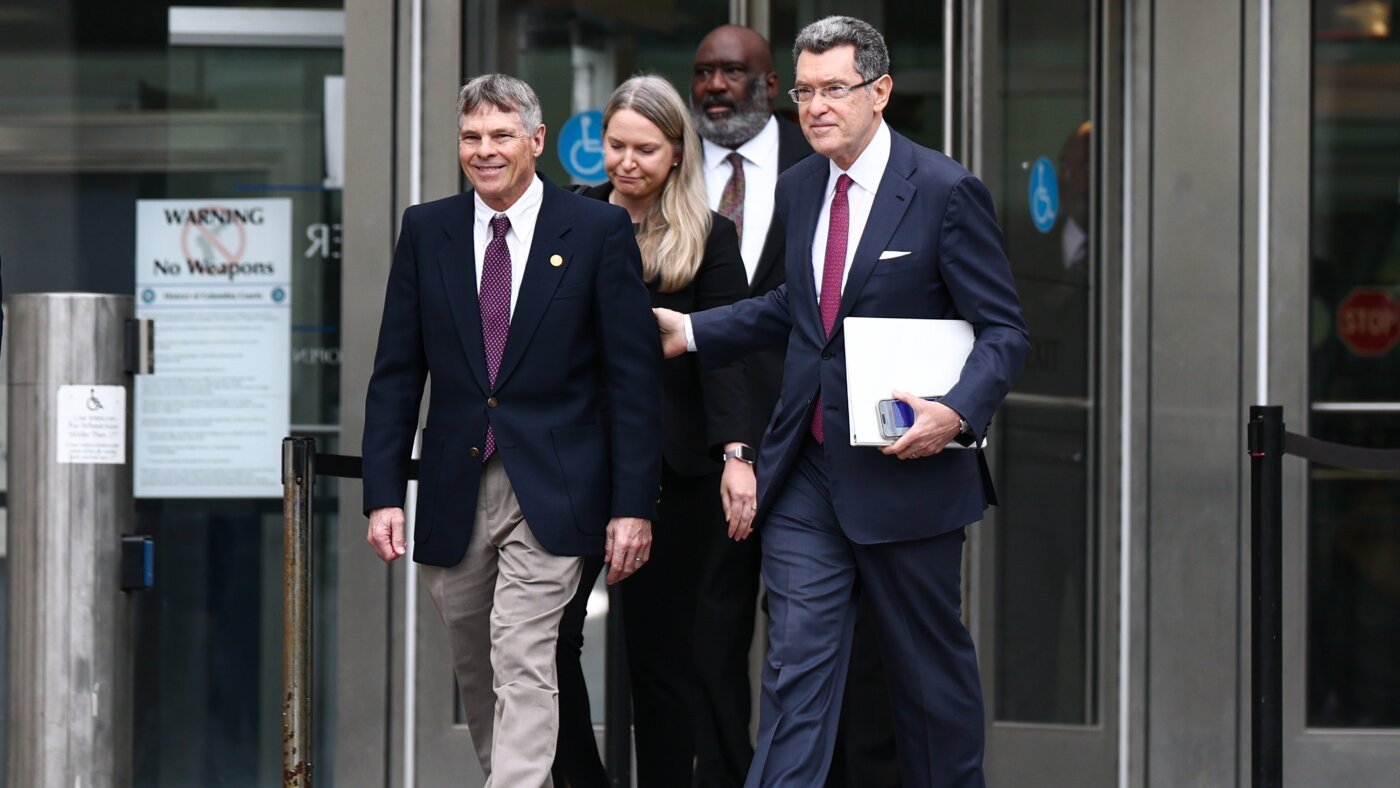
Former U.S. Olympian David Hearn (left) walks with his attorney Norman Eisen to speak to reporters and protesters gathered after his arraignment at the Superior Court of the District of Columbia in Washington, D.C. on Thursday.
Finn Gomez/Getty Images
hide caption
toggle caption
Finn Gomez/Getty Images
Former U.S. Olympic canoeist David Hearn pleaded not guilty to damaging the Lincoln Memorial Reflecting Pool in D.C. Superior Court Thursday morning.
Federal prosecutors charged Hearn with a single count of destruction of property causing more than $1,000 in damage to the pool.

Hearn has previously claimed, which his attorneys repeated during a short press conference outside the court, that he simply touched the water in the pool out of curiosity.
The Trump administration had just completed a $14 million renovation of the pool.
But shortly after the work finished, peeling paint and algae gathered in the water. The remodel has been largely criticized as a massive failure and waste of taxpayer dollars.

Superior Court Judge Carmen McLean released Hearn on his own recognizance. His next hearing is scheduled for Aug. 5.
Norm Eisen, one of Hearn’s attorneys, spoke to reporters outside of court following the hearing. He said the administration is using Hearn as a “scapegoat … for their own failures.”
“It is not a crime to touch the reflecting pool, to touch water in the United States of America,” he said.
Prosecutors say there is a host of evidence against Hearn.
This is a developing story.
-

 Health2 minutes ago
GLP-1 Users’ Guide to Protein Snacks: Here’s What a Dietitian Actually Recommends
-
 Lifestyle17 minutes ago
‘The Invite’ is a marriage comedy with sex and heart
-

 Technology29 minutes ago
I spent a week using the Trump phone — it sucks
-

 World32 minutes ago
With US unleashing attacks, Iranian official threatens that the Islamic Republic will deliver a ‘hard slap’
-

 Politics37 minutes ago
WATCH: Trump’s Energy chief reveals what escalating Iran tensions could mean for gas prices
-

 Health44 minutes ago
Coffee may have powerful effect on liver health, major study suggests
-

 Sports47 minutes ago
Oba Femi vs Brock Lesnar at SummerSlam is a ‘generational matchup,’ WWE legend JBL says
-
 Business59 minutes ago
Billionaire exodus? California drew 10 times more venture capital than any other state this year

